



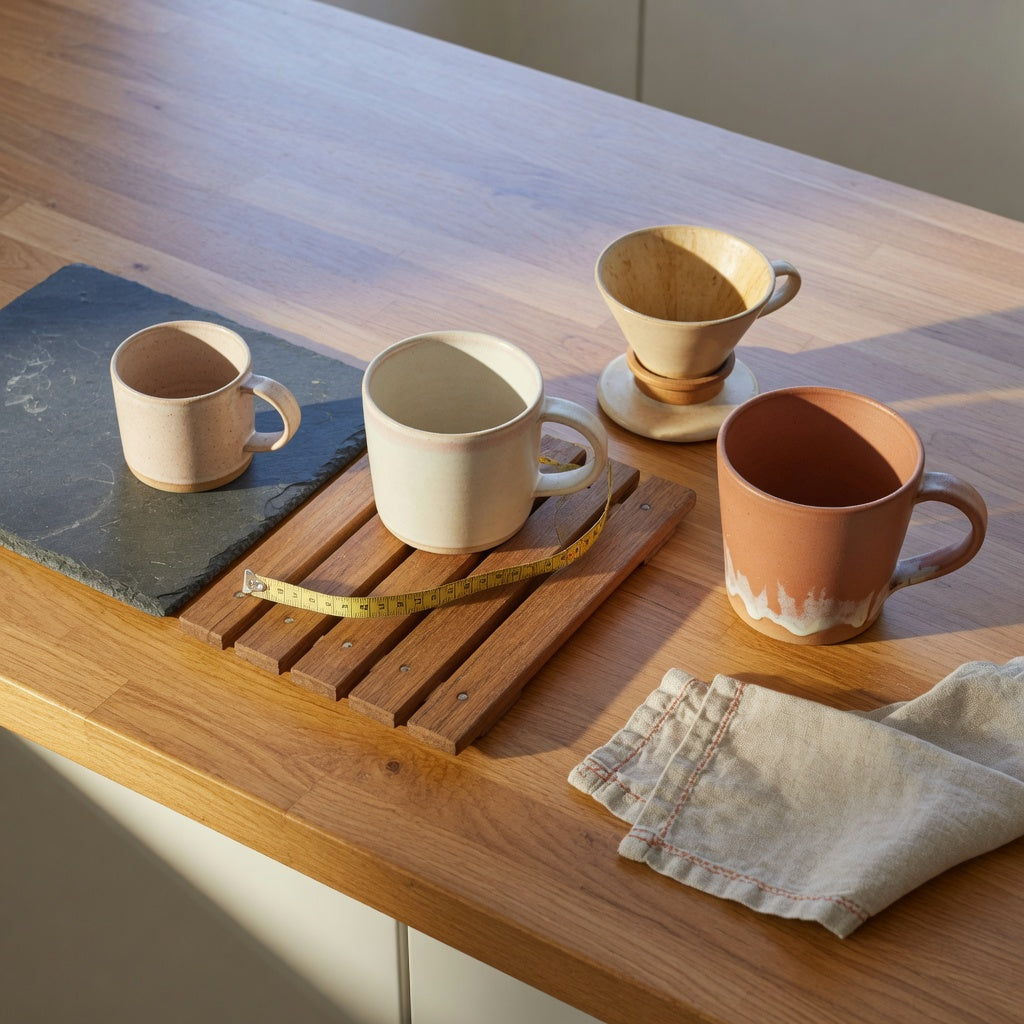
Wide Based Coffee Mugs Weekend Coffee Practical Purchase Checklist
Reading time: about 10 minutes
A Saturday mug rarely fails dramatically. It goes over when someone sets it on the arm of a couch, or on a slatted side table that shifts when the dog brushes past, or on a boat bench that looked leveler than it was. Wide based coffee mugs get bought for those moments, and this wide based coffee mugs weekend coffee practical purchase checklist is the version we walk customers through in our store. The phrase is the first snag: sellers use it for three different shapes, and only one is really about stability.
We handle these mugs daily, so the questions we get are rarely about looks. They are about whether the mug stays put, whether it fits where it needs to sit, and whether it survives a wash without trapping water in the foot. Here is the checklist we actually use.
What does “wide based” actually describe on a coffee mug?
Three shapes get lumped under one label, and they solve different problems.
- A wide foot. The bottom is broad relative to the height. This is the stability shape, and it is what most buyers mean.
- A wide mouth. The rim is broad. That changes sipping, aroma, and whether a dripper or AeroPress sits safely on top — but a mug can have a wide rim on a small foot, and it will still tip.
- A wide body with real height. Broad through the middle, tall overall. These hold the most coffee and are the easiest to knock over when full, because the mass sits higher.
There is no agreed minimum diameter for “wide base,” so the words alone give you nothing to compare. Ask for a number: the diameter across the bottom, in millimetres. That is the first item on any serious wide base coffee mug checklist.
Why does a broader foot help on a Saturday morning — and where does that stop?
A mug stays upright while the vertical line through its centre of gravity falls inside its base of support. Widen the foot and you widen that support area. Fill the mug and you raise the centre of gravity, which is why a small mug topped up can be steadier than a large one topped up on the same footprint.
Height adds leverage. So does the handle, which pulls weight to one side. The foot’s own flatness matters just as much — a slightly warped or concave foot that rocks on a granite counter will wobble more than a nominally narrower mug that sits dead flat.
One honest limit. We have not found a public test — university, standards body, or government — that publishes tip angles for commercial mugs against base diameter, height, and fill level. So “tip-proof” is a marketing word, not a measured one. Treat it as a design direction and check the mug on your own counter.
Which of our three listed capacities fits your weekend routine?
Capacities below come from our own listings. We are deliberately not publishing base diameters or empty weights we cannot confirm on the current product pages. Those are questions to ask us, or to check on the listing, before you order; a photograph flattens perspective and makes feet look wider or narrower than they are.
| Mug | Listed capacity | Weekend job it suits | What to verify before ordering |
|---|---|---|---|
| Ball Handle Coffee & Tea Mug | 250 ml | Short milk drinks, espresso-length pours, narrow side tables where a big mug crowds the lamp | Bottom diameter, empty weight, flat versus recessed base, handle inner clearance |
| The Flow Coffee & Tea Mug | 400 ml | A standard weekend filter coffee or a large tea — the middle of these three for both capacity and fill weight | Rim diameter, wall thickness at the rim, handle clearance for three fingers |
| The Rock Coffee & Tea Mug | 480 ml | Long, slow mornings and a mug you refill less often | Full weight when topped up, bottom diameter, whether the handle still balances when full |
If your weekend coffee is a cortado, a flat white, or two short espressos, the 250 ml Ball Handle mug keeps the fill weight low — and fill weight is the half of stability nobody talks about.
If you make one proper mug and carry it to a chair, the 400 ml Flow mug is where most of our customers land. It is the sensible middle: enough volume for a full pour-over, not so much that a full mug becomes a two-hand job.
If you drink slowly over an hour, the 480 ml Rock mug is the largest listed capacity among these three. It is also the one where bottom diameter matters most, because there is more liquid sitting above the base.
If you are narrowing by footprint rather than capacity, the full unique coffee mugs collection lets you compare shapes side by side rather than one product page at a time.
Will it fit the coaster, shelf, cup holder, and brewer before you order?
Stability questions get all the attention; fit questions cause more returns. Run through this before you order:
- Coaster and side-table footprint. Measure the coaster, not the mug. A small round coaster will not take a broad foot, and a mug perched half-off a coaster is less stable than one sitting flat on the table.
- Shelf and cabinet height. Add the handle to the height measurement, and check the gap against the tallest point of the mug — not the body alone.
- Drip tray clearance. Measure from the tray up to the brew head or spout. A short, broad mug is usually fine here; a tall one is where clearance fails.
- Cupholder, if it will ride in a car. Measure the narrowest point, not the opening. Tapered holders narrow toward the bottom, and some manufacturers state plainly that a wide handled mug is not cupholder compatible.
- Dripper fit. A pour-over cone rests on the rim, so rim width decides. A wide foot does not rescue a narrow rim from an unstable dripper.
- Sink and dishwasher basket. A broad foot can be too wide to drop between the basket tines, which is worth knowing before you buy four.
If a mug is going to ride in a car, check the maker’s own cupholder statement rather than trusting the shape. A broad foot on a table is not a promise of a cupholder fit.
What changes after a month: full weight, handle clearance, and a concave foot?
The first week you notice the shape. The third month you notice these:
- Full weight. An empty mug tells you almost nothing. A 480 ml mug is light on the shelf and noticeably heavier at the end of a long pour.
- Handle clearance. A handle that takes three fingers is comfortable; two is a pinch, especially with a hot drink. Our guide to ceramic mugs with large handles covers the finger-clearance maths.
- A concave or recessed foot. Water pools in it after a wash. Dry these mouth-down on a rack, not flat on the counter, unless you enjoy wiping rings.
- Rocking. Test on the flattest surface you own before the first use. A rock is a defect, not a feature of the shape.
- Glaze on the foot. A rough or unglazed ring can scuff a wooden desk over time, which is the real argument for a coaster.
Material choice sits behind all of this. Our comparison of ceramic versus porcelain mugs is worth two minutes before you commit to a capacity, because weight and chip behaviour differ. For the shape questions specifically, our ceramic wide bottom coffee mugs shape and fit guide goes deeper on foot geometry and brewer clearance.
When is a wide base mug the wrong buy for weekend coffee?
- Commuting. If a mug has to ride in a bag, buy a travel mug with a rated lid. A broad foot and an open rim seal nothing, and none of the three mugs here is sold as a travel mug.
- Cars with tapered holders. The foot that makes a mug stable on a table is often the thing that stops it dropping into a cupholder.
- Small kitchens. Broad feet cost shelf width per mug, so four wide mugs can occupy the space of six narrower ones.
- People with limited grip. A full mug is the operative weight, not the empty one. If a 480 ml mug full of coffee is a two-hand lift, a 250 ml mug is the better call.
- Dishwasher-only households. A recessed foot will hold water through a cycle. That is a reason to choose a flat base, not to avoid the category.
Is a brightly glazed or handmade wide base mug safe for hot coffee?
Worth a moment, especially for gift purchases. The FDA notes that lead in improperly fired traditional pottery glazes can leach into food or drink, and that washing or boiling does not remove it. Its guidance flags handmade, antique, damaged, and brightly orange-, red-, or yellow-decorated pieces as higher concern, while describing ordinary commercial factory tableware as much less likely to be a problem. For cups and mugs, the action level is 0.5 micrograms of lead per millilitre of leaching solution in any one of six units, using methods that include ASTM C738. Items labelled not for food use should stay out of the kitchen.
Practical version: if you are buying a one-off handmade or vintage mug, ask the seller for glaze documentation before it goes near a hot drink. That applies to us too — ask, and we will tell you what documentation we have for a specific piece rather than guess.
Your wide based coffee mugs weekend coffee practical purchase checklist
- Get the bottom diameter in millimetres — not the word “wide.”
- Match capacity to habit: 250 ml for short drinks, 400 ml for a standard mug, 480 ml for a long session.
- Picture the mug full, then judge the weight.
- Measure the coaster, the shelf gap, the drip tray clearance, and the narrowest point of any cupholder.
- Check handle inner clearance against your own hand.
- Ask whether the base is flat or recessed, and how the maker suggests drying it.
- Confirm microwave and dishwasher guidance on the specific listing — glazes and trim vary.
- Request lead or glaze documentation for handmade, antique, or heavily decorated pieces.
- Test for rocking on day one, on the surface where the mug will live.
- Buy one before you buy four. Capacity preferences are personal in ways photographs cannot predict.
Frequently asked questions
What should be on a wide based coffee mugs weekend coffee practical purchase checklist?
Start with bottom diameter in millimetres, listed capacity, full weight, handle clearance, and the surfaces the mug will sit on. Add care questions: flat or recessed foot, dishwasher guidance, microwave guidance, and glaze documentation for handmade or heavily decorated pieces. Then buy one before you buy four.
Are wide based coffee mugs actually harder to tip over?
Usually, up to a point. A broader foot widens the base of support, and that genuinely helps. But height, fill level, handle weight, and whether the foot sits flat all push back. No public test publishes tip angles for commercial mugs, so test yours on the surface you will actually use it on.
Will a wide base mug fit my car’s cup holder?
Only if you measure first. Cupholders are not one standard size, and tapered holders are narrower at the bottom than at the opening. Measure the narrowest point and compare it with the mug’s bottom diameter, then check whether the handle clears the console.
Which capacity suits weekend coffee — 250 ml, 400 ml, or 480 ml?
250 ml for cortados, flat whites, and espresso-length pours. 400 ml for a standard filter coffee or a large tea. 480 ml for a long morning where you would rather not refill. The right answer is the one you can lift comfortably when it is full.
Does a wide base keep coffee hot longer?
Base width alone is not what holds heat. Material, wall thickness, lid design, and starting temperature do most of the work, and we could not find testing that isolates base diameter from those variables. If heat retention is your priority, look at lid and insulation rather than footprint.
Start with the shape you can measure: compare the unique coffee mugs collection by footprint and listed capacity, then ask us the two numbers that settle it — bottom diameter and full weight.
Ready to pick your mug? Two ways to save on today's order:
Ordering 1–3 mugs? Get an extra 10% off your 1st order with code 10_OFF Apply 10% Off & Shop Wooden-Handle Mugs →
Gifting 4+ mugs? Buy 3, Get the 4th Free applies automatically at checkout (no code needed; offers do not stack) · Free standard shipping (Nov pre-Christmas delivery: 15–20 calendar days US) · Free replacement if chipped in transit.
Popular mug buying guides: Ceramic Mugs with Lids Compared · Wooden-Handle Tea Infuser Mugs Compared · Christmas & Secret Santa Mugs 2026 · Espresso & Cortado Cups Guide · Cup & Saucer Gift Sets · All 25 Mugs Spec Table · Mug Size Guide · Shipping & Promo FAQ
FIRST ORDER 10% OFF (CODE: 10_OFF) · OR BUY 3, GET THE 4TH FREE


Read more

15 oz Ceramic Coffee Mugs Weekend Coffee Practical Purchase Checklist
A 15 oz label is a brim number, not a pour number. Our team walks through the weekend checklist we use at the counter: usable fill, full weight, handle room, glaze questions, and which of our 400 m...
Read more
Pottery Tea Cups Weekend Coffee Practical Purchase Checklist
A slower weekend exposes the difference between a 170 ml tea cup and a 250 ml mug. Use this practical checklist to compare capacity, ceramic surfaces, food-contact questions, visible form, and care...
Read more
Leave a comment
This site is protected by hCaptcha and the hCaptcha Privacy Policy and Terms of Service apply.