
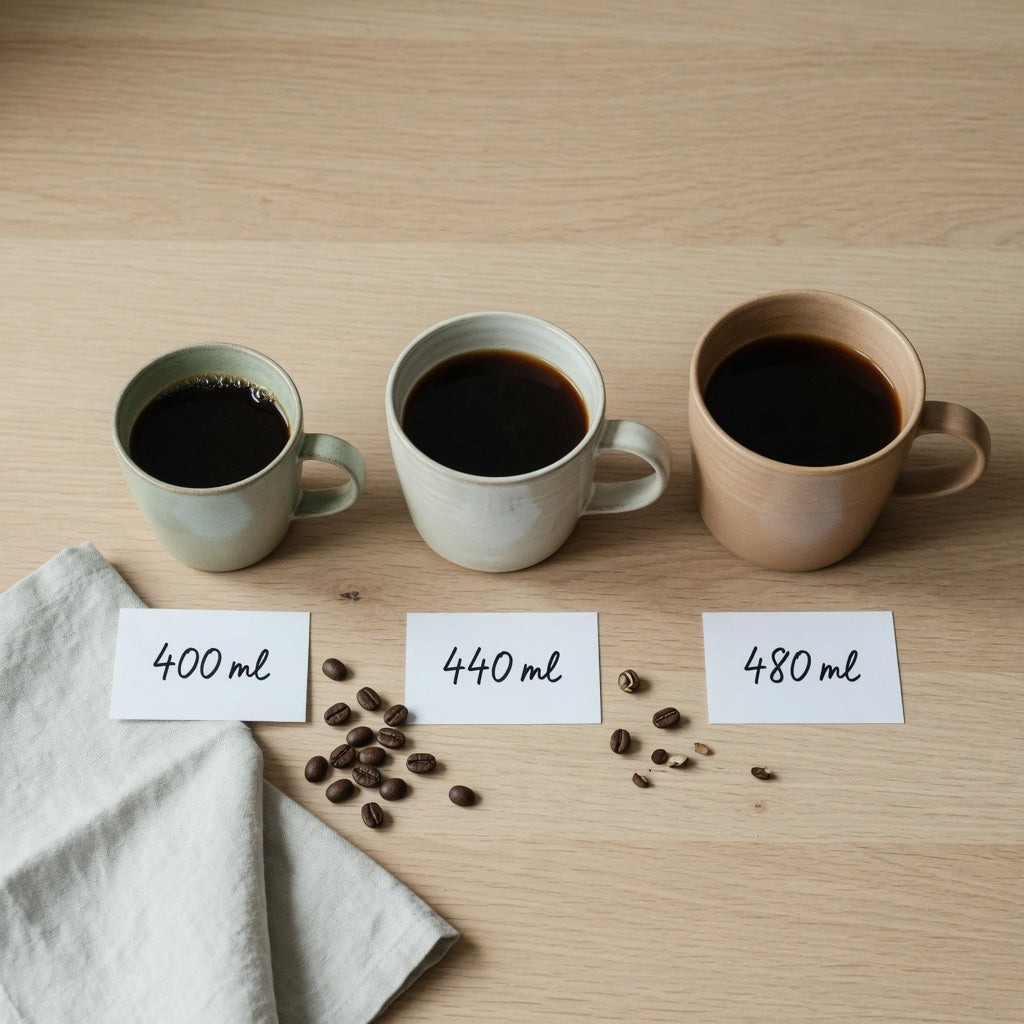
15 oz Ceramic Coffee Mugs: 400 ml vs 440 ml vs 480 ml
Reading time: about 12 minutes
The question lands in our inbox most weeks: why does a mug sold as 15 oz only take about 12 ounces of coffee before it wants to spill? The answer is not a defect. It is headroom. A labeled capacity is measured to the rim, and nobody drinks from the rim. Once you subtract the space needed for cream, foam, or a steady walk from the kitchen to the desk, the usable pour is always smaller than the number on the box. That gap is the whole reason this guide exists, and it is the first thing we explain to anyone shopping for 15 oz ceramic coffee mugs.
What does 15 oz actually measure once you convert it to milliliters?
Fifteen US fluid ounces equals about 443.6 ml. That is arithmetic, and it is the only precise thing about the phrase 15 oz mug. No regulator or trade body defines that size. The FDA, in its ceramic lead guidance, describes cups and mugs as small hollowware used for coffee or tea and gives roughly 240 ml, or 8 fl oz, as its example of the category — an illustration, not a sizing standard.
What that means for you: two mugs both advertised as 15 oz can pour differently, because one seller measures to the brim and the other measures to a realistic fill line. We list capacity in milliliters on every product page because 440 ml is harder to round in a shopper's favor than the word large.
Here is where our three sizes sit:
- 400 ml — roughly 13.5 fl oz
- 440 ml — roughly 14.9 fl oz, the nearest match to a 15 oz mug in our range
- 480 ml — roughly 16.2 fl oz
Which of our three 15 oz ceramic coffee mugs matches how you pour?
None of our listings carries the 15 oz label. The capacities below are exact, and the differences between them matter more than the small milliliter steps suggest.
| Mug | Labeled capacity | Approx. fluid ounces | Where it earns its place |
|---|---|---|---|
| The Flow | 400 ml | ~13.5 fl oz | Drip coffee, tea, smaller hands, tight desk space |
| Morning and Night | 440 ml | ~14.9 fl oz | The 15 oz equivalent — lattes, milk drinks, long mornings |
| The Rock | 480 ml | ~16.2 fl oz | Large single-serve brews, iced coffee, one refill and done |
The Flow, 400 ml (~13.5 fl oz)
Our smallest of the three, and the one we hand to people who describe their coffee as a quick cup rather than an event. A standard drip pour with a splash of milk fits cleanly. So does a strong tea. On a desk already occupied by a monitor, a keyboard, and a tangle of cables, the smaller footprint matters more than most shoppers expect. So does the weight once it is full — the same volume math that makes a big mug reassuring makes a full one heavy.
If you have small hands, a weak grip, or a wrist that complains by mid-morning, start here rather than at the top of the range. See The Flow coffee and tea mug.
Morning and Night, 440 ml (~14.9 fl oz)
This is the 15 oz ceramic coffee mug in practice: 14.9 fl oz, inside a rounding error of the number typed into the search bar. It is sized for milk drinks, overnight oats, and mornings that do not include a refill. If you make one latte a day and want it to look like a latte rather than a puddle at the bottom of a bucket, this is the middle of the range doing its job.
It is also the size we recommend most often when a shopper cannot decide, because 440 ml is forgiving in both directions — not so small that a milk drink feels cramped, not so large that the last third goes cold before you reach it. See the Morning and Night coffee and tea mug.
The Rock, 480 ml (~16.2 fl oz)
Built for volume. A full single-serve brew on the largest setting, iced coffee with real room for cubes, or one mug carried through a ninety-minute meeting. The trade-off is physical: 480 ml is the size most likely to brush a low cabinet shelf, sit awkwardly in a car console, and feel unwieldy in one hand near the end of the drink.
Measure your shelf gap and your cupholder before ordering, not after. See The Rock coffee and tea mug.
If you want the same comparison from a different angle, our breakdown of ceramic versus porcelain capacity covers material and daily fit across these sizes.
How much of the mug is drinkable once cream, foam, or ice goes in?
Brim capacity is the headline number. Usable fill is the one that decides whether you enjoy the mug. When we fill mugs at the counter, we leave roughly 10 mm of clearance for black coffee or tea — enough to cross a room without a wave over the rim. Milk drinks need more space than that.
A latte built in a 440 ml mug wants something like 20 to 25 mm of foam head, which pulls usable liquid down toward 400 ml. Still a generous drink, and the reason the 440 ml size is the one we point milk-drink shoppers toward first.
- 400 ml under a foam cap leaves closer to 360 ml of actual drink. Fine for a flat white or a strong tea, tight for a big brew plus cream.
- 480 ml swallows a large pour without looking half empty, but the last 60 ml tends to cool before you get to it.
- Iced drinks behave differently again: ice displaces volume, so 480 ml is the only one of the three that still reads as full with a handful of cubes in it.
Black-coffee drinkers barely notice the step from 400 ml to 440 ml. Milk-drink and iced-coffee drinkers notice it immediately. That single fact sorts most buyers faster than any spec table.
Will a full mug feel heavy, and does the handle fit three fingers?
Two numbers decide how a large mug behaves in the hand, and neither usually appears on a product listing: the handle opening and the weight when full.
Weight is easy to reason about. 440 ml of coffee weighs roughly 440 g on its own — about the same as a full can of soda. Add the ceramic body and you are lifting well over half a kilogram one-handed, at an angle, before caffeine. Most people never think about it. Anyone with wrist, shoulder, or grip trouble thinks about nothing else.
Handle opening is the quieter issue. A handle that takes three fingers is the practical minimum for most adults. Four is comfortable. A handle you can only thread two fingers through turns a heavy mug into a two-handed lift, which defeats the point of a mug with a handle.
We do not publish empty weights for every piece on the site. If that number decides your purchase, message us before you order and we would rather weigh one on the kitchen scale than have you ship a return. For grip geometry, our guide to ceramic mugs for coffee and tea drinkers digs into handle shape and balance.
11 oz, 12 oz, 15 oz, or bigger: which size belongs in which kitchen?
A 15 oz ceramic coffee mug is a large everyday size, not a universal one. Matching size to setting beats matching size to preference:
- Home drip or pour-over, one drinker: 440 ml is the sweet spot. Room for a splash of milk without a second pour.
- Latte and cappuccino drinkers: 440 ml, with foam head as part of the plan rather than an afterthought.
- Single-serve pod machines: most pod brewers default to a cup well under 15 oz, so a 440 ml mug looks under-filled unless you choose the largest setting or brew twice. The 400 ml The Flow usually looks and feels better proportioned here.
- Shared office kitchens: smaller mugs stack and store more easily. If the cupboard is communal, 400 ml wins on logistics.
- Gifts and branded orders: 11 oz is still the default for promotional merchandise because it ships lighter and suits a standard pour. A 15 oz mug reads as an upgrade, which is exactly why it works as a gift and costs more to ship in bulk.
- Iced coffee and cold brew: 480 ml, because ice takes up space you cannot drink.
Gift sets and mismatched pairs are where the size question gets easier: two different capacities let a household split the difference. You can browse the full spread in our unique coffee mugs collection and compare capacities line by line.
When a 15 oz ceramic coffee mug is the wrong purchase
Bigger is not automatically better, and we say that as a store that sells mostly big mugs.
- Car cup holders. A 480 ml mug is often too wide and too tall for a standard console holder. Measure the holder, not the mug.
- Low cabinet shelves. Tall mugs and short gaps are a bad pairing. Check the shelf clearance before you fall for a shape.
- Espresso and cortados. A 60 ml espresso in a 440 ml mug looks lost and cools fast. Small drinks want small vessels.
- Heat retention over an hour. Ceramic is not insulated drinkware. Thick walls hold warmth longer than thin ones, but no ceramic mug keeps coffee hot through a ninety-minute meeting the way a vacuum-sealed tumbler does. If that is the requirement, buy the tumbler and keep the ceramic mug for the drinking itself.
- Small hands and heavy pours. The combination is the most common reason customers exchange a large mug for a smaller one.
Microwave, dishwasher, and glaze safety: what to verify on the exact listing
This is where generic ceramic advice falls apart. Glaze chemistry, decoration method, and any metallic trim determine care, and those vary mug by mug. What regulators actually publish, in plain terms:
- Lead. FDA guidance for cups and mugs sets a lead guideline of 0.5 micrograms per ml of leaching solution, judged on any one of six units, with methods including ASTM C738 and AOAC 973.32 and 973.82. FDA has documented imported pottery labeled Lead Free that still released extractable lead, and states that ceramicware exceeding the guideline should not carry that label.
- Cadmium. FDA sets 0.5 micrograms per ml for small hollowware under 1.1 liters and 0.25 micrograms per ml for larger pieces. All three mugs here sit well under 1.1 liters, so the small-hollowware figure is the one that would apply.
- Acidic drinks. The California Department of Public Health notes that coffee and tea are acidic and pull lead from a contaminated glaze faster than non-acidic drinks, that microwaving accelerates leaching, and that dishwasher cycles can damage a glaze and raise the odds of later leaching. It also notes lead is rarely found in plain white dishes.
- Decorative-only ware. Under 21 CFR 109.16, ceramicware that looks food-safe is treated as foodware unless it carries both a conspicuous warning label and a permanent version on the base. A mug with a decorative rim you were told not to drink from is not a coffee mug.
- Metallic trim. Gold rims and metallic decals are a microwave problem regardless of the body material.
Two conclusions follow. Microwave safe and lead free are separate claims: one is about thermal shock and arcing, the other about extractable metals, and a mug can be one without being the other. And crazing — the fine web of hairline cracks that develops in older glaze — is a signal rather than a decoration. Once the food-contact surface is compromised, retire the mug.
Our product pages state capacity in milliliters and describe the finish. For care specifics on a given piece, read the current listing rather than this article, because glazes and print methods change between production runs. If you need to know what lead and cadmium documentation exists for a specific mug, ask us and we will tell you exactly what we hold.
What to check before adding a large ceramic mug to your cart
- Exact capacity in ml, not a rounded ounce label.
- Brim versus fill line — if a listing gives one number, ask what the usable pour is.
- Empty weight, if grip or wrist strength is a factor.
- Handle opening — three fingers minimum, four is comfortable.
- Glaze and decoration — plain glaze, printed decal, and metallic trim each carry different care rules.
- Care marks for that specific piece, not for ceramic in general.
- Where it will live — shelf gap, cupholder width, desk space.
If you want the middle of the range, the Morning and Night 440 ml mug is the closest match to a 15 oz ceramic coffee mug and the one we recommend most often to latte and milk-drink people. If you are still weighing ounces against cups, our plain-language guide to how many ounces are in a mug of coffee covers the conversion side.
Frequently asked questions
Is 15 oz the same as 440 ml?
Almost exactly. Fifteen US fluid ounces is about 443.6 ml, so a 440 ml mug is within a few milliliters — a smaller difference than the headroom you leave when pouring. For scale, 400 ml is about 13.5 fl oz and 480 ml is about 16.2 fl oz.
How much coffee does a 15 oz ceramic coffee mug hold after cream and foam?
Plan on roughly 400 ml of actual drink in a 440 ml mug once headroom is accounted for, and less if you build a deep foam cap. Black coffee needs only about 10 mm of clearance; a latte wants 20 to 25 mm, which is why milk-drink shoppers notice the gap between 400 ml and 440 ml far more than drip drinkers do.
Are large ceramic mugs microwave and dishwasher safe?
That depends on the specific glaze, print, and trim, not on the word ceramic. Plain glazed bodies are commonly both; metallic rims and some printed decals are not. Read the care line on the exact listing you are buying, and treat microwave safe as a separate claim from lead free.
Is a 440 ml mug too big for a single-serve pod brew?
Often, yes. Most pod brewers default to a cup well under 15 oz, so a 440 ml mug looks under-filled unless you choose the largest setting or brew twice. If your routine is one small pod, the 400 ml The Flow will look and feel better proportioned.
Do you sell mugs labeled 15 oz?
No. We list capacity in milliliters on every product page, which is why you see 400 ml, 440 ml, and 480 ml instead. The 440 ml Morning and Night is the equivalent of a 15 oz ceramic coffee mug at about 14.9 fl oz.
Read more

Best Ceramic Mug for Home Office Pause: What Buyers Should Compare
A home-office pause mug has to earn its spot beside a keyboard. Here is how we compare capacity, handle clearance, heat behavior, spill risk, and the safety language behind lead-free and microwave-...
Read more
Wide Based Coffee Mugs: 250 ml, 400 ml, or 480 ml?
Compare the 250 ml Ball Handle, 400 ml Flow, and 480 ml Rock by capacity, visible base geometry, desk footprint, grip, brewer clearance, and ceramic-care questions before choosing.
Read more
Leave a comment
This site is protected by hCaptcha and the hCaptcha Privacy Policy and Terms of Service apply.