



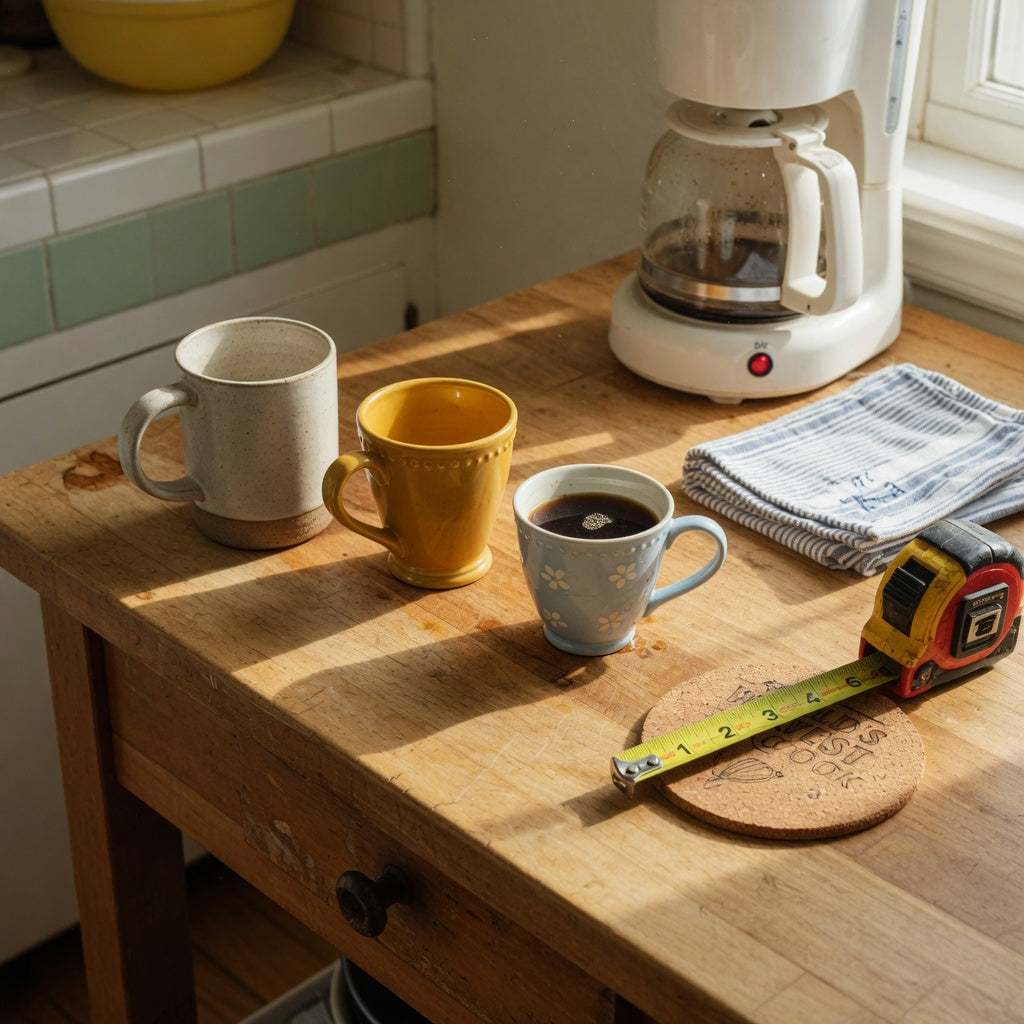
Wide Based Coffee Mugs Shared Household Practical Purchase Checklist
Reading time: about 11 minutes
Three people, one kitchen counter, and the same mug on its side twice a week. That's usually the moment a household starts looking at wide based coffee mugs — not because anyone wants a matching set, but because somebody keeps clipping a tall cup with an elbow on the way to the toaster.
We pack and ship these mugs one at a time, and the questions that come back from shared homes are almost never about colorways. They're about whether a broad foot actually stays put, whether the cup clears an espresso spout, and whether the person drinking a 250 ml flat white should get the same vessel as the one draining a 480 ml brew before the first call. This wide based coffee mugs shared household practical purchase checklist is built around those three realities: stability, fit, and serving size.
Wide foot, wide mouth, and tall body: three shapes shoppers mix up
"Wide based" isn't a standard. No trade body sets a minimum foot diameter, so the phrase on a product page can describe anything from a gently flared foot to a genuinely broad disc. Before comparing two mugs, pull the shape apart into three separate measurements:
- Foot diameter — the ring that touches the table. This is the number that affects tipping.
- Rim diameter — the opening. This drives aroma, how fast the drink cools, and whether a dripper or AeroPress seats cleanly on top.
- Height and taper — what decides whether the mug slides under a brew spout and how high the liquid weight sits.
A mug can have a wide foot and a narrow rim: stable, and better at holding heat because less liquid surface is exposed to air. Another can have a wide rim over a small foot: generous to sip from, easy to knock. Neither is wrong. What goes wrong is buying on the marketing phrase instead of the geometry.
What actually keeps a wide based mug upright on a busy counter?
The physics is worth thirty seconds of your time, because it stops you paying a premium for a word. An object tips when a sideways push moves its center of gravity past the outer edge of its base of support. Widening the foot pushes that edge outward, and lowering the center of gravity means the mug has to lean further before it commits to falling.
What's inside the mug matters as much as the mug:
- Fill level. A mug topped to the rim carries its liquid mass high, which lifts the combined center of gravity. The same mug half full is meaningfully harder to tip.
- Height relative to the foot. A tall cup on a broad foot can still behave top-heavy if the walls flare outward into a heavy rim.
- Whether the foot is actually flat. A broad base with a glaze drip or a slight warp will rock on granite. Stability needs even contact across the whole ring, not just width.
- Handle position. A handle that pulls the grip far out to one side shifts how the mug behaves when a sleeve catches it.
There is no published standard that certifies a ceramic mug as tip-proof, and we don't describe ours that way. A wide foot buys margin on a level counter. It won't rescue a mug from a hard knock, and on a sloped boat console or a car seat a big flat foot can be worse than a small one that settles into a recess.
Will it clear the brewer, the coaster, and the cupboard shelf?
This is where broad-footed mugs lose real arguments in real kitchens. Run these five measurements before you order, with a tape measure rather than an estimate:
- Spout clearance. Measure from the drip tray to the brew spout with the tray in the position you actually use. Pod machines and manual espresso group heads sit low; a low, broad cup often slides in where a tall tumbler won't, but you need the number, not a guess.
- Rim versus dripper. If anyone in the house uses an AeroPress, V60, or Kalita, measure the rim's inner diameter. A dripper needs a rim it can sit on without wobbling or dropping inside the mouth.
- Cupboard depth and shelf gap. Wide feet don't nest. Two rows of shallow upper cabinets fill up fast when every cup needs its own footprint.
- Car cup holder. Measure the narrowest point of the holder, not the widest. Assume a ceramic wide-foot mug is a desk mug until you've checked.
- Coaster and desk footprint. If the foot is wider than your coaster, condensation lands on the wood or the desk mat instead.
Matching 250 ml, 400 ml, and 480 ml to the people in your house
We deliberately don't sell these as a set. Each listing is a single mug with its own listed capacity, which means the job in a shared home is assigning pieces rather than splitting a box. Here's how the three capacities in our catalog differ on paper:
| Mug | Listed capacity | Confirm on the listing | Household role it tends to suit |
|---|---|---|---|
| Ball Handle Coffee Tea Mug | 250 ml | Foot diameter, handle opening, interior glaze | The cortado, flat white, or small-tea drinker |
| The Flow Coffee Tea Mug | 400 ml | Rim diameter for dripper fit, base width, care notes | The standard drip or americano drinker |
| The Rock Coffee Tea Mug | 480 ml | Handle clearance, full weight in hand, shelf gap needed | The large-batch, iced, or long-session drinker |
The Ball Handle Coffee Tea Mug is the smallest listed capacity we carry at 250 ml, which makes it the natural pick for the person pulling a short milk drink or steeping a small pot of green tea. Two cautions. A 250 ml mug is the wrong answer for anyone brewing 10 to 12 ounces in one go, and the sculpted handle that gives the mug its name deserves a close look at the photos if you have large hands or grip issues — check the opening before assuming it's comfortable.
The Flow Coffee Tea Mug sits in the middle at 400 ml, roughly the size of a standard batch-brewer serving with a little headspace left for walking from kitchen to desk. It's the one we'd suggest for the household member who pours a single mug from a drip machine every morning and doesn't want to think about it again. It is not a travel mug — no lid is implied by the listing, so treat it as a table mug.
The Rock Coffee Tea Mug is the largest at 480 ml, and the one to think about twice. Filled to a working level it holds a serious volume, and ceramic tare weight on top of that can turn a one-handed carry into a two-handed one. Check the handle photos and the listed dimensions against your own hand and your shelf gap before committing. For a desk-bound remote worker or a herbal tea drinker who wants one long steep, it's the sensible third piece.
If none of the three matches a particular person's grip or cupboard, browse the full unique coffee mugs collection and apply the same checks — capacity first, then base width, then handle.
Handles, full weight, and the concave foot nobody mentions
Two mugs can share a capacity and still feel completely different after a week of daily use. Three things decide that, and none of them show up in a capacity spec:
- Finger clearance. Measure the handle opening across its widest internal gap, then compare it to the width of your fingers laid flat. A loop that takes two fingers forces a pinch grip once the mug is full; that's a comfort issue long before it's a spill issue.
- Full versus empty weight. Weigh a mug you already own, then weigh it again with water to your usual fill line. That difference is what your wrist actually carries, and it's the honest way to judge whether a 480 ml ceramic body is too much for a morning commute down the stairs.
- The recessed foot. Many broad ceramic mugs have a concave underside so the outer ring sits flat. Turn one upside down in a dishwasher and that cavity becomes a shallow reservoir — expect to shake the mug out or towel-dry the base before it goes back in the cupboard.
On arrival, put the mug on a glass or granite surface and tap the rim lightly. A well-formed foot sits still. A rock means a warp or a glaze blob under the ring, and it will only get more annoying with hot liquid in it.
We also won't tell you our mugs are dishwasher or microwave safe as a category. Glazes and foot treatments vary by piece, so check the care notes on the individual listing you're buying — that's a two-second check that prevents a chipped rim six weeks later.
Glaze, lead, and food-contact checks worth doing before a mug joins the rotation
A mug used by three people every day earns more scrutiny than a decorative shelf piece. The FDA's guidance on lead in glazed pottery is the reference worth knowing: for cups and mugs, the action level is 0.5 micrograms of lead per milliliter of leaching solution in any one of six units, tested using methods that include ASTM C738. The agency also notes that washing, boiling, or other household processes do not remove lead from improperly formulated pottery glazes.
Where the FDA points to higher concern is specific: handmade, antique, damaged, or brightly orange-, red-, and yellow-decorated pieces, plus anything labeled not for food use. Ordinary commercial factory tableware is described as much less likely to have this problem. In practice, that means a hand-thrown souvenir mug from a market stall deserves more caution than a production-line mug bought from a store with a returns policy. Whatever you buy, confirm the listing states it's intended for food use.
One more detail from handling returns: interior glaze texture matters for staining. Smooth, glossy interiors wipe clean of coffee tannins and tea, while heavily textured or matte interiors can hold oils in surface pits and go dull over months of shared use. If the mug lives in a household where nobody rinses it promptly, favor the smooth interior.
Your wide based coffee mugs shared household practical purchase checklist
Print this or keep it open while you order. It's ordered by how often each item causes an actual return:
- Assign a capacity to each person. Write down 250 ml, 400 ml, or 480 ml next to each name based on what they actually pour — not what looks generous.
- Measure spout clearance from drip tray to spout, in the tray position you use daily.
- Measure rim diameter if anyone uses an AeroPress, V60, or other dripper that must sit on the opening.
- Measure the narrowest point of any cup holder before assuming a wide-foot mug travels with you.
- Check the shelf gap and shelf depth where the mugs will live, since wide feet don't stack or nest.
- Measure a handle opening on a mug you already like, and compare it to the photos of the one you're buying.
- Read the care notes on that exact listing for dishwasher, microwave, and food-contact statements.
- Plan for the concave foot — a spot to drain or towel-dry after each wash cycle.
Frequently asked questions
Does a wider base actually stop a mug from tipping over?
It helps, but it's not a guarantee. A wider foot moves the tipping edge outward and lowers the combined center of gravity, so a knock has to be harder to send the mug over. Height, fill level, and whether the foot sits flat still decide the outcome — a tall mug filled to the rim can go over even on a broad base.
Will wide based coffee mugs fit a standard car cup holder?
Often not, and there's no standard holder size to plan around. Measure the narrowest point of your console opening rather than the widest, then compare it to the foot diameter on the listing. If the numbers are close, treat the mug as desk and kitchen only.
How do I use this wide based coffee mugs shared household practical purchase checklist in a houseshare where nobody shares cups?
Assign capacities per person first, then check the shared constraints: brewer clearance, cupboard shelf gap, and where each mug gets stored. Buying three identical large mugs is the common mistake — half the drinks go cold in an oversized cup.
Does a wider base keep coffee hot longer?
Base width alone doesn't drive heat loss. Most heat leaves through the exposed liquid surface, then through wall thickness and material; a lid changes the picture more than a foot does. A wide-foot mug with a narrow rim will hold temperature better than a wide-mouth cup, all else equal.
Are the mugs on this list sold as a set?
No. Each product page is a single mug with its own listed capacity — 250 ml, 400 ml, or 480 ml — so you're choosing individual pieces for individual drinkers, not buying a matched bundle.
Start with the person whose mug gets knocked over most. Measure their usual pour and the clearance under your brewer, then match that number against our full mug collection and confirm capacity, dimensions, and care instructions on the listing before checkout. One good fit beats three identical cups nobody wanted.
More from our blog
Ready to pick your mug? Two ways to save on today's order:
Ordering 1–3 mugs? Get an extra 10% off your 1st order with code 10_OFF Apply 10% Off & Shop Wooden-Handle Mugs →
Gifting 4+ mugs? Buy 3, Get the 4th Free applies automatically at checkout (no code needed; offers do not stack) · Free standard shipping (Nov pre-Christmas delivery: 15–20 calendar days US) · Free replacement if chipped in transit.
Popular mug buying guides: Ceramic Tea Cups & Infuser Mugs · Ceramic Mugs with Lids Compared · Wooden-Handle Tea Infuser Mugs Compared · Christmas & Secret Santa Mugs 2026 · Espresso & Cortado Cups Guide · Cup & Saucer Gift Sets · All 25 Mugs Spec Table · Mug Size Guide · Shipping & Promo FAQ
FIRST ORDER 10% OFF (CODE: 10_OFF) · OR BUY 3, GET THE 4TH FREE


Read more

Coffee Mugs With Big Handles: Shared Household Purchase Checklist
A shared kitchen rarely needs four identical mugs. This checklist maps each drinker to a 250, 400, or 480 ml mug, then shows what to verify about handle clearance, filled weight, appliance fit, and...
Read more
Latte Mugs Tall Shared Household Practical Purchase Checklist
Two people, one cabinet, and three usable capacities. A per-person checklist for latte mugs tall shared household practical purchase checklist decisions: spout clearance, fill line, rim width, hand...
Read more
Leave a comment
This site is protected by hCaptcha and the hCaptcha Privacy Policy and Terms of Service apply.