



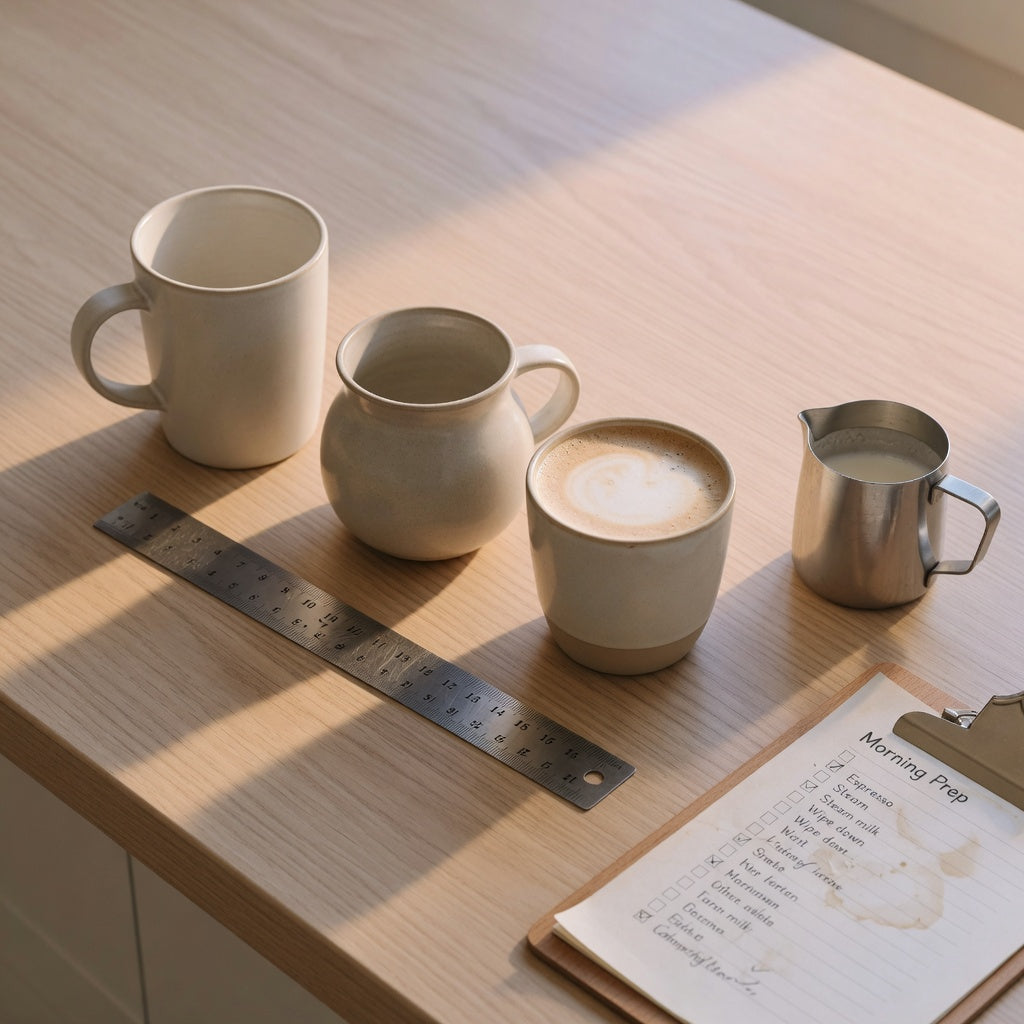
Latte Mugs Tall Shared Household Practical Purchase Checklist
Reading time: about 9 minutes
Two people, one cabinet shelf, and a mug that only one of them can wrap a hand around. That is how the tall-mug conversation usually starts in a shared kitchen — not as a style debate, but as a reach, a spill, or a vessel that will not slide under the espresso spout at 6:40 in the morning.
We handle this drinkware daily in our store and answer the same questions from couples, roommates, and families buying for a house rather than for one person. The latte mugs tall shared household practical purchase checklist below is the one we actually walk customers through: capacity, silhouette, clearance, handle room, and care claims. Four or five measurements decide almost every case.
The same phrase means three different mugs
A shopper typing 'tall latte mug' may want any of three objects, and product photos rarely make the difference obvious.
- A tall everyday mug. Fairly straight sides, taller than it is wide, usually somewhere in the 12–16 fl oz range. Bought because it holds more coffee than a standard cup, not because of how it pours.
- A wide cafe latte cup. Short and broad with a generous rim — the shape a barista reaches for when pouring art, because the pitcher can come close to the surface.
- A conical gift or photo mug. The tall latte mug sold by print shops, flared at the top and often around 17 fl oz, where the selling point is printable surface area rather than drink geometry.
None of these is the wrong purchase. Mixing them up is how someone ends up with a mug that photographs beautifully and then overflows on the second pour.
One calibration point worth knowing: FDA guidance for ceramic hollowware describes a cup or mug as normally holding about 240 ml (8 fl oz), with a mug having cylindrical sides and a handle. That is a regulatory description used to group items for testing. It is not a rule that a latte should be eight ounces. Treat it as the floor, not the target.
What 400 ml, 440 ml, and 480 ml actually pour
Our listed capacities are the one number we can state plainly, so here they are — followed by what they mean once steamed milk and foam are in the mug.
| Listed capacity | Approximate US fl oz (÷ 29.57) | Who it usually suits |
|---|---|---|
| 400 ml | about 13.5 fl oz | One moderate latte or a large tea; the lighter mug in a two-person cabinet |
| 440 ml | about 14.9 fl oz | The middle option when two people make slightly different drinks |
| 480 ml | about 16.2 fl oz | The one-big-drink household member who wants visible headroom |
The conversion comes from NIST's approximate factor of 29.57 millilitres per US fluid ounce. It matters because brim capacity is not drinking capacity. A mug filled to the lip has nowhere for foam to sit and nothing stopping a slosh on the walk from counter to desk. In practice we leave roughly a finger's width of empty wall above the surface — call it 1.5 to 2 cm — which means a 400 ml mug is realistically a 12-oz-ish drink and a 480 ml mug handles something closer to 14 oz.
Will the mug clear your espresso spout and your cabinet shelf?
Height is the spec that fails quietly. Nobody notices it in the listing photo, and everybody notices it when the mug does not fit under the group head or the spout of an automatic machine.
Take two measurements before ordering anything:
- The clear gap between your counter and the lowest point of the group head or coffee spout, with the machine switched on and any drip tray in place.
- The shelf spacing in the cabinet where the mugs actually live — not the display shelf, the crowded one.
Then compare those numbers to the listing's stated height. If the product page gives capacity but not height, that is a question to send to the seller, not a detail to guess from a photo. Height also changes where the handle sits relative to the drink line: on a taller mug the handle can land above a short pour, which is fine, but on a very tall vessel a low handle means the balance point shifts once the mug is full.
Rim width, base diameter, and handle room in a two-person kitchen
Three dimensions do most of the work in a shared household, and none of them is capacity.
- Rim diameter decides sipping comfort and how much room you have to pour. A wider rim lets the pitcher tip closer to the surface, which is why latte art is easier in a short wide cup than in a tall narrow one. Tall vessels show the layers nicely; the pour itself takes more control.
- Base diameter decides stability and whether the mug sits in a car cup holder or a stroller holder. A narrow base is easier to knock over on a crowded counter.
- Handle opening decides whose hand it fits. Two people sharing a cabinet often have very different hand sizes, and a handle that is snug for one is unusable for the other.
If art matters more to your household than volume, a wide-rim shape is a different purchase decision. Our ceramic latte cups shared household checklist covers the bowl-and-saucer end of the shelf, while this article stays on taller vessels and the practical limits that come with them.
Matching each mug to a person, not to a set
These are individual products, not a matched set, and that is deliberate. In a shared kitchen the fastest way to end a mug dispute is to stop buying pairs out of habit and start buying per person.
The Flow 400 ml — for the smaller, more frequent drink
At 400 ml (about 13.5 fl oz) this is the lightest-capacity option of the three. It suits the household member who makes a moderate latte, drinks tea in volume, or splits a double shot and does not want a half-empty mug. The trade-off is headroom: build a full 12-oz milk drink with a thick foam cap and you will be close to the brim. Check the listing for height and rim diameter before you assume it clears a low spout. See The Flow 400 ml mug.
Morning and Night 440 ml — the compromise mug
At 440 ml (about 14.9 fl oz) this sits in the useful middle. It is the sensible pick when two people share one machine but pour different amounts — one a latte, one a longer milk drink — because a mid-size vessel tolerates both without looking half full. Verify the silhouette on the current listing, since the shape of the wall affects how comfortable the last third of the drink is to tip out. See the Morning and Night 440 ml mug.
The Rock 480 ml — the one-big-drink mug
At 480 ml (about 16.2 fl oz) this is the largest listed capacity we carry in this group, and it is the honest answer for the person who makes one big drink and nurses it for an hour. Be realistic about the drawbacks: filled to a working level it carries the most liquid of the three, it is the one to measure against a tight spout gap before ordering, and base diameter — not capacity — is what decides cup-holder fit. See The Rock 480 ml mug, and browse the full unique coffee mugs collection if you would rather compare silhouettes side by side.
The latte mugs tall shared household practical purchase checklist
Keep this open while you shop. It is short on purpose.
- Convert the capacity. Divide millilitres by 29.57 to get fluid ounces you recognise, then subtract a finger-width of headroom.
- Measure spout clearance with the machine on and the drip tray in place.
- Measure the real cabinet shelf, not the one you wish you used.
- Check rim diameter if latte art or sipping comfort matters to anyone in the house.
- Check base diameter against cup holders and the stability of your counter.
- Check handle opening against the largest hand that will use it.
- Assign mugs to people rather than buying identical pairs out of habit.
- Confirm care claims on that exact listing — microwave, dishwasher, and food-contact wording, not a category assumption.
Microwave, dishwasher, and glaze: claims to verify, not assume
Care language is where generic advice does the most damage, because it gets applied to the wrong product. Two things we will not do here: tell you a specific mug is microwave-safe, or tell you it is dishwasher-safe. Those are per-product statements that belong on the listing, and if the listing is silent, ask.
What the sources do support:
- Microwave. USDA guidance says only cookware manufactured for microwave use should go in, and that microwave-safe glass and ceramic are usually labelled as such. China with metallic paint or trim is called out as not safe. If a piece is unlabelled, USDA describes a one-minute test beside a cup of water — if the vessel itself gets hot, it is not microwave safe.
- Ceramic and lead. FDA notes that properly fired lead glazes bind the lead into the glaze, while inadequate firing can leave it leachable, and that washing or boiling does not remove lead from pottery. The action level for cups and mugs is 0.5 micrograms per millilitre of leaching solution. Extra caution is advised for handmade or crude pottery, antiques, damaged or worn pieces, unknown makers, and bright orange, red, or yellow decoration. Everyday commercial factory pottery is described as far less likely to be a problem. Anything marked not for food use should stay out of the kitchen.
- Dishwasher. Only trust this if the maker states it. Printed or decorated surfaces are the first thing we would ask about before trusting a hot cycle.
Frequently asked questions
How many ounces is a 400 ml latte mug?
About 13.5 US fluid ounces, using NIST's factor of 29.57 millilitres per ounce. Allow for a finger-width of headroom and the practical pour lands closer to 12 ounces. That is the short version of the latte mugs tall shared household practical purchase checklist: convert first, then subtract for foam.
Will a 480 ml mug fit under my espresso machine?
Nobody can answer that from capacity alone. Measure the gap between your counter and the group head or spout, then compare it to the mug's listed height. If the listing does not publish height, ask before you order — this is the single most common reason a tall mug gets returned.
Is a taller mug worse for latte art?
Generally yes, and it is a geometry problem rather than a skill problem. A wide rim lets the pitcher tip close to the milk surface; a tall narrow body forces you to pour from higher up. Tall vessels are better at showing layers than at drawing a rosetta.
Do these mugs work for tea and iced coffee too?
Capacity-wise, yes — the 400 ml is a comfortable large tea and the 440 ml takes a generous iced coffee with room for ice. Iced drinks are the one case where you want extra headroom rather than less, so size up if cold drinks are the main use.
Can two people share one tall mug?
They can, but they usually should not. Handle fit and comfortable drink volume differ between people, and a mug that is right for a 16-oz latte habit is a heavy, half-empty vessel for someone who drinks eight ounces. Buy per person and the shared cabinet stops being a negotiation.
More from our blog
Ready to pick your mug? Two ways to save on today's order:
Ordering 1–3 mugs? Get an extra 10% off your 1st order with code 10_OFF Apply 10% Off & Shop Wooden-Handle Mugs →
Gifting 4+ mugs? Buy 3, Get the 4th Free applies automatically at checkout (no code needed; offers do not stack) · Free standard shipping (Nov pre-Christmas delivery: 15–20 calendar days US) · Free replacement if chipped in transit.
Popular mug buying guides: Ceramic Tea Cups & Infuser Mugs · Ceramic Mugs with Lids Compared · Wooden-Handle Tea Infuser Mugs Compared · Christmas & Secret Santa Mugs 2026 · Espresso & Cortado Cups Guide · Cup & Saucer Gift Sets · All 25 Mugs Spec Table · Mug Size Guide · Shipping & Promo FAQ
FIRST ORDER 10% OFF (CODE: 10_OFF) · OR BUY 3, GET THE 4TH FREE


Read more

Wide Based Coffee Mugs Shared Household Practical Purchase Checklist
A shared kitchen ruins the idea of one perfect mug. This checklist helps multi-drinker homes judge base geometry, brewer clearance, cupboard space, and 250 ml vs 400 ml vs 480 ml serving habits bef...
Read more
Large Round Coffee Mugs Shared Household Practical Purchase Checklist
A 400 ml round mug and a 440 ml round mug can behave nothing alike under a brewer or on a crowded shelf. Here is the capacity, clearance, handle and glaze-safety walkthrough our team runs with shar...
Read more
Leave a comment
This site is protected by hCaptcha and the hCaptcha Privacy Policy and Terms of Service apply.