



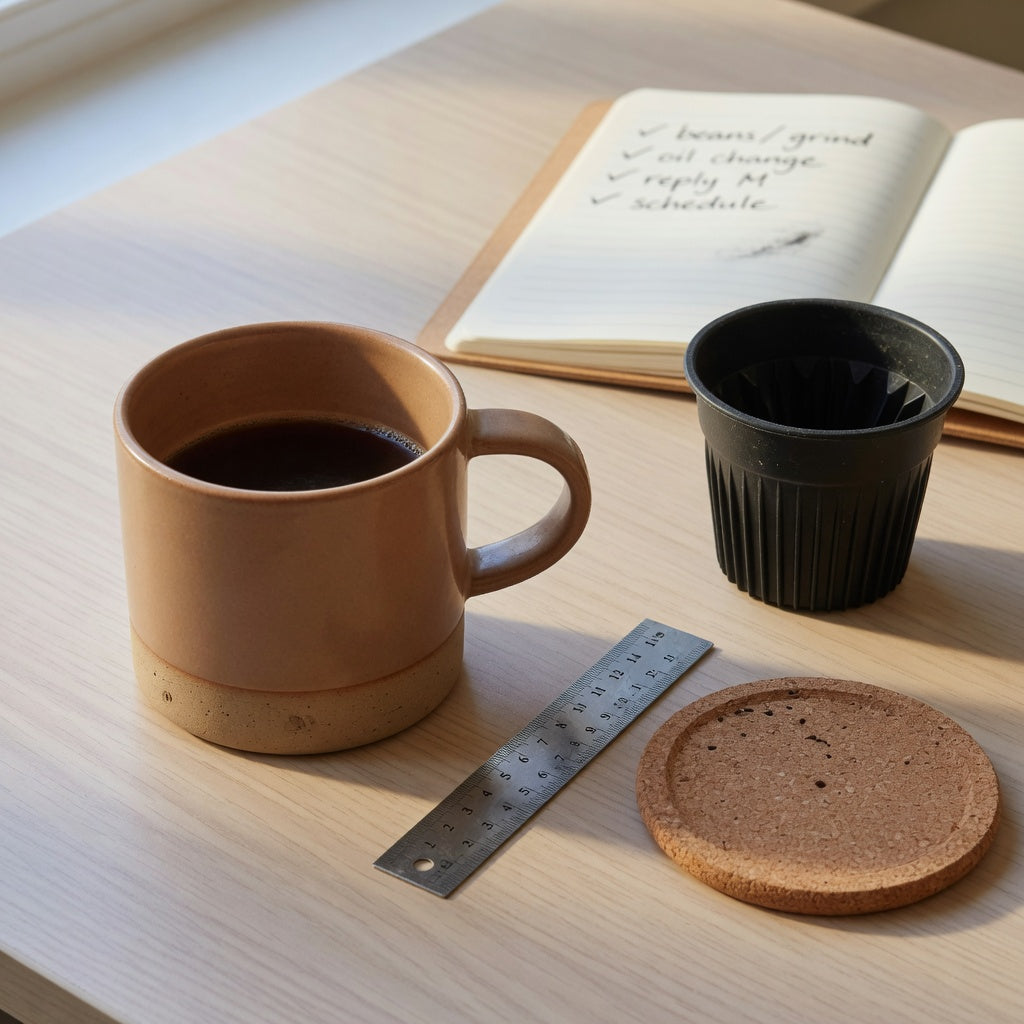
Wide Based Coffee Mugs: First Time Buyer Practical Purchase Checklist
Reading time: about 10 minutes
A mug can look bolted to the desk in a product photo and still skate across the counter the first time you set it down with a full cup. We sell these mugs, pack them, and answer the follow-up emails — and that is why this wide based coffee mugs first time buyer practical purchase checklist is mostly about measuring and verifying rather than browsing.
Almost none of the questions that come back to us are about color. They are about footprint, fill line, and whether the mug fits the spot where it actually lives.
Why does a wide foot feel steady on a desk and uncertain on a dashboard?
The basic physics is honest: a wider base of support and a lower center of gravity both make an object harder to tip past its balance point. What gets lost in the product copy is everything else that changes the answer.
Height matters. Fill level matters more than most first-time buyers expect — a mug that feels planted at half full can get twitchy when you top it off, because you have moved mass upward. Handle position matters, since a heavy handle on one side shifts where the weight sits. A foot that is not flat will rock no matter how wide it is. And the surface underneath matters: a smooth, angled, or vibrating tray is a different problem from a flat wood desk.
We have not found a public standard that grades commercial coffee mugs on tip angle against base diameter, height, and fill level. So treat "tip-proof" as a claim you test in your own setup, not a number you can compare between listings. On our own product pages we describe visible geometry and capacity, and we leave slip resistance as something to confirm on the listing rather than infer from shape alone.
The wide based coffee mugs first time buyer practical purchase checklist, item by item
Most of this is measuring and reading. If a listing does not publish a dimension, write it down as unknown instead of estimating it from an angled photo.
- Base diameter, not rim diameter. The foot is what touches the surface. Compare that number against your coaster, your desk mat, the shelf where the mug will live, and the cabinet gap above it.
- Listed capacity versus usable capacity. A 400 ml mug does not hand you 400 ml of coffee if you stop a centimetre below the rim — which most people do to avoid sloshing on the walk back to the desk.
- Overall height against your brewing setup. Measure clearance under the drip spout, under an espresso outlet, and under the cabinet above the machine. A wide mug can be perfectly stable and still not fit.
- Handle opening, judged with a full mug in mind. Check whether the opening is listed or photographed with a hand in it. A handle that fits two fingers when empty feels considerably worse once a large pour adds roughly half a kilogram of liquid.
- Cup-holder taper. Measure the inside of the holder at its narrowest point, not at the top opening. Plenty of console holders narrow toward the bottom.
- Foot profile. A recessed or concave base can trap water in the dishwasher. Look at the underside photo and plan to dry the base if that would bother you.
- Care and lid language. Dishwasher and microwave safety should be stated on the exact listing, not inferred from the word "ceramic." If a lid is included, check whether the maker calls it splash-resistant or leak-resistant — those are different promises.
- Food-contact glaze statement. This matters most for handmade, antique, or brightly decorated pieces, and we come back to it below.
Ball Handle, The Flow, or The Rock: matching listed capacity to a real morning
We keep three capacities in the range. The honest way to choose is to start from the pour you actually make, then verify the visible foot shape, handle clearance, and care details on the current product page.
| Mug | Listed capacity | Reader situation | What to verify before ordering |
|---|---|---|---|
| Ball Handle Coffee Tea Mug | 250 ml | A modest coffee or tea, a narrow side table, or a gift for someone who drinks one small cup at a time. | Foot diameter against your coaster, finger clearance through the handle, and the care statement. |
| The Flow Coffee Tea Mug | 400 ml | An everyday desk mug, or a first wide-foot purchase that does not jump straight to the largest fill. | Height under your brewer, empty weight, and whether a lid is included. |
| The Rock Coffee Tea Mug | 480 ml | A larger morning coffee, a shared kitchen, or a buyer with the counter space for a substantial mug. | Full weight, handle fit when full, footprint against coasters and cup holders, and care details. |
Our practical read: the 250 ml Ball Handle is the low-commitment choice for small pours and tight spots. The 400 ml Flow is the middle path for a daily desk mug. The 480 ml Rock makes sense when capacity matters more than portability — but it is also the one to measure most carefully, because a bigger pour changes the weight in your hand and the space it needs on the counter.
Two trade-offs worth naming. A larger listed capacity does not guarantee a wider foot, and a wide foot does not guarantee a wide opening — so if aroma, sipping comfort, or fitting a pour-over dripper is your priority, check the rim, not just the base. And if you want to see the whole range side by side before deciding, browse our unique coffee mugs collection and open the listings in separate tabs.
Measuring a cup holder, a coaster, and a brewer before you commit
Vehicle cup holders are not built to one standard size, so the honest answer to "will it fit?" is that it depends on your holder. Measure the inside at its narrowest point, then compare that to the mug's base diameter. A tapered holder can swallow a wide rim and still refuse a broad foot.
The same logic applies to coasters, desk mats, stroller trays, and boat console recesses. For brewing, check clearance in three places: the spout or outlet, the drip tray, and the cabinet shelf above. A wide mug can be rock solid on the counter and still fail to sit under the machine.
If the mug will ride in a car, do not assume a rubberized or non-slip foot unless the listing says so. A wide base helps on a flat tray; it is not the same thing as a sealed travel lid, and a splash-resistant lid is not a promise the mug survives lying on its side in a bag. For a deeper look at base shape and daily handling, our ceramic wide bottom coffee mugs shape and fit guide goes further into geometry.
What a wide ceramic foot does not do for you
Base width is not a heat-retention feature. Heat loss depends far more on material, wall thickness, whether you preheat the mug, the starting temperature of the coffee, and whether a lid is in play. Retail roundups sometimes tie a wide ceramic base to longer heat retention, but no standards-body test we found separates base width from those other variables. If keeping coffee hot is the main goal, compare wall thickness and lid design, not the foot alone.
It also does not make a mug unbreakable, dishwasher-safe by default, or leakproof. Those are material and construction questions, and they belong to the specific listing.
One small habit from our own handling: warm the mug with hot tap water for a few seconds before pouring. It makes more difference to how long the coffee stays drinkable than the footprint does, and it costs nothing.
How do you check the glaze and food-contact side of a wide ceramic mug?
For handmade, antique, damaged, or brightly decorated ceramics, read the food-contact wording before you make it a daily mug. The FDA notes that some ceramic foodware can leach lead from food-contact surfaces, and that continued use of lead-leaching ware can cause adverse health effects, including chronic lead poisoning. For cups and mugs, the action level is 0.5 micrograms of lead per milliliter of leaching solution in any one of six units.
The FDA also states that washing, boiling, or other household processes do not remove lead from pottery, and it flags improperly fired traditional glazes as a higher concern than ordinary commercial factory tableware. Pieces labeled not for food use should not hold coffee. If a listing is silent on glaze and food contact, ask before you buy rather than assuming. The FDA guidance on lead-glazed pottery has the full context.
When a wide based mug is the wrong first purchase
A broad foot is a fit decision, not a universal upgrade. Choose a different style when any of these apply:
- You need leakproof transport in a bag. An open ceramic mug, even with a splash-resistant lid, is not a sealed tumbler. If the mug will lie on its side in a backpack, buy a sealed commuter mug instead.
- Your cup holder is narrow or deeply tapered. A tapered travel mug is more likely to seat than a broad ceramic foot.
- You carry a full mug up and down stairs. A lighter 250 ml mug is easier to manage than a 480 ml one, particularly with limited grip strength.
- You care most about aroma or brewer fit. Wide mouth and wide foot are separate features. A stable foot can sit under a narrow rim, and a wide rim can still balance on a small foot.
- You want a display piece. A decorative mug marked not for food use should stay decorative, whatever its base looks like.
In our experience, a mug that fits your coaster, your brewer, and your hand gets used every day. One that only looks stable in a photo usually ends up at the back of the cabinet. Start with the 250 ml or 400 ml option if you are unsure, and size up once you know how much you actually pour.
Frequently asked questions
Are wide based coffee mugs actually harder to tip over?
A wider base of support can help, but it does not make a mug tip-proof. Height, fill level, handle position, foot flatness, and how grippy the surface is all change the outcome. A tall mug filled to the rim can still go over with a broad foot underneath it.
Will a wide base mug fit my car cup holder?
Not necessarily. Cup holders vary by vehicle and many taper toward the bottom. Measure the inside of your holder at its narrowest point and compare that to the mug's base diameter, not to its rim.
Does a wider base mean the mug holds more coffee?
No. A broad foot can sit under a modest interior. Always check the listed millilitres or ounces, and remember that usable capacity is lower than listed capacity once you leave headspace below the rim.
What is the most useful first step in this wide based coffee mugs first time buyer practical purchase checklist?
Measure the base diameter and the space where the mug will sit. Capacity, height, and cup-holder clearance come next. If a listing does not state a dimension or a care detail, treat it as unknown until the seller confirms it.
Can I put a wide ceramic mug in the dishwasher and microwave?
Check the exact product listing for both claims rather than assuming from the material. Lids with metal or certain plastic parts should stay out of the microwave, and a recessed foot can pool water after a cycle, so dry the base if that bothers you.
More from our blog
Ready to pick your mug? Two ways to save on today's order:
Ordering 1–3 mugs? Get an extra 10% off your 1st order with code 10_OFF Apply 10% Off & Shop Wooden-Handle Mugs →
Gifting 4+ mugs? Buy 3, Get the 4th Free applies automatically at checkout (no code needed; offers do not stack) · Free standard shipping (Nov pre-Christmas delivery: 15–20 calendar days US) · Free replacement if chipped in transit.
Popular mug buying guides: Wooden-Handle Tea Infuser Mugs Compared · Christmas & Secret Santa Mugs 2026 · Espresso & Cortado Cups Guide · Cup & Saucer Gift Sets · All 25 Mugs Spec Table · Mug Size Guide · Shipping & Promo FAQ
FIRST ORDER 10% OFF (CODE: 10_OFF) · OR BUY 3, GET THE 4TH FREE


Read more
Coffee Mug Gifts Ideas First Time Buyer Product Shortlist Guide
A shortlist for first-time mug buyers who do not want to add to someone's cupboard clutter: how drink routine picks the cup, which listing details to confirm, and why 200 ml, 400 ml, and 440 ml cov...
Read more
Large Round Coffee Mugs First Time Buyer Practical Purchase Checklist
Most first-time buyers compare ounces and stop there. This checklist walks through the fit measurements, handle room, mouth width, and food-contact details that decide whether a large round mug act...
Read more
Leave a comment
This site is protected by hCaptcha and the hCaptcha Privacy Policy and Terms of Service apply.