



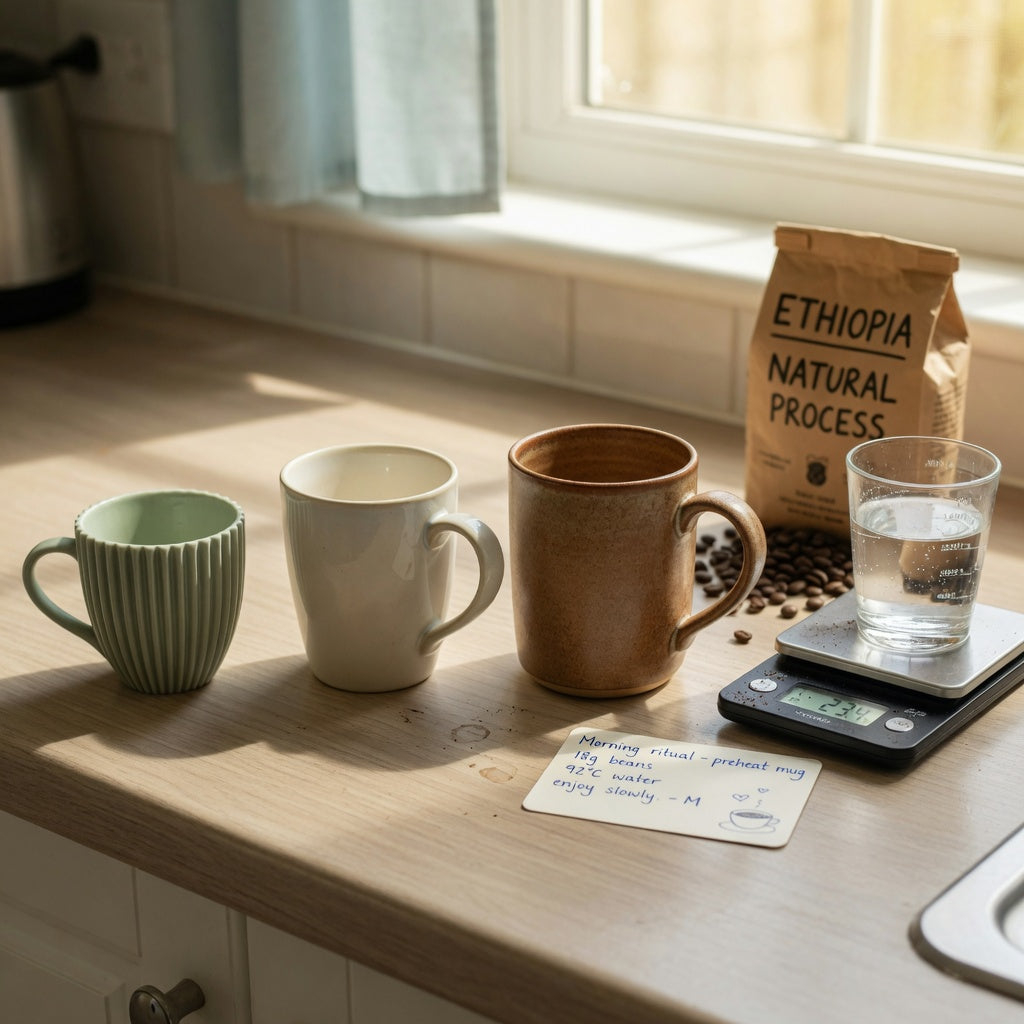
Coffee Mug Gifts Ideas First Time Buyer Product Shortlist Guide
Reading time: about 12 minutes
There is a cup on our sample shelf that nobody has picked up in weeks. It was a gift, and a well-meant one: a wide-mouthed printed mug with no clear job. The cups that leave the shelf every day are the plain ones — a small cup for a mid-morning cortado, a mid-size one for drip with milk, a big one for the iced coffee someone nurses until lunch. That pattern is why this coffee mug gifts ideas first time buyer product shortlist guide starts with the drink instead of the design.
If this is your first time buying a mug for someone else, the listings are genuinely hard to read. Capacity shows up in millilitres on one page and ounces on the next, dishwasher claims arrive without qualification, and almost nothing tells you whether a cup will fit under the recipient's espresso spout. We pack and ship ceramic drinkware every day, and the returns we see are rarely about taste. They are about size and fit.
So this is deliberately narrower than a full buying guide: three routines, three cups, and a short list of details to confirm on the listing before you pay.
When is a mug a welcome gift, and when is it just more clutter?
Gift threads online split cleanly here. Some people name a single mug they have used for years. Others say they already own twenty and quietly re-gift the new ones. The deciding factor is almost never the design. It is whether the mug solves something.
Give it if:
- Their daily mug is chipped, too small, or has a handle that pinches their fingers.
- They mention their coffee going cold before they finish it — usually a sign the cup volume does not match how fast they drink.
- They have picked up a new habit: afternoon tea, espresso at home, iced coffee in summer.
- They sit at a desk where a cup stays within arm's reach for hours.
Skip it if:
- They commute with a sealed travel tumbler and sip from it all day. An open ceramic cup will not replace that, and it should not try to.
- They have said, in so many words, that they own too many mugs.
- They do not drink hot drinks at home at all.
- The only thing you know about them is their job title, which is a design brief, not a drink brief.
Two or more give-it lines, and you have a real gift on your hands. One or fewer, and you are shopping for clutter. With that filter in place, browsing our unique coffee mugs gets much faster, because you are now looking for a shape that fits a habit rather than a slogan that fits a card.
Which of these three drink routines sounds like your recipient?
Capacity only means something once it is attached to a drink. As a working rule: a concentrated drink lands around 150–200 ml, a standard desk coffee around 300–350 ml, and a long latte or iced drink runs 400 ml and above.
- Concentrated. Cortados, flat whites, single-shot pour-overs, espresso with a splash of milk, green tea in small cups. These drinkers stop around 200 ml and actively dislike a large vessel, because the drink cools and the last third tastes flat.
- Standard desk. One 8–10 oz brew from a batch maker or pod machine, topped with milk, consumed over 20 to 30 minutes. They need roughly 300–350 ml of usable volume and a base wide enough that a sleeve does not send it over.
- High volume. A 12–14 oz latte, cold brew over ice, or a long tea session at a kitchen table. Ice displaces liquid, so the iced-coffee drinker needs more cup than the drink's stated volume suggests.
Here is the detail most gift lists leave out: listed capacity is usually measured to the brim, and nobody pours to the brim. Leave 1.5–2 cm of head space so the drink does not slosh when it is carried, which means subtracting roughly 30–50 ml from the stated number. For iced drinks, subtract more, because the ice goes in first. That single adjustment explains most of the it-looked-bigger-online complaints we hear.
Coffee Mug Gifts Ideas First Time Buyer Product Shortlist Guide: Three Routines, Three Cups
This is the shortlist we hand to customers who want to stop browsing. Every line below is grounded only in the listed capacity and the visible ceramic finish — the two things we can state plainly. Everything else, you confirm on the product page.
| Cup | Listed capacity | Visible ceramic finish | Matching routine |
|---|---|---|---|
| Pleated Coffee & Tea Cup | 200 ml (about 6.8 fl oz) | Pleated, fluted exterior | Cortado, flat white, small pour-over, green tea |
| The Flow Coffee & Tea Mug | 400 ml (about 13.5 fl oz) | Smooth, flowing silhouette | Drip with milk, americano, desk tea |
| Morning & Night Coffee & Tea Mug | 440 ml (about 14.9 fl oz) | Substantial body, bolder profile | 12–14 oz latte, cold brew, long tea session |
1. Concentrated drinks: the Pleated Coffee & Tea Cup at 200 ml
For the person whose morning is a double shot with steamed milk, a small pour-over, or a green tea they actually want to taste, a large cup works against them. The Pleated Coffee & Tea Cup lists 200 ml, and its pleated exterior gives the fingers something to read without a handle doing all the work.
- Why choose it: 200 ml keeps a small-format drink hot to the last sip, and the fluted surface reads as considered rather than novelty on a shelf.
- Why skip it: It is the wrong gift for a 10 oz drip-with-cream drinker, and a poor fit for iced coffee, where ice eats a third of the volume before the coffee arrives.
- What to confirm: Whether the 200 ml figure is brim fill or usable fill, and the current care notes on that listing. We will not restate dishwasher or microwave instructions here that we have not confirmed for that exact product.
2. Standard desk coffee: The Flow Coffee & Tea Mug at 400 ml
Most people who drink coffee at a desk sit in the 300–350 ml usable range. The The Flow Coffee & Tea Mug lists 400 ml, which leaves realistic head space for a 10 to 12 oz pour plus a splash of milk.
- Why choose it: 400 ml is the safest middle of the three. It is big enough for a standard brew with milk, small enough that a cortado drinker would not feel absurd holding it, and the smooth contoured finish suits a shared office kitchen as easily as a home counter.
- Why skip it: It has no lid and is not a travel mug. If the recipient's coffee rides in a backpack or a car cup holder, buy a sealed tumbler instead and save the ceramic cup for their desk at home.
- What to confirm: The current care notes and colorway availability on the listing, plus the height if the recipient pulls shots under a low spout or stores cups beneath a cabinet.
3. High-volume mornings: Morning & Night Coffee & Tea Mug at 440 ml
Some drinkers want one generous pour that carries them through a whole morning, or a tall latte they do not have to remake at 10 a.m. The Morning & Night Coffee & Tea Mug lists 440 ml with a fuller body than the other two.
- Why choose it: At about 14.9 fl oz, it takes a 12 to 14 oz latte, a cold brew with ice, or a long tea session without running out of room. The bolder profile also suits drinkers who set a cup down hard and want it to stay put.
- Why skip it: A full 440 ml cup is heavy, and it is the least comfortable of the three for small hands or for anyone who drinks standing up. It is also the wrong pick for an espresso-only drinker, who will leave two-thirds of it empty.
- What to confirm: The listed dimensions, specifically height and base diameter, against the recipient's cabinet clearance and machine spout, plus the care notes for that specific cup.
Still torn between the middle and the largest? Looking at all three together in our ceramic mug collection makes the size difference obvious in a way that three separate product pages never do.
Which listing details should you confirm before you pay?
A product page can only be as good as the claims on it, and gift shopping rewards a two-minute check. These are the items worth reading twice:
- Stated capacity versus usable capacity. Look for whether the number refers to brim fill. If it is not stated, assume brim and subtract head space.
- Dishwasher and microwave claims, read separately. Dishwasher safe does not automatically mean microwave safe, and the reverse is also true. Metallic rims, luster finishes, and some decals behave differently from an under-glaze print, so both claims need to be on the page before you rely on either.
- Handle clearance. Narrow handles punish anyone with larger fingers, and handle placement on the right suits one hand better than the other. If the recipient is left-handed, check the photos carefully.
- Height and footprint. Measure the space under their espresso spout, their cabinet shelf, and their desk monitor stand. This is the most common silent failure in mug gifting.
- Weight when full. A 440 ml cup plus coffee is close to half a kilogram in hand. That matters for anyone with grip issues or a long walk from kitchen to desk.
To be plain about our own pages: they list capacity and describe the visible finish. They are also where you confirm the current care notes for that specific cup, because production runs change and we will not guess on your behalf. If something on a page does not answer your question, ask us before ordering. That is faster and cheaper than a return.
What about glaze safety and lead-free claims?
Most gift roundups skip this entirely, and it matters most for exactly the kind of cup people like to gift. The U.S. FDA sets an action level of 0.5 µg/ml of leaching solution for lead in ceramicware cups and mugs under Compliance Policy Guide 545.450. The agency also notes that lead may be present in glazes or decorations on traditional pottery and can leach into drinks if a piece is not manufactured and fired properly, and that washing or boiling does not remove lead.
FDA flags the higher-concern categories as handmade pieces with crude finishing, antiques, damaged ware, pieces of uncertain origin, and brightly orange, red, or yellow decorated surfaces. Commercially made everyday pottery is described as much less likely to have lead problems. Two label facts are worth carrying into checkout: FDA guidance says ceramicware with extractable lead should not be labeled Lead Free, and under 21 CFR 109.16, decorative ceramicware that looks suitable for food use must carry a conspicuous Not for Food Use warning, including a permanent statement on the base, unless it meets food-contact standards. A piece marked that way is an ornament, not a drinking cup, no matter how good it photographs.
In practice: a lead-free claim on a listing is a marketing statement unless test documentation backs it. If you are buying handmade, vintage, or imported, ask for that documentation. And if a listing, ours included, does not publish leach-test results, treat that as an open question rather than a guarantee.
What should go inside the cup, and what should not?
Pairing a mug with something that gets used on day one turns a generic gift into a considered one. The mistake is overfilling it until the mug disappears.
- Coffee or tea sized to the cup. A 200 ml cup pairs well with a small 250 g bag of whole bean or a tin of loose-leaf. A 440 ml cup can take a full 340 g bag without burying the cup itself.
- A simple coaster. Ceramic holds heat and will leave a ring on a wood desk, which is the fastest way to get a nice gift banished to a shelf.
- A handwritten care card. Copy the exact care instructions from the product listing onto it. This one habit prevents most first-week damage to any mug, printed or handmade.
- Skip shredded filler. If the cup is the gift, do not hide it under packing material — let the finish be the first thing they see.
Three checks before you add to cart
- Name the routine out loud. If you cannot say whether they drink a 6 oz cortado, a 10 oz drip, or a 14 oz latte, you are not ready to choose a size — ask, or pick the middle.
- Do the head-space math. Subtract 30–50 ml from the listed capacity for hot drinks and more for iced. A 400 ml cup gives you about 350 ml of usable coffee.
- Open the listing and find both care claims. Dishwasher and microwave should each be stated. If one is missing, treat it as unknown and handwrite the confirmed instructions on a card.
Then stop shopping. Pick the cup that matches the routine and move on. If you want the fastest possible comparison, our full range of ceramic mugs puts the 200 ml, 400 ml, and 440 ml options in one view, which is enough for almost every gift decision you will face this year.
Frequently asked questions
Does anyone actually want a mug as a gift?
Yes, when it replaces something they use daily rather than adding to a pile. The tell is whether the mug solves a small problem: a chipped handle, a cup too small for their latte, or a drink that always goes cold. A plain mug that fits a routine beats a novelty mug every time.
How does this coffee mug gifts ideas first time buyer product shortlist guide work if I do not know their routine?
Choose the middle option and keep the receipt. A 400 ml ceramic mug covers a standard brew with milk, an americano, and most desk tea without being absurd for a smaller drink. It is the lowest-risk size when you are guessing.
What size mug should I buy for someone who drinks lattes?
A 12 oz latte is roughly 355 ml, so a 400 ml cup is borderline once you leave head space. If they drink 14 oz lattes or add ice, go to the 440 ml mug instead, and confirm the height fits under their machine spout before ordering.
Are these ceramic cups dishwasher and microwave safe?
Check the current care notes on each individual product page rather than assuming — the two claims are separate, and a cup can be one without the other. We do not restate care instructions here that we have not confirmed for that exact cup.
What if the person already has a favorite mug?
Then buy them something else, or buy a cup that fills a gap their favorite does not — a small 200 ml cup for espresso if their daily mug is a large drip vessel. Gifting a second everyday mug to someone attached to their first is how clutter starts.
More from our blog
Ready to pick your mug? Two ways to save on today's order:
Ordering 1–3 mugs? Get an extra 10% off your 1st order with code 10_OFF Apply 10% Off & Shop Wooden-Handle Mugs →
Gifting 4+ mugs? Buy 3, Get the 4th Free applies automatically at checkout (no code needed; offers do not stack) · Free standard shipping (Nov pre-Christmas delivery: 15–20 calendar days US) · Free replacement if chipped in transit.
Popular mug buying guides: Wooden-Handle Tea Infuser Mugs Compared · Christmas & Secret Santa Mugs 2026 · Espresso & Cortado Cups Guide · Cup & Saucer Gift Sets · All 25 Mugs Spec Table · Mug Size Guide · Shipping & Promo FAQ
FIRST ORDER 10% OFF (CODE: 10_OFF) · OR BUY 3, GET THE 4TH FREE


Read more
Pottery Tea Cups First Time Buyer Practical Purchase Checklist
Six lines to verify on a pottery tea cup listing, the capacity numbers worth comparing side by side, and a plain note on which food-contact and care details our own pages still leave unanswered.
Read more
Wide Based Coffee Mugs: First Time Buyer Practical Purchase Checklist
Most first wide-mug purchases go wrong on fit, not looks. This is the listing-by-listing checklist we walk customers through: base diameter, listed capacity, handle clearance, cup-holder taper, gla...
Read more
Leave a comment
This site is protected by hCaptcha and the hCaptcha Privacy Policy and Terms of Service apply.