



Wide Based Coffee Mugs Everyday Mug Rotation Product Shortlist Guide
Reading time: about 11 minutes
Last month a customer asked us which mug would survive a desk shared with a keyboard, a mouse mat, and a cat. Fair question, and a hard one to answer from a product photo. A mug can look broad and planted on screen and still arrive to fail the only two tests that matter: it rocks on the coaster you already own, or it will not slide under the spout of your brewer. This wide based coffee mugs everyday mug rotation product shortlist guide is our attempt to answer that properly — by serving size and by the places a mug actually sits, not by how sturdy it looks in a studio shot.
One clarification before the shortlist. Shoppers use the phrase wide base for three different shapes, and mixing them up is the most common reason a mug disappoints once it is home. A wide foot is about the contact patch on the table. A wide mouth changes how coffee cools and whether a pour-over dripper or AeroPress sits safely on the rim. A tall, high-capacity mug can have a broad foot and still be easy to nudge over when full, because the weight sits high. Stability follows the foot, the height, and the fill level. Aroma, cooling, and brewer fit follow the opening. They are separate decisions that happen to arrive in the same box.
There is also no agreed minimum diameter that makes a mug officially wide-based, so the label alone tells you very little. The unique coffee mugs collection is a better starting point than the phrase, and our shape-and-fit guide to ceramic wide-bottom mugs covers the geometry question in more detail.
Serving size first: the wide based coffee mugs everyday mug rotation product shortlist guide, from 250 ml to 480 ml
The three mugs below are listed at 250 ml, 400 ml, and 480 ml. Those capacities are the details we can state with confidence here; base diameter, outside width, empty weight, and handle opening are things to confirm on each current product page, because a photo can suggest a shape but cannot measure it. Pick your usual pour first, then check the footprint.
| Mug | Listed capacity | Strongest reason to choose it | Strongest reason to skip it |
|---|---|---|---|
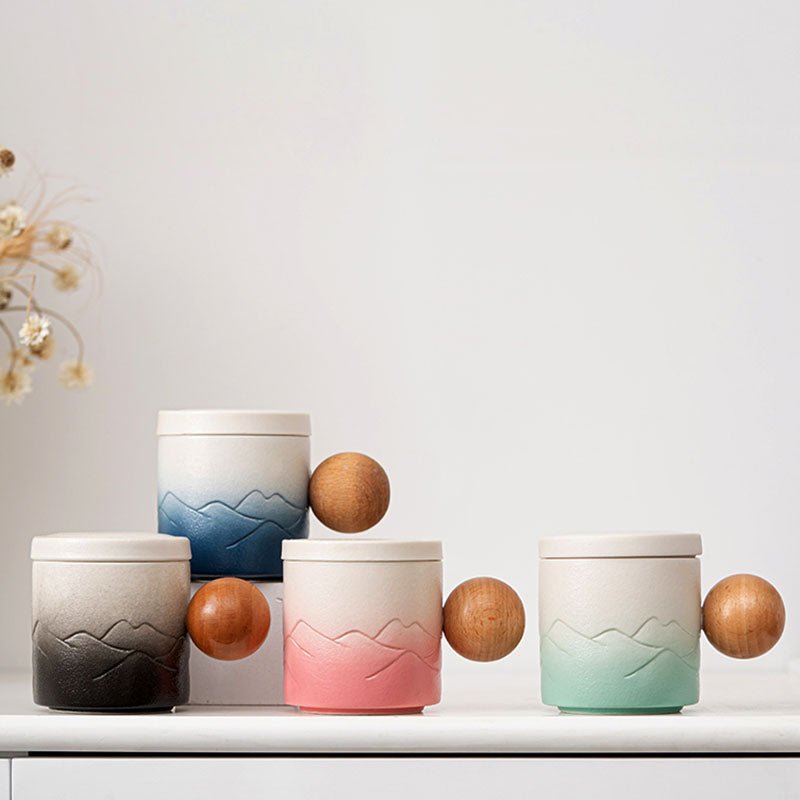
| Ball Handle | 250 ml | Small daily pour, or the spare mug that is clean when your main one is in the sink | You routinely pour 350 ml or more, or want room for plenty of milk |
| The Flow | 400 ml | One proper cup that carries you through a working morning | You drink small cups all day and dislike leaving coffee in the bottom |
| The Rock | 480 ml | A generous single brew, or coffee you sip slowly | You carry the mug between rooms or have shallow shelves |
Ball Handle, 250 ml: the refill mug
Choose it if you make a short coffee or a modest tea and would rather brew twice than haul a big cup around. It is also the sensible second mug in a rotation — the one that is already clean when the first is soaking.
Skip it if your normal pour runs to 350 ml or beyond, or if you like a generous splash of milk, because 250 ml leaves very little headroom once both are in the cup. A small listed capacity does not guarantee a small footprint either: check the outside width, handle included, before assuming it will tuck into a tight shelf.
Verify on the listing: base diameter, handle opening, and care instructions. Capacity tells you the pour, not the grip.
The Flow, 400 ml: the working-morning mug
Choose it if one real cup gets you to mid-morning and you want a little room for milk without running to the rim. At a listed 400 ml, The Flow sits in the middle of this shortlist, which is where most everyday drinkers actually land.
Skip it if you drink small cups through the day and hate tipping cold coffee away, or if you already know you want the largest pour here. Middle capacity is a compromise, not a promise that the mug clears your drip tray — that is a height question, answered with a tape measure.
Verify on the listing: overall height against your brewer clearance with the drip tray in place, plus base diameter if it will sit on a narrow coaster or a wheelchair tray table.
The Rock, 480 ml: the generous pour
Choose it if you brew one large coffee and drink it slowly, or you want a mug that doubles as a hot-chocolate or small-soup vessel on a cold afternoon. The Rock has the largest listed capacity on this shortlist.
Skip it if you carry your mug room to room, have shallow cupboard shelves, or sip one-handed while typing. A full 480 ml is roughly 480 g of liquid before the mug's own weight is added, and that total is what decides whether a mug feels pleasant in the hand or like a small workout. It is also the size where you should check rather than assume: a broad-looking mug is not automatically a travel mug.
Verify on the listing: base diameter, empty weight, and whether the mug is explicitly stated as cup-holder compatible. If the listing is silent, plan as though it is not.
Does a broad foot actually stop a mug from tipping on a desk?
Partly, and less than the marketing implies. A mug stays upright while its center of gravity sits inside the area where the foot touches the surface. Widen the foot and you widen that area, which genuinely helps. But three other things shift the odds just as much: how tall the mug is, how high the liquid sits inside it, and whether the foot makes flat contact or rocks across a tile joint or a warped coaster.
So a 480 ml mug filled near the rim on a wobbly café table is not made safe by a broad base, and a slim 250 ml mug with a truly flat foot can be surprisingly hard to knock over. We do not publish tip-angle tests for our mugs, and we have not found a public benchmark that measures commercial mugs against base diameter and fill level. Two practical consequences: compare the visible foot in product photos as one input among several, and treat words like non-slip or tip-proof as unconfirmed unless that exact product page says it.
For a boat console, a dashboard, or a desk with an enthusiastic cat, a broad mug alone is not the answer. A secured holder, a non-slip mat, or a vessel sold specifically for those settings does more work than base width ever will. And if heat retention over the first hour matters to you, the variables makers actually document are the lid and double-wall vacuum construction on steel vessels — not how wide the foot is on a ceramic one.
Coaster, shelf and drip tray: the three measurements to take before ordering
Measure the spots where the mug will actually live, with a tape measure, not from memory. These are the four numbers we ask customers for when they are stuck between two sizes:
- Coaster or desk pad: the mug's base diameter, not the widest part of the body. Handles project beyond the foot, so leave clearance for the handle swing as well.
- Shelf: usable width, depth, and height, with the handle included in the outside width. Do not plan to stack mugs unless the product information says they are designed to stack.
- Brewer clearance: from the surface the mug stands on to the lowest point of the spout, measured with the drip tray in the position you actually use. If you brew straight into the mug with a pour-over or AeroPress, note the rim diameter too — the brewer needs the opening, not the foot.
- Car cup holder: measure the holder at its narrowest point, usually near the bottom, and check how far the handle sticks out. Cup holders are not one standard size, so your own measurement beats any claim on a listing.
How many mugs do you need between dishwasher cycles?
Count drinks, not mugs. If the dishwasher runs nightly, two mugs are plenty for one coffee drinker. If dishes go in every third day, count the hot drinks you make in that window, add one spare for the mug that gets abandoned on the desk, and you have your number. A two-person household roughly doubles it.
A workable pairing from this shortlist: the 250 ml Ball Handle mug for short afternoon drinks, with The Flow at 400 ml covering the main morning cup. Someone who brews one big coffee and stops there might put The Rock in the lead slot and keep the smallest mug for tea. Both are portion decisions — neither is a claim that these mugs stack neatly, weigh the same, or share care instructions.
On care, read the listing for each mug rather than assuming all ceramics behave alike. Even when a mug is dishwasher-rated, its underside shape matters in daily life: a recessed or concave foot can hold water after a cycle, so tip it out and let it dry fully before it goes back on the shelf. A puddle in the foot ring is exactly the kind of small annoyance that quietly decides which mug you reach for.
Buying one as a gift? Confirm four things before you wrap it
- The drink they actually make. A 480 ml mug is wasted on someone who pulls short espressos.
- Handle comfort. Listed capacity says nothing about how many fingers fit through the handle, so read the dimensions or ask.
- Their shelf and cupboard. If you cannot check, choose the smaller capacity rather than guessing.
- Their washing routine. Hand-wash-only mugs migrate to the back of the cupboard within a month.
One safety note that applies to any ceramic mug, ours included. The FDA warns that improperly fired traditional pottery glazes can release lead into food and drink, that ordinary washing or boiling does not remove lead from pottery, and that items labelled not for food use should not hold drinks. For cups and mugs the FDA lists an action level of 0.5 micrograms of lead per millilitre of leaching solution across six units. That guidance is aimed mainly at handmade, antique, damaged, and brightly decorated traditional pieces, with ordinary commercial factory tableware described as far less likely to be affected. It is general ceramic guidance, not a statement about the glaze or food-contact status of the three mugs linked here — if you need confirmation for a specific mug, ask us and we will tell you what the listing states.
Frequently asked questions
Is a wide base enough to stop a mug tipping, or does height matter more?
Height and fill level matter at least as much. A broad foot widens the area the mug has to lean past before it falls, but a tall mug filled near the rim carries its weight higher and is easier to tip. Flat, even contact with the surface is the other factor people underestimate.
Will the 480 ml Rock fit my car's cup holder?
Do not assume it will. Measure your holder at its narrowest point and compare that with the mug's base diameter and handle projection once you have the dimensions from the product page. If you need a mug for commuting, a vessel the maker explicitly lists as cup-holder compatible is the safer purchase.
Does a wide base keep coffee hot for longer?
Base width alone does not establish heat retention. Material, wall construction, whether there is a lid, and the temperature you started with all affect how quickly a drink cools. For longer holds, look at what the maker documents about insulation and lid design rather than at the silhouette.
Are the Ball Handle, The Flow and The Rock dishwasher and microwave safe?
Check the current product page for each mug before using either appliance, because care instructions are set per product and can change. We cannot confirm dishwasher or microwave compatibility for these three from the details verified here, so contact us if the listing does not answer it clearly.
Using this wide based coffee mugs everyday mug rotation product shortlist guide, which single mug should I buy first?
Buy the capacity closest to what you pour most mornings, then confirm the footprint fits your coaster and brewer clearance. If you are genuinely between two sizes, the smaller one is the safer first purchase — it is easier to refill than to make a too-large mug earn its shelf space.
Your next step: two mugs and a five-minute measurement sheet
Before anything goes in the cart, write these down:
- The millilitres you pour on a normal morning.
- Your coaster diameter and shelf clearance, handle included.
- The clearance under your brewer, drip tray in place.
- Your narrowest cup holder, if the mug will travel.
- Whether you hand-wash or run a machine, and how often.
With those five numbers the shortlist collapses fast. A small pour and nightly dishes point to the 250 ml Ball Handle; one working-morning cup points to The Flow; a single large brew points to The Rock. Start with two mugs rather than five — a rotation that matches your habits and fits your shelf is far easier to keep tidy than a collection that does not. When you are ready, browse the full unique coffee mugs collection and narrow it down to the one or two shapes that clear your measurements.
More from our blog
Ready to pick your mug? Two ways to save on today's order:
Ordering 1–3 mugs? Get an extra 10% off your 1st order with code 10_OFF Apply 10% Off & Shop Wooden-Handle Mugs →
Gifting 4+ mugs? Buy 3, Get the 4th Free applies automatically at checkout (no code needed; offers do not stack) · Free standard shipping (Nov pre-Christmas delivery: 15–20 calendar days US) · Free replacement if chipped in transit.
Popular mug buying guides: Ceramic Tea Cups & Infuser Mugs · Ceramic Mugs with Lids Compared · Wooden-Handle Tea Infuser Mugs Compared · Christmas & Secret Santa Mugs 2026 · Espresso & Cortado Cups Guide · Cup & Saucer Gift Sets · All 25 Mugs Spec Table · Mug Size Guide · Shipping & Promo FAQ
FIRST ORDER 10% OFF (CODE: 10_OFF) · OR BUY 3, GET THE 4TH FREE


Read more

Latte Mugs Tall Everyday Mug Rotation Product Shortlist Guide
Three tall latte mugs, three different daily habits. How 400 ml, 440 ml, and 480 ml vessels actually behave in a real mug rotation — including when to skip each one and what to measure before you o...
Read more
Pottery Tea Cups Everyday Mug Rotation Product Shortlist Guide: 3 Picks
Three ceramic-body pottery tea cups — 170 ml, 200 ml, and 250 ml — matched to the pour you actually finish, the shelf you actually have, and the care checks a daily cup needs before it earns counte...
Read more
Leave a comment
This site is protected by hCaptcha and the hCaptcha Privacy Policy and Terms of Service apply.