
Wide Based Coffee Mugs Comparison: Ball Handle, Flow, or Rock?
Reading time: about 9 minutes
Last week a customer sent us a photo of a coffee ring on a tax return and asked which of our mugs would have survived the elbow that made it. That is the honest starting point for any wide based coffee mugs comparison: not which glaze photographs best, but which cup stays put at nine in the morning when you reach across the desk.
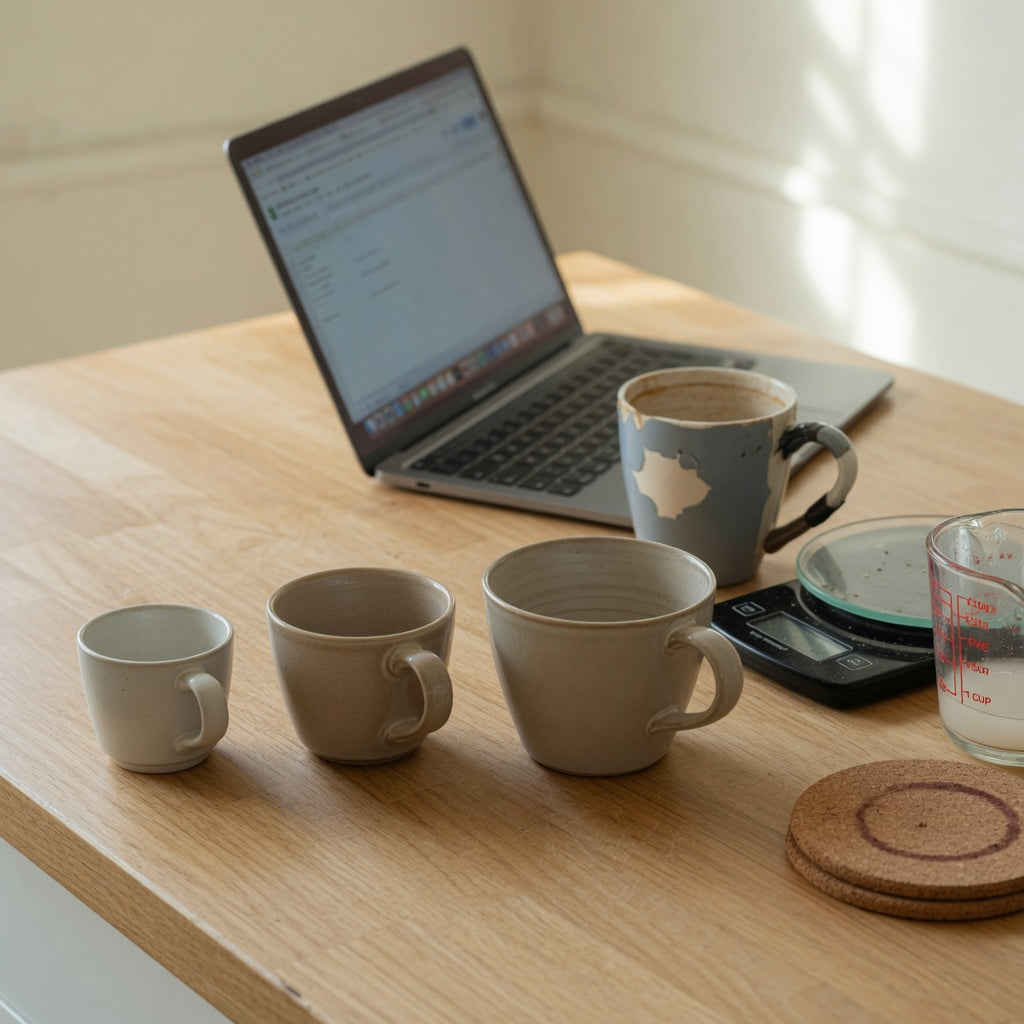
We stock three ceramic options, and this wide based coffee mugs comparison is close to the reply our team types back at the counter. The Ball Handle holds 250 ml. The Flow holds 400 ml. The Rock holds 480 ml. Base shape gets all the attention online; capacity is where the real daily difference lives, and it is the first number we ask shoppers to check before anything else.
What do 250 ml, 400 ml and 480 ml look like in an actual cup?
Millilitres on a listing page are hard to picture. In fluid ounces, the current lineup breaks down like this:
- Ball Handle - 250 ml (about 8.5 fl oz): a short cup. Think lungo, cortado, a small tea, or half a serving of drip.
- The Flow - 400 ml (about 13.5 fl oz): the middle. A standard large pour with room left for milk.
- The Rock - 480 ml (about 16 fl oz): the long one. A full travel-size coffee, an iced drink, or a pot of tea worked through over an hour.
One habit worth breaking: do not trust the markings on a brewer carafe. Markings shift between brands, so fill once with a measuring cup and note the level you actually drink. Someone who genuinely drinks 300 ml every morning is buying the wrong mug at 250 ml and paying for headroom they never use at 480 ml.
Does a wide foot really stop a knock-over, or is height the bigger variable?
A mug goes over when its centre of gravity travels past the edge of its base of support. Widen the footprint and you widen the margin. Lower the centre of gravity and you widen it again. That is plain physics, and it is why a broad foot feels steadier in the hand before you even set it down.
What we will not claim is tip-proof. We have not found a public test that ranks commercial mugs by tip angle against base diameter, height and fill level, and we are not going to invent one. Height, weight distribution, how full the mug is and whether the foot sits flat all move the same needle. A tall mug on a broad foot, filled to the rim, is still easier to knock than a short one on the same foot.
There is also a shape mix-up we clear up almost weekly: a wide foot is not a wide mouth. A stable base can sit under a narrow rim, and a wide rim can sit on a small foot. Aroma, cooling speed and whether your dripper nests inside all depend on the opening, not the foot.
Which option in this wide based coffee mugs comparison fits your morning?
This is the mapping we use at the counter. Match the situation first, then open the product page and confirm the base footprint and care details for yourself, because those are the two things we tell shoppers never to take on faith from a photo.
| Option | Listed capacity | Buy it if | Think twice if |
|---|---|---|---|
| Ball Handle | 250 ml | You pour small and often, drink espresso with milk, or want a small tea beside a laptop | You take a 16 oz coffee to work, or you want one mug to do everything |
| The Flow | 400 ml | You drink everyday drip with milk and carry the mug between kitchen and desk | You drink iced coffee by the pint, or you want the mug to double as a brewer vessel |
| The Rock | 480 ml | You drink long blacks, iced drinks, or tea over an hour, and you refill rather than re-brew | You have small hands, a cramped coaster, or a brewer spout with tight clearance |
The Ball Handle coffee and tea mug is the one that gets bought twice, once for the buyer and once as a gift, because 250 ml is a safe size when you do not know someone's coffee habit well. It is a poor fit for anyone who measures a morning in one big mug.
The Flow is our default recommendation for a desk. At 400 ml it covers a normal pour plus milk without pushing the mug as far into the top-heavy range that bigger vessels drift toward as they fill.
The Rock suits long drinks, but be honest about the weight: 480 ml of coffee is roughly a pound of liquid before the ceramic is counted, and that changes how you lift it one-handed off a low side table. To see all three side by side before deciding, browse the unique coffee mugs collection.
Will the base clear your cup holder, your coaster and the space under your brewer?
Three measurements prevent almost every mismatch we hear about:
- The narrowest point of a tapered cup holder. Car holders taper inward. Measure the bottom, not the rim. Some wide, handled mugs are explicitly listed as not cup-holder compatible, and nobody publishes cross-vehicle fit data, so a tape measure is your only reliable test.
- The footprint of your coaster or shelf. A broad foot overhanging a small coaster is a mug waiting for a nudge.
- Clearance under the spout. Drip machines, capsule spouts and pour-over setups all need vertical room, and a wide rim can foul a dripper that nests inside the cup. AeroPress and V60 users often need a wider mouth, not a wider foot.
If you want the geometry explained in more depth than a product listing can manage, our shape and fit guide for wide-bottom mugs walks through foot versus mouth one more time. If the mug rides in a bag, though, an open ceramic mug is simply the wrong object and a lidded travel mug is the better answer. And if a listing shows a lid, treat it as splash-resistant unless the maker states a leak test, because splash-resistant and leak-proof are not synonyms.
What changes at the sink: full weight, finger room and water in a recessed foot?
Base geometry changes daily handling more than the spec sheet suggests:
- Full weight. Liquid plus ceramic adds up fast. A 480 ml mug filled to a sensible level is heavy enough that lifting it by the rim instead of the handle gets awkward.
- Handle clearance. Count how many fingers actually fit. Two fingers on a full mug is a grip problem, not a stability problem, and no base width fixes it.
- Rocking feet. A foot that is not flat will rock on a stone countertop even when it is wide. Test it on the counter, not on a tablecloth.
- Water in a recessed base. Concave or hollow feet trap water in the dishwasher and in the sink. Drain the mug upside down and dry it foot-up, because that trapped water is also what leaves the ring on the shelf.
Wall thickness matters alongside this, and it is the reason two mugs of identical capacity can feel completely different in the hand. We do not publish a wall figure for these three, so if body weight is the deciding factor for you, ask before ordering rather than assuming from a photograph.
Ceramic glaze and lead: what we can and cannot promise
This is the part of the category where we stay deliberately careful. The FDA publishes a lead action level for cups and mugs of 0.5 micrograms per millilitre of leaching solution, measured across a set of units using methods that include ASTM C738. The same guidance notes that washing, boiling or other household steps do not remove lead from pottery, and flags handmade, antique, damaged, or brightly orange-, red- and yellow-decorated pieces as higher concern. Ordinary commercial factory tableware is described as much less likely to have the problem, and anything labelled not for food use should stay out of the kitchen.
What that means for a buyer: if you are considering an uncertified handmade or vintage mug for daily hot coffee, ask the seller for test documentation. A glossy glaze tells you nothing about lead, and we will not claim otherwise about a mug we have not tested.
Care runs alongside capacity, since a mug you use twice a day gets washed twice a day. Confirm dishwasher and microwave suitability on the specific product page rather than assuming it from the word ceramic, because that detail varies between glazes and bodies.
When a wide base is the wrong pick
We sell these mugs, and we still talk people out of them when the situation calls for something else:
- Bag and bike commutes. An open ceramic mug is not transport-safe, no matter how stable the foot is on a desk.
- Tremor or limited grip. We have not found clinical guidance specifying mug weight or base diameter, so treat it as personal judgement: lighter and smaller is the reasonable starting point, which points to 250 ml rather than 480 ml.
- Small brewers and tight cabinets. A wide rim can block a dripper that sits inside the cup, and a broad body may not clear an over-counter machine.
- Gifting for an unknown habit. 400 ml is the safer middle; 480 ml is a lot of coffee to commit someone to.
Frequently asked questions
Is a wide based coffee mug actually harder to tip over?
Yes, up to a point. A wider base of support and a lower centre of gravity give you more margin before the mug goes over, which is the whole reason the shape exists. But base width alone does not make a mug tip-proof, and a wide based coffee mugs comparison like this one can only get you to the shortlist - height, fill level, weight distribution and a flat foot finish the job.
Will a 480 ml mug fit my car's cup holder?
Sometimes, and there is no way to answer it from the capacity alone. Cup holders taper, so measure the narrowest point of yours and compare it with the base footprint shown on the product page. Some wide, handled mugs are explicitly listed by their makers as not cup-holder compatible.
Does a wider base keep coffee hot longer?
Not on its own. Retail roundups often credit a wide ceramic base with heat retention, but no standards-body or manufacturer test we could find isolates base width from material, wall thickness, lid and starting temperature. A broad foot is a stability feature first.
How much is 400 ml in ounces?
400 ml is about 13.5 fl oz, so it sits just above a standard 12 oz mug once you allow headroom below the rim. That is why we treat The Flow as the everyday middle option rather than a small cup.
Can I put these mugs in the dishwasher and the microwave?
Check the current listing for each mug rather than assuming it from the material. Microwave and dishwasher suitability varies with the glaze and body, and it is exactly the kind of detail that changes between products in the same category.
Start with the number you actually drink, then the footprint you actually have. Measure your brewer pour once, measure your coaster and cup holder, and pick from the full collection using capacity first and base shape second.
More from our blog
Read more

15 Oz Ceramic Coffee Mugs Capacity Guide: 400 vs 440 vs 480 ml
A 15 oz mug is roughly 444 ml, but the printed number is brim capacity, not what you drink. We compare our 400 ml, 440 ml, and 480 ml mugs by usable pour, refill habit, full weight, and handle clea...
Read more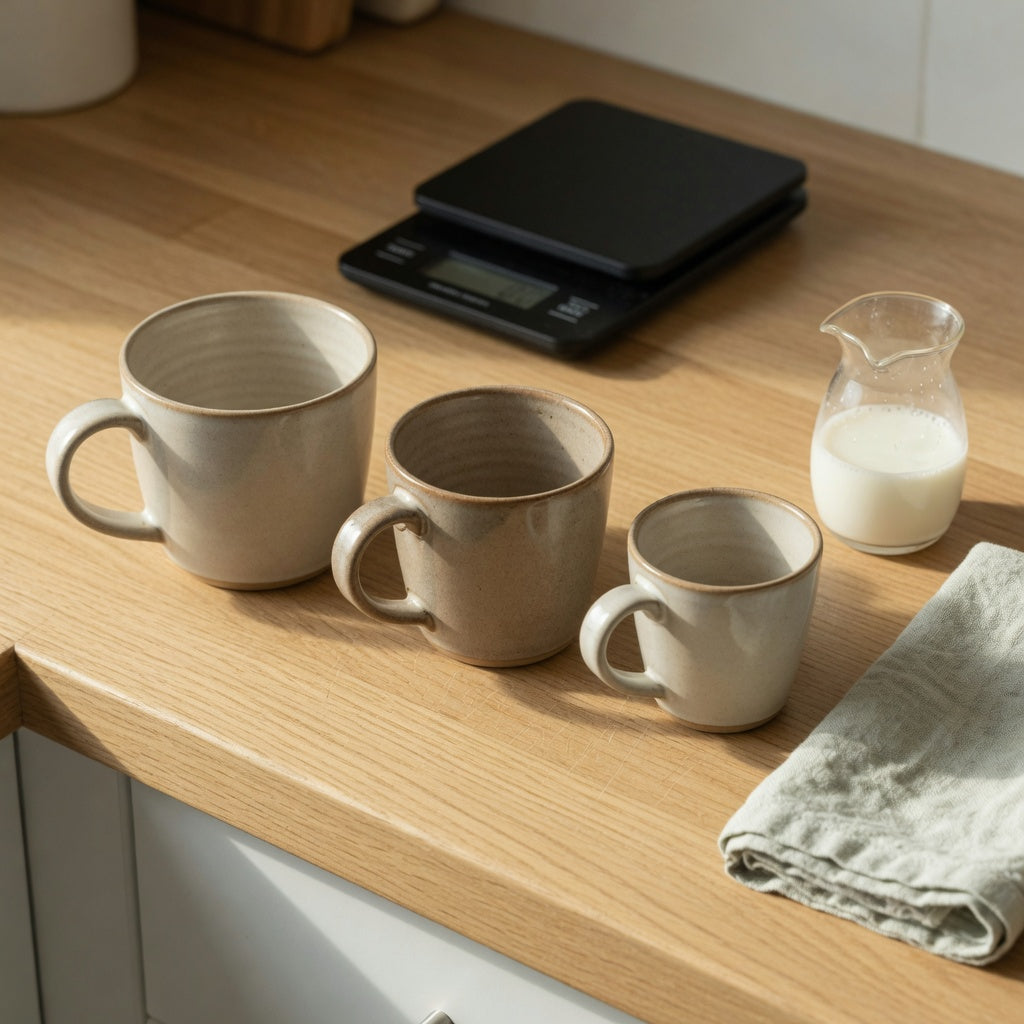
15 Oz Ceramic Coffee Mugs Comparison: Which Option Fits Your Routine?
A 15 oz label hides more than it tells you. We compare our 400 ml, 440 ml, and 480 ml ceramic mugs on usable fill, handle clearance, and glaze care so you can match capacity to the way you actually...
Read more
Leave a comment
This site is protected by hCaptcha and the hCaptcha Privacy Policy and Terms of Service apply.