

15 Oz Ceramic Coffee Mugs Capacity Guide: 400 vs 440 vs 480 ml
Reading time: about 11 minutes
A customer emailed us last month holding two mugs side by side: a department-store mug stamped "15 oz" and our Morning and Night at 440 ml. She swore the 15 oz mug held less coffee. She was right. Once she added cream and left room to stir, her 15 oz mug poured out around 12 oz of actual drink, while the 440 ml mug gave her noticeably more headroom at the rim. That gap between the printed number and the real pour is the entire reason this 15 oz ceramic coffee mugs capacity guide exists.
Here is the conversion we use when customers ask. One US fluid ounce is about 29.57 ml, so 15 fl oz lands near 444 ml. Our current ceramic lineup brackets that number rather than matching it exactly: The Flow holds 400 ml (~13.5 fl oz), Morning and Night holds 440 ml (~14.9 fl oz), and The Rock holds 480 ml (~16.2 fl oz). Three mugs, three different answers to "is 15 oz enough?"
15 Oz Ceramic Coffee Mugs Capacity Guide: What the Printed Number Leaves Out
Retail capacity is a nominal volume, usually measured to the brim, and it ships with no fill line. Nothing on the box tells you how much room to leave for a spoon, a foam cap, or two ice cubes. We have not found a government or standards body that defines a "standard 15 oz coffee mug." The FDA's own example of a cup or mug in its lead guidance is about 240 ml, or 8 fl oz. The 15 oz size is a retail convention, not a regulated specification.
That has a practical consequence: compare listings by exact millilitres, measured height, and rim diameter — not by words like "large," "jumbo," or "oversized." A styled photo can make a 400 ml mug look nearly identical to a 480 ml one. When we photograph our own mugs, we shoot them at the same camera distance for exactly this reason, and they still read bigger or smaller depending on the crop.
Does 15 oz Mean 15 oz of Coffee Once You Add Milk, Foam, or Ice?
Almost never. Brim capacity assumes you fill to the very edge and stop, which nobody actually drinks from. The space you leave is the variable that decides whether a 15 oz mug feels generous or stingy, and it changes with the drink:
- Black coffee or plain tea. Filled to a comfortable line below the rim, a true 15 oz mug pours roughly 13 to 14 fl oz. This is the routine where a 15 oz mug delivers close to its label.
- Latte, cappuccino, or a heavy cream pour. Leave 1 to 2 inches for milk and foam. Many people end up with 11 to 13 fl oz of finished drink, which is why some buyers describe a 15 oz mug as "smaller than expected."
- Iced coffee. Ice displaces a surprising amount of volume. A mug that feels huge empty can feel ordinary once it is half ice.
Our rule of thumb: subtract the space your routine needs, not a fixed percentage. If you always add a big splash of milk and stir with a long spoon, buy on the larger side of the range rather than trusting the label.
Which of Our Three Capacities Matches Your Refill Habit?
The useful question is not "how big is the mug" but "how many times do you get up?" In our store we see three patterns: one large coffee that has to last through a meeting, a milk-drink routine built around foam, and an all-day tea drinker who refills two or three times.
| Mug | Listed capacity | Approx. US fl oz | Routine it fits | Verify on the listing |
|---|---|---|---|---|
| The Flow | 400 ml | ~13.5 | Black coffee or tea with a small splash; readers who want a full cup that stays light in the hand. | Handle opening, empty weight, care marks |
| Morning and Night | 440 ml | ~14.9 | Closest to a 15 oz pour; one large single-serve brew or tea with a modest amount of milk. | Handle opening, empty weight, care marks |
| The Rock | 480 ml | ~16.2 | Extra headroom for foam, cream, or ice; people who routinely overfill a 15 oz mug. | Handle opening, empty weight, care marks |
Read that table by routine, not by rank. Morning and Night at 440 ml (~14.9 fl oz) is the closest thing we make to a 15 oz pour. The Rock at 480 ml (~16.2 fl oz) sits above the 15 oz mark, which is helpful for milk drinks and unhelpful if you are matching a specific brew basket or a recipe that assumes 15 oz. The Flow at 400 ml (~13.5 fl oz) is the smaller daily cup — and, honestly, the one several of us reach for when we want coffee to stay hot to the last sip rather than going cold halfway through a large pour.
If your routine is a single-serve pod plus a generous splash of creamer, the honest answer is that a strict 15 oz mug is borderline. Go up to The Rock, or accept a slightly shorter drink.
How Heavy Is a Full 440 ml or 480 ml Mug by the Time You Sit Down?
Capacity gets the attention; weight causes the complaints. A coffee-like liquid adds roughly 1 gram per millilitre, so 440 ml of liquid weighs about 440 g — around 15.5 oz on a scale — before you count the ceramic at all. The Rock adds roughly 480 g of liquid, and The Flow about 400 g. Then add the mug itself, and add more if you use a saucer.
We do not publish a single universal empty weight for every ceramic mug, because wall thickness, handle construction, and glaze thickness vary from piece to piece. If weight is the deciding factor, check the current product page or ask us before ordering — we would rather weigh a mug than process a return. And be realistic about the trade-off: a full 480 ml mug is not the right choice for someone with a weak grip, arthritis, or a habit of carrying coffee up a staircase one-handed. A 400 ml mug refilled twice is often easier than a 480 ml mug carried once.
Will It Clear the Brewer, the Cabinet Shelf, and Your Fingers?
Clearance is where capacity guides quietly fail people. Four checks before you commit:
- Handle opening. Can you fit three or four fingers without scraping knuckles? A big mug with a tight handle is harder to use than a small mug with a generous one.
- Brewer clearance. Measure from the drip tray to the spout, not just the mug's height. A mug can fit your cabinet and still be too tall for a single-serve machine.
- Cabinet shelf gap. Include the handle in your measurement, and check the vertical gap above the shelf, not just the shelf itself.
- Full weight in the hand. A mug that feels fine empty behaves differently with 440 or 480 ml of liquid in it.
None of those four can be answered by a capacity number. That is why we list exact millilitres plainly and treat handle feel as a separate question you should confirm on the product page.
What Actually Changes After the First Dishwasher Cycle?
Ceramic is not one care category. A plain glaze, a metallic rim, and a printed decoration can carry different instructions, and "ceramic" on a label tells you nothing about which one you have. Check the specific listing for microwave and dishwasher guidance rather than assuming.
Three failure modes come up most often with daily use: chips at the rim or handle from stacking, fine surface cracks called crazing, and printed designs that dull or lift after repeated hot cycles. Crazing is not automatically a defect — it is a glaze-fit issue — but a crazed glaze is easier to stain and harder to clean. If a mug has metallic trim or a hand-applied design, treat the care instructions as product-specific and hand wash when in doubt. Our ceramic vs porcelain capacity comparison explains why two mugs can hold the same volume and still age differently.
Are 15 Oz Ceramic Mugs Lead-Safe? What a "Lead Free" Label Really Means
This is where most capacity articles stop too early. Under FDA CPG Sec. 545.450, the lead guideline for cups and mugs is 0.5 micrograms per mL of leaching solution in any one of six units, using methods that include ASTM C738. FDA's cadmium guidance for small hollowware — anything under 1.1 litres, which covers every mug here — is also 0.5 micrograms per mL. These are test-based limits applied to a finished piece, not a guarantee about a material category.
A "lead free" label is not a free pass. FDA has reported imported traditional pottery labeled "Lead Free" that still contained extractable lead. The California Department of Public Health notes that lead cannot be seen in glaze or paint, that acidic drinks such as coffee and tea leach lead from contaminated ware faster than non-acidic drinks, that microwaving speeds leaching, and that dishwashing a lead-containing piece can damage the glaze and make later leaching more likely. CDPH also notes lead is rarely found in plain white dishes. Decorative ceramicware that looks like foodware is treated as foodware under 21 CFR 109.16 unless it carries the required warning — and that warning is not something you want on a mug you drink from.
For our mugs, use the current product page as the source for care and material claims, and ask us for finished-piece leach documentation if you are buying for a gift, a school, or an office. Keep two questions separate: "is it microwave safe" is about appliance use, and "is it lead free" is about extractable-metal testing. One does not prove the other.
Gift and Office Math: 11 oz, 12 oz, or 15 oz?
The 11 oz mug dominates gifting because it is light, easy to ship, and fits almost any cabinet. A 12 oz mug is the modest step up for someone who wants breathing room without a heavy pour. A 15 oz ceramic mug is the large everyday size — a good fit for a full single-serve brew, a tea drinker who refills once, or the person who always says standard mugs are too small.
The trade-offs are real. A big mug looks generous in a gift box but can stay in the cabinet if it is tiring to hold. In a shared office kitchen, stackability and handle clearance matter more than the extra ounces, and a 480 ml mug takes shelf space a 400 ml mug does not. If you are buying blind for someone else, a mug near 15 oz is a safer gift than one well above it.
Five Checks Before You Add a Mug to the Cart
- Exact ml and fl oz. Compare 400 ml, 440 ml, and 480 ml directly; ignore "large" and "jumbo."
- Brim vs. usable pour. Decide how much headspace your cream, foam, or ice needs.
- Empty weight, if published. If it is missing, ask. Full weight is roughly liquid volume plus the mug.
- Handle opening and brewer clearance. Three or four fingers, and measure drip tray to spout.
- Care marks and leach testing. Microwave, dishwasher, metallic trim, and any published testing documentation.
Start with the unique coffee mugs collection to see the shapes side by side, then decide by routine. Want the closest match to a 15 oz pour? Begin with Morning and Night at 440 ml (~14.9 fl oz). Need headroom for foam or ice? The Rock at 480 ml (~16.2 fl oz) is the larger option. Want a lighter cup you will actually carry? The Flow at 400 ml (~13.5 fl oz) is the smaller one. For the broader ounces conversation, our guide to how many ounces are in a mug of coffee covers the measurement side.
Frequently asked questions
Is 15 oz the same as 440 ml?
Close, not exact. A US 15 fl oz is about 444 ml, and 440 ml converts to about 14.9 fl oz. Our 480 ml mug is about 16.2 fl oz, so it sits just above the 15 oz mark rather than on it.
How much coffee can I actually pour into a 15 oz ceramic mug?
Plan for less than the brim. Black coffee filled to a comfortable line is often 13 to 14 fl oz; add cream, foam, or ice and 11 to 13 fl oz of finished drink is realistic. This 15 oz ceramic coffee mugs capacity guide treats the label as a starting point, not a fill line.
Will a 15 oz mug fit under my Keurig or single-serve brewer?
Not universally. Measure the clearance from the drip tray to the spout and compare it with the mug height, including any handle that sticks out. Capacity alone cannot answer that, and if dimensions are not listed, ask before ordering.
Are 15 oz ceramic mugs microwave and dishwasher safe?
It depends on the glaze, trim, and decoration rather than the word "ceramic." Check the exact product listing. Metallic rims and hand-applied designs may need hand washing, and a microwave-safe claim says nothing about lead or cadmium leaching.
Should I pick 15 oz or 12 oz for a gift?
Choose 15 oz for a large coffee or tea drinker, a desk mug, or someone who wants one full brew. Choose 12 oz for smaller hands, tight cabinets, or a lighter carry. If you are unsure, 440 ml Morning and Night (~14.9 fl oz) lands closest to 15 oz without going over.
More from our blog
Read more

Coffee Mugs With Big Handles Comparison: 250, 400 & 480 ml Picks
Three mugs, three handle shapes, one decision. We compare our 250 ml Ball Handle, 400 ml Flow and 480 ml Rock by finger clearance, pour size and where each one gets awkward in a real kitchen.
Read more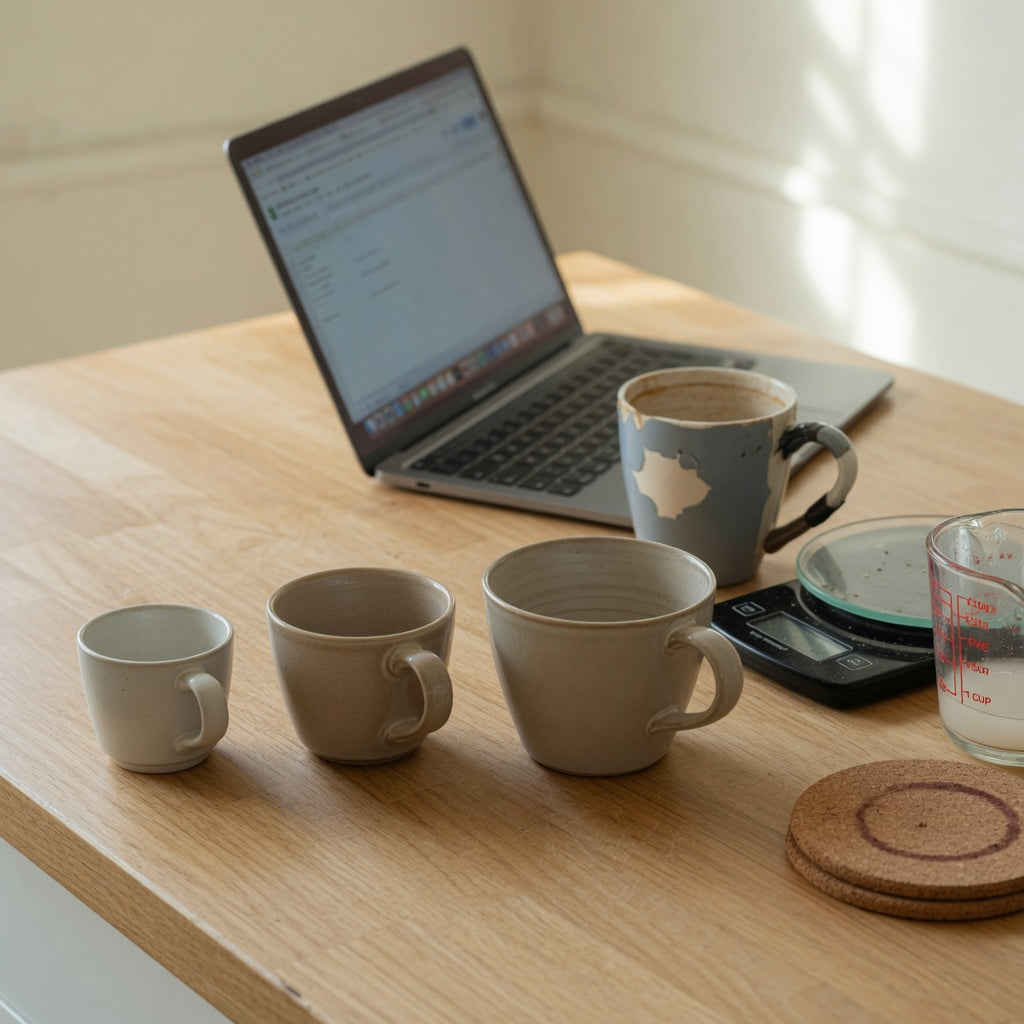
Wide Based Coffee Mugs Comparison: Ball Handle, Flow, or Rock?
Our three current wide based mugs hold 250 ml, 400 ml and 480 ml, and that gap decides more about daily use than base shape does. Here is which one fits a desk, a short pour, a long iced drink or a...
Read more
Leave a comment
This site is protected by hCaptcha and the hCaptcha Privacy Policy and Terms of Service apply.