
15 Oz Ceramic Coffee Mugs Comparison: Which Option Fits Your Routine?
Reading time: about 10 minutes
A customer mailed back a mug last spring with a note taped to the box. The listing said 15 oz, she wrote, but her morning coffee plus a splash of milk had nearly reached the rim before she carried it anywhere. She was not wrong about the mug. She and the seller were quoting two different numbers — one brim-full, one carrying capacity.
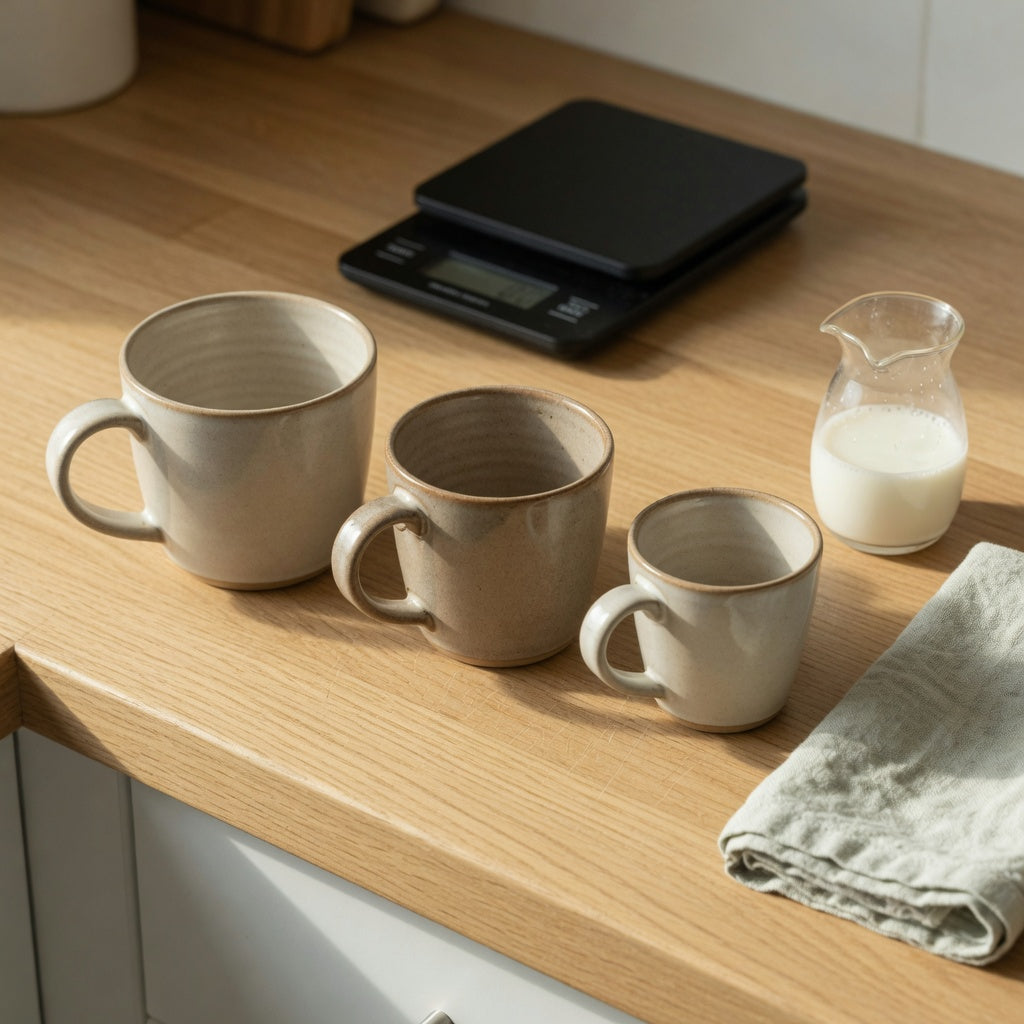
That mismatch is why this 15 oz ceramic coffee mugs comparison starts with our own figures rather than a definition. We list capacity in millilitres because that is what the molds are built to: The Flow holds 400 ml (~13.5 fl oz), Morning and Night holds 440 ml (~14.9 fl oz), and The Rock holds 480 ml (~16.2 fl oz). One of the three lands almost exactly on 15 oz. The other two sit on either side of it, and that spread turns out to be more useful than a single match.
Fifteen ounces is about 444 ml, and no rule fixes anything past that
One US fluid ounce is roughly 29.6 ml, so 15 fl oz converts to about 444 ml. That conversion is the only part of a "15 oz" label with a fixed definition behind it.
The FDA's ceramicware guidance describes cups and mugs as small hollowware used for hot drinks, with about 240 ml or 8 fl oz as its example size. That is an illustration of what the category looks like, not a standard anyone enforces. No regulator publishes a required capacity for a mug sold as 15 oz, and none publishes a fill line below the rim. Two mugs sold as 15 oz can differ by a hundred millilitres and both listings can be truthful, because one quotes volume to the lip and the other quotes what the seller considers a serving.
So the number on the page tells you the size class. It does not tell you how much coffee you get to drink. Only two figures do that: brim capacity, and the usable pour you can actually walk with.
A 15 oz ceramic coffee mugs comparison of our three current capacities
The capacities below are the stated figures on our current product listings, converted to fluid ounces. Empty weight and handle-opening measurements are not published on our pages, so treat those as things to confirm before you order rather than numbers you can assume.
| Mug | Stated capacity | Approx. fl oz | Reader it suits | Trade-off |
|---|---|---|---|---|
| The Flow | 400 ml | ~13.5 | Tea, small milk drinks, smaller hands, a lighter walk to the desk | Under 15 oz — a full brew plus milk crowds the rim |
| Morning and Night | 440 ml | ~14.9 | Closest to a literal 15 oz; everyday drip coffee, matched office sets | Less foam headroom than The Rock |
| The Rock | 480 ml | ~16.2 | Iced coffee, large pours, mugs that stay on the desk for hours | Overshoots 15 oz; more liquid weight to carry |
The Flow, 400 ml (~13.5 fl oz): a large mug without the loaded weight
If you have ever set a giant mug down half finished because lifting it stopped being pleasant, start here. At 400 ml it is still a large mug by most people's standards, but it is the smallest of the three and the easiest to move one-handed from a kitchen counter to a desk without thinking about it. Tea drinkers and short milk drinks suit it best. It is a poor fit for a full 12 oz brew plus a generous pour of half-and-half, and it is the wrong purchase if your routine is a tall iced coffee with room for a straw.
Morning and Night, 440 ml (~14.9 fl oz): the closest thing we sell to a literal 15 oz mug
440 ml is about 14.9 fl oz — roughly four millilitres short of a literal 15 oz. If the number you typed into the search bar is the number you want, this is the nearest match in our current line. In our store, we point office buyers toward it when a team wants one size across a floor, because it holds a normal single-serve brew with space for a splash of milk and does not look absurd on a meeting table. Where it gives ground is foam: a cappuccino drinker layering stiff milk foam will want the headroom in The Rock.
The Rock, 480 ml (~16.2 fl oz): for iced drinks and long desk sessions
480 ml converts to about 16.2 fl oz, so The Rock deliberately lands above 15 oz. That margin earns its keep with iced coffee, where cubes stack with air gaps and displace a serious share of the volume before the liquid goes in, and with anyone who treats a mug as a two-hour companion rather than a single serving. It is the wrong choice for a reader with wrist pain or small hands, and it is the wrong choice if you drink a small black coffee — a bigger pour simply takes longer to finish, so plan on a second trip to the kettle rather than a hot last sip.
How much of that 15 oz survives cream, foam, and ice?
These three shrink a mug at very different rates:
- Cream and milk. A generous pour of half-and-half takes a real bite out of usable capacity. Dairy is the most common reason a 15 oz mug feels small to its owner.
- Foam. Steamed milk foam is mostly air, but it still needs vertical room. A latte drinker loses more headroom in the same mug than a black-coffee drinker does.
- Ice. Cubes stack with gaps, so iced drinks consume capacity fastest of all. This is the one scenario where The Rock's 480 ml is the sensible pick over a mug marketed as 15 oz.
Our own habit when we pour from the store kettle: leave roughly a finger's width of headroom on a hot drink before carrying it anywhere. On a 440 ml mug that gets you close to a normal single-serve brew. If you fill to the brim and then add milk, no mug in the 15 oz class will feel generous — that is a pouring habit, not a product flaw.
Handle clearance and loaded weight: when a full 15 oz pour is too much mug
Capacity gets all the attention. The handle and the loaded weight decide whether a mug gets used twice a day or lives at the back of the cupboard.
- Three fingers should pass through the opening without your knuckles pressing into the body.
- The handle should sit high enough that your fingers clear the counter when you set the mug down.
- A wider base is steadier on a wobbling café table and hungrier for shelf depth at home.
A full 15 oz mug is a real lift at arm's length over a keyboard. If you have arthritis, small hands, or a wrist injury, a 400 ml mug with a roomy handle usually beats a larger one you have to lift with two hands. Liquid drives most of that weight, so sizing down is the simplest fix.
Honest limitation: our product pages do not publish empty weight or exact handle-opening dimensions. Measure the mug you already reach for — height, rim diameter, handle opening — and compare those against the listing before ordering. A ruler answers in a minute what a photo cannot.
Glaze, lead, and dishwasher reality: what to verify before you commit
"Ceramic" describes the body. "Microwave safe" describes the piece. Neither phrase is a statement about what is in the glaze, and with coffee and tea the distinction matters because both drinks are acidic and acid is what pulls metals out of a compromised finish.
The regulatory backdrop is worth knowing when you read a listing:
- FDA guidance for cups and mugs sets a lead guideline of 0.5 micrograms per mL of leaching solution on any one of six units tested, using methods that include ASTM C738 and AOAC 973.32/973.82.
- Cadmium guidance is 0.5 micrograms per mL for small hollowware — under 1.1 litres, which covers all three mugs here — and 0.25 for large hollowware.
- Ceramicware that shows extractable lead under that test should not be labelled "Lead Free," and the FDA has documented imported pottery carrying the label anyway.
- The California Department of Public Health notes that lead cannot be seen in a glaze, that microwaving speeds leaching, that repeated dishwasher cycles can damage a glaze and make later leaching more likely, and that plain white dishes rarely contain lead.
- Under 21 CFR 109.16, decorative ceramicware meant for display must carry a visible warning plus a permanent mark on the base, or a hole through the food-contact surface. If you see "Not for Food Use" on a mug, it is an ornament.
What we tell customers is boring but reliable: read the care block on the specific listing instead of trusting category language, and if leach testing matters to you, ask before you buy. We would rather answer that question than have you guess. Readers weighing body material against heat feel should also read our ceramic versus porcelain capacity guide, which covers how the same volume behaves in different clay bodies.
Gifting, office kitchens, and the 11 oz versus 15 oz call
- A named gift: 440 ml reads as a deliberate upgrade. A 15 oz mug for one person feels chosen; the same mug in a stack of fifty feels like leftover swag.
- A bulk giveaway or promo order: 11 oz stays the safe default — smaller to ship, cheaper to produce, and nobody resents a modest mug they did not pick.
- A shared office kitchen: buy one size for everyone and buy multiples. Mixed sizes create quiet resentment about who got the big one.
- Tea drinkers: 400 ml, because a smaller pour gets finished while it is still hot.
- Latte and cappuccino: the larger end, so foam has somewhere to sit.
- Iced coffee: 480 ml at minimum, since ice takes volume before the coffee does.
If you would rather scan everything at once, the unique coffee mugs collection puts the current lineup in one grid. For the unit math in more depth, our guide to how many ounces are in a mug of coffee walks through the conversions buyers ask about most.
The five-line checklist we run before recommending a mug
- Exact capacity — in ml or fl oz, and whether it is brim or usable.
- Height and rim diameter — against your brewer spout, cabinet shelf, and car holder.
- Handle opening — three fingers without pinching.
- Glaze and decoration — metallic trim usually rules out the microwave.
- Care marks and any published leach testing — read the care block, not the marketing headline.
Run those five lines against any mug in this 15 oz ceramic coffee mugs comparison and the label stops being a guessing game.
Frequently asked questions
Is a 15 oz mug the same as 440 ml?
Close enough for practical purposes. Fifteen US fluid ounces converts to about 444 ml, so a 440 ml mug sits within a few millilitres of a literal 15 oz. That is why Morning and Night is the nearest match in our current lineup.
Will a 15 oz ceramic mug fit under my Keurig or drip brewer?
Height decides that, not capacity, and dispensers vary widely. We do not publish exact heights here, so compare the mug height on the product page against the clearance under your machine's spout before ordering. A wide 480 ml mug can also foul a narrow drip tray even when the height clears.
Is 15 oz too big for one cup of coffee?
It depends on the brew. Fifteen ounces is close to two standard 8 oz cups, so it suits a large single-serve pour or a drink with milk added. If you usually drink a small black coffee, a 400 ml mug will feel better balanced in the hand and you will finish it before it cools.
Are 15 oz ceramic coffee mugs lead free?
That is a question for the specific listing, not the category. FDA guidance does not allow a "Lead Free" label on ceramicware that shows extractable lead under its test method, and imported pottery has been found carrying the label regardless. If it matters to you, ask the seller for finished-mug test results and check the care instructions for microwave guidance.
Which mug wins this 15 oz ceramic coffee mugs comparison for a daily drip coffee?
Start with Morning and Night at 440 ml (~14.9 fl oz), the closest thing we make to a true 15 oz mug. If you take milk and want extra headroom, step up to The Rock at 480 ml (~16.2 fl oz). If a lighter carry matters more than volume, choose The Flow at 400 ml (~13.5 fl oz). All three sit in our unique coffee mugs collection if you would rather compare them side by side.
More from our blog
Read more
Wide Based Coffee Mugs Comparison: Ball Handle, Flow, or Rock?
Our three current wide based mugs hold 250 ml, 400 ml and 480 ml, and that gap decides more about daily use than base shape does. Here is which one fits a desk, a short pour, a long iced drink or a...
Read more
Pottery Tea Cups Comparison: 170 ml, 200 ml, or 250 ml?
A side-by-side pottery tea cups comparison of our three current ceramic cups — 170 ml retro, 200 ml pleated, and 250 ml ball handle — covering grip, capacity, the glaze questions worth asking, and ...
Read more
Leave a comment
This site is protected by hCaptcha and the hCaptcha Privacy Policy and Terms of Service apply.