
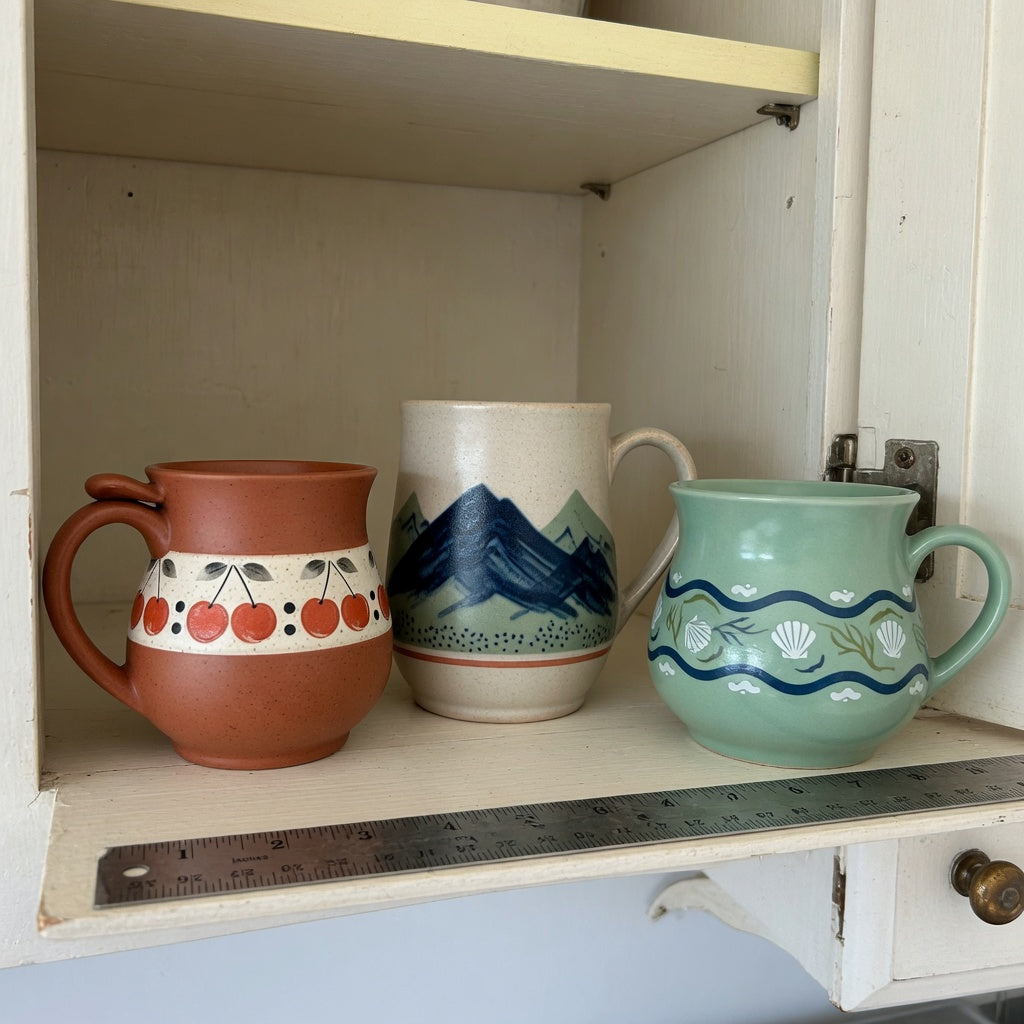
Vintage Pottery Coffee Mugs Storage Fit Guide: Shelf Needs
Reading time: about 8 minutes
A mug can clear the shelf opening and still keep the cabinet door from closing. The usual culprit is the handle extending beyond the body, or a rounded wall using more side room than the rim suggests. Our vintage pottery coffee mugs storage fit guide starts with that practical failure point and compares the current Retro, Mountain Sea, and Great Mountain forms without treating a product photo like a ruler.
In our store, we assess storage fit as three separate footprints: the base, the widest part of the body or rim, and the body plus handle. That approach is more useful than judging by capacity alone. Product-specific claim boundary: the comparisons below use product names, visible silhouettes, and any specifications presented on the linked listings. We do not infer an exact width, clay body, stacking rating, or dishwasher status from styling alone.
Using the vintage pottery coffee mugs storage fit guide: which measurements matter?
Capacity describes beverage volume. It does not tell you how much cabinet space a mug occupies. For storage fit, record these details whenever the product page provides them:
- Overall height: measure from the foot or base to the highest point of the rim.
- Widest body or rim: a curved body can extend beyond both its base and rim.
- Overall width including the handle: this is more useful than body diameter for a closed cabinet.
- Base footprint: compare the contact area with the usable shelf surface, especially if the shelf has a front lip.
- Usable cabinet space: measure behind the face frame, hinges, door hardware, and any raised shelf edge.
Handle projection is the distance from the side of the mug body to the handle's outermost edge. A body-width measurement does not settle that question. If a listing omits the full overall size, leave the fit unconfirmed instead of estimating from photography, which can distort scale through camera angle and cropping.
Which current CoffeifyMug shape fits your storage plan?
Use the three current pages as different shopping paths. Each visible form suits a particular display preference, but the final cabinet decision still depends on listed measurements and your own usable shelf space.
| Current product | Visible form | Reader situation and next step | Fit limit to verify |
|---|---|---|---|
| Retro Coffee Tea Cup | Rounded, retro cup silhouette | Start here if you want a traditional profile for an enclosed cabinet. | Confirm the widest body or rim, overall height, and full width including the handle. The familiar shape does not prove it is the smallest option. |
| Mountain Sea Coffee Tea Mug | Decorative mountain-and-sea presentation | Consider it for an open or glass-front shelf where the scenic design can face outward. | Check the depth in that display orientation, the base footprint, and the handle's outer edge. |
| Great Mountain Coffee Tea Mug | Mountain-focused decorative mug form | Review it for a display shelf or a mountain-themed gift with known storage space. | Measure independently rather than assuming it shares the Mountain Sea mug's footprint. |
A reliable storage recommendation follows measurements, not product names. Two mugs can share mountain imagery without sharing dimensions, and a retro label does not establish compactness. We would not name a smallest option unless the listings provide directly comparable overall measurements.
Open shelves, closed cabinets, mug trees, and office desks
General fit guidance: the same mug behaves differently across these storage setups.
- Closed cabinet: the entire body and handle must sit behind the door, with enough room to grip and lift the mug past the face frame.
- Open shelf: a handle may extend slightly beyond the shelf and still be supported, but it can catch a sleeve or dish towel if the shelf borders a walkway or sink.
- Mug tree: confirm the handle opening fits over the hook and that the mug can hang without contacting the stand or another cup. A visible handle loop is not proof of compatibility.
- Office desk: check the complete footprint with the coaster in place. Monitor stands, keyboards, charging cables, and the side used by your drinking hand all reduce practical room.
- Gift storage: a scenic mug can make a strong display piece at unboxing, yet it may be a poor match for a recipient who relies on tightly packed or stacked cabinets.
If none of these forms matches a fixed shelf, browse our unique coffee mugs collection for alternative silhouettes. That is the more practical path for a narrow cabinet, a crowded shared kitchenette, or any setup that depends on nesting rather than display.
How do you measure handle projection and cabinet access?
Measure the slot the mug will actually use, not the cabinet's outside dimensions. We use this sequence because it catches obstructions that a single depth number misses:
- Remove the neighboring mug, canister, or glass so you can measure the intended storage slot by itself.
- Measure usable depth from the frontmost obstruction, such as a face frame or shelf lip, to the back wall.
- Measure usable width in the orientation you plan to store the mug. A handle turned sideways changes the front-to-back footprint but requires room to rotate during removal.
- Measure vertical clearance and the lift path. A mug may fit while resting but still strike the shelf above when tilted over a raised edge.
- Copy the listing's stated overall dimensions for the selected item or variant. If all dimensions are available, make a simple cardboard envelope at that maximum size and test the cabinet door gently.
We do not add a universal clearance allowance because hand size, handle geometry, and shelf access differ. Leave enough room for your fingers and normal lifting motion, then confirm that allowance in your own kitchen rather than relying on an invented rule.
What do stacking, material, and care instructions change?
The phrase vintage pottery coffee mugs describes a shopping style, not a complete technical specification. It does not by itself prove that a mug is stoneware, porcelain, hand-thrown, stackable, microwave-safe, or dishwasher-safe. Treat the material and care information on each product listing as the authority.
- Stacking: if a page does not identify the mug as stackable, plan for single-level storage. A foot resting on a glazed rim can create concentrated contact, particularly if the pieces rock.
- Dishwasher loading: follow the listed care directions. Even where machine washing is permitted, check that the handle and rim do not sit tightly against rack tines or neighboring dishes.
- Drying space: measure drying-rack clearance separately from cabinet clearance. A shape that fits a bare shelf may compete with plates or bowls beside the sink.
- Contact points: the rim, base or foot, and outer handle are the areas most likely to meet another hard surface during storage and unloading.
These shapes are not a good choice for storage that requires secure nesting, confirmed stackability, or care properties that the listing does not state. A simpler straight-sided mug designed and documented for stacking would suit a busy office cabinet better.
Which product page should you open before checkout?
- For a traditional rounded appearance in an enclosed cabinet, review the Retro page first, then confirm the complete handle-inclusive footprint.
- For a scenic mug on an open or glass-front shelf, compare the Mountain Sea form with the depth and orientation of your display.
- For a mountain-focused gift or dedicated display space, check the Great Mountain page against the recipient's shelf dimensions.
- For a strict storage limit, prioritize the collection listings that provide enough dimensional information to resolve body, handle, height, and base fit.
Keep five notes beside you before buying: usable shelf width, depth, height, door clearance, and the mug's full handle-inclusive size. If one of those remains unknown, the fit remains unknown too.
Frequently asked questions
How should I use this vintage pottery coffee mugs storage fit guide before ordering?
Measure the cabinet's usable interior width, depth, and height, then compare those numbers with the product page's overall dimensions. Include the handle and the room needed to grip and lift the mug. Do not use capacity or listing photography as a substitute for physical dimensions.
Does mug capacity tell me if it will fit my kitchen cabinet?
No. Capacity describes liquid volume, while shelf fit depends on the rim, curved body, base, handle, and storage orientation. Two mugs with similar capacities can occupy different amounts of cabinet space.
Can I stack the Retro, Mountain Sea, and Great Mountain mugs?
Do not assume they are stackable from their photos. Unless the relevant product page explicitly confirms stackability, plan to store each mug on its own shelf level. This avoids balancing a base on a rim or placing weight on a glazed contact point.
Which CoffeifyMug option is best for a shallow shelf?
There is no reliable winner based on appearance alone. Compare the listed front-to-back depth in your intended orientation and the complete width including the handle. The Retro form may be your first visual candidate for a traditional cabinet, but it should not be called compact without measurements.
What should I do if the full handle width is not listed?
Treat cabinet fit as unconfirmed rather than estimating from the image. Measure your shelf first, then compare other shapes in the CoffeifyMug unique mug collection and choose a listing whose dimensions resolve the body, handle, height, and base checks before checkout.
More from our blog
Read more

Cacao Cup Storage Fit Guide: 250, 390, and 400 ml
Compare the confirmed capacities, listed dimensions, visible openings, and handle projection of three current cacao cup shapes. This guide also shows how to measure usable cabinet space without tre...
Read more
Rustic Ceramic Coffee Mugs Storage Fit Guide: Shelf Needs
Compare three current rustic ceramic mug shapes by handle projection, cabinet clearance, stacking limits, and care needs. This guide separates visible product details from general storage advice so...
Read more
Leave a comment
This site is protected by hCaptcha and the hCaptcha Privacy Policy and Terms of Service apply.