

Cacao Cup Storage Fit Guide: 250, 390, and 400 ml
Reading time: about 11 minutes
An upper-cabinet door can clear a cup's rim and still strike its handle. A shelf can also look deep enough until a hinge, raised front lip, or neighboring dinner plate takes away the last usable space. This cacao cup storage fit guide addresses those practical problems by separating confirmed product facts from the dimensions that still need checking.
We sell three relevant shapes in our store: a Ball Handle cup with a 250 ml listed capacity and 11.2 cm listed diameter, a Round cup with a 390 ml capacity, and a Spittoon cup with a 400 ml capacity. Capacity describes how much each cup holds. It does not establish total width, height, base diameter, or the amount of cabinet space the cup needs.
We treat all three as everyday drinkware for cacao, coffee, or tea. We do not present them as traditional, ritual, certified, or purpose-built cacao vessels. Our comparison is deliberately narrower: confirmed capacity, the one available diameter, visible opening and silhouette, handle projection, and the shelf conditions each form asks you to verify.
Cacao cup storage fit guide: which measurements decide cabinet fit?
The useful measurement is the cup's complete storage envelope, not just the diameter of its bowl. That envelope includes the widest point of the body, any handle extending to the side, the highest point, and the area where the base contacts the shelf. Product capacity cannot substitute for any of those measurements.
Before comparing the three cups, record these five variables at the exact storage position:
- Usable depth: Measure from the back wall or the nearest obstruction to the inside face of the closed door. Do not rely on the cabinet's advertised external depth.
- Usable width: Measure between dividers, stacks of dishes, shelf supports, or other objects that will remain in place.
- Vertical clearance: Measure from the shelf surface to the underside of the shelf above. Include any downward-projecting hardware.
- Door and hinge path: Check the space swept by the door and the area occupied by an inset hinge. A cup may fit on the board but still block closing.
- Shelf surface: Note a raised lip, wire grid, uneven board, or liner that could keep the cup's base from sitting fully supported.
Only the Ball Handle model has a listed diameter in the verified facts used here. The Round and Spittoon capacities are confirmed, but their external measurements are not. We keep that distinction visible because a confident guess is not a usable specification.
How much room does the Ball Handle 250 ml actually need?
The Ball Handle 250 ml cup has a listed diameter of 11.2 cm. The listing fact available for this comparison does not define the measurement endpoints, so we would not assume that 11.2 cm represents either the body alone or the complete side-to-side span with the handle. Use it as a published reference, then confirm the maximum exterior width if your cabinet has little spare room.
The visible ball-style handle introduces directional projection. Orientation therefore matters. Turning the handle toward the cabinet door, divider, or adjacent mug can require more room than rotating it toward open space. This is the kind of detail shoppers miss when they compare only the 250 ml capacity.
This model makes the most sense for someone who prefers the smallest listed serving of the three and has an open shelf, uncluttered counter, or cabinet position with free side space. The smaller capacity does not guarantee the smallest overall footprint, but the cup can be positioned around its projecting grip when the shelf is not tightly divided.
It is a poor match for a narrow cubby, rigid drawer organizer, or packed cabinet where every item must fit inside a fixed rectangular slot. It is also the first shape we would rule out when a door already passes close to the front of existing cups. In that situation, review the current product page or ask us for the latest maximum width before ordering.
Does the Round 390 ml suit a crowded shelf better?
The Round 390 ml cup holds 140 ml more than the Ball Handle model. Its visible form does not show the Ball Handle cup's projecting ball grip, which removes one obvious source of side interference. That can make the Round shape a more sensible candidate for a shelf where neighboring items sit close together.
Candidate is the key word. We do not have a verified diameter or height for the Round model in the source facts, so we cannot claim that it occupies less shelf area. A wider body or opening can consume horizontal room even without a handle. Separate product photos are also unreliable measuring tools because camera distance, cropping, and image scale can differ.
Choose the Round shape when your situation is a larger everyday serving, no desire for the ball-style side grip, and enough flexibility to confirm the cup's exterior measurements before purchase. It is not a good choice for a fitted drawer insert or a shelf with only a few millimeters of tolerance unless you first obtain the current width, height, and base measurements.
For open shelving, also consider how you will lift it. A cup that technically fits between two objects can still be awkward to pick up if there is no finger clearance around the opening. Leave practical handling space instead of planning for edge-to-edge contact.
Where does the Spittoon 400 ml fit most realistically?
The Spittoon 400 ml cup has the largest listed capacity here, but only by 10 ml over the Round model. In this context, Spittoon is the product name for its visible shape. We are comparing it as everyday cacao drinkware, not claiming that it has a traditional, ritual, or specialized function.
Its distinct opening and profile should prompt a full-width check. No verified diameter, height, or base measurement is available in the facts supplied for this comparison, so it would be misleading to assign it a minimum shelf depth or claim that it needs more base area than the Round model. The product image can show the form you are considering, but it cannot provide a dependable scale.
This is the relevant choice for a shopper who prefers the 400 ml capacity and the visible Spittoon silhouette, and who has a generous open shelf or cabinet position that can be measured against current product dimensions. The extra 10 ml alone is not a strong storage reason to choose it over the Round 390 ml.
We would not recommend this shape solely because a 400 ml cup sounds similar in size to another large mug you own. Different openings, feet, and wall profiles can produce different external dimensions at the same capacity. If your only available space is a shallow wall shelf, a narrow office cupboard, or a fixed organizer, confirm every exterior measurement first or choose a style with a complete dimension set.
What do capacity and visible opening reveal about shelf space?
Capacity helps you compare serving volume. Visible form helps you identify likely clearance questions. Neither one, by itself, proves that a cup will fit. This table separates what is confirmed from what remains to be checked.
| Current shape | Confirmed capacity | Verified dimension available here | Visible storage variable | Confirm before buying |
|---|---|---|---|---|
| Ball Handle | 250 ml | 11.2 cm listed diameter | Ball-style handle projects in one direction | What the diameter includes, total width, height, and base size |
| Round | 390 ml | No external dimension in the verified facts | Rounded open form without the ball-style grip | Maximum width, height, opening, and base size |
| Spittoon | 400 ml | No external dimension in the verified facts | Distinct visible opening and profile | Maximum width, height, opening, and base size |
The 390 ml and 400 ml capacities are close, but that 10 ml difference says almost nothing about cabinet fit. The Ball Handle is 140 ml smaller than the Round and 150 ml smaller than the Spittoon, yet its projecting grip can still be the deciding constraint. That is why our cacao cup storage fit guide treats volume and exterior clearance as separate buying decisions.
Stacking is another unknown. We have no verified nesting or stackability claim for these shapes, so do not plan a two-level arrangement based on photos alone. Until compatibility is confirmed, a single layer is the more practical storage plan and reduces rim-to-base contact that could lead to scratching or chipping.
How should you test doors, hinges, and drying space?
A quick cabinet check is more reliable when it copies the way you actually store and retrieve drinkware. We use this sequence when helping shoppers think through tight spaces:
- Clear the intended position but leave permanent shelf supports, liners, and nearby dishes in place.
- Measure usable depth to the inside of the closed door, then mark the area occupied by hinges or latches.
- Measure the narrowest usable width, including any divider or neighboring item that cannot move.
- Measure vertical clearance and account for the hand movement needed to lift the cup over a shelf lip.
- Compare those numbers with current maximum exterior product measurements, including the handle. Do not compare them with capacity alone.
- Plan where the cup will dry after washing. A dish rack can have different height, tine spacing, and handle clearance from the cabinet.
Care claims need the same restraint as dimension claims. The verified facts supplied for this article do not establish a material, dishwasher rating, microwave rating, or specific cleaning method, so check the current product instructions before use. After washing by the stated method, allow the cup and any recessed handle area to drain and dry fully before placing it in a closed cabinet. Trapped moisture and crowded drying racks are avoidable storage problems, regardless of the cup shape.
Do not force a cup between rack tines or rest a projecting handle against another piece. Repeated hard contact at a rim, foot, or handle creates a more credible damage risk than ordinary empty shelf space. A soft shelf liner may reduce sliding, but it also consumes a small amount of vertical clearance and can hide an uneven surface.
Which shape fits a kitchen, office, or gift situation?
Start with the constraint that cannot change. Then connect that situation to a product rather than assuming one cup is universally easiest to store.
- Open kitchen shelf and a smaller serving: The Ball Handle 250 ml is the relevant next step because it has the lowest capacity and its grip can face open space. Confirm what the listed 11.2 cm diameter includes before placing it near a wall or divider.
- Closed cabinet where side projection is the main concern: Review the Round 390 ml because its visible form avoids the Ball Handle model's projecting ball grip. Confirm total width and door clearance; the missing handle does not prove a smaller footprint.
- Roomy shelf and preference for the 400 ml shape: Consider the Spittoon 400 ml after checking its current exterior dimensions. Its advantage over the Round is the particular visible form and a 10 ml capacity increase, not a verified storage benefit.
- Narrow office cubby or fitted drawer organizer: None of the three is a responsible recommendation without maximum width, height, and base measurements. A different cup with fully listed dimensions may suit the space better.
- Several cups on one short shelf: Do not assume these forms nest. Plan a single layer or browse the unique coffee mug collection for another style whose current measurements and storage form better match the available area.
- Gift for someone with a full cabinet: Ask for the recipient's shelf width, depth, and height before choosing. The Ball Handle suits a smaller serving with side room, while the Round or Spittoon is a more logical starting point if a projecting grip would be inconvenient.
Gift unboxings often happen away from the recipient's kitchen, so visual appeal can overshadow storage reality. A cup that needs permanent counter space may not be welcome in a compact home. Measuring first makes the gift more useful and keeps the decision tied to the recipient's actual routine.
Frequently asked questions
How do I use a cacao cup storage fit guide before ordering?
Measure the usable shelf depth, width, and height at the exact storage position, including the closed door and hinge area. Then compare those numbers with the cup's maximum exterior measurements rather than its capacity. Confirm handle projection and base size separately if the shelf is tight.
Is 11.2 cm the total width of the Ball Handle 250 ml cup?
The verified listing fact is an 11.2 cm diameter, but the available information does not define whether that measurement includes the handle or only part of the cup. Do not treat it as guaranteed total width. Check the current product details or ask us to confirm the maximum side-to-side span.
Will the Round 390 ml and Spittoon 400 ml need the same shelf space?
Not necessarily. Their capacities differ by only 10 ml, but cups with similar volume can have different openings, heights, bases, and maximum widths. No verified exterior measurements for those two models are available in the source facts used here, so measure against current product dimensions before choosing.
Can these cacao cups be stacked in a cabinet?
We do not have a verified nesting or stackability claim for these shapes. Do not build a storage plan around stacking unless the current product information explicitly confirms it. A single layer avoids an unstable arrangement and unnecessary contact with rims and handles.
Which cacao cup is best for a narrow office cupboard?
The answer depends on the cupboard's usable measurements. The Round and Spittoon forms avoid the Ball Handle model's visible projecting ball grip, but that does not prove either one is narrow enough. If the cupboard has fixed dividers or a close door swing, obtain complete exterior dimensions before buying.
Your next step: Write down usable depth, width, height, door clearance, and whether you require stacking. Compare those five constraints with the current product details, then use our unique coffee mug collection to choose the shape that fits the shelf as well as the serving size.
More from our blog
Read more
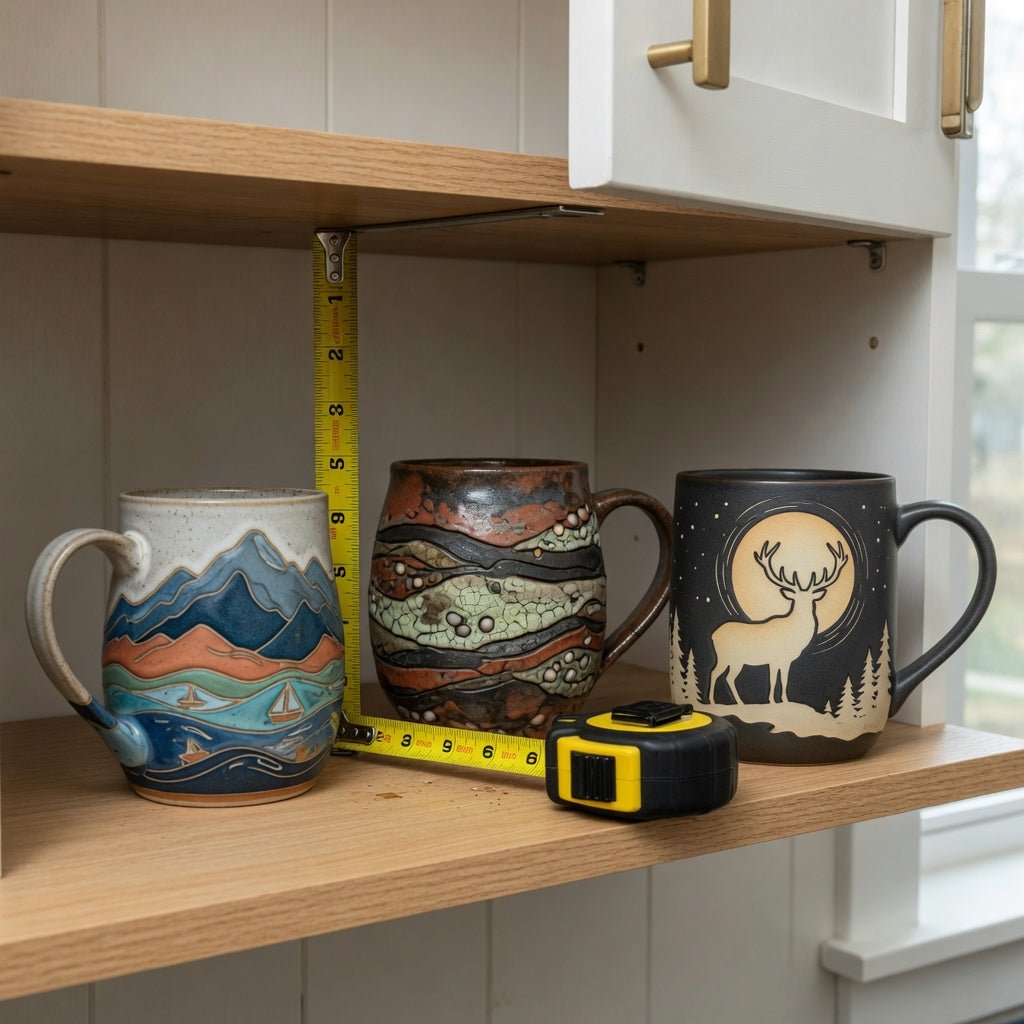
Coffee Mug Gift Ideas for Him Storage Fit Guide: Shelf Check
Compare Mountain Sea, The Rock, and Elk and Moon by visible profile, handle clearance, cabinet depth, and shelf height. Learn what to measure, where product photos can mislead, and which gift situa...
Read more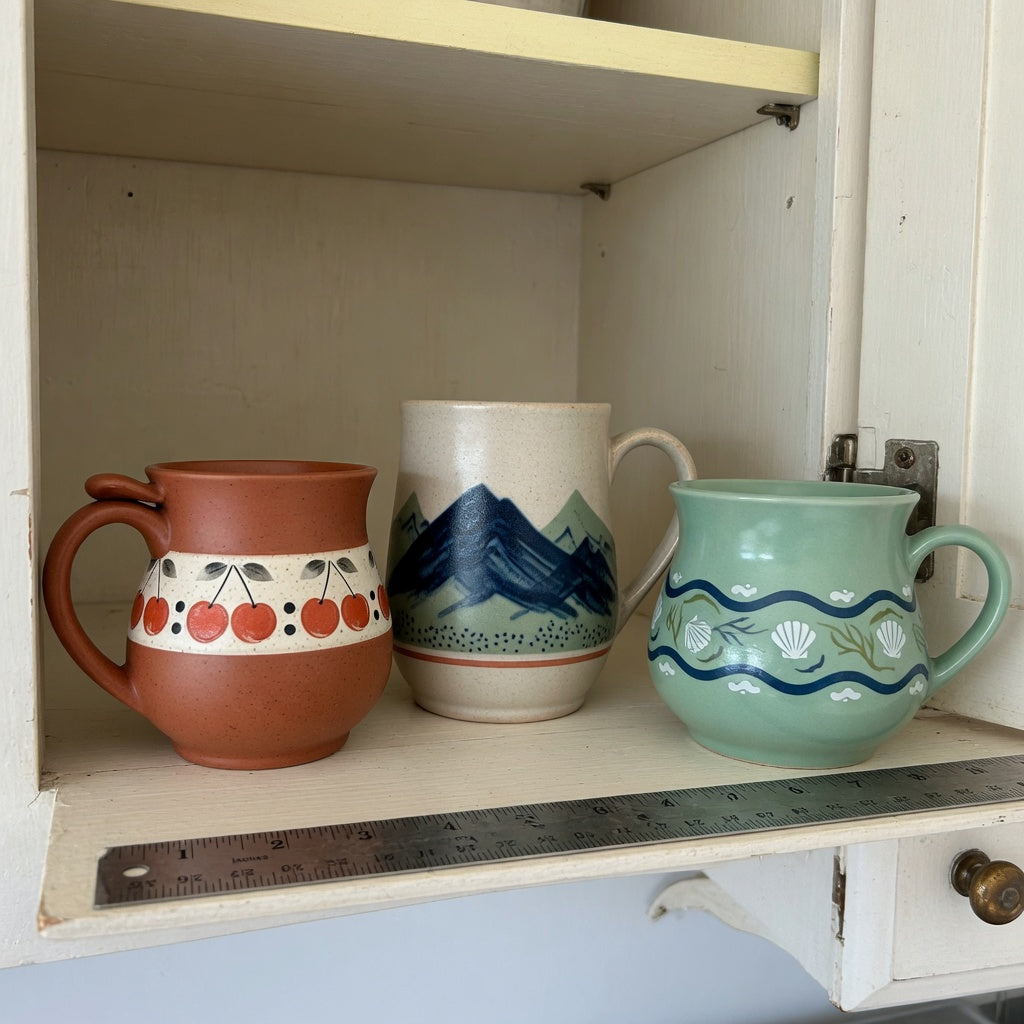
Vintage Pottery Coffee Mugs Storage Fit Guide: Shelf Needs
Compare the visible Retro, Mountain Sea, and Great Mountain mug forms using cabinet depth, overall handle width, shelf height, and display needs. We separate listing facts from general measuring ad...
Read more
Leave a comment
This site is protected by hCaptcha and the hCaptcha Privacy Policy and Terms of Service apply.