
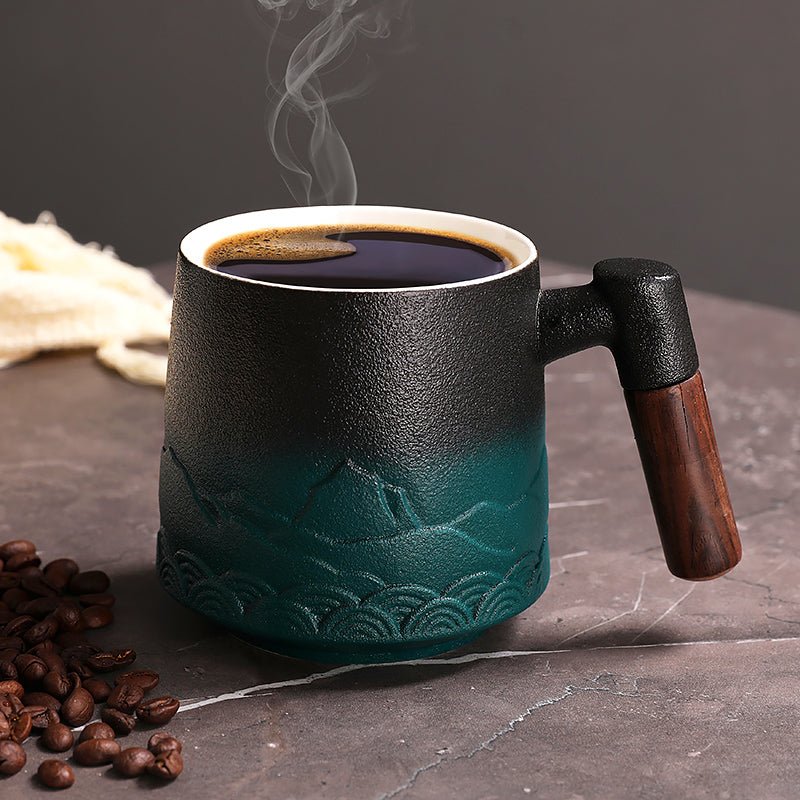
Vintage Pottery Coffee Mugs Compact Kitchen Practical Purchase Checklist
Reading time: about 9 minutes
A mug can pass through a cabinet opening and still keep the door from closing once its handle faces forward. Our vintage pottery coffee mugs compact kitchen practical purchase checklist begins with that overlooked outside width, then moves to shelf lift-out room, coffee-machine clearance, care, and specifications that remain unknown. In our store, compact-kitchen problems are usually physical: a rim catches the shelf above, a handle strikes the neighboring cup, or the mug occupies the only dry counter space beside the sink.
Keep two shopping labels within their limits. Vintage can describe an aesthetic; it does not prove antique age or documented provenance. Pottery is also a broad retail term. A product page must identify the exact material if you need to know whether a mug is earthenware, stoneware, porcelain, or another ceramic body. The same rule applies to dimensions, capacity, included pieces, and appliance care.
Will the mug clear the cabinet door, shelf, and coffee machine?
Measure the space the mug will actually occupy, not the cabinet's exterior or the full distance between its walls. Hinges, shelf supports, a door lip, and nearby dishes all reduce usable room. We also recommend checking the path used to lift the mug out; a mug that technically fits can still be frustrating if its rim must be tilted around the shelf above.
- Usable shelf height: Measure from the shelf surface to the underside of the shelf above, then account for the upward movement needed to remove the mug.
- Closed-door depth: Measure from the cabinet back to the line reached by the inside of the closed door. A forward-facing handle must remain behind that line.
- Maximum outside width: Use the distance from the far side of the body to the outer edge of the handle. Body diameter alone does not establish cabinet fit.
- Base footprint: Check the foot ring or contact area as well as the widest part of the body. This affects shelf density, counter stability, and placement on a drying rack.
- Use-position clearance: Measure beneath the coffee-machine outlet, across the drip tray, and beside any kettle, grinder, or dish rack that shares the counter.
Compare these spaces only with measurements stated on the current product page. If a listing gives capacity but omits maximum outside width, it has not answered the handle-clearance question. Photographs are useful for understanding shape, but perspective and camera angle make them unreliable measuring tools.
How should you use the vintage pottery coffee mugs compact kitchen practical purchase checklist?
The vintage pottery coffee mugs compact kitchen practical purchase checklist works best as a rejection tool. Eliminate physical and care mismatches first, then compare glaze, motif, and overall style among the mugs that remain.
- Choose one storage location. Decide whether the mug will live in a closed cabinet, on an open shelf, or permanently on the counter.
- Record usable measurements. Note shelf height, closed-door depth, available width, and machine clearance in the units used by the listing.
- Define the drink requirement. Consider milk, foam, ice, or a tea infuser instead of relying only on a nominal capacity figure.
- Set the care requirement. Decide whether hand washing is acceptable and whether microwave or dishwasher use is essential.
- Read the live page. Write down only the stated material, dimensions, capacity, included pieces, and care instructions.
- Mark omissions as unknown. Do not infer stackability, appliance compatibility, or comfortable fill level from a similar-looking mug.
- Test the footprint. If the maximum dimensions are provided, make a paper template and place it on the shelf, drip tray, counter, and drying rack.
Which listed design belongs on your shortlist?
The product names below provide useful style directions, but they are only the beginning of the decision. Each recommendation connects a specific visual preference to the live page where fit and care details must be checked.
| Reader situation | Why it fits the shortlist | Relevant next step |
|---|---|---|
| You want the clearest retro-style starting point for coffee or tea. | The product name explicitly uses the words retro, coffee, and tea. It is the most direct style match of these three candidates. | Open the Retro Coffee Tea Cup details and compare every listed dimension with your cabinet notes. |
| You prefer a design direction that combines mountain and sea imagery. | The name identifies that particular theme, helping you narrow the visual choice before reviewing specifications. | Inspect the Mountain Sea Coffee Tea Mug for its current images, measurements, material, and care information. |
| You want a mountain-led design rather than a combined landscape theme. | The Great Mountain name makes this the more direct mountain-focused candidate. | Review the Great Mountain product page and verify the details that affect your storage and drink routine. |
| You have not settled on a motif, handle shape, or body profile. | A collection view lets you compare several silhouettes instead of forcing one decorative option into an unsuitable space. | Compare shapes in our unique coffee mug collection and remove any option that lacks a required specification. |
Product claim boundary: These names support the style and use words that appear in them. They do not, by themselves, establish antique age, handmade production, a specific ceramic body, stackability, dishwasher or microwave compatibility, or any measurement not shown on the live product page.
Which pottery, glaze, and care details need a live-page check?
The checks in this section are general category guidance, not claims about the linked mugs. Start with the material field. Earthenware, stoneware, and porcelain are distinct ceramic body types, and a rustic surface or heavy-looking form does not reliably identify one from a photograph.
- Capacity: Check whether the listing explains how volume is measured. Brim capacity and a practical drinking level are not necessarily the same.
- Dimensions: Look for overall height, body diameter or width, maximum width including the handle, and base dimensions. Do not substitute one for another.
- Care: Follow explicit dishwasher, microwave, and hand-washing instructions. A ceramic appearance alone does not establish appliance compatibility.
- Stacking and included pieces: Confirm these only when the listing states them. A tapered body is not proof that two mugs will nest securely.
- Product images: Inspect the interior, drinking rim, handle connections, and foot ring, not just the decorated front.
When we handle glazed mugs, we pay particular attention to the rim, both handle joints, and the base. At unboxing, look for rim chips, glaze pinholes on the drinking surface, fine lines around the handle attachments, and rocking when the mug is placed on a flat counter. Check the foot ring as well; an exposed or rough ceramic foot may need a coaster on a delicate counter or shelf.
Fine surface lines need context. Some listings may describe an intentional crackle-style finish, while similar-looking lines can also raise a condition question. Compare the received mug with the product description and images instead of automatically treating every variation as damage. Unless the maker provides different care guidance, avoiding abrupt changes from very cold to very hot conditions is a sensible precaution for ceramic drinkware.
Does the mug earn its footprint for coffee, tea, gifts, or office use?
A decorative mug can be a sound choice as one frequently used favorite and a poor choice as one member of a tightly packed set. The right compromise depends on where it will be stored and how often it must move through the sink, dishwasher, microwave, or drying rack.
- One daily coffee mug: A more distinctive silhouette may justify extra shelf width if it clears the door and works with your cleaning routine.
- Several mugs in one cabinet: Documented outside dimensions and confirmed stackability matter more. A straighter, simpler style may store more efficiently.
- Iced coffee or milk drinks: Verify usable capacity and opening size. A nominal volume does not tell you how much room remains for ice, foam, or stirring.
- Loose-leaf tea: Check that the opening works with your infuser and that the mug can still be stored with any accessories you keep beside it.
- Shared office kitchen: Missing dishwasher or microwave guidance can become a daily burden. A mug with explicit care instructions may be the more practical option.
- Gift giving: Inspect the rim, handle joints, glaze, and base before wrapping, and keep the original packaging until the condition and included pieces have been checked.
Which missing detail should stop the purchase?
An unknown specification is manageable only when it does not affect a non-negotiable requirement. Stop and choose another candidate in these situations:
- Your cabinet has little spare room, but the maximum width including the handle is not listed.
- You must stack every cup, but the product page does not confirm stackability.
- You rely on a dishwasher or microwave, but the relevant care statement is absent.
- You are buying an antique rather than a vintage-style design, but age and provenance are not documented.
- You need a specific serving volume, but the listed capacity or measurement method is unclear.
A decorative pottery-style mug is not a good fit for a cupboard that works only with verified nesting. In that situation, a straight-sided mug with documented dimensions and stackability would be the better style, even if it has less visual detail.
Frequently asked questions
What should I measure before buying a vintage-style pottery mug?
The vintage pottery coffee mugs compact kitchen practical purchase checklist starts with usable shelf height, closed-door depth, available width, and the mug's use-position clearance. Include the outer edge of the handle, the base footprint, and the lift-out path beneath the shelf above. Also measure the coffee-machine tray and drying rack if the mug must fit there.
Does a retro or vintage product name mean the mug is an antique?
No. Retro and vintage can describe a design aesthetic without documenting age. Treat a mug as an antique only when its product page explicitly provides age or provenance information.
Can I assume a pottery coffee mug is microwave and dishwasher safe?
No. Ceramic body type, glaze appearance, and wall thickness do not confirm appliance compatibility. Use only the care instructions on the current listing, and consider missing guidance a blocker if microwave or dishwasher use is essential.
Which CoffeifyMug design should I compare first?
Start with the Retro Coffee Tea Cup if the retro cue is your priority, the Mountain Sea Coffee Tea Mug for a combined landscape theme, or the Great Mountain Coffee Tea Mug for a mountain-focused direction. That is a style shortlist, not a fit verdict. The live dimensions, material, capacity, and care details still decide whether the mug works in your kitchen.
What should I do if a shelf-critical measurement is missing?
Do not estimate the dimension from product photography. Remove that candidate from your compact-space shortlist and compare another mug shape with clearer fit details before ordering.
More from our blog
Read more
Loose Leaf Tea Mug Weekend Coffee Practical Purchase Checklist
Compare CoffeifyMug's 250 ml Ball Handle, 390 ml Round, and 400 ml Spittoon mugs for a slower weekend coffee-and-tea routine. This checklist covers capacity, visible openings, infuser fit questions...
Read more
Cute Ceramic Coffee Mugs Compact Kitchen Practical Purchase Checklist
Use cabinet, shelf, handle, base, capacity, and care checks to find a ceramic mug that earns its space. We compare three CoffeifyMug styles without guessing at unlisted specifications.
Read more
Leave a comment
This site is protected by hCaptcha and the hCaptcha Privacy Policy and Terms of Service apply.