
Unique Pottery Coffee Mugs Compact Kitchen Practical Purchase Checklist
Reading time: about 11 minutes
A mug can look compact in a product photo and still block a cabinet door, crowd the kettle, or take the last dry spot beside the sink. A 22-inch-deep counter may offer little usable landing space after appliances are in place, while an 11-inch shelf and 14-inch open-door clearance create two different fit tests. This unique pottery coffee mugs compact kitchen practical purchase checklist turns those pinch points into a pass-or-pause decision before you buy.
In our experience helping shoppers compare distinctive mugs, the body is rarely the only problem. Handle projection, the width of a flared rim, the room needed to lift a mug out, and the care routine can matter more than capacity. In our store, we treat the current product page as the source of truth: if a dimension, material, or care instruction is not listed, we call it an unknown rather than filling the gap with an assumption.
Claim boundary: The storage, shape, and care guidance below applies to pottery and ceramic drinkware generally. The linked CoffeifyMug product pages are the authority for each mug's current dimensions, capacity, material, included pieces, and care instructions.
How to use this unique pottery coffee mugs compact kitchen practical purchase checklist
Open the mug page and your cabinet at the same time. Run these checks in order so an attractive glaze does not distract from a poor physical fit.
- Choose its parking place. Decide whether the mug will live inside an upper cabinet, on an open shelf, on the counter, or in a drawer. Measure that exact location rather than an empty area you rarely use.
- Measure access as well as storage. Record shelf height and depth, then open the door fully and check the path your hand and the mug must travel.
- Copy only the facts listed on the product page. Look for total height, widest width, base diameter, capacity, material, and care. A photo cannot replace a missing specification.
- Rehearse cleanup. Check the sink, dishwasher rack if relevant, and drying area. Compact-kitchen clutter often begins after the drink is finished.
- Choose the design role. Decide whether you need one display mug, a daily pair, or a set that must line up or stack. The same decorative shape will not suit all three jobs.
Keep our unique coffee mugs collection open as a comparison tab. Remove any candidate that fails a must-have measurement or leaves a required care detail unresolved. Compare color and motif only after the practical checks pass.
Which counter, shelf, and cabinet measurements decide the fit?
Nominal cabinet dimensions are less useful than the space left after shelf lips, hinges, neighboring cups, and appliances are accounted for. Measure the usable area where the mug will actually sit.
- Vertical clearance: Measure from the shelf surface to the lowest obstruction with the cabinet door open. The mug also needs room to be lifted rather than scraping through an exact-height opening.
- Usable shelf depth: Measure from the back panel to the inner edge of the shelf lip. Check whether the mug must sit with its handle facing forward or sideways.
- Lateral width: Compare the mug's widest listed measurement, including its handle, with the space remaining beside other drinkware.
- Working counter area: Mark the landing spot beside your kettle, coffee maker, or French press. Total counter depth is not the same as clear space.
On an 11-inch shelf, a mug might fit front to back in one orientation but not another. With 14 inches of open-door clearance, the listed mug height still needs enough lift room for your hand. A 22-inch-deep counter does not provide 22 inches of mug space once a kettle, toaster, utensil jar, and backsplash gap occupy it.
Capacity is not a shortcut for these measurements. Two mugs can hold a similar drink volume while having different bases, rims, and handle projections. We avoid universal compact-mug cutoffs because your usable cabinet opening is the measurement that matters.
How do the base, rim, and handle affect compact storage?
A pottery mug's silhouette determines how efficiently it uses a shelf. These are general category variables to inspect in the listed measurements and product images, not claims about every mug on our site.
| Mug variable | Compact-kitchen effect | Trade-off to consider |
|---|---|---|
| Base and foot ring | The contact area determines how much shelf space the mug occupies and how it sits on the surface. | A broader base uses more room. A smaller contact area deserves a closer stability check. |
| Handle projection | The handle may be the widest point and can prevent mugs from sitting side by side. | A close-fitting handle can save space but may feel cramped for larger hands. |
| Rim profile | A flared or sculpted rim can extend beyond the body and catch neighboring pieces. | The distinctive silhouette adds visual interest but reduces storage efficiency. |
| Body profile | Straight-sided forms are generally easier to arrange in a row than irregular forms. | Irregularity can create the handmade look a shopper wants, but it may limit tidy alignment. |
| Stacking geometry | Stable stacking depends on compatible bases, rims, and weight distribution. | Do not assume a unique pottery mug stacks simply because two product photos look similar. |
Pottery is also a broad shopping term rather than a precise material specification. Stoneware, earthenware, and porcelain are distinct material labels, and glaze appearance alone does not identify the clay body or establish care compatibility. Use the exact material wording on the current product page.
If you need four identical mugs stacked two-high in a shallow cabinet, an irregular statement mug may not be the best category. A more uniform, straight-sided ceramic set with explicitly listed stackability and care details would be a safer purchase. Unique pottery makes more sense when one or two pieces can earn dedicated shelf space.
Which CoffeifyMug design should you compare first?
We use style as a filter only after a shopper writes down the nonnegotiable fit and care requirements. The three pages below offer different visual starting points, but none should be treated as a size ranking without checking its current listed specifications.
| Reader situation | Start with | Why it is the sensible first comparison |
|---|---|---|
| Your kitchen already has several colors, and you want visual structure rather than another scenic motif. | Rhombus Coffee Tea Mug | The repeating rhombus pattern shown on the page gives you a geometry-led focal point. Verify the listed height, widest width, handle clearance, capacity, and care before calling it compact. |
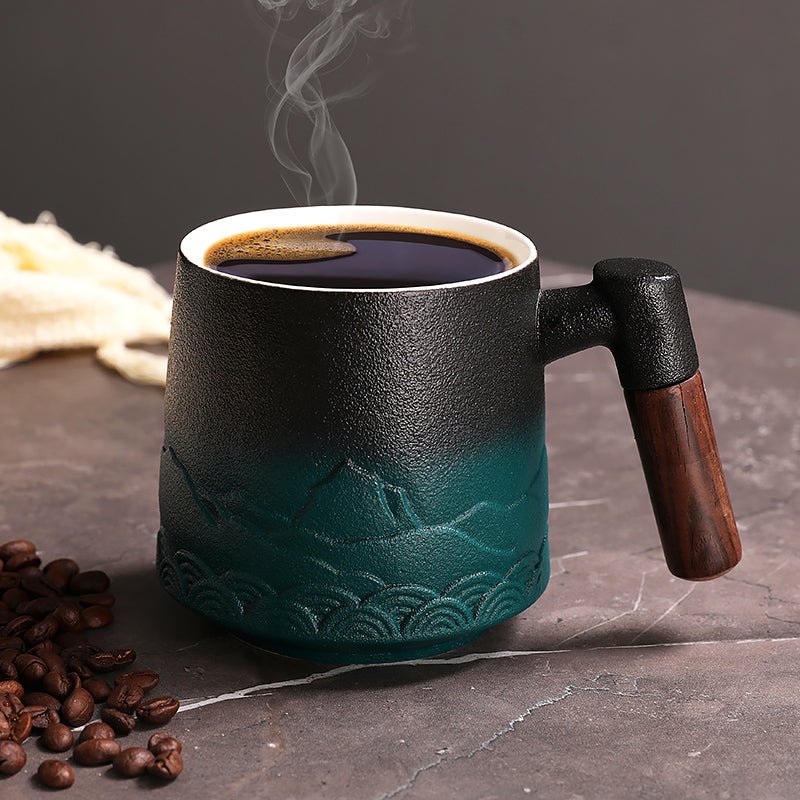
| One mug will sit on an open shelf, and you prefer a landscape-led accent. | Mountain Sea Coffee Tea Mug | The mountain-and-sea imagery and blue-green tones shown in the product photos suit a scenic display role. Confirm its physical fit and care requirements because the palette does not answer either question. |
| Only one mug can remain visible, so it needs to carry the decorative weight of the space. | Golden Waves Kio Coffee Tea Mug | The golden-wave and koi motif shown in the imagery makes this the statement-first candidate. Verify total width and storage orientation, and do not assume it is designed to stack. |
These are style-to-situation recommendations, not claims that one mug is shorter, lighter, or easier to clean than another. If you are buying a gift for someone with a compact kitchen, prioritize the page with enough listed information to check fit and care. A surprising design is useful; a surprise hand-washing routine or storage problem is not.
What must the product page confirm about material and care?
A mug can pass the shelf test and still fail the daily routine. A piece that requires hand washing occupies sink and drying space, while a dishwasher-compatible piece may reduce that friction if the product page explicitly allows machine washing. We do not assign either care label to the linked mugs without a stated instruction.
- Exact material: Read the listed material rather than identifying it from color, shine, or texture.
- Dimensions and capacity: Confirm that the page gives enough information to assess both storage footprint and drink size.
- Dishwasher guidance: Do not translate glazed or ceramic into dishwasher-safe unless the page says so.
- Microwave guidance: Check for a direct statement if reheating is part of your routine. Decorative finishes do not prove microwave compatibility.
- Included pieces and variation: Verify whether pictured lids, spoons, or other accessories are included and whether the page describes natural finish variation.
As general pottery care, separate from any product-specific instruction, use a nonabrasive cleaning tool, avoid hard knocks at the rim, and avoid abrupt temperature changes such as moving a very cold mug directly to very hot liquid. Follow the product page whenever its directions differ, then dry the mug fully before returning it to a crowded cabinet.
Inspect the drinking rim, handle joints, glazed interior, and foot ring for chips, hairline cracks, new crazing, or rough wear. Crazing is the network of fine lines that can appear in a glaze. These are known inspection points for ceramic drinkware, not claims that the linked CoffeifyMug products arrive with or will develop defects.
If dishwasher use and microwave reheating are nonnegotiable but a page does not explicitly confirm both, choose a different mug. A distinctive finish is not worth a care routine that consumes the last free section of a one-sink kitchen.
Will the mug work at the kettle, desk, and dish rack?
Create a paper footprint from the product page's listed overall dimensions, if available, and place it where the mug will normally sit. If only capacity is stated, you cannot complete this test reliably; pause rather than estimating from the photo.
- Kettle test: Put the template beside the kettle in its normal position. Check that you can pour without moving another appliance or setting the hot mug at the counter edge.
- Cabinet test: Open the door and rehearse the lift path with a similarly sized mug. Shelf fit is not useful if the rim or handle catches during removal.
- Dish-rack test: Check where the mug will drain and whether a broad handle would occupy the neighboring slot. Drying space is part of compact-kitchen fit.
- Office-desk test: If the mug travels from the kitchen to a keyboard, weigh handle comfort and carrying convenience against decorative shape. A shelf-efficient handle may not provide your preferred grip.
- Coffee, tea, and ice test: Use the listed capacity and rim opening to judge your normal serving. Iced coffee and tea infusers can require more usable opening than a plain hot drink.
In our experience, a mug that fits the shelf but repeatedly displaces the kettle, blocks the dish rack, or feels awkward at the desk is not compact in the practical sense. The full routine has to work.
A pass-or-pause check before you add one mug or a small set
Use the unique pottery coffee mugs compact kitchen practical purchase checklist once for every product page, not once for the whole collection. Mark each item as passed, failed, or unknown.
- The mug has a specific storage location.
- You measured the location's usable height, depth, and width.
- The page lists enough dimensions to compare against that space.
- The widest measurement accounts for the handle or sculpted details.
- The listed capacity suits your usual coffee or tea serving.
- The exact material is identified on the page.
- Dishwasher and microwave guidance match your routine, if required.
- Stackability is confirmed rather than assumed, if you need it.
- The mug can move from cabinet to counter to drying area without creating clutter.
- The design earns the shelf space it consumes.
A candidate is ready to buy only when every must-have item passes. Pause if a critical size or care detail remains unknown. Choose a more uniform mug style if you need a tightly stacked, identical, low-maintenance set; choose unique pottery when one or two expressive pieces can have dedicated space. Your next step is to reopen the CoffeifyMug unique coffee mugs collection and keep only the product tabs that match both your measurements and your routine.
Frequently asked questions
How do I use the unique pottery coffee mugs compact kitchen practical purchase checklist?
Measure the mug's intended parking place, including the open-door lift path, and compare those numbers with the current product page. Then confirm capacity, material, care, and stacking needs. Treat every missing must-have detail as unresolved rather than estimating from an image.
Can I judge compact-kitchen fit from mug capacity alone?
No. Capacity describes drink volume, not total height, base size, rim width, or handle projection. Two mugs with similar capacities can use shelf space very differently.
Can unique pottery coffee mugs be stacked in a shallow cabinet?
Only if their bases and rims are designed to sit together securely and the product information supports stacking. Decorative profiles and natural variation can make a stack unstable. If stacking is essential, a uniform straight-sided set may suit your cabinet better.
Are the Rhombus, Mountain Sea, and Golden Waves Kio mugs dishwasher safe?
Use the care statement on each current product page; a glazed appearance does not establish dishwasher safety. If a page does not explicitly confirm machine washing, treat it as unknown and choose according to the care routine you can realistically maintain.
What should I do if a product page leaves a fit or care detail unanswered?
Treat the detail as unresolved, not as a yes. Return to the unique coffee mugs collection, compare another page, and choose only after the listed facts match your measurements and routine; if none does, a more uniform mug style is the better purchase.
More from our blog
Read more
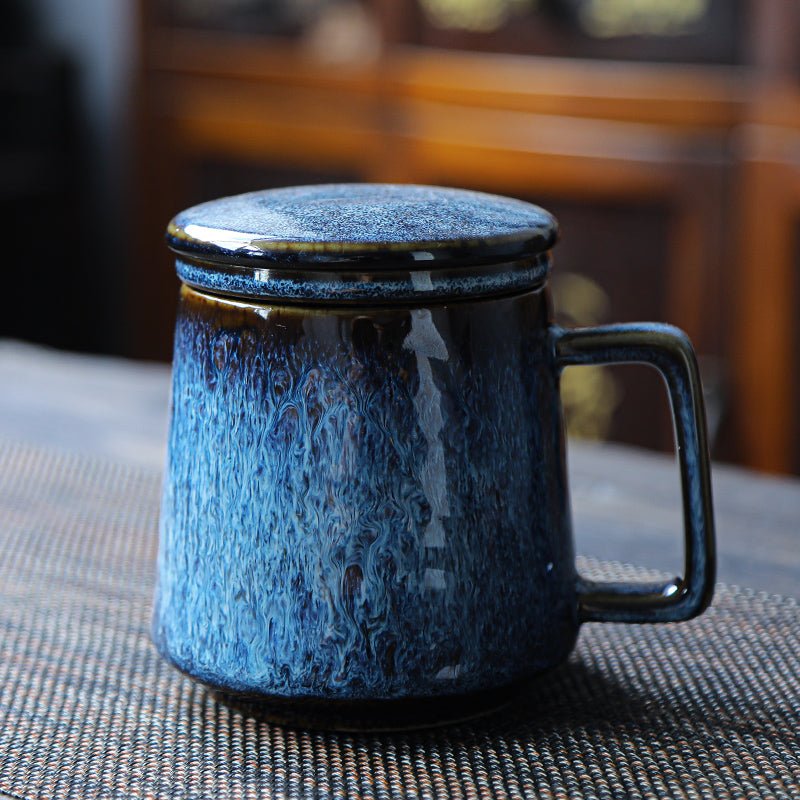
Wassail Mug Compact Kitchen Practical Purchase Checklist: 3 Capacities
Compare The Flow 400 ml, Morning and Night 440 ml, and The Rock 480 ml without assuming capacity equals physical size. Use cabinet, counter, and handle-clearance checks to make a decision from veri...
Read more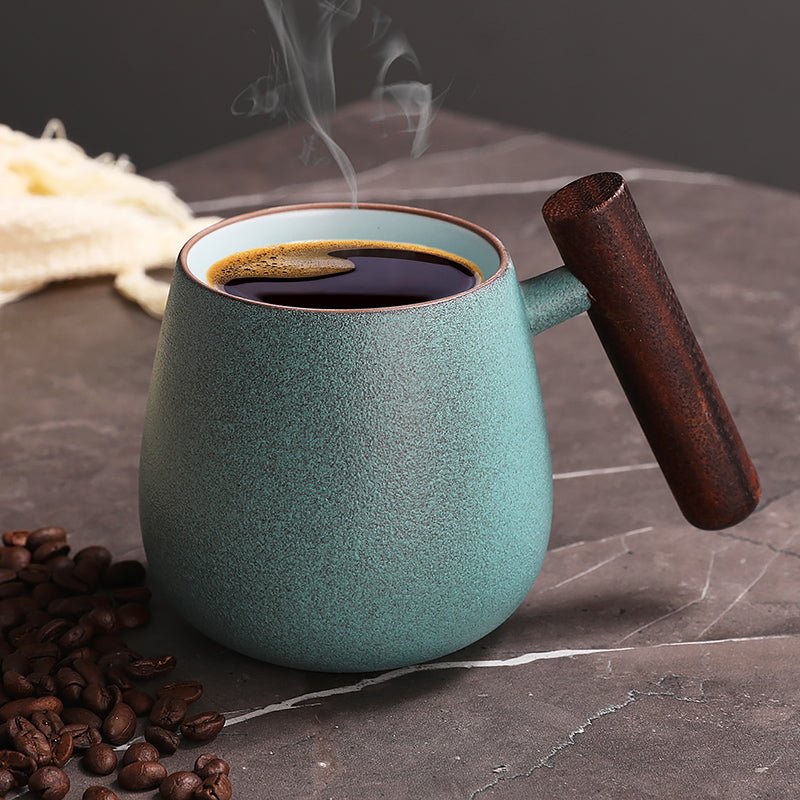
Green Ceramic Coffee Mugs Compact Kitchen Practical Purchase Checklist
Measure shelf clearance, door swing, handle projection, foot-ring space, and care requirements before buying. We compare Emerald, Green Waves, and Round without guessing at unlisted specifications.
Read more
Leave a comment
This site is protected by hCaptcha and the hCaptcha Privacy Policy and Terms of Service apply.