
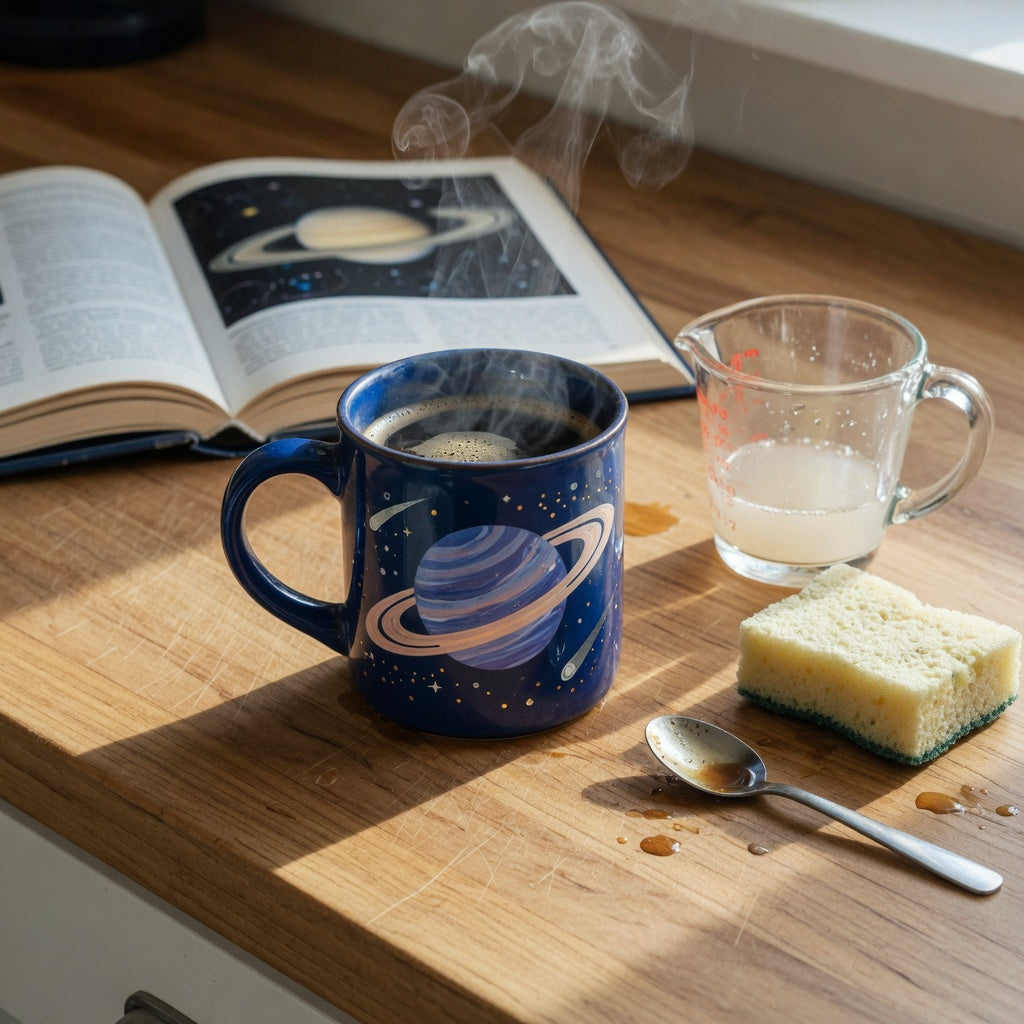
Unique Planet Ceramic Mug: Compare Design, Size, and Care
Reading time: about 9 minutes
A planet mug can win the gift photo and still lose the 7 a.m. coffee test. In our experience with novelty drinkware, the mismatch is usually practical: the cup is smaller than the buyer's normal pour, the handle crowds the knuckles, or the finish needs hand washing in a dishwasher-only home. A unique planet ceramic mug has to work as both a ceramic vessel and a decorated object. The body, finish, size, and routine matter more than how dramatic the artwork looks online.
In our store, we start with use before artwork. If the planet theme is non-negotiable, open our planet coffee and tea mug and check the current page for listed material, capacity, care instructions, and included pieces. We do not transfer specifications from one cosmic mug to another; the product page for the item you are buying is the source that counts.
Which unique planet ceramic mug construction fits your routine?
Planet artwork can be built into a fired surface, printed onto smooth ceramic, revealed by heat, or formed as raised texture. These methods may look similar in a thumbnail, but they do not wear or clean the same way.
| Construction | Best fit | Main trade-off |
|---|---|---|
| Fired glaze or hand-finished pottery | Daily hot drinks when the listed care matches your routine | Color movement, speckling, and shape may vary from the photos |
| Surface-printed ceramic | Buyers who want repeatable, easy-to-read artwork | Wear resistance depends on how the print was applied and how it is washed |
| Heat-changing finish | A hot-coffee or tea reveal during gift unboxing | The thermochromic exterior adds little for cold drinks and may have stricter care limits |
| 3D relief or planet ring | A tactile desk piece or display mug | Grooves take more effort to clean, while protruding details are exposed to knocks |
The useful distinction is where the decoration sits. A fired glaze is not exposed in the same way as a surface coating. A thermochromic effect belongs to the outer finish, not to the ceramic body itself. Raised craters cannot peel, but their high points can chip if they hit a faucet, dishwasher rack, or neighboring mug.
If you need two pieces to match closely, choose a listing that explicitly describes a set or a repeatable printed design. If easy cleaning, handle shape, or a simpler finish matters more than the planet motif, compare the broader collection of unique coffee mugs instead of forcing a decorative style into the wrong routine.
Is the mug clearly intended for food and drink?
A mug-shaped object can still be ornamental ceramicware. Before judging the rings, craters, or nebula colors, we check how the listing describes the interior and intended use.
- The product is presented as drinkware for coffee, tea, or another beverage.
- Any food-contact statement applies to the ceramic and glaze, not only the packaging.
- There is no Not for Food Use warning.
- Microwave and dishwasher claims account for the decoration as well as the ceramic body.
The FDA ceramicware guidance sets an action level of 0.5 micrograms per milliliter of leaching solution for extractable lead from ceramic cups and mugs, with test methods including ASTM C738. FDA guidance also states that ornamental ceramicware which looks suitable for food use must carry a warning such as Not for Food Use if it may leach lead. That is regulatory context, not proof that an individual mug has been tested.
A decorative piece is not made suitable for coffee simply because it has a handle. If beverage use is unclear, ask the seller or choose clearly described drinkware.
For the item in our store, rely on the current product listing rather than assumptions based on another planet mug. Missing safety or care information should be clarified before the first pour.
Dishwasher, microwave, or hand wash: which limit matters?
There is no universal care rule for planet mugs. A ceramic body may be durable while its print, metallic luster, or heat-changing layer requires gentler treatment. In our experience, that difference is the detail most likely to be missed before checkout.
- Read the instructions before the first wash. Save the care information instead of relying on memory after the box is discarded.
- Avoid abrupt temperature changes. Let a hot mug cool before running cold water over it.
- Use mild dish soap and a soft sponge. Abrasive pads can scratch prints and dull specialty finishes.
- Clean relief with a soft nylon brush. A flat sponge may skip coffee residue inside cratered grooves.
- Dry the foot ring. If the base includes unglazed ceramic, dry it before returning the mug to a wood desk or shelf.
- Do not nest textured mugs. Raised rings and crater edges can strike the inner wall of the mug below.
Dishwasher-safe and microwave-safe are separate claims. Use a dishwasher only if the current listing permits it. If decoration looks metallic and the listing is silent, do not microwave the mug until the seller confirms compatibility. A heat-changing exterior responding to a hot pour does not automatically mean it can withstand a microwave cycle.
A specialty planet mug is a poor daily choice for a household that machine-washes every cup without checking labels. It is also a weak match for a crowded office sink where abrasive scrub pads and tightly packed dishwasher racks are the norm. A simpler glazed mug may serve that buyer better.
Capacity, handle clearance, and rim shape at 7 a.m.
Listing photos make mugs look larger than they pour. Planet designs are sold across different formats, so compare the stated capacity with your actual drink instead of guessing from height.
- Fill your current favorite mug to the level you normally drink, then pour that water into a measuring cup.
- Compare the result with the listed capacity while leaving headspace. If you normally pour 14 fluid ounces and a mug holds 12 fluid ounces only when filled to the brim, it is not a practical replacement.
- Check the handle's inner opening. A decorative planet ring or wide body can reduce knuckle clearance even when the handle looks large.
- Measure cabinet height and base footprint, especially if a saucer or protruding relief is included.
- Study the rim close-up. Sculpted or uneven rims change sip feel and should not have sharp glaze points.
When our team handles a ceramic mug, we set it on a flat counter, grip it with the number of fingers we would normally use, check where the thumb rests, and bring the rim to the lip. We also look at both handle joints for hairline cracks. Product photos flatten these contact points, so ask for dimensions if handle clearance is a must-have.
An open ceramic planet mug is not a leakproof commuting cup, and raised relief is not ideal for a tightly stacked cabinet. A color-changing design also offers little visual payoff to an iced-coffee drinker because the reveal depends on warmth.
Which planet mug fits a desk, kitchen, or gift box?
The right construction depends on the recipient's routine, not just an interest in space.
- Hot-drink astronomy fan: A heat-changing design can suit someone who enjoys the reveal and accepts its listed care requirements.
- Home-decor collector: Hand-finished glaze fits a buyer who values individual variation more than an exact photo match.
- Teacher or office user: Favor a smooth, easy-to-clean surface and explicit dishwasher or microwave guidance if those appliances are part of the workday.
- Couple wanting a matched pair: Choose a repeatable print or a listing that specifically describes a coordinated set.
- Commuter or young child needing a drop-resistant cup: Breakable, open ceramic is the wrong tool. A lidded, shatter-resistant option makes more sense.
Novelty artwork can also be stylized. We do not assume every solar-system print uses accurate scale, spacing, or planetary order. If the mug is intended as a teaching aid, inspect the artwork rather than treating it as a classroom model.
For someone who specifically asked for a cosmic coffee or tea cup, compare the current planet mug product page with their normal pour and cleaning habits. If a large handle, straightforward care, or another novelty style outranks the planet theme, scan our unique coffee mug selection for a better routine-to-product match.
What should you inspect before the first pour?
When we receive or handle ceramic drinkware, the artwork comes after four contact points: rim, interior, handle joints, and foot ring. A quick inspection separates harmless variation from a functional defect.
- Use side lighting to check the body and raised details for chips or cracks.
- Carefully trace the drinking rim for sharp spots or exposed ceramic.
- Inspect both places where the handle joins the body for hairline cracks or gaps.
- Set the mug on a flat counter and check for rocking or an unstable base.
- Look inside for cracks, sharp glaze flaws, or exposed clay in the drink-contact area.
- Check surface coatings for bubbles, lifting edges, or scratches before washing.
- Wash according to the listing instructions and dry the foot ring before use.
Hand-finished pottery may show glaze movement, uneven color, speckling, or slight shape differences. Those visual variations are not the same as a sharp rim, cracked handle, unstable base, or damaged coating. Photograph a functional issue and contact the seller before adding hot liquid.
Frequently asked questions
Is a unique planet ceramic mug dishwasher safe?
Not automatically. The ceramic body may tolerate machine washing while a printed or thermochromic finish may require hand washing, and raised relief can knock against the rack. Use the dishwasher only if the current listing explicitly permits it.
Can I microwave a color-changing planet mug?
Only if the product listing says it is microwave safe. A heat-sensitive finish reacting to hot coffee does not prove microwave compatibility, and metallic decoration needs separate confirmation. If the listing is unclear, reheat the drink in a plain microwave-safe cup.
Will the planet design peel or fade?
Fired glaze does not peel like a surface film, although ceramic can still chip. Printed and heat-changing coatings are more exposed to abrasive pads, long soaking, and dishwasher wear. Follow the care directions for the specific finish rather than treating every ceramic mug the same.
Will a handmade planet mug match the product photo exactly?
Do not expect an exact duplicate if the listing describes the mug as handmade or hand-finished. Glaze flow, speckling, ring thickness, and shape can vary. Buyers who need a closely matched pair should choose a repeatable print or an explicitly coordinated set.
Is a planet ceramic mug a good astronomy gift?
It fits an astronomy fan who already uses open ceramic drinkware and will follow the stated care. It is a weaker gift for a commuter, a dishwasher-only household, or a young child who needs a drop-resistant cup. For educational use, inspect the accuracy of the artwork before ordering.
Your next step: write down five non-negotiables—normal pour, dishwasher need, microwave need, handle space, and tolerance for visual variation. Check those points against the current planet coffee and tea mug listing; if one remains unclear or a simpler shape would serve you better, compare the unique coffee mugs collection before checkout.
More from our blog
Read more

What Size Coffee Mug Is Best For A Gift? 11 oz vs 15 oz
An 11–15 oz mug is the safest gift range: choose 11 oz for smaller pours, tighter storage, and easier handling; choose 15 oz for milk, foam, ice, or a longer drink. Compare brewer clearance, grip, ...
Read more
Home decor coffee mug for coffee lovers: Display or daily use?
Compare a decorative mug as both drinkware and visible kitchen decor. This guide covers glaze condition, usable capacity, handle fit, care labels, display hardware, and the trade-offs between handm...
Read more
Leave a comment
This site is protected by hCaptcha and the hCaptcha Privacy Policy and Terms of Service apply.