

Home decor coffee mug for coffee lovers: Display or daily use?
Reading time: about 11 minutes
A home decor coffee mug for coffee lovers can pass the shelf test and fail the first pour. At our packing table, the weak points are rarely the artwork: they are a handle that pinches, a foot ring that rocks on the counter, a rough drinking rim, or care directions that leave the buyer guessing. A useful decorative mug must feel comfortable at breakfast, clean without drama, and still look intentional when it sits empty beside the kettle.
In our store, we compare the drinking surfaces and care requirements before the motif. That keeps a display piece from becoming a dust collector and stops buyers from expecting an open-top kitchen mug to perform like a sealed travel cup.
What makes a home decor coffee mug for coffee lovers worth displaying?
The mug has to earn its space twice: once in your hand and again on the shelf. Start with the situation in which it will actually be used.
- One focal mug for an open shelf: If the current design shown on the Mountain Sea Coffee Tea Mug listing suits your room, use it as your starting point. Check the current material, capacity, dimensions, and care instructions before ordering; we do not infer those facts from a product name or styled photograph.
- Several mugs that need to coordinate: Compare the silhouettes, handle sizes, finishes, and color weight across our unique coffee mugs for open-shelf styling. A collection view is more useful than choosing each mug separately because you can see which designs will compete and which will sit comfortably together.
- Commuting or spill-prone use: A decorative open mug is the wrong category if you need a gasket, sealed lid, bag protection, or verified cup-holder fit. Do not choose a display piece and expect it to replace a travel mug.
Gift buyers should make the same distinction. A mug can look impressive during unboxing yet be a poor fit for someone who reheats every drink in a microwave, runs every cup through a heated dishwasher cycle, or has limited shelf space.
Glaze, rim, and foot ring: what can photos and labels reveal?
Ceramic is a broad description, not a complete specification. Stoneware, porcelain, and earthenware bodies can all be used for mugs, while glaze type, firing, decoration, and care instructions determine how a particular piece should be handled.
For regulatory context, the FDA guidance for pottery and ceramicware lists an action level of 0.5 µg/ml of leaching solution for lead in cups and mugs tested using the agency’s specified methods. That threshold does not certify an individual product, and compliance cannot be established from color or appearance alone.
These are the areas our team checks in listing images and again after unboxing:
- Interior surface: Look for a continuous, cleanable finish. If clay is intentionally exposed inside the vessel, ask the seller to confirm that the piece is intended for food contact.
- Drinking rim: Reject chips, sharp spots, flaking, or rough decoration where your lips make contact. The rim is also one of the first areas to suffer damage from contact with other dishes.
- Crazing: This is a fine network of lines in the glaze. It can be an intentional visual effect, but unexplained or newly developing crazing deserves clarification and may collect visible coffee staining.
- Pinholes and crawling: Pinholes look like tiny craters. Crawling leaves an exposed patch where glaze has pulled away. Either defect on the interior or rim is a reason to ask for a closer photograph or choose another piece.
- Handle joint: Inspect where the handle meets the mug body. A hairline crack, rough seam, or gap at that attachment point matters more than a harmless variation in exterior color.
- Foot ring: The base should sit flat. An unglazed foot can be normal, but a rough one may mark a painted shelf or wood table, so plan to use a coaster or shelf liner.
A visual inspection helps identify workmanship issues, but it cannot prove food-contact compliance. A generic surface swab is also not equivalent to the FDA’s specified leach test. If the seller or maker cannot clarify the intended use, treat the mug as display-only rather than experimenting with hot drinks.
Capacity, handle clearance, and rim shape: will it fit your brew?
Product photographs flatten scale. They also rarely show the difference between brim capacity and the amount you can carry without spilling. A mug filled to the rim may meet its stated volume while offering too little usable space for milk, foam, or a walk from the kitchen to the desk.
- Fill your current favorite mug to the level you normally drink from, then pour that amount into a measuring cup.
- Add the headroom you need for milk, foam, stirring, or carrying the mug upstairs.
- Measure the mug’s height if it must fit under a pod machine, espresso spout, cabinet shelf, or low coffee-bar cubby.
- Compare the handle opening at its narrowest point. A delicate loop may look elegant but still pinch your knuckles once the mug is full.
Rim and body shape create trade-offs too. A wide opening gives you room for latte foam and makes the interior easier to clean, but the larger exposed surface allows the drink to cool faster. A narrower opening suits a slow sipper, while a thick rolled rim tends to resist small knocks better than a very fine edge. Heavy walls can feel substantial, yet the extra weight may be uncomfortable for one-handed drinking, grip limitations, or a lightly built mug tree.
Which finishes suit Japandi, cottagecore, farmhouse, or bold shelves?
Our easiest styling rule is to make displayed mugs share at least two of three qualities: palette, surface finish, and silhouette. That creates a relationship without forcing every piece to match.
- Japandi or Scandi: Choose a restrained palette, an uncomplicated profile, and a matte or satin-looking surface. Some matte glazes show gray teaspoon marks more readily, so confirm the recommended cleaning method.
- Cottagecore: Cream grounds, botanical details, speckling, and gentle handmade variation fit naturally. An irregular rim can add character, but it should still feel smooth where you drink.
- Farmhouse: Substantial forms, earthy colors, and visible texture suit wood shelves and simple coffee stations. Heavier pieces generally belong on a stable shelf rather than an unverified wall hook.
- Bold or dopamine decor: Use one saturated color or graphic as the focal point, then repeat one of its colors elsewhere. A row of unrelated slogans and high-contrast patterns can make a small coffee bar feel crowded.
- Scenic or nature-led decor: Give the image room to read instead of surrounding it with equally detailed pieces. If the current photographs of the Mountain Sea Coffee Tea Mug provide the visual anchor you want, pair it with quieter shapes or colors.
If you are not committed to one interior style, browse the unique coffee mug collection and compare designs against a photograph of your actual coffee bar. For a gift, also compare the recipient’s microwave and dishwasher habits; care compatibility matters more than matching wrapping paper.
Handmade pottery or factory-made ceramic: which trade-off fits?
Handmade is not a synonym for indestructible, and factory-made does not automatically mean bland. The useful distinction is variation versus repeatability.
| Buyer variable | Small-batch handmade pottery | Factory-made ceramic |
|---|---|---|
| Shape and glaze | Natural variation can make each mug feel collected and individual. | More repeatable color, profile, and handle placement within a product line. |
| Rim and handle feel | Inspect the individual piece because thickness and clearance may vary. | Usually more consistent, though every mug should still be checked for damage. |
| Building a set | Best if you enjoy related pieces rather than exact matches. | Better suited to buyers who want a uniform row or table setting. |
| Care information | May depend on the individual maker, clay body, glaze, and decoration. | Often standardized for the line, but the current product instructions still control. |
| Best use case | A single statement mug or a visibly collected coffee bar. | A repeatable set that can be replaced more easily while the line remains available. |
Neither method alone proves chip resistance or heat retention. Clay-body formulation, firing, wall thickness, rim geometry, handle attachment, and everyday impacts all matter. Handmade pottery is a weak choice if you need six exact replacements; a uniform factory set may be disappointing if your goal is a shelf that looks personal and collected.
Microwave, dishwasher, and thermal shock: what does daily care require?
Missing or conflicting care labels should pause the purchase. They should not start a kitchen experiment.
- Compare every source: Read the current product page, base stamp, packaging, and included care card. Ask the seller if they disagree rather than choosing the most convenient instruction.
- Keep unverified metallic finishes out of the microwave: Gold, silver, and metal-bearing luster decoration can spark or overheat. Use the microwave only when the maker explicitly permits it for that finish.
- Prevent dishwasher impacts: If the mug is dishwasher-approved, position it so its rim and handle cannot knock against plates, rack posts, or another mug during the cycle.
- Avoid abrupt temperature changes: Do not move a fridge-cold mug directly to boiling liquid or place a very hot mug on a cold, wet surface. Sudden temperature differences can stress ceramic bodies and existing flaws.
- Inspect high-contact areas: Check the rim, handle joint, and base periodically. Retire a mug from drinking use if the rim chips or the interior finish begins flaking.
Our store rule is simple: missing care information is not permission to test the limit. Verify it or use the piece as decor.
Floating shelf, mug tree, peg rail, or cubby: where should it live?
The safest display depends on the mug’s weight, handle opening, and center of gravity, not just the amount of free wall space.
| Display method | Best fit | Check before use |
|---|---|---|
| Floating shelf | Heavy, irregular, or frequently used mugs | Shelf depth, load rating, wall fixing, and clearance above each mug |
| Mug tree | Lighter mugs with generous handle openings | Arm spacing and balance; load opposite sides instead of one side first |
| Peg rail or hooks | Mugs with strong handle joints and enough hook clearance | Hook diameter, mounting method, and rated load for the complete setup |
| Cubby or plate-style rack | Designs that look best facing forward | Interior height, handle projection, and room to remove the mug without scraping it |
Open shelves near a cooktop collect grease as well as dust, so keep display mugs away from the main cooking zone and wipe them before use. If the collection is large, rotate a weekly group instead of crowding every mug onto one rail. The room looks calmer, and each handle has space to clear its neighbor.
Seven checks before adding a decorative mug to your cart
The right home decor coffee mug for coffee lovers should pass all seven checks without relying on assumptions:
- The current design works when the mug is empty, not only in a filled lifestyle photograph.
- The listed capacity leaves enough practical headroom for your normal drink.
- The mug’s height and handle projection fit its brewer, shelf, or cubby.
- The rim, interior finish, handle joint, and foot ring appear clean and intact.
- The seller clearly describes the mug as intended for beverage or food-contact use.
- The microwave and dishwasher instructions match the visible decoration.
- The planned shelf, hook, tree, or rail suits the mug’s weight and handle opening.
For one nature-led focal piece, review the current facts on the Mountain Sea Coffee Tea Mug product page. If you are still comparing motifs or shelf personalities, shortlist two options from our unique coffee mugs collection and run both through the same seven checks.
Frequently asked questions
Is a home decor coffee mug for coffee lovers suitable for everyday use?
Yes, if the current listing confirms beverage use, the handle fits your hand, and the care requirements match your routine. It is not a strong daily choice if the finish is unverified, the rim feels rough, the capacity is too small for your brew, or you actually need a sealed travel cup.
How can I verify that a decorative ceramic mug is food-safe?
Check the product page, base markings, packaging, and maker’s care information for a clear food-contact statement. Appearance alone cannot establish compliance, and a generic home surface test is not the same as laboratory leach testing. If the seller cannot confirm the intended use, reserve the mug for display.
Can I microwave a decorative mug with metallic or iridescent details?
Do not microwave it unless the maker explicitly identifies that exact finish as microwave-safe. Iridescent finishes vary, while gold, silver, and metal-bearing lusters may spark or overheat. Heat the drink in a plainly approved vessel if the instructions are missing.
Should I buy one statement mug or a matching set for my coffee bar?
Choose one statement mug if you want a shelf focal point and do not need exact replacements. Choose a set if repeatable capacity, profile, and care instructions matter more than individual variation. Open the unique coffee mugs collection, shortlist two designs, and verify their current dimensions, capacity, finish, and care notes before deciding.
More from our blog
Read more
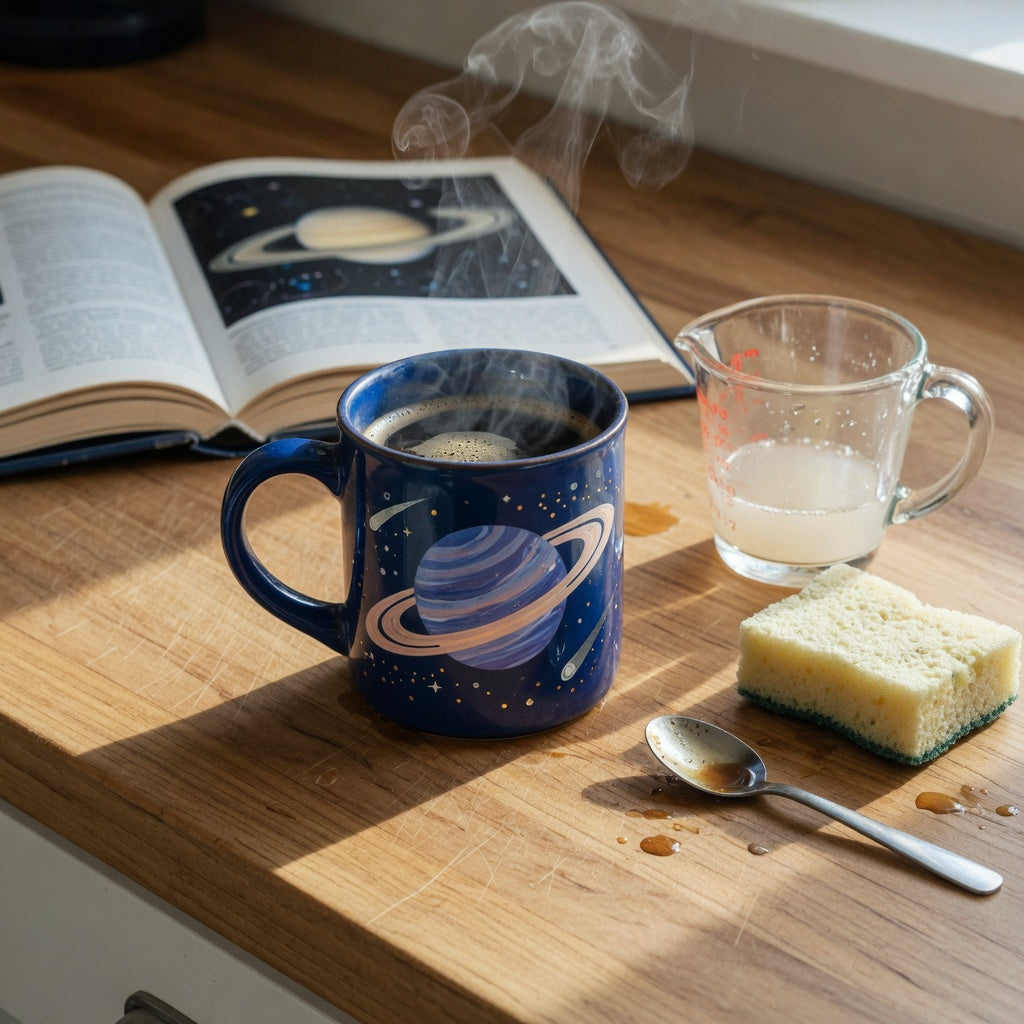
Unique Planet Ceramic Mug: Compare Design, Size, and Care
Planet designs may use fired glaze, raised relief, surface print, or a heat-changing coating, and each has different care limits. Compare food-use labeling, capacity, handle clearance, and gift fit...
Read more
Mountain Sea II Mug Gift vs Daily Use: Which Fits Better?
The Mountain Sea II pairs a 450 ml ceramic body with a wooden handle. See where it works as a gift or daily desk mug, what care it needs, and when an all-ceramic option is the smarter buy.
Read more
Leave a comment
This site is protected by hCaptcha and the hCaptcha Privacy Policy and Terms of Service apply.