
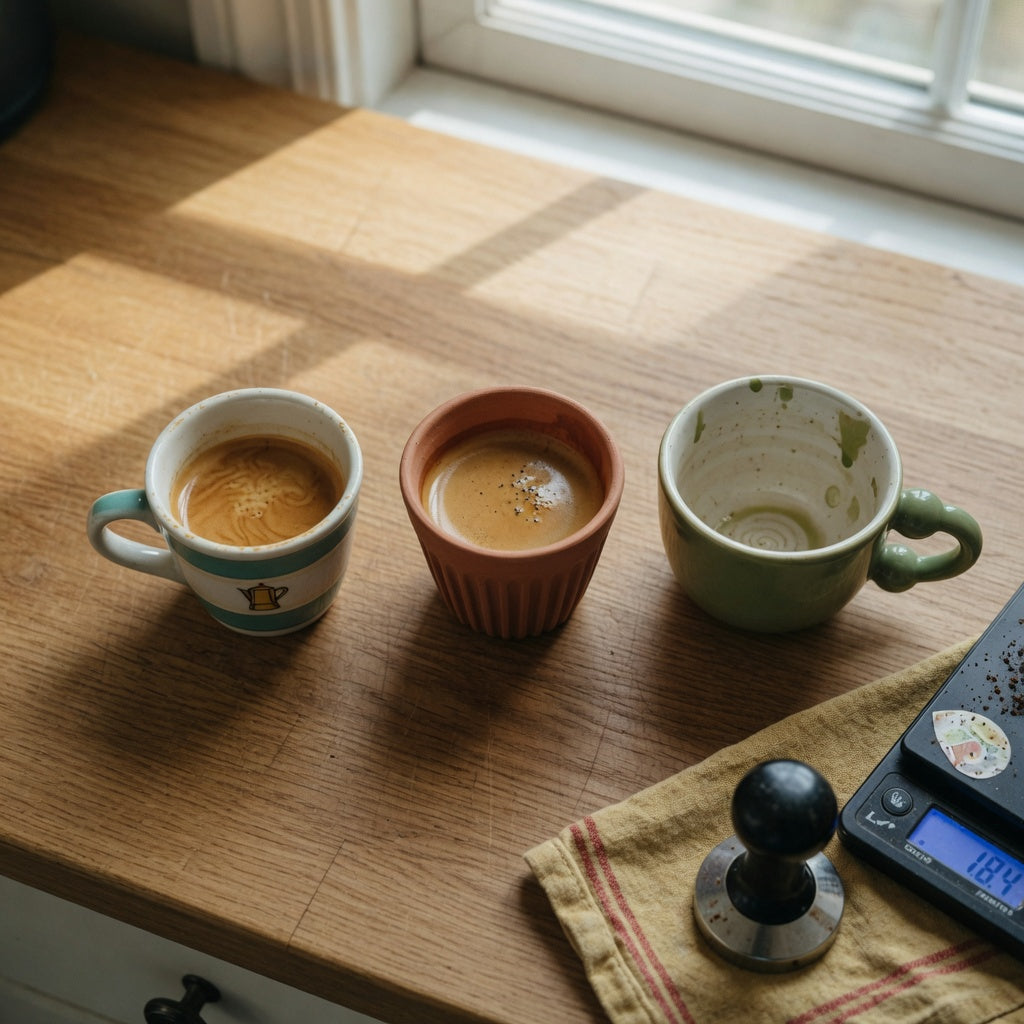
Unique Espresso Cups Replacement Purchase Product Shortlist Guide
Reading time: about 11 minutes
The chipped cup is still in the cupboard, and you keep sliding it to the back. Sometimes the complaint is different: a handle that only fits two fingers, a bowl so wide the double goes tepid before the second sip, or an interior glazed dark enough that you cannot see the blonding at the edge of the crema until the shot is already in your mouth. Replacement shopping almost never starts with wanting something prettier. It starts with one specific failure — and the fastest way to buy badly is to forget that failure and shop by pattern instead.
This unique espresso cups replacement purchase product shortlist guide runs the other direction. Name the flaw, then keep only the two or three current cups that fix it. We sell these cups and answer the messages that arrive after delivery, so the scenarios below are the ones we actually see. All three are compact ceramic vessels listed at 170 ml, 200 ml and 250 ml, and each entry ends with the situation where we would tell you to skip it.
Why the cup you are replacing is a better filter than any buying guide
Every replacement is a small audit. In our experience, five complaints cover almost all of them, and each one narrows the field immediately:
| What went wrong with the old cup | What it usually points to | What to check on the replacement |
|---|---|---|
| The shot goes cold in two minutes | Bowl too wide, wall too thin, or the cup was never preheated | Smaller capacity, more ceramic mass, a hot-water rinse habit |
| The rim chipped early | Thin rim plus stacking plus dishwasher heat | Rim thickness and the care line on the exact listing |
| You cannot judge the crema | A dark, metallic or heavily patterned interior | Interior colour — a light interior shows extraction |
| The handle pinches or takes two fingers | Narrow loop, or a thick wall behind the handle | Handle opening and where the cup balances when full |
| It will not sit under the group head, or it wobbles | Tall body or a wide foot | Outer height and base diameter against your drip tray |
Write the single worst thing about the old cup on a sticky note. That sentence is your shortlist. Everything that does not address it is decoration — and with unique cups you are already paying for decoration, so it had better not get in the way of the coffee.
What does 'unique' actually change about a 25 ml shot?
Three things, and only one of them is purely visual.
- Interior colour decides how you read a shot. A dark or heavily reactive interior looks striking on open shelving and hides the pale edge where a shot has run long. If you like watching crema settle, keep the interior light or clear and treat a dark glaze as a display piece.
- Rim shape changes the first sip. A thin rim delivers coffee quickly; a rolled, thicker rim spreads it across the tongue. Irregular hand-thrown rims feel wonderful in the hand and inconsistent on the lip, because the contact point shifts as you turn the cup.
- Wall mass changes heat. A heavy ceramic wall pulls heat out of a 30 ml shot until the walls have warmed through. That is a habit problem rather than a defect — a hot-water rinse before you pull the shot solves most of it, which is why busy cafés keep stacks of cups sitting on the machine.
What unique should never change is the working geometry. A cup small enough that a double fills a decent share of it still behaves like an espresso cup; a wide decorative bowl with a handle behaves like a soup dish with ambitions.
Capacity versus shot volume: why 170, 200 and 250 ml all count as espresso cups
Shot volume and cup capacity are different numbers, and mixing them up is the most common checkout error we see. A certified Italian espresso is about 25 ml. Older specialty definitions put a single at 25–35 ml. The cup is deliberately bigger than the drink because it has to hold crema and headspace — general buying guidance lands around 50–100 ml of working capacity, and one major coffee brand's own guide puts a demitasse at about 60 ml.
So a 170 ml cup is not automatically too big. It is roughly three times the liquid of a double, which leaves room for crema, headspace and a short pour of steamed milk. It becomes the wrong cup at the point where the shot spreads thin, cools fast and looks lonely at the bottom.
- Singles, sipped fast at the machine: 50–90 ml.
- Doubles and small milk drinks: 150–200 ml is comfortable.
- Cortado with room to swirl, longer blacks, one cup for everything: 200–250 ml.
The three cups below are listed at 170 ml, 200 ml and 250 ml, and those figures are the ones we stand behind. Wall thickness and outer base diameter are not published on the pages. If either one decides whether a cup fits your machine, ask us before ordering rather than estimating from a photograph.
The unique espresso cups replacement purchase product shortlist guide
Three cups drawn from our unique coffee mugs collection, three replacement scenarios, and an honest reason to walk away from each one.
Your old cup was too wide and the shot died in it: Retro Coffee and Tea Cup, 170 ml
- Your situation: the previous cup was broad and shallow enough that a double looked like a puddle and was lukewarm by the second sip — or you drink cortados at a desk and want the cup to feel small in the hand.
- Why it fits: at 170 ml the liquid stays deep instead of spreading out, which is what a double-shot or cortado routine needs. The visible ceramic finish is why it looks different on a shelf; the capacity is why it works.
- Skip it if: you regularly build drinks past 200 ml, or you want one cup that also covers a full cappuccino when guests turn up.
Start here when heat loss was the complaint: the Retro Coffee and Tea Cup, 170 ml. Confirm the finish and care details on the current listing before you commit.
Your old cup doubled as a tea cup and never felt like enough: Pleated Coffee and Tea Cup, 200 ml
- Your situation: one cup that handles a morning espresso and an afternoon tea without feeling like a toy at either job.
- Why it fits: 200 ml gives a double proper headroom plus a little room for milk, and it still reads as a coffee cup rather than a mug. The pleated body is the reason it looks different on open shelving.
- Skip it if: your teas and Americanos run to 300 ml, or you want strict demitasse proportions for tasting flights.
The middle option and the most versatile single purchase: the Pleated Coffee and Tea Cup, 200 ml.
The handle was always the problem: Ball Handle Coffee and Tea Mug, 250 ml
- Your situation: the old handle pinched, or the cup was too small for a cortado so you kept reaching for a mug anyway.
- Why it fits: 250 ml is the largest here — enough for a cortado with room to swirl, or a longer black coffee — and the ball handle is the feature that gets your fingers off the body of the cup. If the handle drove the replacement, look here first.
- Skip it if: you pull singles only and want the cup to look full, or counter and cupboard space is tight and you are matching a pair.
See the Ball Handle Coffee and Tea Mug, 250 ml for the milk-drink end of this decision.
Will the cup clear the group head, the drip tray and the shelf?
This is where shortlists collapse after delivery. Outer height and base diameter rarely appear on product pages, and those two numbers decide whether a cup fits under your machine and sits flat on the tray.
- Measure the gap between the group head and the drip tray with the tray in place.
- Measure the grid spacing on the tray. Small feet slip between bars; wide bases can cover the drain.
- Look at the handle profile. A generous handle is often the part that meets the machine body first.
- Decide whether you need a pair or a stack. Straight-sided ceramic usually stacks; one-off pottery and double-wall glass generally do not.
- Check the saucer footprint against your shelf or cabinet height before buying four of anything.
If a number is missing from a listing — ours included — ask before ordering. Two centimetres of height is the difference between a cup you use daily and one that lives at the back of the cupboard.
Are bright glazes and handmade pottery safe for hot coffee?
Worth two minutes if reactive glazes or bright decoration are what drew you in. The FDA's guidance on lead-glazed traditional pottery is direct: lead in a glaze or decoration can leach into food and drink if a piece is not properly fired, and washing or boiling will not remove it. The agency also flags higher-risk ware — handmade pieces with a crude or irregular look, antiques, damaged or worn pieces, flea-market finds, and pottery brightly decorated in orange, red or yellow.
For cups and mugs specifically, the FDA's chemical-contaminants listing sets an action level of 0.5 µg/ml of lead in leaching solution under CPG 545.450. A 'lead free' label is not the same thing as a test result: the FDA notes that some traditional pottery labelled lead free has still shown extractable lead at or above action levels. Federal regulation also requires ornamental ware that could be mistaken for tableware to carry conspicuous 'Not for Food Use' wording or a hole through the food-contact surface.
What that means at checkout: if a piece is sold as decorative, treat it as decorative. If it is sold as drinkware, ask the seller for the food-contact statement and any test results they hold. We would rather answer that question before you buy than after, so message us and we will point you to whatever documentation sits with the current listing.
What should you check before the first dishwasher cycle?
- Decoration type. Gold, platinum and some hand-applied decoration are the first things to fail in a dishwasher. Confirm the care line on the exact listing rather than assuming it matches a similar cup.
- Thermal shock. Do not pour boiling water into a cold, thick-walled cup. A hot tap rinse warms the cup and is gentler on the glaze.
- Crazing. Fine cracks in the glaze are common on older pottery and trap coffee oils. Once a cup crazes, retire it from daily espresso duty.
- Feet and saucers. Unglazed feet and deep saucer wells hold water through the drying cycle, so dry them upside down on a rack.
- Microwave. Only if the listing says so. Metallic decoration and some glaze formulations are not microwave-safe.
Frequently asked questions
Is 170 ml too big for a single espresso?
For a single, yes — a 25–35 ml shot will look and feel lost in it. It is a sensible size for a double or a cortado, where the extra volume holds crema, headspace and a small pour of milk without the shot spreading thin.
Do I need to preheat a thick ceramic espresso cup before pulling a shot?
For a shot this small, yes. A quick hot-water rinse raises the cup temperature enough that the coffee is not losing its heat to the ceramic in the first thirty seconds. The heavier the wall, the longer the rinse should be.
Are the cups in this unique espresso cups replacement purchase product shortlist guide dishwasher safe?
Check the care line on each individual listing, because glaze and decoration drive that answer far more than capacity does. If the detail is missing from the page, message us and we will check the current listing rather than guess.
Can I buy one cup instead of a set?
That depends on the variant selector on each product page, so confirm it before you commit. If you are replacing one broken cup rather than refreshing a whole shelf, a single is usually the better call — mismatched cups are fine as long as each one does its job.
Will the Ball Handle mug fit under my espresso machine?
We do not publish outer height or base diameter on that page, so measure the gap between your group head and drip tray first, then ask us for the current dimensions. A generous handle is usually the part that runs into the machine body, not the bowl.
Before you check out: five answers and two candidates
- The one flaw in the old cup, written down in a single sentence.
- Your usual drink volume: single, double, cortado, longer.
- Group head clearance and drip tray grid, measured with the tray in place.
- Storage: stacked in a cupboard, or lined up on open shelving.
- Care: hand wash only, or dishwasher every day.
With those five answers the choice usually makes itself. Browse the unique coffee mugs collection, shortlist two cups rather than ten, and pick the one whose listed capacity matches the drink you actually make on a Tuesday morning — not the one you imagine making on a Sunday.
More from our blog
Read more
Big Latte Mug Replacement Purchase Product Shortlist Guide: 3 Sizes
A failure-first shortlist for replacing a big latte mug: convert the printed millilitres, measure the fit you actually live with, and match The Flow 400 ml, Morning and Night 440 ml or The Rock 480...
Read more
Unique Espresso Cups Home Coffee Station Practical Purchase Checklist
The checklist we actually walk shoppers through: capacity versus shot volume, preheating a thick ceramic wall, group-head clearance, glaze safety, and care — plus which of our 170 ml, 200 ml, and 2...
Read more
Leave a comment
This site is protected by hCaptcha and the hCaptcha Privacy Policy and Terms of Service apply.