
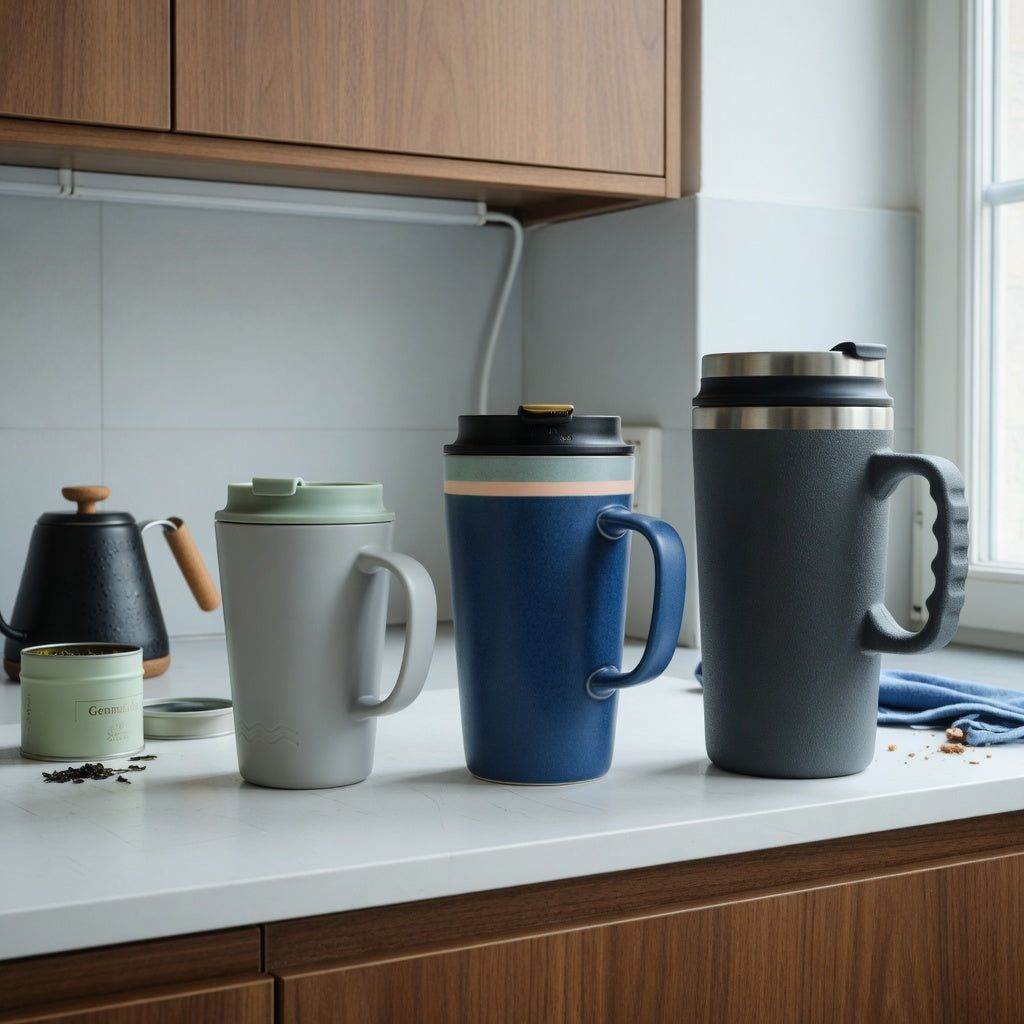
The herbal tea mug compact kitchen product shortlist guide: 3 capacities
Reading time: about 9 minutes
A mug can sit neatly beside the kettle and still fail in a compact kitchen: the handle clips an open cabinet door, the full cup feels awkward to lift from a crowded shelf, or the serving is larger than the drinker actually wants. This herbal tea mug compact kitchen product shortlist guide narrows the decision to verified capacity and handle comfort, using three tea-suitable CoffeifyMug options at 400 ml, 440 ml, and 480 ml.
We handle and sell this category, and one point comes up repeatedly at our packing table: resting space is only half of the fit question. A mug also needs a clear route in and out of storage, plus enough room for the buyer's usual grip. The catalog facts available here confirm tea use and capacity, but capacity alone cannot establish height, body width, base diameter, or handle projection. If you want to scan the wider range first, open our broader unique coffee mugs collection, then use the scenarios below to eliminate capacities that do not suit your routine.
Which compact-kitchen bottleneck should rule out a mug first?
Start with the place where your current mug causes trouble. Compact kitchens vary: one shopper has enough shelf space but cannot get fingers around the handle, while another has a clear cabinet and no spare counter area beside the kettle. We separate those problems before recommending a capacity.
- Storage access: A mug may rest on a shelf yet remain awkward to remove if the handle faces a side wall or sits close to a shelf lip. Test the route your fingers and knuckles need, not just the empty resting spot.
- Counter sharing: Place your current mug beside the appliances and preparation items that normally stay out. Turn the handle toward your dominant hand and check whether it intrudes into the sink area, blocks a drawer, or requires other items to be moved.
- Liquid load: The listed 400 ml, 440 ml, and 480 ml capacities describe how much each mug holds. They do not tell us the mug's own weight, but they do show how much liquid you may be carrying when the mug is filled to its stated capacity.
We use capacity as an initial filter, not as a substitute for external dimensions. The Flow having the lowest capacity does not prove that it is the shortest or narrowest mug on the outside. The same caution applies to the other two options. If exact cabinet clearance decides the purchase, verify the current product listing rather than guessing from the milliliter figure.
Our herbal tea mug compact kitchen product shortlist guide: three scenarios
This shortlist makes only the comparisons supported by the available catalog facts. Each option maps a drinking routine to capacity, then gives a handle-related reason to continue or pause.
| Reader situation | Start with | Why it fits | Reason to skip |
|---|---|---|---|
| One-person routine, a usual serving that fits within 400 ml, and a preference for the lowest maximum liquid load | The Flow coffee and tea mug, 400 ml | It has the lowest listed capacity of the three. Choose it when extra beverage volume would go unused and you want to limit how much liquid you carry when filling the mug. | Skip it if your normal serving exceeds 400 ml, you dislike refilling, or the product views do not give you enough confidence about the handle grip. |
| A shared shelf or gift choice where 400 ml seems low and 480 ml is more than the drinker normally uses | Morning and Night coffee and tea mug, 440 ml | Its capacity sits exactly 40 ml above The Flow and 40 ml below The Rock. That middle position is useful when neither end of the shortlist clearly matches the routine. | Skip it if the user clearly prefers the lowest or highest capacity. A midpoint adds little value when the serving preference is already known. |
| A larger single serving, with the buyer comfortable carrying the highest listed liquid volume and able to give the handle a clear movement path | The Rock coffee and tea mug, 480 ml | It provides the largest verified capacity, holding 80 ml more than The Flow and 40 ml more than Morning and Night. Choose it for beverage volume, not an assumed exterior size. | Skip it if reducing the liquid carried when full is the priority, your usual serving is much smaller, or your storage setup leaves little room to turn and grasp a handle. |
For a solo drinker whose normal serving fits within the lowest listed capacity, The Flow is the logical first product page to inspect. Morning and Night is the practical middle check for two people with similar habits or a recipient whose preferred volume sits between the other options. The Rock belongs on the shortlist when 480 ml reflects the buyer's actual serving and the higher liquid load is comfortable. These are starting points, not universal winners.
What does the 40 ml step between capacities change?
The capacity sequence is evenly spaced: 400 ml, 440 ml, and 480 ml. A 40 ml difference may be irrelevant if you routinely leave plenty of headroom, but it matters if your normal serving sits close to one of those limits. Instead of estimating from the outside of your current mug, use room-temperature water and a kitchen measuring jug to identify the amount you usually pour.
If all three mugs are filled with the same amount, the amount of liquid carried is the same. The larger capacity matters only when you use it. Filled to their listed capacities, The Rock contains 80 ml more liquid than The Flow and 40 ml more than Morning and Night. The supplied facts do not include the mugs' own weights, so we do not rank total carry weight.
The practical value of this herbal tea mug compact kitchen product shortlist guide is choosing the lowest capacity that still supports your normal serving, then evaluating handle comfort as a separate decision. That prevents a shopper from selecting 480 ml simply because a larger number appears more useful.
How can you test handle comfort around low cabinets and shelf lips?
Handle comfort involves more than the size of the opening. It includes how many fingers you use, whether your knuckles clear nearby surfaces, the wrist angle needed to lift the mug, and the path the handle follows as the mug leaves a shelf. We handle mugs in our store, but no team can declare one grip universally best because hand size and kitchen layout differ.
- Place your current mug in the tightest storage position you use and turn its handle toward the hand that normally retrieves it.
- Lift it using your usual number of fingers without moving adjacent dishes. Note any contact with a shelf lip, cabinet wall, or the mug beside it.
- Repeat the motion with the nearest cabinet door or drawer open. The mug needs enough room for the complete retrieval path, not only its resting position.
- Review all available product photos, paying particular attention to side views that show the handle relative to the mug body. Photos can inform the check, but they cannot prove how the opening will fit your fingers.
- Use a measuring jug at 400 ml, 440 ml, and 480 ml to compare the liquid load. This will not reproduce the mug's handle geometry, but it can tell you whether the highest capacity is comfortable to carry.
An empty handle may feel acceptable while the grip feels less secure with a fuller serving. That is why we keep capacity and handle comfort linked in the shortlist without pretending they are the same measurement. If a product page does not show enough detail for a strict grip requirement, pause rather than assuming it will work.
When should you skip all three mug options?
These mugs are not the right shortlist for every small kitchen. Step away from all three if the main requirement falls outside the facts this comparison can support.
- Your normal serving is well below 400 ml: Every option may provide more capacity than you need. Look for a current listing that explicitly confirms a lower capacity instead of buying unused volume.
- Exact exterior dimensions are non-negotiable: Capacity cannot guarantee clearance under a shelf or inside a cabinet. Do not purchase based on an assumed relationship between milliliters and outside size.
- You need a highly specific handle fit: A shopper who requires a particular finger opening, wrist position, or two-handed grip should only proceed when the available product information answers that requirement.
- Your main decision is material, care, a lid, or another accessory: This comparison does not rank those features and makes no unlisted care or accessory claims. Silence in a listing should not be treated as confirmation.
Gift buyers should also resist defaulting to 480 ml because the larger capacity appears more generous. In our experience, the recipient's current mug is a better reference: check how full they make it, how they hold it, and where they store it. Morning and Night at 440 ml is a midpoint, but it is not automatically the safest gift for every person.
If any of these limitations applies, return to the current unique coffee mug listings and compare only products whose pages explicitly answer the missing capacity or handle question.
Frequently asked questions
Is The Flow 400 ml automatically the best mug for the smallest kitchen?
No. The Flow has the lowest verified capacity in this three-product shortlist, but that does not prove it has the smallest exterior dimensions. Choose it when 400 ml suits your serving and the available handle views fit your grip requirements.
Which mug has the largest verified capacity for herbal tea?
The Rock has the largest listed capacity at 480 ml, and its catalog description supports tea use. It holds 40 ml more than Morning and Night and 80 ml more than The Flow. Choose it only if you expect to use that capacity and are comfortable with the additional liquid volume when full.
Can this herbal tea mug compact kitchen product shortlist guide guarantee cabinet fit?
No. Capacity does not establish exterior height, width, base diameter, or handle projection. Use the guide to narrow your serving volume, then verify the current listing and your own available storage path before ordering.
Is Morning and Night 440 ml the safest choice for a shared shelf or gift?
Not automatically. Its 440 ml capacity is a useful middle option when 400 ml feels limited and 480 ml would go unused, but two people may have very different serving and grip preferences. Check the recipient's current mug before treating the midpoint as the answer.
Which option is best for smaller hands?
There is no universal answer based on capacity alone. The Flow limits the maximum liquid volume to 400 ml, but the mug's own weight and each buyer's handle fit still matter. Compare the product photos with the number of fingers and knuckle clearance you normally use.
Use this checkout checklist: confirm your usual serving volume, decide the maximum liquid load you want to carry, test the handle removal path with your current mug, and verify any required exterior measurements on the current product listing. Open the linked page for the capacity that passes those checks. If the volume fits but the grip or storage path remains uncertain, compare the collection again and choose only a listing that answers the missing question.
More from our blog
Read more
Coffee Mug Birthday Gift Ideas Compact Kitchen Product Shortlist Guide
A practical three-product shortlist for birthday shoppers working around tight counters, shelves, and cabinets. Compare the Handbag, Gradient, and Golden Waves Kio mugs with clear reasons to choose...
Read more
Green Ceramic Coffee Mugs Compact Kitchen Product Shortlist Guide
Compare Emerald, Green Waves, and Round mugs against a nine-inch shelf opening, an eight-to-ten-inch cabinet depth, and a crowded twelve-inch counter. Each option includes a reason to choose it, a ...
Read more
Leave a comment
This site is protected by hCaptcha and the hCaptcha Privacy Policy and Terms of Service apply.