

The Flow Coffee Tea Mug for Coffee Lovers Home Decor: Compare
Reading time: about 13 minutes
A customer wrote to our store last Tuesday with three screenshots and one complaint: every open tab said Flow, and none of the cups matched. One was a speckled piece with a long curved handle, one was plain white porcelain, and one was a printed slogan telling the drinker to go with the flow. If you are comparing the flow coffee tea mug for coffee lovers home decor, start on the listing we actually sell, not on a lookalike tab that happens to share the word. A styled photo can tell you whether a silhouette belongs on an open shelf. It cannot tell you whether that other page's ounces, glaze, or care line belong to the mug in our cart.
We pack mugs that have to clear a gift box, a kitchen counter, and a partner who asks whether the pretty cup is actually for drinking. In our experience that question shows up the morning after unboxing, not during checkout. A piece bought as home decor still gets judged the first time someone pours coffee into it. Those are different jobs. A lifestyle image only covers one of them.
Which Flow mug is actually in the other tab?
Search stacks several products under one word. Shoppers land on a Ferm Living Flow tableware mug, sometimes sold with a saucer, and on a separate Villeroy & Boch porcelain Flow mug. Printed gift mugs use the phrase as a slogan. Insulated travel bottles borrow it for a steel cup with a lid. None of those catalog details transfer to our product page. A capacity printed by another retailer, a glaze name, or a saucer bundled with someone else's SKU is not a specification of the mug we ship.
We treat that mix-up as the first buying error, not a footnote. If a review describes a sculptural handle that needs two hands, ask whether the reviewer held this listing. If a care card mentions reactive glaze and cutlery marks, check whether our current description uses those words. If it does not, leave both the warning and the reassurance with the other brand. Outside pages for those other lines already disagree with each other on material and size. Pasting one of them onto our mug would only repeat the disagreement.
Shoppers who want more than this name can scan unique coffee mugs and compare silhouettes side by side. Name recognition is a weak filter. Rim shape, handle clearance, and the promises written on the page are stronger ones.
Is the flow coffee tea mug for coffee lovers home decor a drinker or a display piece?
This is the split we hear when someone styles a coffee cart on Sunday and brews in the same cup on Monday. U.S. rules draw a line, and it is worth reading before a home-decor phrase does the deciding.
Under 21 CFR 109.16, lead used in glazes and decorative decals on ornamental ceramicware may move into food if that ware is used to prepare, serve, or hold food. Ceramicware that appears suitable for food use is treated as food-use ware unless it is conspicuously and permanently labeled that it is not for food use, or a hole is bored through the potential food-contact surface. A mug with a handle, offered next to coffee language, looks like a drinking vessel. Words about home decor in a title do not erase that appearance.
The FDA has said some ceramic foodware can leach lead from food-contact surfaces, and that the metal can be extracted by food with adverse health effects, including effects of chronic lead exposure when use continues. For cups and mugs, the compliance action level is 0.5 micrograms of lead per milliliter of leaching solution in any one of six units. The agency describes cups and mugs as small ceramic hollowware commonly used for coffee or tea above room temperature, normally about 240 milliliters (8 fluid ounces), and usually made with a handle. That 240 milliliter figure describes the category regulators have in mind. It is not the fill line on our listing. Read the capacity written there before you plan a full morning pour.
A pilot study in Food Safety and Risk reported that lead in ceramic mugs can leach into coffee and tea. Measured lead in that study ranged from 0.2 to 8.6 micrograms per liter in coffee and from below 0.2 to 1.6 micrograms per liter in tea. Those numbers belong to the samples in that study. They are not a leach report for the mug we sell. A shared name is not a lab result, and we are not attaching a lead or cadmium figure to this product here. If paperwork is a requirement for your household, ask for it and read the materials and safety lines on the current page before you pay.
What this purchase is not: it is not a shelf object you should later fill with hot coffee if the page marks it decorative and not for food. If the page presents it as a coffee and tea mug, silence is still not a test result. Missing safety language is a question, not a clearance.
Will the pour suit a daily coffee, or only a small tea serving?
Coffee drinkers and tea drinkers argue over the same ceramic more often than gift copy admits. A cup that looks generous beside a linen napkin can be a short serving once you leave the headspace you should not fill. Hot liquid sloshes on the walk from kettle to desk. The lip is also where mouths and dishwasher jets meet first, so any print or softer glaze there wears ahead of the rest of the body.
Use the volume stated on our listing, not a number you remember from another Flow mug. Outside this catalog, a mug and a mug-with-saucer in one design family are sometimes listed at different sizes, and some maker pages publish no number at all. That is why we will not quote milliliters for this product unless the live page states them. If the field is blank, size is unverified. Walk away if your ritual needs a large milky pour or a tiny espresso sip and you cannot confirm the volume.
Comparisons we use on the phone, always against the number on the page rather than the photo:
- Near that 240 milliliter category picture: one modest filter coffee, or a milky drink that is mostly milk. Not a bucket latte.
- Noticeably under it: better as tea, a short coffee, or a styled tasting pour. Someone who refills twice before 9 a.m. will be annoyed.
- Well above it: check whether the handle still feels secure and whether the base fits a cup warmer, a saucer, or the shelf you actually own. Height becomes its own cabinet problem.
An open ceramic mug will not hold heat the way a lidded, double-wall travel cup does. People who need a desk drink to stay hot through a meeting are happier with an insulated bottle. A quick preheat with hot water can slow the first temperature drop. It does not turn any open cup into a thermos, and we are not calling this listing stoneware, porcelain, or double wall until the page uses those words. If you need a lid, a carry loop, or a shape that sits in a car cup holder, this is the wrong object.
Does the handle stay comfortable once the mug is full?
Handle complaints outrun glaze compliments. Shoppers describe elongated or sharply curved handles that photograph well and feel awkward once the mug is full. Some switch to a second hand. That can be pleasant at a slow breakfast. It is a bad fit for the walk from the kettle to a laptop when the other hand is already holding a phone.
On the product page, check three things. Do not guess them from a stock photo of a different brand.
- Clearance. Can two fingers, or three, pass the opening the photos show? A loop that admits only one finger gets painful with a hot, full cup.
- Attachment. The joint where handle meets body is a common failure point in this category: a hairline after a knock on a steel sink, or a slight wobble if the join is thin. We cannot inspect your unit from the warehouse photo. Check it on arrival, before you wrap it as a gift.
- Balance. A handle set high, or set far from the wall of the cup, changes where the weight sits. Smaller hands and weaker grips usually prefer a generous C-handle over a design-forward loop.
Microwave heat is a separate problem. Some ceramic mugs, or only the handles, come out too hot to hold even when the bowl of the cup seemed acceptable. There is no reliable way to predict that from a glaze color in a photo. Do not microwave this mug unless the current listing says it is microwave safe. If it does, run a short cycle first and touch the handle with a dry hand before you trust a full reheat. Metallic paint, a gold rim, or a silver decal is a reason to keep a mug out of the microwave even when the ceramic body would otherwise be fine. If the photos show metal, stop and read the care line. If they do not, confirm anyway. Cropped photos hide rims.
What happens to glaze and print after real dishwasher cycles?
The third wash is when the emails start. Printed slogans fade or flake. On some designer cups, a matte or reactive glaze picks up cutlery streaks that a glossy diner mug shrugs off. Speckle can vary from piece to piece, so a pair may not match the hero photo or match each other. Those are behaviors of certain finishes in the wider category. They are not automatically true of every mug that uses the word Flow, including the one we sell. Read the finish words on this listing before you borrow another brand's care story.
Look for an explicit dishwasher statement before you load a basket. The word ceramic is not that statement. Decals, metallic decoration, and hand-painted surfaces are the pieces we tell people to wash by hand unless the maker says otherwise. A top-rack note is narrower than a blanket dishwasher claim. A heated dry cycle is harsher than pulling the mug out to air dry. If you are buying mainly for the shelf and will only rinse, decide that on purpose. Do not promote the cup to daily tableware later without care language that supports the new job.
Staining is the quieter failure. Tea tannins and coffee oils settle into crazing, onto an unglazed foot ring, and into textured speckle. A mug that looks clean between books on an open shelf can show a brown tide line after a month of black tea. If that mark would bother you, favor a smooth, fully glazed interior and wash soon after use. We would rather point you toward a simpler glossy cup than watch you fight a finish that was meant to look softly imperfect.
Where a shelf, a saucer, and a coffee-lover gift actually fit
Decor is a real use, not a consolation prize. We sell to people styling open shelves, coffee carts, and dining tables, not only to people counting ounces. One considered silhouette can anchor a tray: kettle, small spoon, linen, a single cup. A saucer, if this listing includes one, gives the spoon a landing spot and keeps a wet foot ring off the wood. If the variant does not list a saucer, do not expect one because some other Flow product is sold as a pair.
Gifts get sloppy here. A coffee lover who already drinks from a heavy diner mug may admire a decor piece and never fill it. That is a good gift only if you meant to give an object. Say which job you intend before you order. For someone who reheats coffee, refuses hand washing, or already lives with a large tumbler, pick another style. This listing is a weak match for commuting, for an office mug that will sit in a shared dishwasher you have not checked the care label for, and for anyone who wants a measured heat-retention claim.
On the shelf, leave space around the handle so the shape reads from across the room. Afternoon sun can fade some printed colors over a long stretch. That is an ink problem, not a clay problem, and it matters more for slogan mugs than for a glaze-only body. Confirm which of those you are actually buying.
Checks we want on the current listing before checkout
Before you treat the flow coffee tea mug for coffee lovers home decor as both a daily drinker and a shelf piece, run the live page against this list. We keep it beside the product photo when we answer pre-sale mail. A blank line means unknown. It does not mean probably fine.
| Check | What you are deciding | If the page is silent |
|---|---|---|
| Exact product name and URL | You are not buying a different Flow from another maker | Do not borrow a review from another brand |
| Stated capacity | A coffee pour versus a small tea or espresso serving | Do not guess from the photo or from the 240 mL category picture |
| Material words | Whatever body the maker actually names | Leave it unverified; other Flow lines are already described inconsistently |
| Food-contact wording | Drinking versus decorative-only | Ask before you use it for coffee or tea |
| Microwave mark | Reheating, and whether metal decoration is present | Do not microwave it |
| Dishwasher mark | Daily wash versus hand wash | Hand wash until you know |
| Handle description | One-handed comfort with a full cup | Judge the photo, then confirm in hand on arrival |
| Set matching | Saucer, extra mugs, a shelf pair | Buy only the pieces the variant actually lists |
If the rows match how you drink and how you wash, order from the product page, not from another tab of similarly named cups. If capacity, care, or handle comfort fails your actual morning, stay with the unique mug collection and choose a shape built for that job. One mug does not have to be a travel cup, a diner mug, and a sculpture at the same time.
Frequently asked questions
Is the flow coffee tea mug for coffee lovers home decor safe to drink from?
Only if the current listing presents it as food-contact tableware and does not mark it as decorative-only. U.S. rules treat ceramic that looks usable for food as foodware unless it is permanently labeled otherwise or pierced through the food surface. We do not publish a lead-leach result for this mug on this page. If that documentation is a requirement for you, get it before you brew into the cup.
Can I put it in the dishwasher and the microwave?
Check the live product description for those two claims separately. A ceramic body can be acceptable in one appliance and a poor idea in the other, especially when a handle heats up or when metallic decoration is present. If either sentence is missing, do not assume safety. Hand wash, and reheat the drink in a vessel you already trust.
Why do some ceramic mug handles get too hot to hold?
Shoppers report handles that feel hotter than the cup wall after a microwave cycle, and a glaze photo will not predict it. That is a reason to require a microwave-safe statement on the listing and to test with a short cycle before a full reheat. It is not a reason to blame the coffee, and it is not something we will guess for a mug whose care line is blank.
Will every mug match the photo if the glaze is reactive or speckled?
On designer lines that use a reactive or semi-matte glaze, piece-to-piece variation is common, and cutlery can leave marks that glossy glaze hides. Apply that expectation only if this listing describes that kind of finish. A printed graphic mug fails differently: the ink or decal can wear in the dishwasher even when the ceramic underneath is durable.
Is this a better coffee lover gift than a tall or insulated mug?
It is a better gift when the person will enjoy the object on a counter and the listing's stated size matches how they actually drink. It is a worse gift for commuters, for people who need a lid, or for anyone whose current large mug is already the right volume. Match the job. A decor mug that never gets used is just something to dust.
More from our blog
Read more

Round Coffee Mug Gift Ideas: Shape, Fill, and Care
Round coffee mug gift ideas only work when shape, real pour size, and care marks match how someone drinks. Here is what we check before a rounded mug leaves our store as a gift.
Read more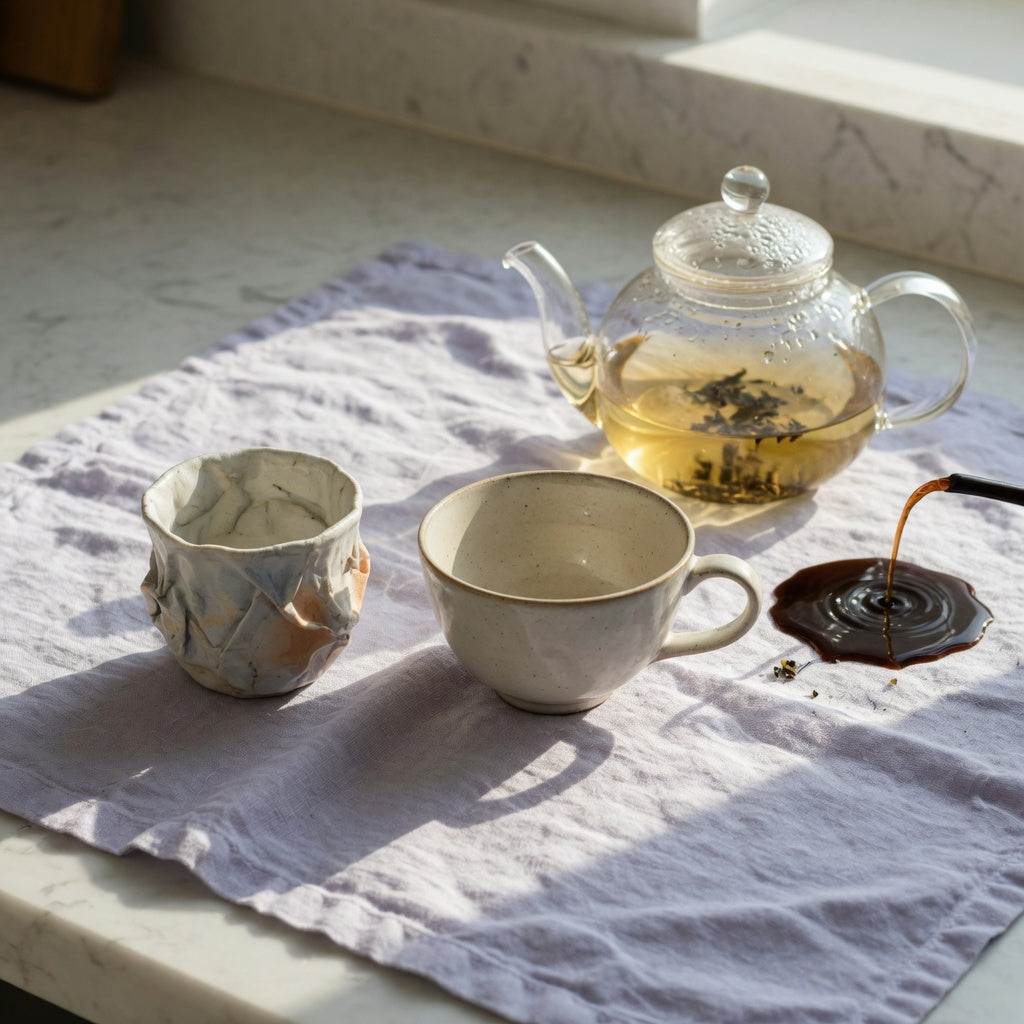
Pleated Ceramic Coffee Cup vs Tea Cup: Fit, Heat, Grip
A pleated cup and a tea cup can both be ceramic and still drink differently. We compare capacity, rim, wall, grip, heat, and glaze so the ridges do not pick the wrong vessel.
Read more
Leave a comment
This site is protected by hCaptcha and the hCaptcha Privacy Policy and Terms of Service apply.