



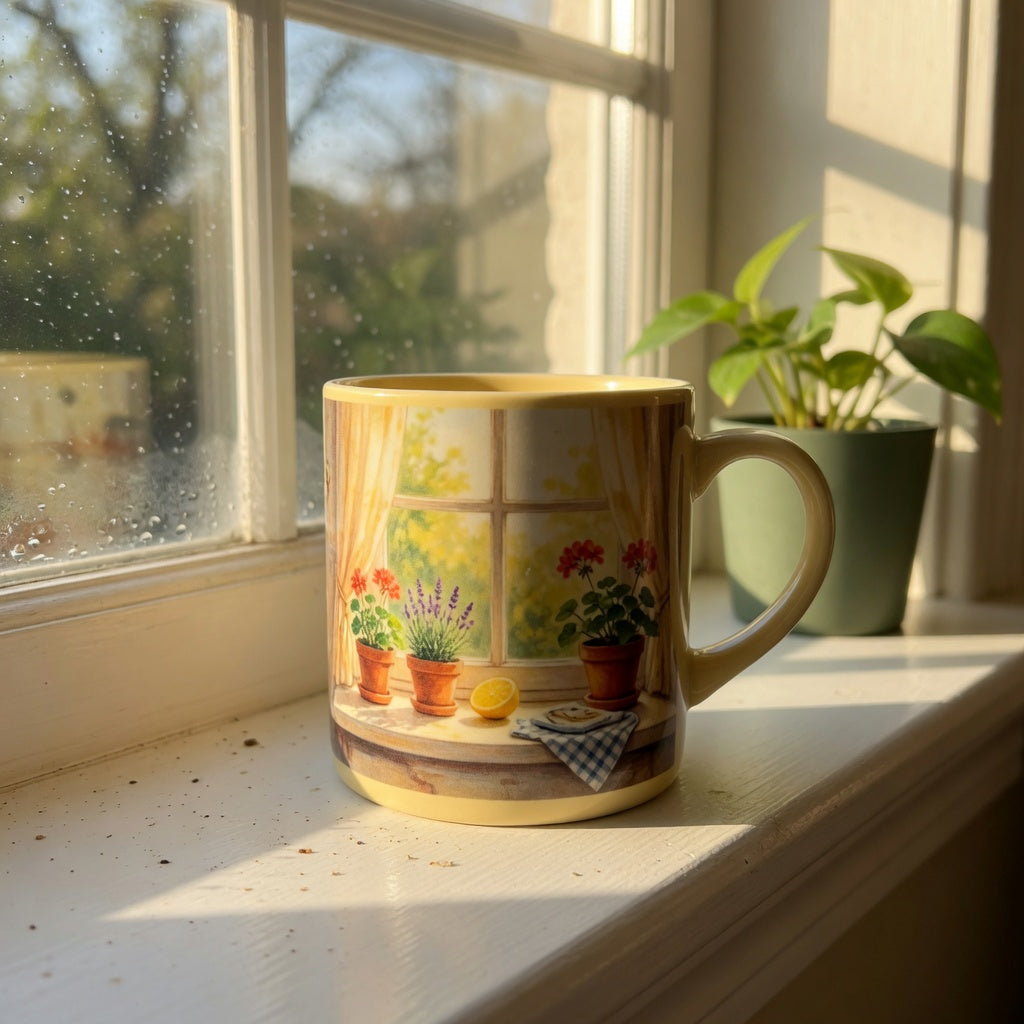
Sunny Window Coffee Mug: What Buyers Should Compare
Reading time: about 12 minutes
The tissue paper is still creased when someone holds the new cup up to the glass. The print looks warm. The handle feels fine for a second. Then the question that actually decides the purchase shows up: will this sunny window coffee mug take weekday coffee, or is it a pretty object that should stay on a shelf?
In our store we split those jobs. Artwork is easy to like from a thumbnail. Capacity, care labels, and food-contact markings decide whether the mug stays beside the kettle or gets retired after one lifted patch of sky. If you are comparing forms rather than locking onto a single print, start with our unique coffee mugs and read each live listing. Two ceramic cups can share a sunny mood and still be meant for different washing habits.
What should you compare on a sunny window coffee mug before the first pour?
What turns up for this phrase is mostly ceramic drinkware decorated with a sunny window, a windowsill, or morning light, plus photos of a cup next to a bright pane. Listings and buyer discussions treat these pieces as everyday drinkware and as gifts. They are not one model with one spec sheet. You are shopping a category. A capacity or a care rule from one listing does not transfer to the next sunny scene.
The points that change the decision are specific:
- How much the cup holds for a normal home pour versus a larger gift pour
- Whether the page says dishwasher-safe and microwave-safe, rather than only ceramic
- Whether a printed design can fade or flake even when the clay body is solid
- Whether the piece is appropriate for food contact, especially when decoration sits in or near the glaze
A glossy wrap can look kiln-fired in a small photo and still be a surface print. We cannot identify the application method from a picture. Our team asks for the maker's own line on how the image is applied. If that line is missing, durability stays unconfirmed.
Morning light itself does not make a mug safer, larger, or more durable. Authoritative sources do not connect a sunny-window look to a material, a capacity, or a test result. The aesthetic is a reason to like the cup. The listing text is the reason to trust it.
Does an 11 oz or a 15 oz pour belong on a narrow sill?
People comparing this kind of drinkware often sort it into two familiar sizes, about 11 oz and about 15 oz. Those are shopping habits, not a measurement we are assigning to any cup in our catalog. They are also not the figure used in federal leach guidance. That guidance describes cups and mugs as small ceramic hollowware commonly used for coffee or tea above room temperature, normally about 8 fl oz (240 mL), and typically made with a handle. Retail sizes around 11 oz and 15 oz are aimed at a bigger pour than that example. Do not treat the regulatory description as the ounce stamp on a product page.
How we walk through the fit:
- Around 11 oz suits one brewed cup, a short reading pause, or a person who does not want a heavy vessel while opening a window.
- Around 15 oz suits a larger home pour, coffee with a lot of milk, or a gift for someone who dislikes constant refills.
- A taller cup can feel tippy on a narrow sill, especially if the window hardware sticks out. A lower cup sits more steadily beside a plant, and it needs more depth on the counter.
- Handle clearance matters more than the ounce number when the drinker's hand is large. A pleasant scene does not widen a cramped grip.
| Situation | Size lean | Verify on the listing |
|---|---|---|
| One cup at a desk or sill | Around 11 oz | Stated capacity, footprint, handle room |
| Larger or milky home pour | Around 15 oz | Weight when full, stability on a narrow sill |
| Gift meant to stay photogenic | Either, if care fits | How the image is applied, and wash limits |
| Heated sanitize cycle every day | Skip a surface print | An explicit dishwasher claim, or choose plain glaze |
We have not counted a preferred size among orders, and we will not invent that split. Shape is a separate choice from the artwork. Open the round coffee tea mug when you want to compare a round profile for a short pause at a desk or sill. Open the pleated coffee tea cup when you want a pleated form rather than a straight-sided printed mug. We are not stating a capacity, a glaze formula, a print method, or an appliance rating for either listing. Those facts have to be on the page you see now. A title does not prove a sunny window scene is printed on that cup, and a similar mug on another marketplace cannot supply the missing lines.
If the number on the page is the only capacity you have, use that number. Nominal ounces on art mugs are a weak stand-in when you need a recipe-accurate measure. This category is not a measuring cup.
Will a printed windowsill scene flake after real dishwasher cycles?
The complaint usually arrives after the unboxing glow is gone. The clay body comes out of the machine intact. The sky, the curtain, or a thin window bar lifts in patches. Buyers of printed drinkware describe designs washing off or flaking after repeated cycles, including on mugs that were sold as dishwasher-safe. Those are individual reports, not a controlled comparison, and they are not a verdict on every maker. They are enough to change the questions we ask before we recommend a printed cup for daily use.
Independent, non-retailer tests that pit full-wrap or sublimation sunny-window prints against underglaze or kiln-fired decoration are scarce. A dishwasher-safe line on the ceramic body is not a promise that the picture will look new after a year of detergent and heat.
Read the listing in this order:
- A specific dishwasher claim, not a vague sentence about durable ceramic.
- Any limit to the top rack, a gentle cycle, or hand washing.
- How the image is applied. Decoration fired under or into the glaze faces different stress than a surface print or a sublimation wrap.
- The base stamp. No care mark means you do not get to guess one.
In our experience, a few habits cut down on the surprises customers describe later:
- Follow the maker's wash instructions even when the glaze looks machine-proof.
- Skip abrasive pads on the printed face. They scuff a pale sky faster than they clear coffee film.
- Thin window bars and light backgrounds show scratches early. A bright print does not hide wear.
- Heat plus detergent is harder on a surface print than a hand rinse. If the gift needs to stay sharp, say that in the card.
A printed scene is a poor match for a household that runs a heated sanitize cycle on every cup and expects the artwork to stay crisp. A plainly glazed mug is the better daily driver there. Keep the windowsill picture for someone who will hand wash, or accept that the scene may soften.
How do lead and cadmium limits apply to a decorated cup?
Decorated ceramic is not automatically unsafe, and a listing photo does not prove it is safe. FDA has said there is no known safe level of lead exposure, and that lead is not authorized as a color additive or food additive, including in foodware or on a food-contact surface. A compliance policy sets an action level of 0.5 micrograms of lead per milliliter of leaching solution for cups and mugs. Regulators may consider action when any one of six tested units exceeds that level under the stated methods. That is an enforcement benchmark for ware that was actually tested. It is not a certificate you can infer from gloss, and it is not the same statement as a marketing line that says lead-free.
Cadmium uses a different benchmark. For small hollowware, meaning ceramic articles that hold less than 1.1 liter, the action level is 0.5 micrograms of cadmium per milliliter of leaching solution. Ordinary coffee mugs fall inside that size range. A phrase such as BPA-free does not answer either question. Shoppers often blur those labels on printed art mugs. Lead, cadmium, and BPA are separate issues, and only the maker's food-contact statement speaks to the cup in your hand.
Ornamental ware is the easy mistake. Ceramic that appears suitable for food is treated as foodware unless it is permanently marked not for food use with the specified lead warning, or a hole is bored through the potential food-contact surface. The reason is lead in glazes or decorative decals, which can move into food. Washing, boiling, or similar home processing does not remove lead from pottery. Anything labeled not for food use should not be used to cook, serve, or store food or drinks. A sunny picture does not override that label.
- A window-scene piece sold as a mug should show food-contact and care language before checkout.
- A not-for-food-use mark means the object is decorative. Do not pour coffee into it.
- No mark on handmade, thrifted, or a newly listed cup is not proof of a hazard, and it is not proof of safety. Ask the seller, or pick another cup.
- We do not run leach tests on the counter, and we will not treat a product photo as a stand-in for the maker's food-contact statement.
What does microwave-safe mean when window art includes metal?
Half-finished coffee gets reheated more often than anyone plans. ASTM C1607 is the standard test for whether ceramicware is suitable as microwave safe for reheating in a consumer microwave. Most ceramicware absorbs little microwave energy. Some pieces absorb more, can become very hot, and may be a hazard. Metallic glaze, decoration, or paint sits outside that ordinary case unless the piece was designed for microwave use and marked that way.
We are not going to describe a home test. One calm cycle does not prove the next one. A hot wall, a hot handle, or a metallic fleck in a printed frame can show up later. Shopper guidance on when a decorative window-scene mug should be treated as ornamental rather than daily drinkware is thin, so the mark on the piece still does the work.
- Use the microwave only when the current listing or the base mark says the cup is microwave safe.
- Gold, silver, or other metal in the artwork stays out of the microwave unless the maker designed and labeled that decoration for it.
- No safety mark is a reason to be careful, not a prompt to experiment. Reheat in a vessel you already trust, then pour.
- A sunny window coffee mug is an open ceramic cup. It is not a commute mug, and it should not ride in a hot car.
Who should keep a windowsill mug for a quiet morning?
People reach for this scene when coffee is a pause: a book, a desk, the first drink before the day gets loud. It fits someone who already uses an open ceramic cup, likes illustrated ware, and will follow a care line. It is a weak choice for a commuter, a job-site cup, or anyone who needs a leakproof lid. It is also a weak choice if the sill is narrow, high, or over a radiator. A wide cup is the one that meets the plant. A tall cup is the one that tips.
Pass on a printed windowsill mug when the household sanitize-washes every piece and will not accept faded art, when the item is unmarked decorative ceramic or explicitly not for food use, or when you need a verified measure rather than a nominal ounce stamp.
In our experience, the buyers who stay happy picked the scene for a person and then checked four lines: capacity, dishwasher wording, microwave wording, and food-use status. The disappointed ones usually skipped print durability because the photo looked glazed.
Silence on a listing is not a hidden yes. If dishwasher, microwave, or food-use language is missing, treat that line as unverified.
Use this pass, then order:
- View the scene at full size, including any window frame or lettering that wraps under the handle.
- Match capacity to the pour using only the number on this listing.
- Read dishwasher and microwave statements exactly. Silence means unverified.
- Reject anything labeled not for food use.
- Accept hand washing, or do not buy a surface print on hope.
- Check height and footprint against the sill and the window hardware.
- Inside our catalog, compare the round coffee tea mug listing, the pleated coffee tea cup, and the unique coffee mugs collection using only what each live page states.
Take the cup whose listing answers those lines. The sunny picture cannot.
Frequently asked questions
Is a sunny window coffee mug dishwasher safe only if the label says so?
Yes. A ceramic body that survives heat is not the same claim as a printed design that survives detergent. If the listing or the base does not say dishwasher safe, and does not say which rack or cycle, wash by hand. Even a dishwasher-safe mark does not guarantee the windowsill artwork will never fade or flake. Surface prints are the usual failure, and independent cycle comparisons for this kind of artwork are scarce.
Will the printed design flake after a few months of washing?
It can. Buyers report flaking and wash-off on printed mugs after repeated dishwasher use, including pieces sold as dishwasher safe. Those reports do not test every maker. If the artwork has to stay intact, choose a listing that explains the decoration method, and hand wash when the maker says to.
How cautious should I be if there is no safety mark on the bottom?
Cautious. No mark does not prove the mug is unsafe, and it does not give you permission to microwave or machine-wash it. Do not use anything labeled not for food use for coffee or tea. Washing or boiling will not remove lead if it is in the glaze. If food-contact status is missing on a new listing, ask the seller or choose another cup.
Should I get an 11 oz or a 15 oz mug for everyday coffee?
Use about 11 oz for a single cup or a lighter desk mug, and about 15 oz for a larger home pour or fewer refills. That is a use-case fit, not a ranking, and it is not the specification of every sunny-window listing or of every cup in our catalog. Confirm the capacity on the product page you are buying. Handle room and stability on a sill matter as much as the ounces.
Is a windowsill scene a good gift for a quiet morning coffee ritual?
It can be, when the person already likes an open ceramic cup and will follow the care label. It is a poor gift for commuters, for people who sanitize every mug on a heated dry cycle, or if the item is decorative only. If the listing is cautious about the print, say hand washing in the note that goes with the gift.
More from our blog
Ready to pick your mug? Two ways to save on today's order:
Ordering 1–3 mugs? Get an extra 10% off your 1st order with code 10_OFF Apply 10% Off & Shop Wooden-Handle Mugs →
Gifting 4+ mugs? Buy 3, Get the 4th Free applies automatically at checkout (no code needed; offers do not stack) · Free standard shipping (Nov pre-Christmas delivery: 15–20 calendar days US) · Free replacement if chipped in transit.
Popular mug buying guides: Ceramic Tea Cups & Infuser Mugs · Ceramic Mugs with Lids Compared · Wooden-Handle Tea Infuser Mugs Compared · Christmas & Secret Santa Mugs 2026 · Espresso & Cortado Cups Guide · Cup & Saucer Gift Sets · All 25 Mugs Spec Table · Mug Size Guide · Shipping & Promo FAQ
FIRST ORDER 10% OFF (CODE: 10_OFF) · OR BUY 3, GET THE 4TH FREE


Read more

Ceramic Mug Pair for Coffee Station: What to Compare
A shared coffee bar needs two cups you can tell apart, fill below the rim, and wash the same way. We compare pour size, handle grip, cabinet fit, and glaze safety before a pair earns the tray.
Read more
Quiet Workday Coffee Mug Gift: What Buyers Should Compare
A quiet workday coffee mug gift should match office tone and daily use, not just a funny line. We compare message risk, plain desk mugs, travel cups, care, and what to verify on the current listing.
Read more
Leave a comment
This site is protected by hCaptcha and the hCaptcha Privacy Policy and Terms of Service apply.