



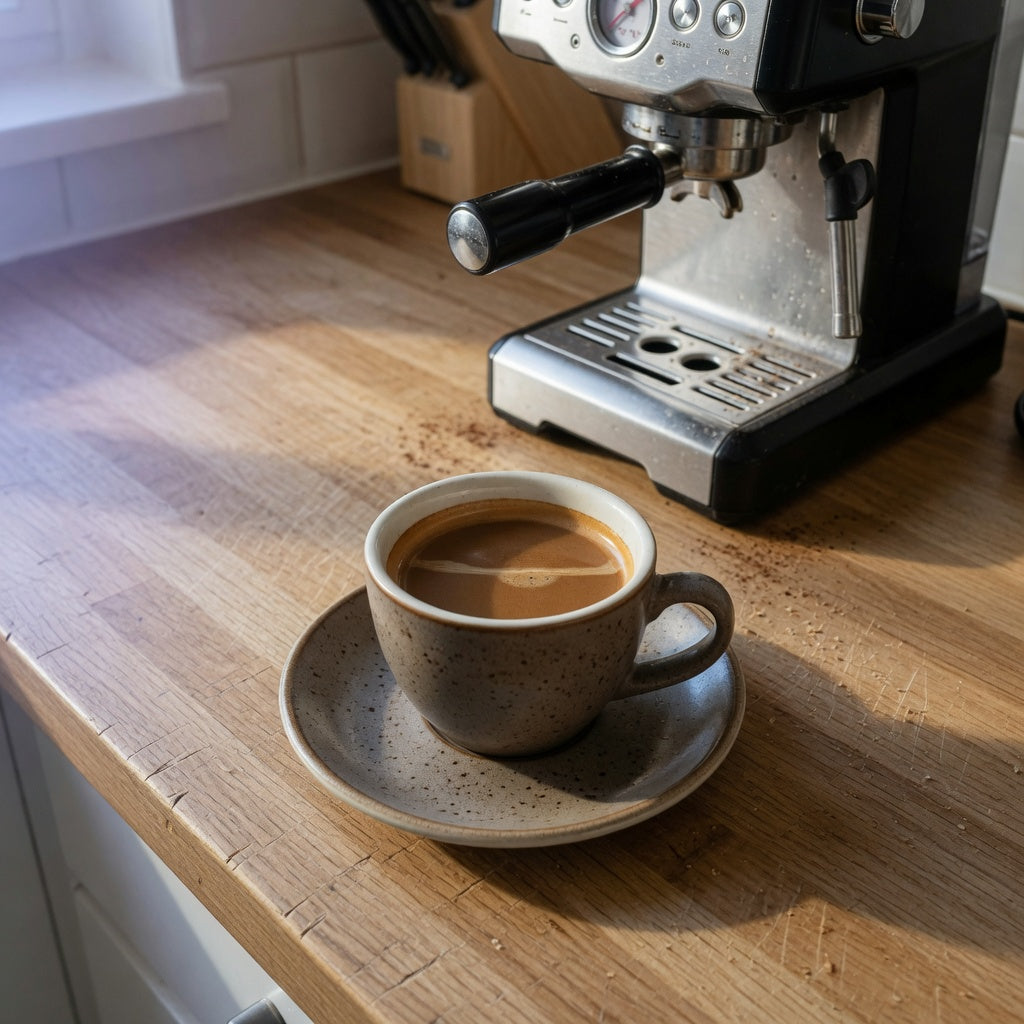
Small Retro Ceramic Coffee Cup: Size, Glaze, and Fit
Reading time: about 13 minutes
A small retro ceramic coffee cup hits our packing table and we pour before we admire the glaze. Last Tuesday one cup took a short espresso and still showed a clean band of wall above the crema. The cup beside it had the same curved handle and the same word small in the title, then swallowed that shot and looked unfinished. One search phrase, four vessels.
In our store that phrase starts as a style request: the 1970s curve, speckled stoneware, or a souvenir-cup silhouette. The drink comes second, and it is the part that disappoints after unboxing. Usable capacity, heat through the wall, a saucer that actually catches drips, and a glaze fit for acidic coffee decide whether the cup stays in the Tuesday rotation or becomes a shelf piece.
Which drink is a small retro ceramic coffee cup actually for?
We sort the request into four bands before anyone talks pattern. A wrong band will not be saved by a pretty glaze. A European espresso-bar small and a U.S. cafe small coffee are not the same pour either. If you learned cup sizes on one side of that split, read milliliters on the listing instead of trusting the drink name in the title.
- Demitasse. Often listed near 60 ml, about 2 oz. Right for a short espresso if the crema stays off the lip. Wrong the moment milk shows up.
- Cortado and macchiato cups. Commonly about 90 to 150 ml, roughly 3 to 5 oz. Espresso, a short milk pour, and a little air left at the top.
- Modest coffee or tea cups. About 180 to 250 ml, or 6 to 8 oz. This is the small coffee people mean when they refuse a bucket mug, and it works for tea as well.
- Retro diner mugs. Often 10 to 12 oz, thick-walled, and heavy. Small here is the style name, not the serving.
Cups sold as espresso cups often sit near 60 ml so crema has somewhere to live. That spare room is not a cappuccino. Near 5 oz, a cortado can still fit. A foamy cappuccino or a small latte usually needs the next band, or the foam scrapes the rim and the first step away from the machine is a spill.
Heat behaves differently at each band. A 2 oz pour cools in a few minutes on a stone counter. An 8 oz pour stays drinkable longer, yet a thick wall can still sting the fingers when the handle opening is tight. Name the drink first. Judge the grip second.
If the compact retro silhouette is what you came for, start with our retro coffee and tea cup. We are not assigning it an ounce rating here. Photos flatten scale, and only the current listing is current. Read capacity, height, what is included, and any care line on that page, then place it in one of the four bands.
If the height or the ounce band fights your machine or your shelf, look through the unique coffee mugs in the shop. A shorter bowl with a wider foot often clears a home espresso group better than a narrow souvenir shape that only looks small in the thumbnail.
Why the printed ounces feel bigger than the pour
Brim capacity is the volume at the lip. Usable fill stops lower, where you can walk the cup from kettle to desk without a wave, and where crema or milk foam still has air. When a cup feels smaller than advertised, the listing usually printed brim fill and the buyer measured a comfortable drink.
Three checks on the product page beat one bold number:
- How capacity is worded. Brim, about, and filled to a line are different claims. If the page is silent, treat the number as a maximum, not your serving.
- Height and diameter together. A wide shallow bowl and a tall narrow bowl can share an ounce rating. The wide one spills sooner and cools across more surface. The tall one may kiss the portafilter.
- Headroom for the drink you make. Crema takes space the liquid shot does not. Steamed milk takes more. A spoon needs a margin too.
A home brewer's 6 oz mark will not land neatly inside a cup rated 6 oz to the rim. You will have no splash room on the walk to the office desk. We would rather see you step up one band than drink at the edge. If you want a numeric neighbor in that modest range, our 200 ml ceramic coffee cup notes sit there, not in diner-mug territory.
Thick stoneware or thin porcelain at the lip
Retro is a look. The clay body is what you are actually holding.
Thin porcelain and fine stoneware warm fast at the rim and feel light. A thin lip usually leaves less drip on the mouth. The trade-off shows up at the handle join: knock it on a faucet and the join chips. A tight finger opening also lets the hot bowl meet a knuckle. Thick diner stoneware, and plenty of 1970s-style mugs, buffer heat in the wall, then tax a smaller hand with empty weight. A heavy rim can shed a drop back onto the chin. That weight is annoying on a laptop tray, and it is annoying if you cup both hands around a tiny bowl out of habit.
Handle opening is the spec almost no listing prints and every buyer notices on morning two. Two fingers, or a full grip. Whether the knuckle clears the bowl. A handle-less shape photographs cleanly and is a poor idea once the coffee is hot. If the page shows no handle, plan on a saucer and a lower fill, or choose another cup.
Read the material words as written: porcelain, stoneware, or earthenware. Do not guess them from a brown glaze. Earthenware that never fully vitrified is more porous once the glaze is chipped. Stoneware is the usual body behind a heavier retro mug. Porcelain is the usual body behind a light demitasse. Confirm the body on the listing you are buying, including the retro coffee and tea cup, instead of borrowing it from a lookalike photo.
Reactive and handmade glazes move. A darker rim, a pooled speck, a second cup that is not a twin: that is the point of a 1970s-style glaze, not a packing mistake. If you need four identical cups for a breakfast set, do not order a variation glaze and hope. The mismatch we see most often is a buyer who wanted hotel-matched cups and received a glaze that is supposed to differ from piece to piece.
Saucer, foot ring, and room under the portafilter
Without a landing spot, a retro cup stains the desk on the first morning. A dry, gritty foot ring can also scratch a wood tray. In our experience, four fit points matter more than the pattern name.
- Whether a saucer is included or separate, and whether it is wider than the cup with room for a spoon.
- Foot ring glazed or left dry, and whether a stack rocks.
- Height once the saucer is underneath. Some home machines leave little air between the drip tray and the spouts.
- Stack height in a shallow cabinet. Retro curves often refuse to nest.
Clearance is rarely measured the same way across brands. Measure from your drip tray to the underside of the portafilter, then compare that span with the cup height on the listing. A cup can be small across and still hit the spouts if the bowl is tall. If the catch surface has to be settled in the same purchase, the small ceramic coffee cup with a tray notes go further on footprint and drip than a one-line saucer mention usually does.
Vintage decoration, lead, and a lead-free line
A nostalgic shape is not automatically a food vessel. Everyday factory-made pottery is much less likely to present lead problems than the pieces regulators flag. FDA guidance asks for extra caution with handmade crude or irregular pottery, antiques, damaged or worn glaze, flea-market finds from unknown makers, and ware brightly decorated in orange, red, or yellow. Lead that can leach is not removed by washing or boiling. Anything marked not for food use should not hold coffee, and it should not store a drink for later.
For cups and mugs, FDA compliance policy sets a leachable-lead action level of 0.5 micrograms per milliliter of leaching solution in any one of six tested units. The agency describes cups and mugs as small ceramic hollowware commonly used for coffee or tea above room temperature. They normally, though not only, hold about 240 ml (8 fl oz) and have a handle. A separate cadmium policy sets 0.5 micrograms per milliliter for small hollowware, because extractable cadmium from acid foods could cause chronic cadmium poisoning with continued use. Those figures are enforcement thresholds for ware tested by named methods. They are not proof that an unmarked vintage cup was tested.
A lead-free line on a label is not a lab report. FDA has said ceramicware that releases extractable lead under the cup-and-mug test should not be called lead free, and it has reported imported traditional pottery that wore the phrase while still at or above action levels.
The lip matters as much as the inside. A 2025 peer-reviewed migration study of new and second-hand ceramic mugs found cadmium and lead moving into 4 percent acetic acid more readily from the exterior lip than from the interior, especially where the lip was decorated. In that study, interior concentrations after 24 hours did not exceed about 9 micrograms per liter of cadmium and about 6 micrograms per liter of lead. Exterior lead over 24 hours ranged from about 1.2 to 934 micrograms per liter. Your cup is not one of those samples. The practical reading: your mouth meets the lip, so an interior-only reassurance can miss a painted edge.
How we separate piles in the shop:
- A current production cup sold for beverages is a different conversation from flea-market faience or an unmarked souvenir.
- Bright orange, red, and yellow on old ware is a reason to pause. It is not a ban on every modern glaze that happens to be warm.
- Chips through the glaze, a worn lip, and crackle stained gray with coffee are condition problems. We do not treat every crazed cup as unsafe. Crackle does stain, it is harder to wash, and on an unknown old piece it is another reason to keep the cup decorative unless you know it was made for food.
Coffee is acidic. Do not hand a vintage unknown a daily coffee job because it survived a cabinet. On a gift unboxing, the pattern gets the smile and the first hot pour gets the verdict. The recipient's dishwasher and their real drink matter more than the print. We set that choice out in the retro ceramic coffee cup gift guide.
Microwave bands, dishwasher cycles, and drinks this shape will not hold
USDA guidance on microwave ovens is narrow. Only cookware manufactured for microwave use belongs in one, and china with metallic paint or trim does not. A gold or silver band is out, even when the clay looks plain. For an unlabeled utensil with no metal trim, USDA describes a one-minute test beside a cup of water: if the piece comes out warm or hot, it is not microwave safe, because metal in the material or the glaze is the usual reason it heated. Do not run that test on a gilded lip.
Dishwasher safety is a sentence on the listing, not a trait of the word retro. Wooden handles, unglazed feet, and some metal rims are what fail across repeated cycles. On the retro coffee and tea cup page, read the care line that is posted there. Do not copy it from another mug in a similar color.
Crazing is the fine crackle shoppers already ask about and product pages rarely explain. On a new cup it can be an intentional crackle glaze. On a vintage cup it can be age. Coffee stains the lines either way. If brown webs in the glaze bother you, skip crackle and skip a second-hand cup whose crazing is already dark.
This shape is the wrong tool when:
- You want a 12 oz milky latte or a lidded commute. The volume is short, and there is no travel lid.
- You need matched cups for a service line. Reactive and handmade retro glazes vary on purpose.
- You reheat coffee and the cup has metal trim, or the listing never mentions the microwave.
- The piece is a flea-market antique with no food-use information.
- The portafilter sits low and the bowl is tall, even if the title says small.
Match the drink on the listing before checkout
Run this against the product page, not the lifestyle photo.
| Drink | Volume shoppers usually mean | Question to answer on the listing |
|---|---|---|
| Single espresso | Short pour; cups often sold near 60 ml | Is this a demitasse, or a mug shot close up? |
| Cortado or macchiato | About 90 to 150 ml | Is there headroom after the milk goes in? |
| Small brewed coffee or tea | About 180 to 250 ml | Is the ounce rating brim fill or a drinkable fill? |
| Retro diner mug | Often 10 to 12 oz | Is small only the style, not the capacity? |
- Name the drink: espresso, cortado, small brewed coffee, or tea.
- Pick usable ounces, not the biggest number in the title.
- Separate brim fill from the pour you can carry across the kitchen.
- Note porcelain, stoneware, or earthenware exactly as the page writes it.
- Check handle opening, rim thickness, and empty weight if they are listed. If they are missing, treat comfort as unproven.
- Confirm saucer, foot, stack behavior, and machine clearance.
- Read the dishwasher and microwave lines. Metal trim stays out of the microwave.
- Look for food-contact language. Be stricter with vintage finds, unknown handmade work, bright old decoration, chips, and worn lips.
- Decide whether glaze variation is welcome on your table.
- Separate a display gift from a Tuesday cup.
Open the retro coffee and tea cup and match it to one row. If that row does not fit the drink, use the unique coffee mugs and choose the band that does. The pattern is the easy part. The pour, the lip, and the glaze are the purchase.
Frequently asked questions
Is a small retro ceramic coffee cup large enough for a double espresso?
Often yes for the liquid, and sometimes no once crema sits on top. A cup sold near 60 ml can take a double shot with little room left. A true tiny demitasse can be tight beyond a short single. Read the listed capacity and leave headroom. Do not judge the scale from the photo.
If I add milk, is about 5 oz too small for a cappuccino?
About 5 oz can work for a cortado or a macchiato. It is usually tight for a cappuccino or any drink with a tall foam cap. Move to a modest 6 to 8 oz cup if milk is part of the ritual, and confirm the listing's ounces describe a usable fill rather than brim fill.
Why does my cup hold less than the capacity printed on the page?
Many listings quote brim capacity. A drinkable pour stops short of the lip so the cup can travel without spilling and so crema or milk has air above it. A wide bowl can also feel smaller than the number because the surface sits closer to the rim.
Are retro ceramic cups with a gold band safe to microwave?
No. USDA says to microwave only cookware made for that use, and china with metallic paint or trim is not safe. Leave a gold or silver band out even if the clay looks ordinary. If the listing never mentions the microwave, do not assume this cup is fine, and do not borrow a care line from a similar glaze.
Is a crazed vintage cup still okay for acidic coffee?
Not by default. Everyday factory pottery is a lower-concern group than antiques, flea-market pieces, damaged glaze, or brightly decorated old ware. Crazing stains and is harder to clean. We do not call every crackle cup unsafe, but an unknown vintage piece with no food-use claim belongs on display until you know otherwise. Washing does not remove lead that can leach.
Ready to pick your mug? Two ways to save on today's order:
Ordering 1–3 mugs? Get an extra 10% off your 1st order with code 10_OFF Apply 10% Off & Shop Wooden-Handle Mugs →
Gifting 4+ mugs? Buy 3, Get the 4th Free applies automatically at checkout (no code needed; offers do not stack) · Free standard shipping (Nov pre-Christmas delivery: 15–20 calendar days US) · Free replacement if chipped in transit.
Popular mug buying guides: Wooden-Handle Tea Infuser Mugs Compared · Christmas & Secret Santa Mugs 2026 · Espresso & Cortado Cups Guide · Cup & Saucer Gift Sets · All 25 Mugs Spec Table · Mug Size Guide · Shipping & Promo FAQ
FIRST ORDER 10% OFF (CODE: 10_OFF) · OR BUY 3, GET THE 4TH FREE


Read more
Everyday Round Coffee Mug: Capacity, Handle, and Fit
Judge an everyday round coffee mug by usable ounces, handle clearance, lip, weight, care marks, and fit under a brewer. A round photo does not tell you any of that, and an open cup is not a travel ...
Read more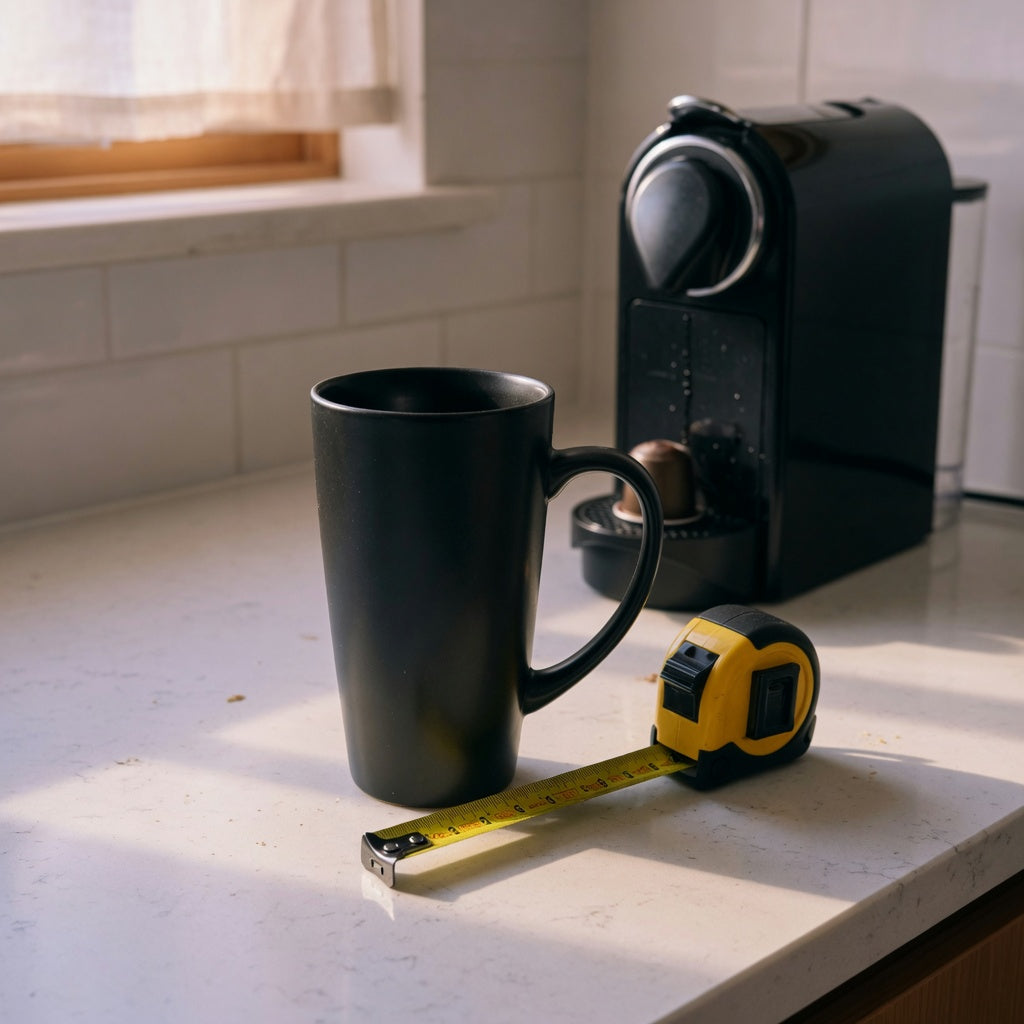
Landscape Tall Coffee mug 350: Ounces, Fit, and Care
Our Tall Landscape ceramic mug is listed at 350 ml in black, about 11.83 US fl oz to the brim. We separate that name from scenic-print gift mugs and list the height, base, and care facts the produc...
Read more
Leave a comment
This site is protected by hCaptcha and the hCaptcha Privacy Policy and Terms of Service apply.