
Rustic Ceramic Coffee Mugs Size Decision Guide: Daily Fit
Reading time: about 10 minutes
A mug that looks compact in a product photo can feel oversized once it is filled and parked beside a keyboard. The opposite mismatch is just as frustrating: an attractive cup runs out before a morning task is finished. This rustic ceramic coffee mugs size decision guide starts with the amount you actually pour, the capacity listed on the product page, and the space available around your hand, brewer, desk, and cabinet.
In our store, we treat size as a fit question rather than an upgrade ladder. Larger is not automatically better, and smaller is not automatically easier. During handling and packing, we also see how the ceramic body, handle shape, and overall profile affect the space a mug claims beyond its stated capacity.
How we separate facts from guidance: Product-specific details here are limited to information presented by the current product pages, including the ceramic category, designs, listed capacities, and the wooden handle identified for Mountain Sea II. Advice about measuring a pour, loaded weight, cabinet clearance, and chip prevention is general ceramic-mug guidance. The linked product page should be treated as the source of truth for current specifications and care instructions.
Rustic ceramic coffee mugs size decision guide: what does your pour require?
A capacity number becomes useful only after you compare it with a finished drink. Guessing from a product photo is unreliable because images may use different crops, props, and camera distances. Terms such as small or large are also relative; your measured serving is the better reference.
- Fill your current mug with cool water to the level you normally use, then transfer that water to a marked measuring cup.
- Account for the milk, cream, foam, or other additions you regularly include. For an iced drink, remember that ice occupies part of the available space.
- Leave the same headroom you normally keep below the rim. A listed capacity should not be treated as an instruction to fill the mug completely.
- Write down the current capacities shown on the Mountain Sea, Elk and Moon, and Mountain Sea II product pages.
- If your measurement sits between two options, decide which inconvenience matters more: making another pour or lifting and storing the larger mug.
This process avoids made-up drink standards. A person who prepares a short coffee, a large tea, and an iced drink may need three different amounts even though all three beverages can technically go in a coffee and tea mug.
Smaller capacities: when is less volume more practical?
A smaller rustic ceramic mug makes sense when it holds your usual serving with enough room to carry it comfortably. Less unused capacity also means you are not lifting extra ceramic and liquid simply because a larger option looked more substantial online.
- Short kitchen-counter drinks: You finish one modest serving and do not mind returning to the brewer for another.
- Busy desks: A compact daily pour leaves more working room around a keyboard, notebook, charging cable, or mouse.
- Lower loaded weight: You prefer a mug that remains easier to lift once liquid has been added.
- Limited storage: Your cabinet or open shelf has little spare height or depth, although exterior dimensions still need to be checked separately from capacity.
- Known gift routines: The recipient already uses a modest mug and rarely fills it to the rim.
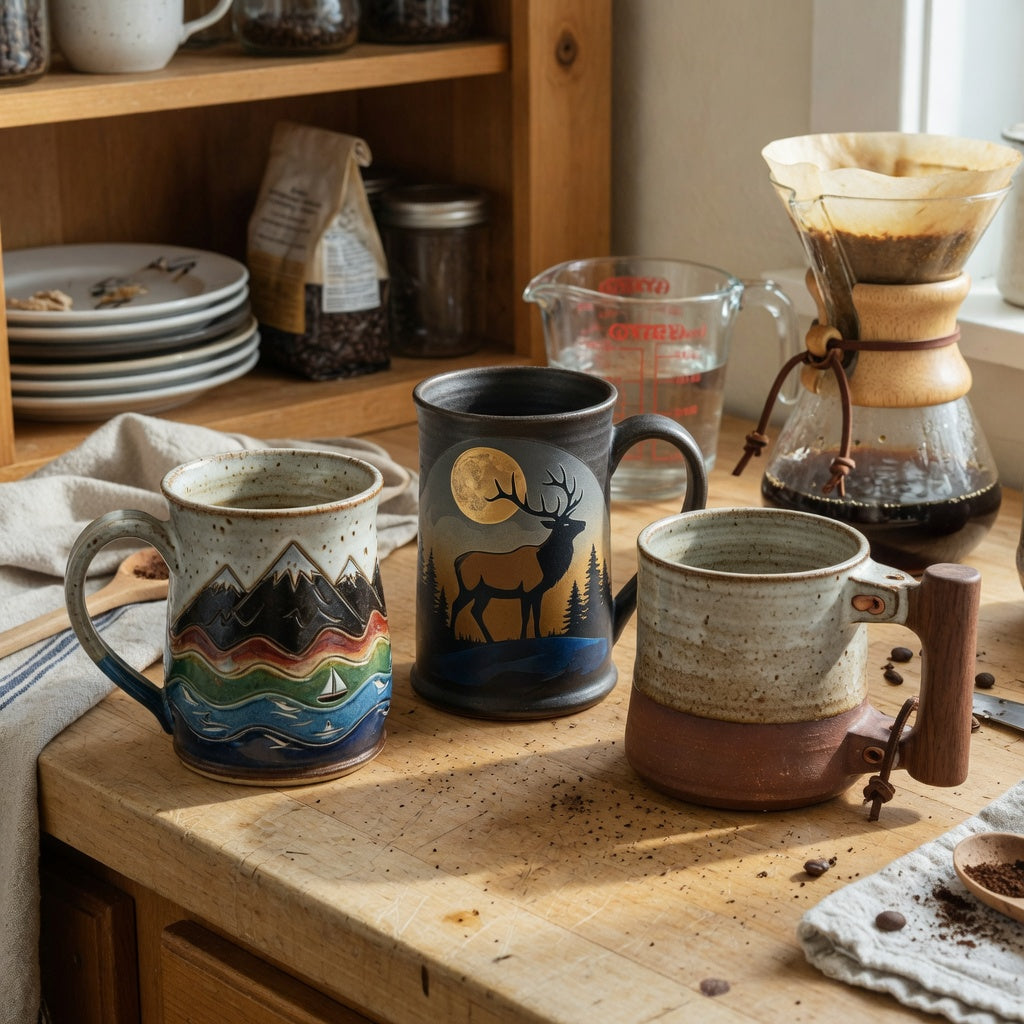
If your measured serving fits comfortably within the capacity currently shown for the Mountain Sea coffee tea mug, that page is a sensible starting point for the smaller side of this comparison. The mountain-and-sea design gives you a clear style reason to choose it, while the listed capacity tells you whether it fits your actual routine.
The limitation is room for change. A smaller mug is not the practical choice if you regularly add a large amount of milk, prepare drinks over ice, or want one fill to cover a long desk session. If your normal drink would sit close to the rim, move to a larger listed capacity instead of planning to carry the mug cautiously every day.
Larger capacities: when does the extra room earn its space?
A larger current option is justified when the added volume solves a routine problem. It can provide room for a bigger finished drink, generous headroom, or ice and additions without crowding the rim. That benefit should be weighed against a heavier full mug and a larger claim on the counter or shelf.
- One-fill work sessions: You stay at a stationary desk and prefer not to interrupt a meeting or focused task for another pour.
- Drinks with additions: Your base coffee or tea is followed by milk, foam, or other ingredients that need space.
- Iced servings: Ice takes up volume, so the liquid amount alone does not describe the mug capacity you need.
- Shared brewing equipment: Your usual portion from a press or pot is consistently larger than the smaller current option can hold with comfortable headroom.
For these situations, compare the listed capacities on the Elk and Moon coffee tea mug and the Mountain Sea II coffee tea mug with wooden handle. Choose Elk and Moon when its current capacity fits your measured drink and that nature motif is the better match. Choose Mountain Sea II when the capacity works and a wooden handle is specifically part of the appeal.
Do not assume the wooden handle makes a fuller mug universally easier to carry. Grip comfort depends on hand size, handle opening, balance, and the final loaded weight. The mixed ceramic-and-wood construction also means you should check the product page's current care instructions rather than applying an automatic cleaning routine.
Mountain Sea, Elk and Moon, or wooden handle: which variable decides?
Once your target capacity is clear, design and handle material can break the tie. We would compare the current products this way:
| Current design | Reader situation | Why it fits | What to verify |
|---|---|---|---|
| Mountain Sea | Your regular pour aligns with the smaller side of the current comparison, and you want a landscape design. | You are choosing the capacity for the drink and the mountain-and-sea motif for personal style. | Current listed capacity, exterior clearance, and care information. |
| Elk and Moon | You need more room than the smaller option provides and prefer the elk-and-moon artwork. | The larger-side comparison supports a more generous finished serving without making design an afterthought. | Current listed capacity and whether the loaded mug suits your grip and storage. |
| Mountain Sea II with wooden handle | You want a larger-side option and specifically prefer the look and contact feel of wood. | The handle material becomes a genuine selection variable rather than a decorative detail. | Capacity, handle clearance, and all product-specific cleaning and care directions. |
Product names and photos should not be used to infer capacity. Read the current figures on each page and place them beside your measured pour. If none leaves the right amount of headroom, browse the broader unique coffee mugs collection instead of forcing one of these designs into the wrong routine.
Cabinet, desk, grip, and care limits that change the answer
Two mugs with similar capacities can occupy different amounts of physical space. Before ordering, measure the shelf opening rather than looking only at the empty area in front of it. Include vertical clearance, body width, and the space a handle needs beside neighboring cups. Also check the clearance beneath your coffee maker if the mug will be filled directly from the machine.
Loaded grip is another practical check. Fill your current mug with cool water to the target volume and lift it several times from the surface where you normally drink. More capacity means more liquid weight when full, even before differences in ceramic construction are considered. If that test already feels cumbersome, a larger mug is unlikely to become more convenient through daily use.
During routine handling, our team pays particular attention to the rim, the point where the handle meets the body, and the foot ring. Those are useful places to inspect for chips, rough damage, or hairline cracks before first use and after accidental contact with a sink or hard countertop. A chipped drinking rim or visibly cracked handle is a reason to stop using the mug.
Care must remain product-specific. Do not assume every ceramic mug belongs in a dishwasher or microwave, and do not treat a wooden handle as though it were ceramic. If your routine depends on repeated dishwasher cycles with no separate care step, confirm that compatibility on the product page before choosing Mountain Sea II.
Rustic ceramic is also not the best category for every setting. A breakable, open mug is a poor match for a moving vehicle, rough outdoor use, very young children, or a workspace where spills are frequent. A lidded insulated vessel or a more impact-resistant material would be more practical in those situations.
Gift decisions: match the recipient's routine before the artwork
Artwork creates the first reaction during a gift unboxing, but size determines whether the mug returns to the kitchen counter each morning. In our experience, the most useful clue is the mug the recipient already reaches for.
- If that mug holds a modest serving, begin with the smaller current capacity and compare it with Mountain Sea.
- If the recipient keeps one drink beside a computer for a long work block, compare the larger-side Elk and Moon and Mountain Sea II pages.
- If they collect landscape designs, choose between Mountain Sea and Mountain Sea II only after confirming capacity and handle preference.
- If the elk-and-moon motif reflects their taste, select that design only if its listed capacity also suits their normal pour.
- If they avoid special cleaning routines, verify all care directions before gifting the wooden-handle model.
If you know nothing about the recipient's drink volume, cabinet space, or grip preference, do not default to the largest mug. Use the current unique coffee mug selection to compare designs, then choose a capacity close to the mug they already own.
A five-minute comparison before checkout
| Decision point | Smaller makes sense when | Larger makes sense when |
|---|---|---|
| Finished pour | The lower current capacity holds it with normal headroom. | The lower capacity would crowd the rim or require a second serving. |
| Additions | You add little beyond the base drink. | Milk, foam, or ice regularly needs extra room. |
| Handling | Reducing loaded weight is a priority. | You are comfortable lifting the measured volume and usually set the mug down. |
| Storage | Desk and cabinet space are tight. | You have measured enough clearance for the body and handle. |
| Care | You want the simplest routine confirmed by the product page. | The selected model's stated care requirements fit your routine. |
The working rule behind our rustic ceramic coffee mugs size decision guide is simple: capacity solves the drink requirement, while design and handle material settle the choice between options that already fit.
Frequently asked questions
How do I use this rustic ceramic coffee mugs size decision guide if two capacities are close?
Measure your finished drink and include normal headroom. If both capacities work, choose the smaller one when lower loaded weight and compact storage matter more; choose the larger one when avoiding refills or leaving room for additions matters more. Then use motif and handle material as the tie-breakers.
Is a larger rustic ceramic mug automatically better for iced coffee?
No. Ice occupies space, so a larger listed capacity may be useful, but only if the full mug remains comfortable to lift and fits your counter or desk. Measure the amount of liquid and ice you actually use instead of selecting the largest available option.
Should I choose Mountain Sea II just because it has a wooden handle?
Choose it when the current capacity fits, you prefer a wooden grip, and its listed care requirements suit your routine. Wood changes the material you touch and the mug's overall character, but it does not guarantee a better grip for every hand. Buyers who want one uniform ceramic care routine may prefer another current design.
Can the current rustic ceramic mugs go in a dishwasher or microwave?
Follow the care information on each current product page rather than applying one rule across the category. Check the wooden-handle Mountain Sea II especially carefully because mixed materials may have different care limits. If the page does not confirm the cleaning method you require, choose a different mug.
Which current rustic ceramic mug is the more practical gift?
Match the recipient's usual serving first. Mountain Sea is the starting comparison for a smaller-volume routine, while Elk and Moon and Mountain Sea II are the larger-side pages to check. After capacity, choose the motif and handle material that best fit the recipient's taste and care habits.
Open the three product pages from the unique coffee mugs collection and make a short note for each: listed capacity, handle material, required clearance, and care directions. Cross out any option that fails one practical check, then choose the design you want from the mugs that remain.
More from our blog
Read more

Coffee Mug Birthday Gift Ideas Size Decision Guide: Small or Large?
Compare the 400-480 ml range by desk space, refill habits, iced-drink headroom, grip, cabinet fit, and care. We map compact and larger gift situations to current CoffeifyMug options.
Read more
Ceramic Glazed Coffee Mugs Storage Fit Guide for Real Shelves
Compare three current CoffeifyMug designs using shelf depth, opening height, handle projection, stacking limits, and care needs. This guide separates visible product details from the measurements y...
Read more
Leave a comment
This site is protected by hCaptcha and the hCaptcha Privacy Policy and Terms of Service apply.