
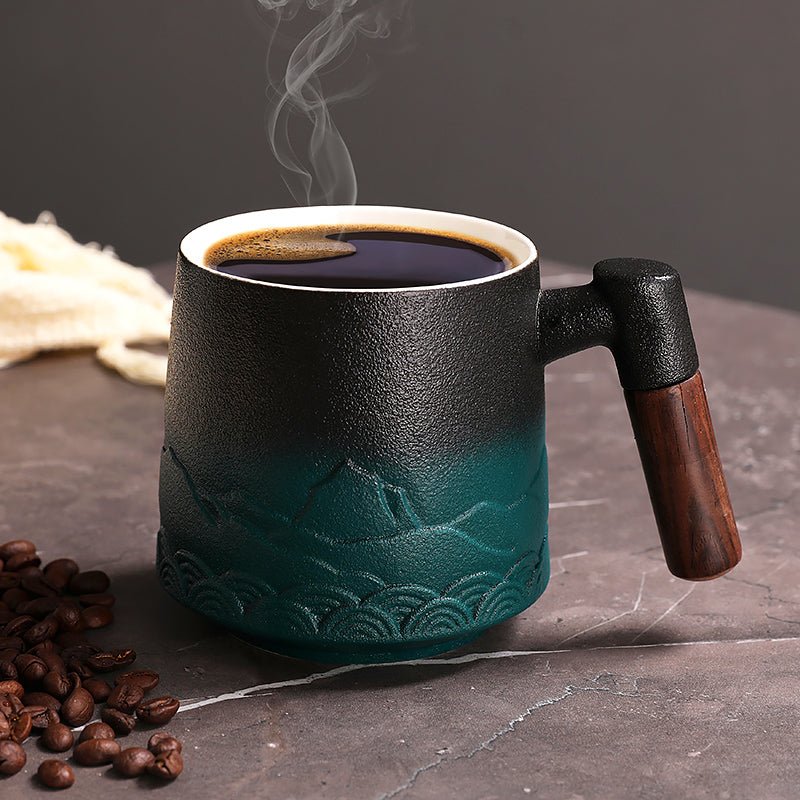
Rustic Ceramic Coffee Mugs Shape and Handle Guide: Current Options
Reading time: about 11 minutes
A mug that looks compact in a product photo can still catch the cabinet frame because its handle projects farther than its ceramic body. In our store, that is one of the details we slow down and check before comparing designs. This rustic ceramic coffee mugs shape and handle guide focuses on evidence that can support a purchase: the visible profile, stated materials, listed capacity and dimensions, and handle form. We keep general fit and care advice separate from product-specific claims because a photograph alone cannot prove finger clearance, dishwasher compatibility, or comfortable working volume.
Why can the same mug look different on a desk and a shelf?
Product photography is useful for comparing artwork and proportions, but it can flatten scale. A wide, rounded body may look short from the front while using more counter space than expected. A tapered mug may have a narrow foot but reach its maximum diameter higher up. A projecting handle can also determine if two mugs fit side by side in a cabinet.
General shape guidance: use the profile to identify where the mug is widest, then confirm that impression against the dimensions stated on its product page. Common profile terms help describe what you see without assigning performance claims:
- Straight-sided: the wall follows a mostly vertical line, making the body width easy to compare with a ruler.
- Rounded or bellied: the widest point may sit above the base, so the foot diameter does not represent the full counter footprint.
- Tapered: the base is narrower than the upper body. Check both the base and maximum body width.
- Flared rim: the opening extends beyond the wall below it, which matters for shelf spacing and some tea infusers.
None of those profiles automatically makes a mug more comfortable or better at retaining heat. Wall construction, weight distribution, rim finish, and the drinker's grip also matter, and those details should not be inferred from a silhouette alone.
Rustic ceramic coffee mugs shape and handle guide: which measurements matter?
The most useful size comparison starts with an existing mug that already works in your kitchen or office. Measure it, record the units, and compare the same points on the listing. One inch equals 25.4 millimetres, so converting both products to one unit prevents small but meaningful mistakes.
- Body height: measure from the counter to the highest point of the rim. Compare it with the usable shelf space and the clearance below a coffee machine outlet.
- Maximum body diameter: measure the widest part of the ceramic body, not only the foot. This is the number that determines the main counter footprint.
- Overall width: measure from the far side of the body to the outer edge of the handle. This matters in narrow cabinets and on crowded office desks.
- Inside handle opening: record both its height and width. An exterior handle measurement does not tell you how much room your fingers receive.
- Rim opening: compare the inside opening if you use large ice cubes, a tea infuser, or a particular cleaning brush.
Capacity is a separate measurement. Two mugs can have a similar listed volume but different height, width, and handle projection. Likewise, a visually large mug may devote some of its external size to thick walls, a broad foot, or a pronounced profile. Use the page's stated capacity rather than estimating volume from the photograph.
How do the three current CoffeifyMug designs differ?
The linked product pages are the source of record for their current specifications. The distinctions below stay within what the product names and current listings establish; exact dimensions, capacity, option availability, and care directions should be confirmed on the page before checkout.
| Current option | Page-backed distinction | Reader situation and fit | Detail to verify |
|---|---|---|---|
| Mountain & Sea Coffee & Tea Mug | Mountain-and-sea design presented as a coffee and tea mug. | Start here if you want landscape-led rustic artwork and do not specifically need the wooden-handle version. | Compare the pictured sidewall, rim, handle opening, listed capacity, and overall dimensions with your current mug. |
| Elk and Moon Coffee & Tea Mug | Elk-and-moon design presented as a coffee and tea mug. | This is the more direct next step for a shopper or gift recipient who prefers an animal and night-sky motif. | Check the current profile photographs and listed measurements rather than assuming it matches the Mountain & Sea model. |
| Mountain & Sea II Coffee & Tea Mug with Wooden Handle | The listing explicitly identifies a wooden handle and a second Mountain & Sea design. | Consider it if the contrast between ceramic and wood is part of the appeal and you accept a more cautious cleaning routine. | Confirm handle construction, total width, capacity, dimensions, and the currently stated care instructions. |
To compare the photographs fairly, look at the same landmarks on every page: rim width relative to the body, sidewall taper, maximum body width, handle attachment points, and foot width. Product images may not share a common scale, so let the listed measurements settle a close decision.
If none of these three themes or handle treatments is quite right, the unique coffee mugs collection is the practical place to compare other current silhouettes. A product name can establish its motif or named material, but it does not establish microwave safety, dishwasher safety, stackability, cup-holder fit, or usable fill level.
Which handle form suits your grip and cleaning routine?
Handle comfort is personal. Some people place one or two fingers through a loop and support the body with the other hand. Others expect room for three or four fingers. We assess those uses by looking at the interior opening, distance from the hot ceramic body, outer projection, and the upper and lower attachment positions. Capacity alone tells us none of that.
- For larger hands: prioritize the listed or visibly verifiable inside opening. A large-looking outer loop can still have limited internal clearance.
- For compact storage: compare overall mug width, including the handle, rather than selecting the narrowest body.
- For repeated office use: check that your preferred grip does not force the knuckles against the body and that the full footprint clears the keyboard, monitor stand, and nearby containers.
- For a wooden handle: read the product care directions before ordering. Unless the current page expressly permits machine washing, our conservative approach is to hand wash with mild detergent, avoid soaking the wood, and dry it promptly.
A buyer who expects every mug to go through repeated dishwasher cycles should not select a mixed-material handle without confirming that the listing allows it. A ceramic-handle style may suit that routine better, but its own care instructions still govern. If substantial body and handle proportions are your main preference, our thick ceramic coffee mugs shape and handle comparison provides a more focused route through that category.
How should listed capacity and dimensions be read?
Capacity may be shown in millilitres or fluid ounces. As a general conversion, one US fluid ounce is about 29.6 millilitres, so 12 US fluid ounces is about 355 millilitres. That conversion does not assign a capacity to any linked mug. Use the number displayed on the individual product page, and check the selected option if the page presents more than one.
A listed capacity also should not be treated automatically as a comfortable fill line unless the listing defines how it was measured. Coffee needs headspace for carrying. Milk, foam, an infuser, and ice all occupy part of the available volume. We use this simple calculation at the comparison stage:
- Black coffee or tea: start with the amount you normally brew, then allow space below the rim.
- Coffee with milk: add the brewed coffee and usual milk volumes before comparing them with the listed capacity.
- Iced coffee: account for the ice displacement and check that the rim opening accepts the cubes you use.
- Loose-leaf tea: confirm both liquid capacity and compatibility with your infuser; a volume figure cannot tell you the opening diameter.
If 12 ounces is the target rather than a flexible preference, use our 12 oz ceramic coffee mugs shape and handle guide to keep that size reference central. For a machine, shelf, or cup warmer, compare body height and maximum diameter separately. Do not assume a rustic ceramic mug fits a vehicle cup holder simply because its base looks narrow.
Which option fits a kitchen, office, or gift?
The strongest recommendation starts with the recipient's actual setting, then uses the product page to verify fit.
- Landscape-focused kitchen shelf: the Mountain & Sea mug is the direct next step because the named scene matches that preference. Check its current height and total width against the shelf before ordering.
- Shared office cupboard: the Elk and Moon mug has a distinct named motif that may be easier to identify among plain drinkware. Confirm handle clearance and desk footprint for the person who will use it.
- Gift for someone who likes mixed materials: the Mountain & Sea II wooden-handle mug makes that material contrast explicit. It is not our default gift for someone who values uncomplicated dishwasher loading over appearance.
- Large milk drink, tea infuser, or iced coffee: do not choose a winner from artwork alone. Compare the currently listed capacity and rim opening across the product pages or return to the collection for a better-sized alternative.
- Travel and commuting: these listings should not be treated as travel mugs unless a product page explicitly provides the required lid, spill-control information, and cup-holder dimensions. A purpose-built travel style is the better choice when those features are mandatory.
Gift unboxings add another constraint: the recipient cannot easily change a handle that does not suit their grip. If you cannot check their hand preference, compare the inside opening with a mug they already use or choose based on a clearly known design preference rather than guessing at comfort.
What should you inspect after unboxing?
These are general ceramic drinkware inspection points, not a claim that the linked products exhibit defects. Check the mug before first use and before wrapping it as a gift.
- Confirm the order: match the design and any selected option to the order record, then compare the received dimensions with the listing.
- Inspect the rim and body: use side light to look for chips, a crack through the ceramic, or damage around the foot. Rustic colour or glaze variation may be visual character, but structural damage is different.
- Check both handle joints: look for a hairline extending from an attachment point. Do not use a mug with a structural crack.
- Test the base while empty: place the dry mug on a known flat counter and check for pronounced rocking before filling it.
- Check mixed-material connections: a wooden handle should feel secure. Stop and contact the store if it is loose rather than trying to tighten or alter an unfamiliar fitting.
- Follow the listed care directions: wash before first use as directed. If the page does not make machine washing clear, hand wash with a soft, nonabrasive sponge and mild detergent; keep a wooden handle from prolonged soaking and dry it promptly.
Microwave and dishwasher compatibility are product-specific facts. Ceramic construction by itself is not enough to make either claim, especially where wood or an undisclosed attachment material is present.
Frequently asked questions
Which measurements matter most for a rustic ceramic mug?
Use this rustic ceramic coffee mugs shape and handle guide to compare body height, maximum body diameter, overall width including the handle, inside handle opening, and rim opening. Capacity must be checked separately because equal-volume mugs can have different profiles and footprints.
Is the Mountain & Sea II mug better because it has a wooden handle?
No handle material is universally better. The named wooden handle provides a mixed-material appearance, but it also deserves closer attention to the listing's cleaning instructions. Choose it for that design preference, not as an assumed improvement in comfort, durability, or heat performance.
Can these rustic ceramic mugs go in the dishwasher or microwave?
Only rely on the care and use statements shown on the individual product page. We do not infer dishwasher or microwave compatibility from the word ceramic. For a wooden-handle model, hand washing and prompt drying are the conservative choices unless the current listing says otherwise.
How much capacity should I allow for milk or ice?
Add the coffee, tea, milk, or other liquid amounts you normally use, then leave carrying space below the rim. Ice and infusers displace liquid, so they require additional room. Compare that total with the product's currently listed capacity rather than estimating from the photographs.
Will a rustic ceramic coffee mug fit a car cup holder?
Do not assume it will. Compare the mug's base and maximum body diameters with the cup holder, and account for any low handle that may hit the holder's rim. If secure travel fit and spill control are essential, a purpose-built travel mug is a more suitable style.
What should you check in the final 60 seconds?
- Match the visible motif to the person and setting.
- Confirm the product page's current material description and handle form.
- Compare height, maximum body diameter, overall width, and handle opening with a mug that already fits.
- Check listed capacity against the full drink recipe, including milk, foam, ice, or an infuser.
- Read the care instructions instead of assuming dishwasher or microwave compatibility.
- Choose a different style if you need travel features, guaranteed cup-holder fit, or low-maintenance machine washing that the listing does not explicitly support.
Keep those measurements beside you and compare the current unique coffee mugs collection. The best next step is the listing that matches both the preferred artwork and the physical limits of the shelf, desk, grip, and drink you already use.
More from our blog
Read more

Current piccolo cup shape and handle guide: 170, 250, 270 ml
Compare CoffeifyMug's current 170, 250, and 270 ml options by visible shape, handle form, counter fit, and capacity. We also flag the dimensions, material details, and care instructions to confirm ...
Read more
Eggnog mug shape and handle guide: 170, 200, or 270 ml
Compare the current Retro 170 ml, Pleated 200 ml, and Emerald 270 ml options by listed capacity, visible profile, and handle checks. Includes measured-pour examples, fit limitations, care questions...
Read more
Leave a comment
This site is protected by hCaptcha and the hCaptcha Privacy Policy and Terms of Service apply.