

Round Coffee Mug for Coffee Lovers: What to Compare Before You Buy
Reading time: about 9 minutes
A customer sent us a photo of her kitchen shelf last month: six mugs, three of them round, and one honest question — which of these actually deserves the daily slot? That's the right way to shop for a round coffee mug for coffee lovers. The shape is the easy part. What decides whether a round mug earns a permanent spot is capacity, glaze, weight, and how it survives a real dishwasher cycle on a real Tuesday morning.
We handle these shapes every day, and the same comparison points come up in nearly every conversation at our store. Below is the rundown we give customers in person, including the questions we'd ask about any listing — our round coffee and tea mug included — before recommending it. One note first: we don't quote that mug's specs from memory here. Capacity and care details can shift between production runs, so the current listing — not a blog post, including this one — is the source of truth.
Which size round mug matches the drink you actually make?
Round mugs flatter themselves in photos. A generous spherical body can look like it holds 14 ounces and top out well below that, so step one is to ignore the picture and read the listed fluid ounces. Then match them to the drink:
| Drink | Capacity to look for | Buyer mistake we see |
|---|---|---|
| Espresso | 2–3 oz | Ordering a “mug” that arrives the size of a thimble |
| Cappuccino or flat white | 5–6 oz | Too much empty space, so the foam layer looks thin |
| Latte | 8–12 oz | A squat body with no wall height for steamed milk |
| Drip or pour-over | 10–14 oz | Buying pretty, needing a refill by 9 a.m. |
These are shop-floor rules of thumb, not lab standards, but they prevent the two returns we see most: the drip drinker stuck refilling a pretty 6-ounce round, and the espresso drinker who paid mug prices for cup capacity. If a listing doesn't state capacity in fluid ounces at all, ask the seller before ordering — we'd much rather answer the question than process the return.
How well does a round shape hold heat?
Coffee cools two ways: through the walls and across the liquid's surface. A wide round opening exposes more surface than a tapered rim, so all else equal, a broad bowl sheds heat a little faster at the top. Thick walls and a preheated body more than make up for it in practice. Our favorite trick costs nothing: fill the mug with hot tap water while the coffee brews, dump it, then pour. A preheated mug makes even thin porcelain slower to cool.
Material changes the math:
- Thick stoneware: slow to heat, slow to cool, heavy in the hand. Great for slow sippers; tiring for weak grips.
- Thin porcelain: heats fast, cools faster, light. Suits quick drinkers who hate heavy mugs.
- Double-wall glass: insulates well and stays cool outside, but verify the care instructions on the specific listing before assuming it can go in the dishwasher.
- Stainless tumblers: the retention champs — and the wrong choice if you want crema, tasting notes, or latte art.
One honest trade-off: a mug that keeps coffee scalding for an hour isn't automatically better. Most of us finish a cup in the time it takes to skim the headlines, so grip comfort and glaze quality usually matter more than a few extra minutes of warmth.
What do “dishwasher safe” and “lead-free” actually promise?
These two phrases carry more weight than any shape decision, and most product pages treat them as throwaway labels. Underneath “dishwasher safe” sits a material property: potters measure how absorbent a fired ceramic body is using the ASTM C373 water-absorption test. High-fired, vitrified stoneware absorbs very little water, which is what lets a glaze survive hundreds of dishwasher cycles without crazing — those fine spiderweb cracks. Low-fired, porous earthenware is far more likely to craze, even when the glaze looks flawless on day one.
On food safety, the FDA sets limits on lead and cadmium in ceramic foodware, which is why reputable sellers source tested glazes and why some listings carry California Proposition 65 disclosures. On microwaves the rule is blunt: metallic rims or trim can arc, so a gorgeous gold-rimmed round mug may be hand-wash-only and microwave-off-limits.
When we evaluate a mug for the store, three lines on the listing matter most:
- Confirmation the piece is intended for food contact.
- Explicit dishwasher and microwave guidance — not just a symbol buried in the photos.
- A note about metallic or decorative finishes, if any.
If any of those is missing, treat it as a question for the seller, not an assumption.
Does mug color really change how coffee tastes?
More than shoppers expect. Peer-reviewed research — including a frequently cited study published in the journal Flavour — has reported that cup color shifts how intense and how sweet the same coffee tastes. The brew doesn't change; the vessel does. Party fact aside, it has practical consequences when you pick a finish:
- A white interior shows crema color and extraction at a glance — useful if you dial in pour-overs.
- Dark glazes hide stains and look striking in a cabinet, but they mask the brew you're judging.
- A wide rounded bowl gives latte art room to read as something other than a blob.
If finish matters to you as much as function, see the options side by side before committing — that's why we group shapes and glazes in our unique coffee mugs collection instead of making you imagine them from one photo.
Will a round mug fit your hand, your cabinet, and your commute?
Ergonomics is where round mugs quietly fail. Two knuckles of clearance inside the handle is our minimum comfort rule; less than that and every lift is a pinch. A thick stoneware round that feels substantial on day one can feel like a dumbbell by winter. Full-body rounds with no handle are meant to be cupped in both hands — lovely at a kitchen table, awkward at a standing desk.
A mug you can't lift comfortably becomes a pen cup by March.
Run these fit checks before buying any rounded shape:
- Base: a flat base belongs on a desk; a true round-bottom sphere needs a cradling stand or coaster and has no business near a keyboard.
- Rim diameter: wide rims feel inviting but expose more surface, which cools coffee faster.
- Height and width: measure against your cabinet stack, your dishwasher rack, and your car's cup holder — wide round bodies often fail the last one.
- Weight: more mass means more heat held and more wrist work. Shoppers with arthritis or limited grip strength are usually better served by a classic handled mug, and we'll say so in person rather than upsell a shape that fights them.
Also be honest about where you drink. A round mug is the wrong tool if you commute with a lidded cup, work at a full keyboard all morning, or toss your mug into a tote bag — those jobs belong to travel tumblers and standard handled mugs, and there's no shame in that.
Is a round coffee mug for coffee lovers a good gift?
Round mugs succeed as gifts when the size matches the recipient's drink, and fail when they don't. A sphere-shaped mug lands beautifully at an office white-elephant swap; a latte drinker who receives a 3-ounce round will smile politely and shelve it. Couple sets work because two people rarely drink alike — one espresso fan and one drip devotee can share a shape without sharing a size. If you're bundling accessories, a flat-bottomed round mug plus a matching coaster or small spoon covers the practical gaps a round-bottom shape would create.
Before gifting any handmade-looking piece, run the same checks you would for yourself: listed capacity, care instructions, and food-contact language. If a listing advertises a set of two or personalization options, treat those as details to confirm rather than assume. And if the recipient's drink doesn't match any round shape you're seeing, a classic handled mug from a wider range is the better call — the right mug beats the on-trend one every time.
The 60-second listing check before you order
Here's the condensed version — the same sequence we run in the store:
- Capacity in fluid ounces, matched to the drink from the table above — never estimated from photos.
- Material and firing language — stoneware or porcelain with low water absorption survives dishwashers; a vague “ceramic” label alone tells you little.
- Care symbols — dishwasher and microwave claims, plus any metallic-rim warning.
- Base shape — flat for desks and cupboards, round-bottom only with a stand.
- Dimensions — cabinet clearance, dishwasher rack, cup holder.
- Food-contact confirmation and any Proposition 65 disclosure.
- Return policy — mugs travel poorly, so know the remedy before the box opens.
Run that list against our round coffee and tea mug listing, then compare finishes and capacities across the unique coffee mugs collection until one checks every box. Ten minutes of checking beats a shelf of almost-right mugs — which, judging by that customer photo, is exactly how most mug collections start.
Frequently asked questions
What size round coffee mug do I need for a regular cup of coffee?
For drip or pour-over, look for 10–14 ounces of listed capacity so one brew fills the mug without a second trip to the kettle. Milk drinks run smaller: cappuccinos and flat whites suit the 5–6 ounce range, lattes the 8–12 ounce range. Always go by the listed fluid ounces, not the shape in photos.
Are round mugs dishwasher and microwave safe?
It depends on the glaze and finish, not the shape. Vitrified, high-fired stoneware and porcelain handle dishwashers well, while metallic rims or decorative trim can arc in a microwave and often need hand washing. Check the care guidance on the specific listing and ask the seller if it's missing.
Is a round coffee mug for coffee lovers a good gift?
It's a strong gift when the capacity matches how the recipient drinks — a drip drinker wants 10–14 ounces, while an espresso fan needs far less. Round shapes photograph well and feel special to unwrap, especially in sets of two. Verify capacity, care instructions, and food-contact language on the listing before you order.
Do round-bottom mugs tip over easily?
True spherical mugs with no flat base will roll or tip without a stand, which makes them a poor fit for desks or couch arms. Round-bodied mugs built on a flat base are as stable as any standard mug. If the listing doesn't show the base clearly, ask — or plan on a coaster that cradles the curve.
Why is the glaze on my round mug developing fine cracks?
That's crazing, and it happens when glaze and the ceramic body beneath it absorb water and expand at different rates — a common outcome for lower-fired or porous ceramics run through repeated dishwasher cycles. It's usually cosmetic, but it can trap stains and odors over time. Hand washing and avoiding sudden temperature swings slow it down considerably.
More from our blog
Read more

Landscape Tea Mug vs Coffee Mug Size: Ounces, Fit & Trade-offs
A landscape mug trades height for width, and that changes capacity, cooling, and cupboard fit more than the tea-versus-coffee label does. We compare typical sizes in fl oz and ml, list the real tra...
Read more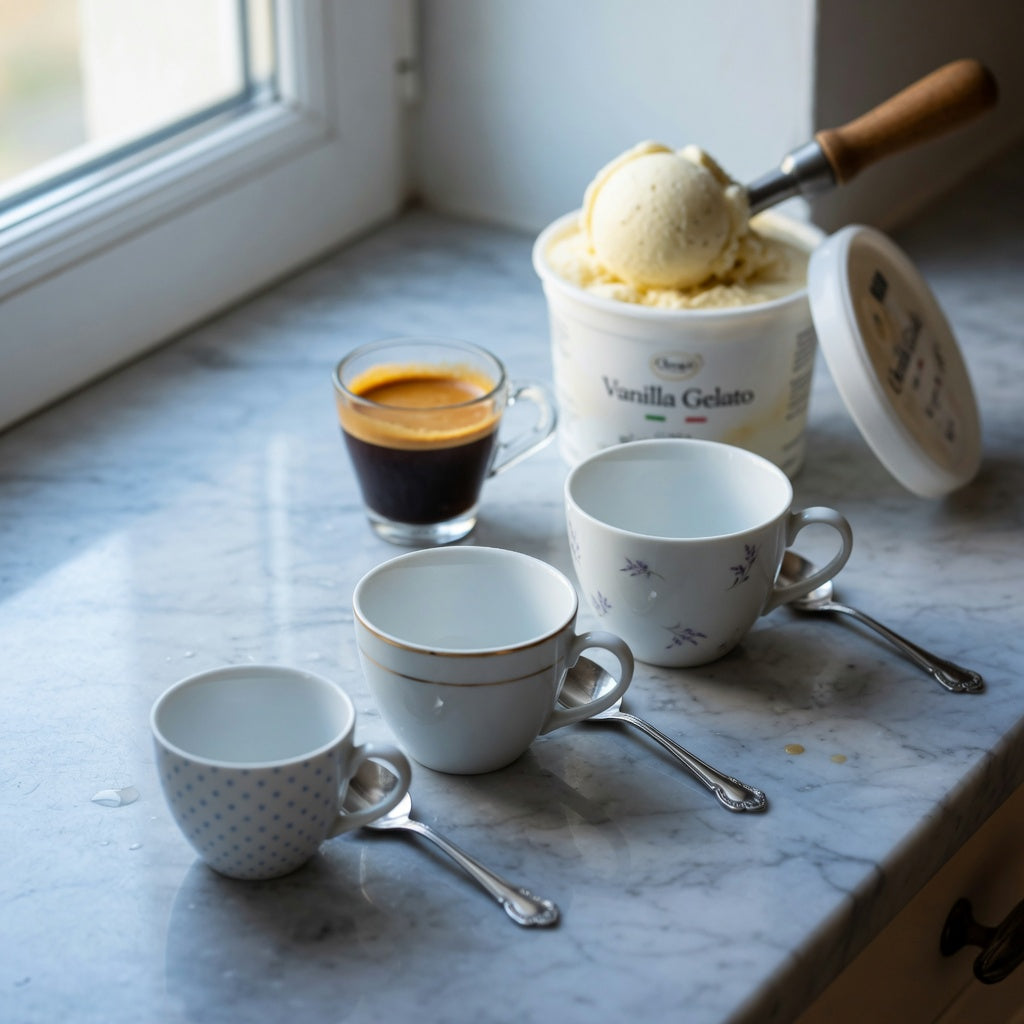
What Size Cup for Affogato? Best Sizes in Oz and ML Compared
A 4–6 oz (120–180 ml) cup is the affogato standard: one 25–30 ml espresso shot plus one or two scoops of gelato with almost no headroom. See demitasse, rocks glass, and coupe sizes compared — and w...
Read more
Leave a comment
This site is protected by hCaptcha and the hCaptcha Privacy Policy and Terms of Service apply.