
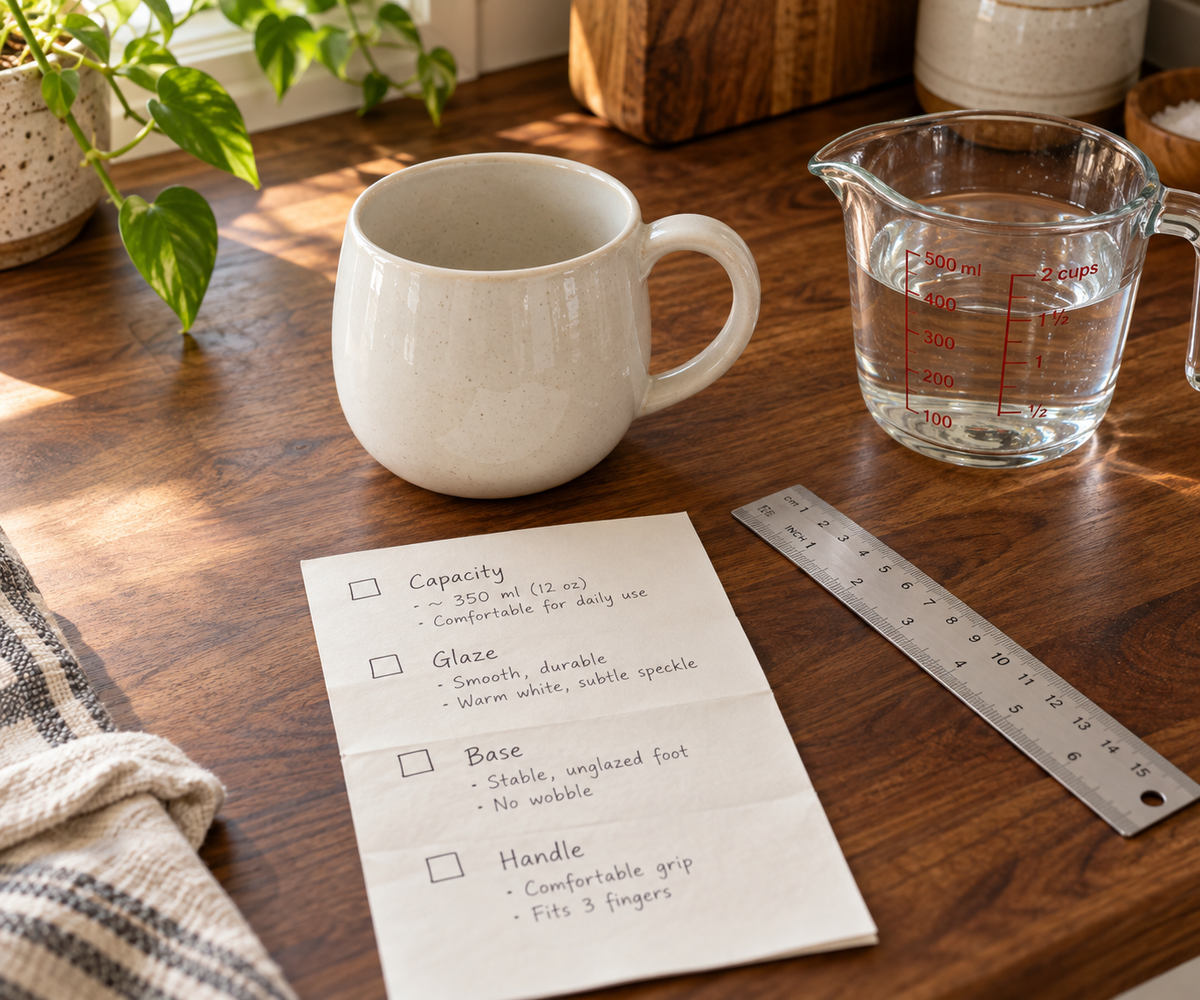
Round Coffee Mug Buying Checklist: 8 Things to Compare Before You Buy
Reading time: about 9 minutes
A photo a shopper sent us last month: the rounded mug she had just bought somewhere else, mid-rock on a granite counter, coffee sloshing toward the rim every time she set it down. Her question was blunt — would ours do the same? That question, and the dozen variations of it our store team fields every week, is why we built this round coffee mug buying checklist. Everything below comes from those conversations about the mugs in our unique coffee mugs collection — including our own Round Ceramic Coffee Mug — and from the returns we would rather have prevented.
The 8-point round coffee mug buying checklist our team actually uses
Work through the points in order. The first two kill most bad purchases before checkout does.
- Capacity mapped to your actual drink. Espresso, cappuccino, drip and oversized lattes each want a different volume — the table below sorts it out.
- Material and firing. Porcelain, stoneware and earthenware differ in weight, chip resistance and how scalding the wall feels a minute out of the microwave.
- Glaze safety you can verify. “Food-safe” printed on a box is a claim; lead-free and cadmium-safe statements tied to the glaze are closer to evidence.
- Handle and knuckle clearance. A curve changes where your fingers actually sit.
- Base flatness. The single most common fault we see in rounded bodies.
- Microwave and dishwasher compatibility, confirmed against the specific finish rather than assumed from the shape.
- Care matched to glaze type. Gloss, matte, metallic luster and hand-painted decoration age very differently.
- Gifting and shipping protection, because curved rims arrive chipped far more often than they should.
Want the shape-agnostic version first? Our general coffee mug buying checklist covers nine points across every silhouette. This one sticks to what changes once the body curves.
Which size round mug fits your drink — and why a “cup” isn’t 8 oz
Coffee maker “cup” lines measure 6 oz of brewed coffee, so a 12-cup machine brews 72 oz — and an 8 oz mug means refilling mid-pour. Rounded bodies complicate the math further: the belly eats interior volume, so a round mug usually holds less than a straight cylinder of the same height. Buy by fluid ounces, not by eyeball.
| Mug size | Drink it suits | What to know |
|---|---|---|
| 3–4 oz | Espresso | Rounded demitasses look great, but flat bases are rare at this size — check the foot before gifting one |
| 5–6 oz | Cappuccino, flat white, tea | Matches the classic 6 oz brewing “cup”: one machine cup fills it exactly once |
| 8–12 oz | Drip coffee, home latte, tea | The daily-driver range; 12 oz suits most café-style lattes made at home |
| 14–16 oz | Oversized coffee, soup, cereal | Expect a two-hand grip unless the handle is genuinely oversized |
Before ordering, confirm stated capacity in fluid ounces — for the mug we sell, that means the stated capacity and dimensions on its current listing. If any listing gives volume only as “regular size,” ask the seller before you pay.
How do you verify a glaze is lead-free and food-safe?
Properly fired ceramics with compliant glazes are safe for daily coffee. The risk concentrates in four corners of the market: pieces labeled for decorative use, vintage mugs, unverified handmade imports, and cheap novelty ware that may never have been fired to food-contact standards at all. Our verification sequence:
- Read for explicit claims. Lead-free and cadmium-safe statements should refer to the glaze itself, not just the packaging.
- Check for California Prop 65 warnings. A warning is not an automatic no — it’s your cue to ask whether decoration touches the drink line or only the outside wall.
- Treat “decorative use only” as a hard stop. That phrase exists because the maker won’t stand behind food contact. Pen holder, not pour-over.
- Assume vintage is unverified. Older glazes were made under different rules. Shelf duty beats boiling coffee every morning.
One trade-off worth naming: small handmade studios often can’t afford third-party testing even when their work is perfectly fine. Buying from a brand that specs its glazes shifts that uncertainty off your counter.
Does a round shape change taste — or hold heat longer?
Two honest answers, because this is where mug marketing drifts furthest from the science. Taste: published sensory research on crossmodal perception has found that the same drink can get rated differently depending on a vessel’s color and shape. The effect is real but subtle, and your kitchen is not a lab — buy the shape you enjoy holding, because that daily pleasure outweighs a few points of perceived flavor. Heat: no, curvature does not insulate anything. Wall thickness, material density and a lid hold heat; in our experience, thick stoneware of any silhouette outlasts thin porcelain by a wide margin. The trade-off nobody prints: rounded bodies rarely accept standard travel lids and they don’t stack. If lid compatibility or cabinet space drives your purchase, go straight-sided.
What should you inspect when the box arrives?
- Run the wobble test. Set it on a flat, hard surface and press the rim lightly. Any rocking means an uneven foot — the exact fault in that shopper’s photo.
- Flip it and read the foot ring. The unglazed ring should be smooth, evenly fired and grit-free. A rough foot scratches wooden tables and signals a rushed kiln run.
- Drag a finger around the rim. Feel for chips and judge thickness: a thin, gently rounded lip sips cleanly, while a thick rolled edge forces you to tilt further for the last third of the cup.
- Hold the belly to a light. The lowest curve is where thin glaze, pinholes and uneven coverage show up first.
- Grip it mid-sip. On curved walls, knuckles crowd the ceramic faster. You want a finger’s width of clearance; a 14 oz mug without it becomes a permanent two-hander. We go deeper on grip geometry in our checklist for ball-handled mugs.
Which finishes survive the microwave — and which need the sink?
Compatibility follows the finish, not the curve:
- Plain glossy glaze: generally the most forgiving in both appliances, but compatibility is stated per product, so confirm it on the listing rather than assuming it by category.
- Metallic luster, gold or silver rims: keep them out of the microwave. FDA microwave guidance warns against metal-decorated ware because the trim can spark.
- Matte glazes: lovely in hand, faster to show coffee oils and tea tannin. A baking-soda paste lifts most staining, and hand-washing keeps the finish matte — dishwasher detergents slowly polish matte surfaces glossy.
- Hand-painted exteriors: hand-wash, and keep scouring pads away from the artwork.
One habit that protects any ceramic mug: avoid thermal shock. Boiling water poured into a mug fresh off a cold windowsill can crack it. Pre-warm with hot tap water first — it costs nothing and keeps your coffee hotter, too.
Round vs straight-sided: where each mug shape actually wins
- Round wins on hand feel — the curve cradles a palm the way a cylinder never will — plus open-shelf presence and gift distinctiveness. Nobody mistakes a round mug for a conference freebie.
- Straight wins on stacking, standard-lid compatibility and dense cabinet storage.
- The measurement most buyers skip: a 16 oz round mug can measure wider across the belly than a straight 16 oz cylinder. Check the listed diameter, not just the height, against your shelf spacing before ordering a set.
Who our round ceramic mug suits — and who should skip it
The buyers happiest with a rounded mug share a profile: they drink one or two real cups a day rather than topping up constantly, they hold the mug while they work, and they want the object on their desk to look chosen rather than defaulted to. If that sounds like you, the rounded mug in our lineup is the shape this checklist was built around — verify its capacity, finish and care details on the current listing, and ask us anything the page doesn’t spell out.
Who should skip it: anyone who needs mugs to stack in a crowded cabinet, anyone who relies on travel lids, and anyone hunting a true 3 oz espresso cup. A straight-sided set will serve you better, and we would rather say that now than process the return.
As a gift, rounded mugs punch above their price because they read as deliberate. Our checklist for gifting ceramic mugs covers pairing and presentation; the one request we make of every gift buyer is to ask how the seller packs curved bodies. Loose tissue in a padded mailer is how rounded rims arrive chipped.
Before you order: the 60-second final sweep
Our team’s counter rule in one line:
If a listing won’t state capacity in fluid ounces or stand behind its glaze and finish, it’s a question mark, not a mug.
Your own sweep before any order: capacity stated in ounces, glaze safety spelled out, finish matched to your appliances, and a flat base you can verify the day the box lands. If a listing fails any of the four, email the seller — answering those questions is what we do all day. Ready to compare silhouettes side by side? Browse the full lineup of unique coffee mugs and see which shape earns shelf space in your kitchen.
Frequently asked questions
What size round coffee mug should I buy for daily coffee?
Most daily drinkers want 8–12 oz for drip coffee or a home latte, and 5–6 oz for cappuccino. Remember that a coffee maker’s “cup” is 6 oz, so a mug holds fewer refills than you’d guess. It’s the first item on our round coffee mug buying checklist for a reason: the listing should state capacity in fluid ounces, and if it doesn’t, ask before ordering.
How can I tell if a round ceramic mug is lead-free?
Look for lead-free and cadmium-safe statements that refer specifically to the glaze, check for a Prop 65 warning and ask whether decoration touches the interior, and treat anything marked “decorative use only” as unfit for hot drinks. Vintage mugs deserve extra caution, since their glazes were made under different rules.
Can round mugs go in the microwave and dishwasher?
It depends on the finish, not the curve. Plain glossy glazes usually tolerate both appliances, metallic or gold rims should never see a microwave, and matte finishes keep their look longer with hand-washing. Compatibility is stated per product, so confirm it on the specific listing before you buy.
Do round mugs keep coffee hot longer than straight mugs?
No — curvature itself doesn’t insulate anything. Heat retention comes from wall thickness, material density and whether you use a lid, which is also why round mugs rarely pair with standard travel lids. Judge warmth by the wall, not the silhouette.
Why is the bottom of a round mug left unglazed?
That unglazed ring — the foot — is where the mug rested against the kiln during firing, since glaze there would fuse it to the shelf. A smooth, evenly fired foot ring is a good sign, while a rough, gritty one suggests a rushed run and will scratch wooden tables.
Read more

Coffee and Tea Mug Buying Checklist: 8 Comparisons Before You Buy
Label ounces versus real ounces, handle clearance, rim and foot-ring finish, care claims — this is the coffee and tea mug buying checklist our team runs on every mug before it earns a listing, so y...
Read more
Unique Tea Mug Gift Ideas: What to Compare Before You Buy
A store-side guide to unique tea mug gift ideas: compare capacity, handle fit, infuser needs, and care instructions before buying — including where a large ceramic mug like The Flow fits, and where...
Read more
Leave a comment
This site is protected by hCaptcha and the hCaptcha Privacy Policy and Terms of Service apply.