
Rock Mug vs Ceramic Mug: Material, Heat, Safety & Care Compared
Reading time: about 10 minutes
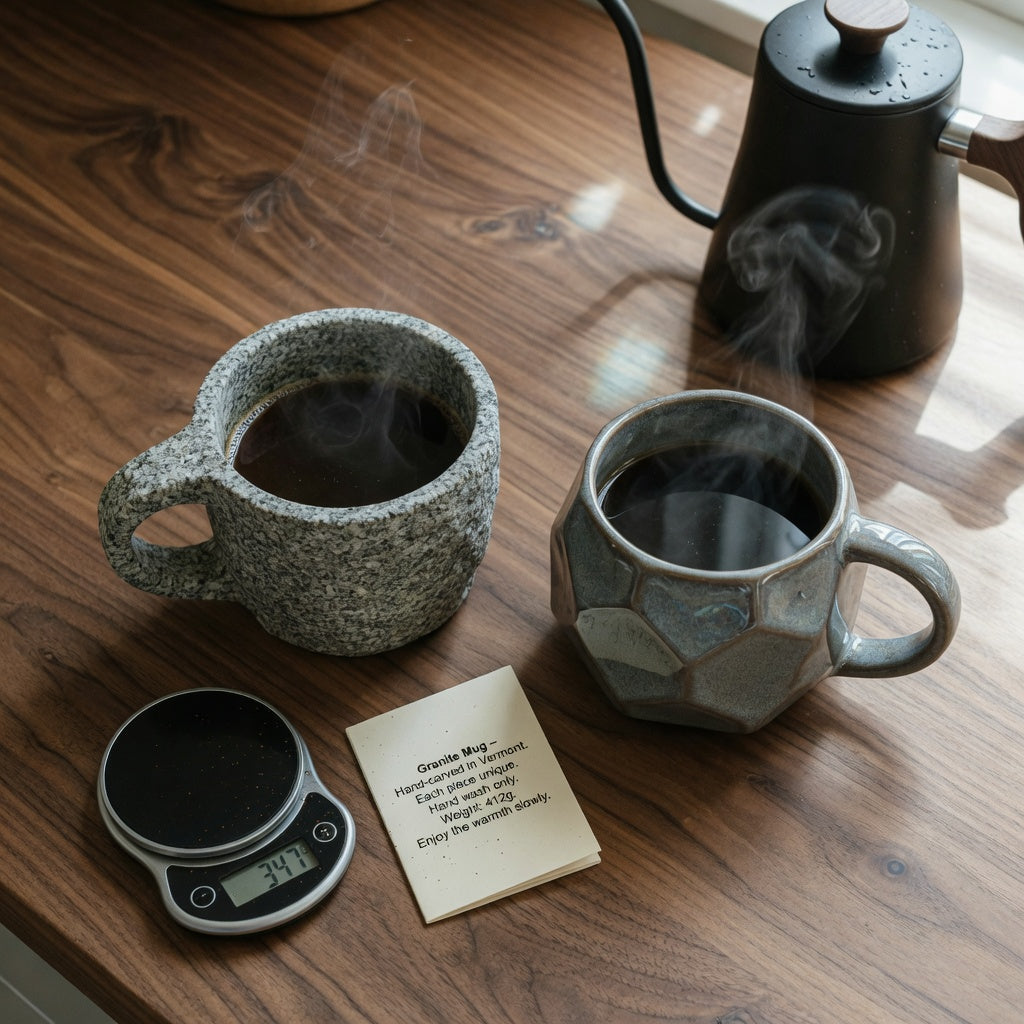
In our store, the first thing customers do when they pick up a carved stone mug is frown and ask why it feels cold — cold like it just came out of a fridge, even though it has been sitting on the shelf all day. That single moment captures most of the rock mug vs ceramic mug decision. The two look nearly identical in product photos. In your hand, in the microwave, and at the sink, they behave like different products entirely, and most listings never explain how.
We sell and ship mugs for a living, and “rock mug” is the most misunderstood phrase in our category. Before you compare anything, make sure you are comparing the right two objects.
First, which “rock mug” are you actually comparing?
The same search term describes two completely different products:
- Carved natural stone mugs. Solid rock — granite, soapstone, onyx, or basalt — cut, hollowed, and polished. No clay, no kiln.
- Rock-look ceramic mugs. Ordinary stoneware molded with a faceted or rough texture, then glazed so it reads as stone from across the room.
Listings blur this line constantly, so verify with your hands and the product details rather than the hero photo:
- Turn the mug over. Ceramic shows a glazed body with a small unglazed foot ring, usually stamped by the maker. Carved stone is rock all the way through — grain, tool marks, no glaze line.
- Feel the temperature. Natural stone sits cool at room temperature and warms slowly in your palm; ceramic feels neutral.
- Read the material line word by word. “Hand-carved granite” and “ceramic with a stone-look finish” are not the same product and will not survive the same care routine.
Once you know the difference, you will spot it everywhere — including across our unique coffee mugs collection, where rock-textured pieces and genuinely carved pieces can sit only a few tiles apart. Questions about our own The Rock Coffee Tea Mug come up so often that we tell every caller the same thing: read the material and care lines on the listing first, photos second. If a seller will not state plainly what a rock mug is made of, that silence is information.
If a seller will not tell you what the mug is made of, they have told you something anyway.
Granite, soapstone, or fired clay: what are you actually holding?
Natural stone mugs are exactly what they sound like. Granite is an extremely hard igneous rock, so carved granite mugs hold crisp edges and a polished but stone-honest surface. Soapstone is softer, with a smooth, almost waxy feel, and it is chemically inert — one reason it shows up in laboratory counters as well as kitchens. Onyx and basalt mugs exist too, usually as statement pieces.
Ceramic follows a different manufacturing story: clay is shaped, dried, then fired in a kiln at high temperature until the body hardens. Stoneware and porcelain fire at different ranges, and porcelain emerges denser and typically thinner-walled — we break down that fork in the road in our ceramic vs porcelain mug comparison. The finish step matters most: glaze is essentially glass fused onto the clay, which is why a glazed ceramic mug does not absorb coffee, oils, or odors.
A stone mug has no glaze unless the maker adds one. Its drinking surface is polished rock, and everything about its long-term behavior — staining, sealing, cleaning — flows from that single difference.
Are stone mugs safe to drink from, and is ceramic automatically safer?
Both categories can be completely food-safe, and both have a failure mode worth knowing.
With ceramic, the material itself is rarely the issue — the glaze is. Properly fired ware from established manufacturers locks the glaze down. The documented caution involves vintage, decorative, or carelessly fired handmade pottery: regulators such as the FDA have long warned that lead can leach from improperly formulated ceramic glazes. Buying from a maker who states food-safe glazing closes most of that gap.
With stone, the questions shift to the finish. Ask, or look for in the listing:
- Is the interior sealed, and is the sealer rated food-safe?
- Which stone is it? Soapstone's inertness is a genuine point in its favor, while unsealed granite can drink up coffee oils and stain within days.
- Is there a care card? In our experience, sellers who include one have usually thought the whole product through.
Honest limitation: neither category carries a certification you can simply assume. If a listing is quiet on food-contact finish, email the seller before buying — for stone especially.
Rock mug vs ceramic mug on heat: does stone actually keep coffee hotter?
You will see confident claims in both directions. Here is where our team lands after handling both materials daily: we have not found a published, independent test that logs temperature over time for carved stone mugs against ceramic mugs, and we will not invent one. What we can say comes from handling and basic physics:
- Stone feels cold at first because it is dense and pulls heat from your hand and your pour. An unheated stone mug actively robs the first minutes of heat from your coffee.
- Once a stone mug is fully warmed, that same mass works for you — thick stone walls hold temperature steadily.
- Ceramic reaches drinking temperature faster and behaves more predictably, especially thinner-walled porcelain.
In practice, wall thickness and preheating matter more than the material label. Rinse any mug with hot tap water before the pour and you will do more for your coffee's lifespan than any stone-versus-ceramic argument. Skeptical? Run the test yourself: pour, then check the temperature at one, five, and fifteen minutes. And when a seller claims porous stone changes how coffee tastes, treat it as marketing — independent evidence for that is just as thin.
Weight in the hand: what a full pour does to your wrist
Liquid is heavy no matter the vessel — 350 ml of coffee adds roughly 350 g before the mug itself weighs anything. Stone is denser than fired clay, and stone mugs typically carry thicker walls, so a stone mug starts the race already heavier and pulls further ahead with every pour. Pick one up blind and you will know which it is.
That heft splits buyers cleanly:
- Heft works against you if you have wrist or grip issues, you sip at a desk for hours, you have small hands, or you stack mugs in a shallow cabinet.
- Heft works for you if you like a mug with presence, you drink outdoors where a light mug tips in a breeze, or the mug is a gift meant to feel substantial through the wrapping paper.
Check the handle too. Carved stone handles tend to be thick, slab-like affairs, and a photo of the mug held in a hand tells you more than any dimension list.
Microwave, dishwasher, and daily care: what each material expects
This is where the two differ most in daily life. The table reflects general care patterns for each material — always confirm the specific listing before you buy:
| Daily task | Carved stone mug | Ceramic mug |
|---|---|---|
| Microwave | Usually not recommended; trapped moisture in stone can heat unevenly. Only if the listing says so explicitly. | Yes for most, unless there is metallic trim or decoration. |
| Dishwasher | Hand washing is the safer default; harsh detergents can dull polished stone and degrade sealers. | Most are dishwasher safe; check the maker's care note. |
| Boiling water | Generally fine, but sudden extreme temperature swings can stress any material. | Fine for well-fired ware; avoid pouring boiling water into an ice-cold mug. |
| Staining | Unsealed stone can absorb coffee tannins and darken. | Glazed surfaces resist staining; the unglazed foot ring may discolor. |
| Upkeep over time | Some stones and finishes need periodic resealing. | Nothing beyond normal washing. |
Damage patterns differ as well. From the mugs we handle day to day, ceramic tends to fail loudly — a chip leaves a sharp glaze edge, and that mug's daily-driver career is effectively over. Stone usually fails quietly, with small crumbles along an edge rather than a shattered lip. That observation comes from handling, not lab testing, but if you are hard on your mugs it is worth weighing.
What you are paying for: carved stone versus molded clay
Price follows the process. A ceramic mug is formed in a mold and fired in batches, which is why solid, well-glazed stoneware stays affordable. A carved stone mug is cut from a block, hollowed, then ground and polished — hours of extra work on a material that can crack mid-production, and no two finished pieces share the same grain. A rock-look ceramic mug delivers the rugged aesthetic at ceramic prices because the “rock” is simply texture in the mold. Decide which of those you are actually paying for before comparing price tags.
Which mug fits your routine — and which one will fight it?
Match the material to the morning, not to the aesthetic:
- You reheat coffee in the office microwave. Ceramic, without question. A stone mug will fight the single habit your routine is built on.
- You are buying a gift. A rock-look ceramic carries the rugged look with none of the care burden — we walk through what to compare in our buyer's guide to The Rock mug as a gift.
- You sip slowly and hate a lukewarm first sip. Choose a preheated thick ceramic — or stone, if you will commit to preheating it too.
- You want the stone look without hand-washing anything. Rock-textured ceramic again. It is the pragmatic middle path, and a large share of mugs sold as “rock mugs” are ceramic underneath.
If the pour itself — rim shape, drip behavior, how the mug feels mid-sip — matters more to you than the material, our flow mug vs ceramic mug comparison covers that angle in depth.
A 60-second checklist before you buy either one
- Identify the real material — carved stone or rock-look ceramic — from the listing's material line, the weight, and the foot.
- Confirm the food-contact finish: food-safe glaze for ceramic, food-safe sealer for stone. Silent listing? Ask.
- Check the care labels against your actual habits: microwave use, dishwasher, resealing.
- Read the weight spec and picture it filled. Your wrist lives with this decision daily.
- Match capacity to your brew — your usual pour should not threaten to overflow the rim.
Ready to act? Open The Rock Coffee Tea Mug, run its listing through the five steps above, then compare it against the rest of our unique coffee mugs collection. Five minutes spent on the material line will tell you more than an hour of scrolling photos.
Frequently asked questions
Are stone mugs actually safe to drink from?
Yes, when the stone and its finish are intended for food contact. The key questions are whether the interior is sealed with a food-safe sealer and whether the seller states food-contact suitability. Soapstone is chemically inert, which works in its favor; for any stone mug, an explicit food-safe note or a direct confirmation from the seller is what you want before daily use.
Can you microwave a rock mug?
Most stone-mug makers advise against it. Dense stone can heat unevenly, and trapped moisture inside the rock can cause cracking or surprising exterior heat. Unless the listing explicitly states microwave safety, treat the microwave as off-limits and reheat your coffee in a vessel you know is rated for it.
Is a stone mug dishwasher safe?
Frequently no, or at least not recommended. Dishwasher detergents are harsh enough to dull polished stone and can degrade sealers over time, so hand washing is the safer default. Ceramic is more forgiving — most glazed mugs are dishwasher safe unless they carry metallic trim — but confirm both on the specific listing.
In a rock mug vs ceramic mug matchup, which keeps coffee hotter?
Neither wins on the material name alone. An unheated stone mug pulls heat from your first pour because of its mass, while ceramic reaches drinking temperature faster; a fully preheated thick stone mug then holds temperature steadily thanks to those same dense walls. Preheating with hot tap water and choosing thicker walls will shape your coffee's temperature more than the label does.
How do I tell if a “rock mug” is real stone or just ceramic?
Turn it over and feel the weight. Real stone is rock through and through — no glaze ring, no maker's stamp, cool to the touch even at room temperature — while ceramic shows a glazed body with an unglazed foot ring and feels neutral. The listing's material line settles it: “hand-carved granite” and “ceramic with a stone-look finish” are different products that need different care.
Read more
Golden Waves Coffee Mug vs Tea Mug: Which One Should You Buy?
A store-team take on the golden waves coffee mug vs tea mug question: what really differs (capacity, shape, handle, care for gold decoration), when one dual-use mug covers both drinks, and the thre...
Read more
Great Mountain Ceramic Coffee Mug Gift: 7 Checks Before Checkout
A seven-point pre-checkout comparison for a great mountain ceramic coffee mug gift: how to read stoneware vs. porcelain claims, tell raised designs from decals, confirm a food-safe glaze, match oun...
Read more
Leave a comment
This site is protected by hCaptcha and the hCaptcha Privacy Policy and Terms of Service apply.