

Great Mountain Ceramic Coffee Mug Gift: 7 Checks Before Checkout
Reading time: about 10 minutes
Every week, the same unboxing moment repeats itself: wrapping paper off, mug out, and the recipient flips it base-up before the mountain artwork even registers. Thumb across the foot ring. Knuckle rap on the rim. A quick look at the handle join. People judge mugs the way they judge used cars — fast, tactile, and with strong opinions. If a great mountain ceramic coffee mug gift is on your list this year, run that same inspection before checkout, not after the wrapping paper hits the bin.
We sell and ship ceramic mugs from our store year-round, and the questions that fill our inbox are almost never about the artwork. They're about ounces, glazes, dishwashers, and whether the parcel survives the courier. Those are the right questions. This guide walks through the seven checks we run with every buyer, using our Great Mountain coffee tea mug as the working example — and flagging, every time, which details you should confirm on the current listing rather than assume.
Is a mountain mug the right gift for this person — or should you pick a different style?
Gift messages and order notes tell us a lot about who actually loves this style. From what we see, four kinds of recipients light up at a mountain design:
- Hikers and trail people who already own the water bottle, the patches, and the topo map — the mug becomes the kitchen version of the hobby.
- National-park and cabin-decor fans building a shelf of outdoorsy pieces.
- New homeowners who need to start a mug set somewhere and would rather start with character than with plain white.
- Desk coworkers, because a sculpted mountain starts conversations a plain mug never will.
Just as useful is who to skip it for. Espresso drinkers want small cups, not big novelty vessels. Commuters need a sealed travel lid. Anyone with sore hands or arthritis may struggle with a heavy stoneware body, and in a minimalist kitchen, novelty designs tend to die in the back of the cabinet. For those recipients, pick a different style from our unique coffee mugs collection instead — a gift should match the person, not the sender's enthusiasm.
Stoneware, porcelain, or earthenware: what body are you actually buying?
Nearly every mug on the market hides behind the single word "ceramic," and the three main body types behave very differently:
- Stoneware fires at roughly 1,200°C — hot enough to vitrify the clay. The result is dense, chip-resistant, and thick-walled, so it holds heat well and weighs more.
- Porcelain fires even hotter and can be made thinner, which makes it lighter and more refined but less forgiving when it meets a hard floor.
- Earthenware fires at lower temperatures and stays more porous, so it's common on decorative pieces and usually wants gentler care.
The body predicts the mug's whole personality: how it lands on a desk, whether the rim survives a sink knock, how long a pour-over stays warm. A good listing names it. If a product page — ours included — says only "ceramic" with no body type, treat that silence as a question to send the seller before you order.
One honest trade-off: a chunky stoneware mug feels wonderful on a frozen morning and less wonderful in hands with arthritis. Weight is a feature and a flaw, depending on who's holding it.
Lead, cadmium, and glaze safety: what to settle before you gift
Regulators including the FDA set limits on lead and cadmium in food-contact ceramics because certain glazes — mainly on vintage pieces, unverified handmade imports, and anything labeled decorative use only — can leach heavy metals into hot, acidic drinks. Daily coffee is exactly that scenario: hot and acidic.
- Buy mugs whose listing states the glaze is food-safe in the drinking and lip-contact areas.
- Take "decorative use only" labels literally. A piece meant for a shelf is not meant for a morning pour.
- Treat thrifted or inherited vintage mugs as display items unless their history is genuinely known.
Gloss describes appearance, not composition. For the Great Mountain mug, the current product listing is where a food-safety statement gets confirmed — we'd much rather a buyer email us and ask than assume a shiny finish guarantees anything, because it doesn't.
Raised ridges, printed decals, or hand paint: how the design is built decides how it wears
Mountain mugs come in three main constructions, and each one ages differently:
- Raised or embossed (3D) designs are shaped with the body, so you feel the ridge under your thumb. They don't peel — but the high points are exactly where chips start when a mug meets a faucet or the sink edge.
- Printed decals sit smooth in the glaze. They handle dishwashers for years, though harsh detergent and high-heat drying can dull the print gradually.
- Hand-painted pieces vary slightly from mug to mug, which is the charm — and they usually prefer a gentle hand wash.
"Will the ridges survive the dishwasher?" is the question our team fields most often on raised-design mugs — and the honest answer depends on the body and the build, which makes it a listing question, not a guess.
Check which construction the Great Mountain listing describes, then think about the recipient's actual kitchen. A raised mountain range is a great desk conversation piece and a weaker match for a shared office dishwasher that runs twice a day.
10–12 oz or 15–18 oz: matching capacity to how the recipient actually drinks
Capacity is where mug gifts most often miss. The design can be perfect and the size still wrong for how that person drinks.
- 10–12 oz suits drip and pour-over drinkers, desk coffee, and tea with room for milk — the standard daily shape.
- 15–18 oz fits home-latte people, camp-style servings, soup on cold days, and anyone who considers a second refill a chore.
- Under 10 oz serves the espresso-and-cortado crowd, whom gift buyers underserve constantly.
Two practical notes. A stated capacity usually means filled to the brim, so usable volume runs lower once you leave headroom for milk or foam. And an oversized mug may not clear the drip tray of a single-serve brewer or fit a car's cup holder. Confirm the stated ounce capacity on the listing rather than eyeballing the photos — mug photography is notoriously bad at scale. Our size, material, and safety comparison for this mug goes deeper on the fit questions.
Thermal shock, dishwashers, and microwaves: how ceramic mugs actually die
In our experience, ceramic mugs rarely die from defects. They die from temperature swings. Boiling water into a mug that sat in a cold car overnight is the classic crack scenario, and so is rinsing a hot mug under a cold tap. The early warning sign is crazing — a spiderweb of fine hairlines in the glaze — which shows up before an actual break.
- Let a mug come toward room temperature before a hot or iced fill, especially in winter or straight from the fridge.
- Keep ceramic off the stove: an empty mug on a burner, or a dry run in the microwave, is how handles and rims separate.
- Dishwash on the top rack if the listing allows it — harsh detergent plus high-heat drying is what slowly dulls printed designs.
- Microwave only what the listing clears. Plain glazes are usually fine; metallic paint or trim is not.
Care labeling is the detail that separates a mug you can gift confidently from one that needs an asterisk. Look for it stated plainly on the Great Mountain listing — and if it isn't there, that's an email worth sending before the order, not a support ticket after the crack.
Shipping, breakage, and timing: the gift logistics most listings skip
A mug is the most fragile thing most people ship all year. Before checkout, three logistics questions matter more than the artwork:
- How is it packed? Look for protective packaging around the mug itself, ideally a double-boxed setup for courier transit, and ask about gift wrap or a handwritten note if it's going straight to the recipient.
- What happens if it arrives broken? Ask about the replacement policy now. Sorting out breakage after the birthday is worse for everyone involved.
- When should you order? Holiday couriers slow down every December, and a direct-to-recipient shipment removes your buffer entirely.
One detail almost nobody plans for: a parcel that sits on a freezing porch lets the mug go fully cold, so the first boiling pour becomes textbook thermal shock. Let the gift reach room temperature before its maiden brew.
The seven checks before checkout on a great mountain ceramic coffee mug gift
Here's the exact list we walk buyers through, condensed to seven checks. Run it against the listing in ten minutes:
| Check on the listing | Why it matters |
|---|---|
| Stated capacity in ounces | Predicts whether it matches the recipient's real pour — remember brim-full vs. usable |
| Body type: stoneware, porcelain, or earthenware | Forecasts weight, chip resistance, and heat retention |
| Design construction: raised, decal, or hand-painted | Decides the texture, the chip points, and the dishwasher fate |
| Food-contact / glaze statement | Separates a daily mug from a decorative-only shelf piece |
| Dishwasher and microwave labeling | Prevents dulled designs, sparked trim, and cracked handles |
| Base glazing | An unglazed foot ring can leave fine scratches on glass tables and shelves |
| Packaging and breakage policy | Determines whether the gift survives the courier — and what happens if it doesn't |
For the same comparison applied across the rest of the category, our category-wide comparison of ceramic mountain coffee mugs covers the same ground with other designs in the lineup.
If the seven answers line up, check out with the Great Mountain coffee tea mug. If one of them doesn't fit the person on your list, browse our unique coffee mugs until a design does — a mug that matches the recipient beats a mug that merely matches the wrapping paper. Ten minutes of comparing now beats a gift that chips by February, and if any answer isn't on the listing, ask us. We field these questions every day.
Frequently asked questions
Is a great mountain ceramic coffee mug gift dishwasher and microwave safe?
Check the current listing's care label first — that's the authoritative source for this specific mug. As a general rule, plain glazed ceramics tolerate dishwashers on the top rack, while metallic decoration should never go near a microwave. If the listing doesn't state either, ask the store before gifting so your recipient isn't left guessing.
What size coffee mug makes the best gift?
Most daily drip and pour-over drinkers are happy with 10–12 oz, while home-latte and camp-style drinkers prefer 15–18 oz. Remember that stated capacity usually means filled to the brim, so usable volume is a little lower. Match the size to how the person actually drinks, not to the biggest option on the shelf.
Do ceramic mugs contain lead?
Lead and cadmium in food-contact glazes are regulated because some glazes — mainly on vintage, unverified, or decorative-only pieces — can leach into hot, acidic drinks. The practical safeguard is simple: buy mugs whose listing states a food-safe glaze, and keep decorative or vintage pieces off the daily coffee rotation.
Will a raised mountain design chip or peel over time?
Raised designs are shaped with the ceramic body rather than painted on top, so they don't peel — but the highest points are where chips start after hard knocks against faucets or sinks. Printed decals don't chip the same way, though they can slowly dull under harsh dishwasher detergent. Which build applies to the mug you're buying is a listing question worth asking before you order.
How do I stop a ceramic mug from cracking?
Avoid sudden temperature swings: no boiling water into a freezer-cold or car-cold mug, no hot mug under a cold tap, and never an empty mug on a burner. Let the mug move toward room temperature first. Watch for crazing — fine hairlines in the glaze — as the early warning before an actual break.
More from our blog
Read more
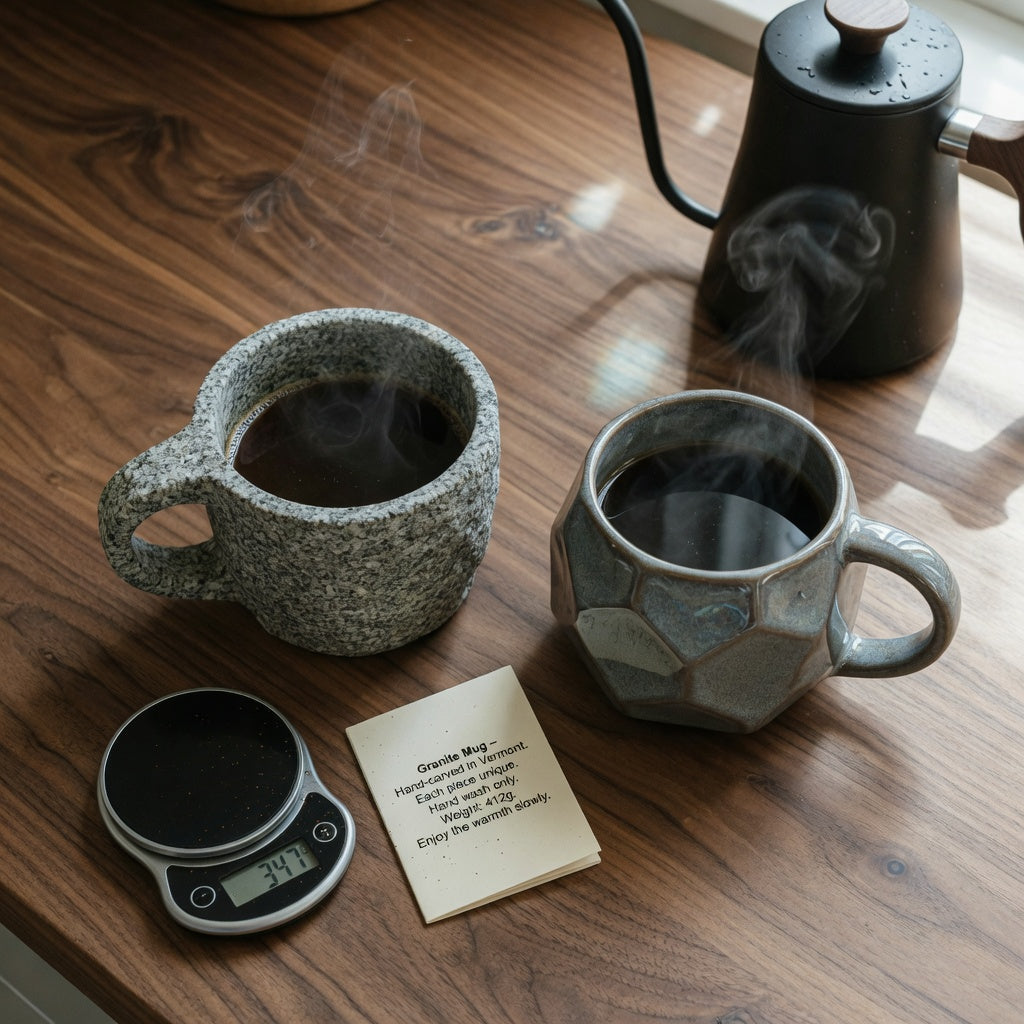
Rock Mug vs Ceramic Mug: Material, Heat, Safety & Care Compared
A practical rock mug vs ceramic mug comparison from a team that handles these mugs daily: how to spot real carved stone, which material is safer, how each handles heat, weight, microwaves and dishw...
Read more
Large Ceramic Tea and Coffee Mug Gift: What Buyers Should Compare
Large on a label can mean 14 ounces or 24, and that gap decides whether the gift gets used daily or shelved. Here is the comparison list we give customers before they order: true capacity, food-saf...
Read more
Leave a comment
This site is protected by hCaptcha and the hCaptcha Privacy Policy and Terms of Service apply.