
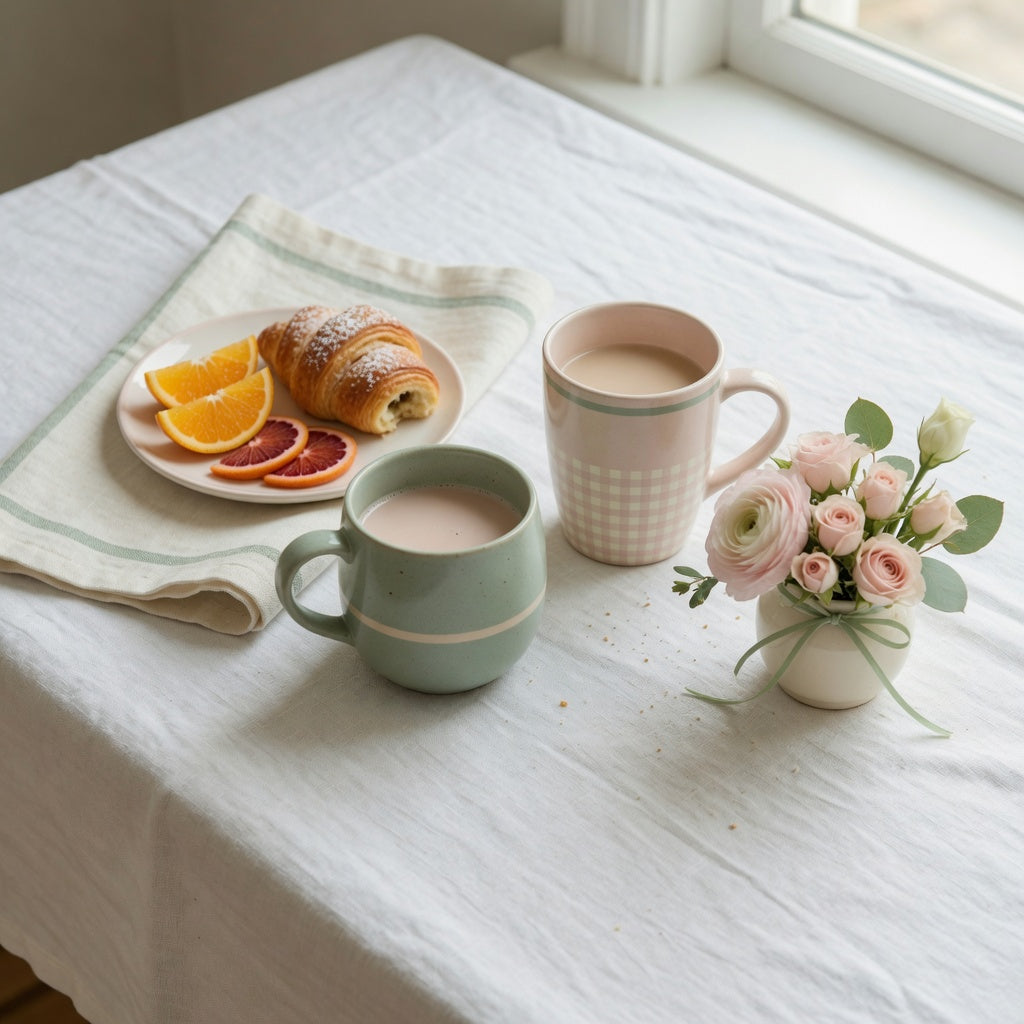
Preppy Coffee Mug: Compare Shape, Material, and Care
Reading time: about 9 minutes
A mug can look polished in a square product photo and feel wrong the first time it reaches a real brunch table. The handle presses into your knuckles, the tall body crowds a water glass, or the pastel bow competes with a patterned plate. A useful preppy coffee mug has to do more than carry gingham, stripes, florals, or a soft color palette. It must suit the drink, the hand holding it, the available cabinet space, and the owner's cleaning routine.
At CoffeifyMug, we compare this category on a counter, beside tableware, and at a desk—not only against a white photo background. We pay attention to details shoppers often miss: the foot ring under the base, clearance inside a C-shaped handle, headspace above a normal pour, and the design's position beside the handle. Use the current product listing as the final source for exact material, capacity, dimensions, and care; a shape name or styled photo cannot answer those questions.
What makes a preppy coffee mug work at a real brunch table?
Preppy drinkware generally falls between classic prep—stripes, checks, greens, navy tones, and nautical details—and softer coquette styling such as blush colors, bows, and small florals. Both can look intentional. Problems start when one mug combines too many visual cues or ignores the plates already on the table.
Before choosing a print, set a similarly sized cup beside your usual plate and napkin. Then browse our unique coffee mugs collection with those surroundings in mind. This makes it easier to judge the mug as tableware rather than as an isolated design.
- Pattern scale: A small check, narrow stripe, or single bow usually mixes more easily than a full wrap competing with patterned dishes.
- Color role: Decide whether the mug should match the linens, repeat an accent color, or provide the only bright note. Asking it to do all three often makes the setting busy.
- Design orientation: A one-sided graphic may face the drinker or the room depending on which hand holds the mug. Check all listing images if presentation matters.
- Set logic: Mismatched mugs look deliberate when they share one feature, such as shape, color family, or pattern scale. Random sizes and unrelated motifs tend to look like cabinet leftovers.
Round or tall: which silhouette fits your place setting?
Silhouette changes the visual balance of a table, but it does not prove capacity, weight, or stability. A tall mug can have a broad base, while a round mug can have a narrow contact ring. Stability depends on the base and how the mass is distributed, so shape should be treated as a starting point rather than a performance guarantee.
For a seated brunch with plates, bowls, glasses, and serving dishes, begin by comparing the Round Coffee Tea Mug. A rounded outline generally blends with traditional tableware and keeps the mug from becoming the visual centerpiece. Confirm its current measurements and capacity on the product page before deciding.
If the mug will spend more time on an open shelf or a styled coffee station, compare the Landscape Tall Coffee Tea Mug. A taller outline provides stronger vertical presence and can work well as a display-forward choice. Measure the shelf clearance, though; tall does not automatically mean larger capacity, and it may not fit beneath a low cabinet.
| Reader situation | Better starting point | Verify before purchase |
|---|---|---|
| Crowded seated brunch | Round profile | Overall height, handle projection, and base width |
| Open shelf or coffee station | Tall profile | Shelf clearance, design direction, and listed capacity |
| Larger morning drink | Either shape | Actual capacity and room for comfortable headspace |
| Outdoor table or busy desk | Compare the bases | Contact-ring width, flatness, and total footprint |
Ceramic mug or lidded glass cup: which matches your drink?
Preppy search results often mix ceramic mugs with can-shaped glass cups, lids, and straws. The visual theme may match, but the use case does not. A traditional 11-ounce ceramic mug with a C-shaped handle is a common retail format, and product pages often state whether that mug is suitable for a microwave or dishwasher. Those details do not transfer automatically to every decorated cup.
- Hot coffee or tea at a table: Choose drinkware explicitly listed for hot beverages, then confirm the material and care instructions.
- Iced coffee at home or at a desk: A lidded glass cup may fit, but verify the glass type, capacity, lid care, straw care, and permitted temperatures. Do not assume clear glass is borosilicate.
- Drinks carried in a bag or car: Look for explicit leak-resistance, insulation, and cup-holder information. A ceramic mug or simple glass cup with a lid is not automatically travelware.
Ice also occupies part of the stated capacity, so compare the size with your finished iced drink rather than the coffee alone. If drop resistance, a sealed lid, or backpack use is the priority, a purpose-built travel tumbler is a better category than a decorative brunch mug.
Handle clearance, base contact, and capacity checks photos hide
The fastest way to avoid an unused mug is to inspect the parts that affect every sip. These are the checks our team considers before color or pattern settles the decision.
- Check the grip clearance. Decide whether you prefer a one-finger, two-finger, or fuller grip. A decorative loop can look delicate but become tiring during a long desk coffee. If dimensions are not shown, look for an image with a hand for scale and treat the missing measurement as an uncertainty.
- Inspect the handle joins. The upper and lower attachment points take stress each time a full mug is lifted. On arrival, look for hairline cracks, sharp ridges, or visible damage before putting a hot drink in the cup.
- Look underneath the base. Set the empty mug on a known-flat surface and check for rocking. A rough, unglazed foot ring may also mark a delicate table, so use a coaster if the underside is not smooth.
- Compare capacity with your normal pour. Measure your usual coffee, milk, or tea in a kitchen measuring cup. A listed 11-ounce capacity and a comfortable working fill are not necessarily the same because most people need some headspace below the rim.
Do the unboxing inspection before the first dishwasher cycle. Check the drinking rim for chips, the handle for movement or cracks, the base for instability, and the decorated surface for sharp or raised damage. If a rim or handle joint is compromised, stop and follow the seller's return process rather than testing it with a very hot drink.
Can the decoration handle your dishwasher and microwave routine?
Decorations are not all constructed the same way. An underglaze design sits beneath the glaze, while a surface decal, metallic luster, or raised appliqué has different exposure to abrasion and heat. A product photo may not reveal the construction, so the current listing's care language should carry more weight than assumptions based on appearance.
- Use a microwave only when the specific mug is stated to be microwave suitable. Never microwave metallic trim or decoration.
- If a surface print or raised detail has unclear care instructions, hand-wash it with a soft, nonabrasive sponge.
- If dishwasher use is permitted, position the mug so the decorated wall and handle do not rub against plates, tines, or another mug.
- For a glass cup with separate parts, confirm the care instructions for the lid and straw independently from the glass body.
Food-use claims deserve the same restraint. FDA guidance for food-use ceramicware describes action levels for extractable lead and cautions against labeling ceramicware containing extractable lead as Lead Free. That guidance is not a certification of a particular mug. We do not infer laboratory testing from a pastel glaze, a decorative photo, or vague safety wording; check the documentation and food-use information the current seller actually provides.
Which mug fits a brunch host, an office desk, or a display shelf?
The right recommendation starts with the recipient's routine. Aesthetic preference matters, but it should not override where the mug will be stored, cleaned, and carried.
- For a seated brunch host: Start with the round mug option because its outline is the more natural starting point beside plates and bowls. Confirm the current dimensions, material, and care before ordering multiples.
- For an open shelf or coffee station: Compare the tall mug option for stronger display presence. Measure vertical clearance and do not assume the extra height means extra volume.
- For a gift with uncertain taste: Use the unique mug collection to compare motifs, then favor a practical handle and a pattern that works beyond one themed event.
- For an office commuter: Prioritize a flat base, simple cleaning, and any required microwave compatibility for desk use. If the cup must travel in a bag or car, choose a different style unless the listing explicitly states that it is sealed and designed for transport.
A heavily embellished cup is not the best gift for someone who relies on a crowded shared dishwasher. A table mug is also not a substitute for insulated travel drinkware. Recognizing those limits prevents a pretty purchase from becoming shelf-only clutter.
Frequently asked questions
What should I compare before buying a preppy coffee mug?
Compare the silhouette, listed capacity, handle clearance, base contact, material, and care instructions before choosing the pattern. Check how the mug will fit beside existing dishes and inside the intended cabinet. Use the current product page for exact specifications rather than assuming them from a styled image.
Is a round mug or a tall mug better for brunch?
A round profile is usually the easier starting point for a crowded seated table because it visually blends with plates and bowls. A tall mug can suit a sparse setting, open shelf, or display-focused coffee station. Capacity and stability still need to be checked separately because shape alone does not establish either one.
Is an 11-ounce mug large enough for everyday coffee?
An 11-ounce ceramic mug is a common traditional format, but the right size depends on your usual pour. Measure the coffee and milk you normally use, then allow space below the rim. Choose a larger listed capacity if your drink only fits when the mug is filled uncomfortably close to the top.
Can I put a decorated preppy mug in the dishwasher and microwave?
Only if the specific listing says the mug is suitable for that appliance. Metallic decoration should not go in a microwave, while surface decals and raised details may benefit from gentle hand-washing when care information is unclear. Separate lids and straws can have different instructions from the cup itself.
Can a glass cup with a lid replace a ceramic brunch mug?
It can work for iced coffee at home, but it fills a different role on the table. A lidded glass cup is not automatically safe for hot drinks, leakproof, insulated, or suitable for commuting. Choose ceramic-style tableware for a traditional hot-coffee setting and purpose-built travel drinkware when transport is the priority.
Before adding a mug to your cart, run this short comparison:
- Is it for seated brunch, everyday desk use, shelf display, or travel?
- Does a round or tall outline fit the surrounding dishes and storage space?
- Does the listed capacity leave enough headspace for your normal drink?
- Can you confirm comfortable handle clearance and a practical base footprint?
- Does the listing state the material, food use, and relevant care instructions?
- Will the decoration survive the cleaning routine the mug will actually receive?
If those checks point to a table-ready mug rather than travel drinkware, compare the current details in our unique coffee mugs collection. Choose the shape that fits the actual pour, hand, cabinet, and care routine; let the preppy pattern be the finishing decision, not the only one.
More from our blog
Read more

Brunch Ceramic Mug: Compare Shape, Handle, Glaze and Care
A brunch mug has to fit beside a plate, feel balanced when full, and suit the care routine you actually use. Compare silhouette, handle clearance, glaze condition, food-contact safety, and round ve...
Read more
Quiet Coffee Mug Ceramic: Compare Bases, Glaze, and Shape
“Quiet” can mean a softer set-down on a desk or a mug that does not ping as coffee cools. Compare base materials, glaze condition, wall feel, care instructions, and shape before buying.
Read more
Leave a comment
This site is protected by hCaptcha and the hCaptcha Privacy Policy and Terms of Service apply.