
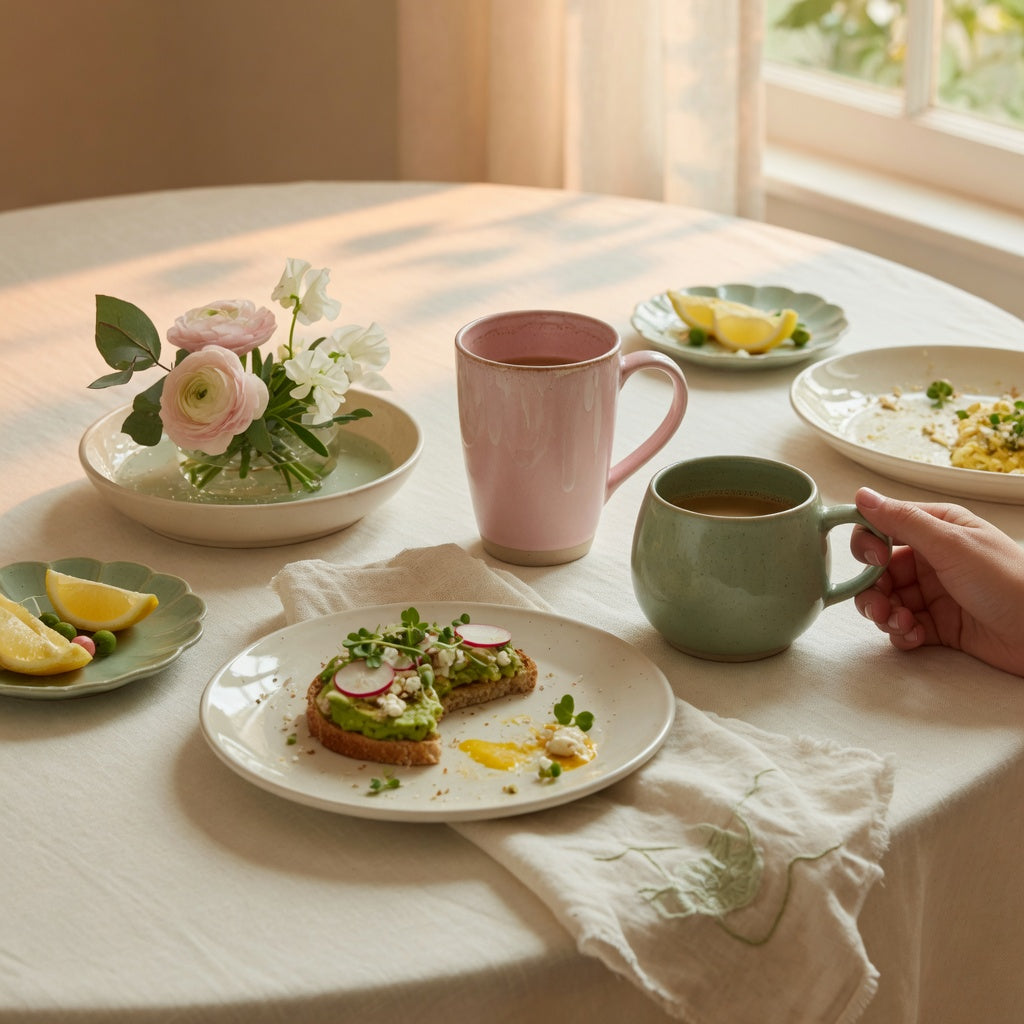
Brunch Ceramic Mug: Compare Shape, Handle, Glaze and Care
Reading time: about 10 minutes
A mug can look polished in a product photo and still be the awkward piece at brunch: its base crowds the side plate, the handle pinches once the cup is full, or the printed design turns out to need more careful washing than expected. A brunch ceramic mug has to work at a busy table, not just against a white studio background.
In our store, we evaluate mugs with the full routine in mind: the one-handed carry with a plate, the second coffee pour, the crowded dishwasher rack, the cupboard shelf, and the gift unboxing. Those moments reveal more than a decorative print does. Before buying, decide which practical compromises you are willing to make.
What job should a brunch ceramic mug do at your table?
The best brunch ceramic mug for a weekly gathering may not be the best weekday desk mug. Choose its main job first, because that decision changes which specifications deserve priority.
- Daily coffee and weekend brunch: Prioritize explicit care instructions, a stable base, comfortable handle clearance, and a size that fits your cabinet and dishwasher.
- Guest tables and styled place settings: Compare the mug's measured footprint, overall height, color, and design orientation against your plates, napkins, flowers, and serving dishes.
- Host or birthday gifts: Look for a design that suits the recipient, but also confirm food-use labeling and care requirements. A hand-wash-only gift is a poor fit for someone who machine-washes everything.
If the message, color, or unusual shape is the main reason for buying, start with our collection of unique coffee mugs for brunch and gifting, then check the live product page for capacity, dimensions, and care details. Ceramic is not the best choice for every setting: use glassware for mimosas and consider an insulated or less breakable cup for travel, poolside use, or rough stone patios.
Round or tall: which silhouette fits your plates and centerpiece?
Product photos often hide scale. Before ordering, use the listed maximum width, including the handle, to make a paper template. Place it beside your largest brunch plate, then mark the mug's listed height against a vase, candle, and cabinet shelf. This five-minute check catches table-fit problems that styled images do not show.
If you prefer a rounded profile that visually echoes bowls, curved plates, and softer table settings, review our round coffee and tea mug. Treat the shape as a starting point rather than a guarantee of compactness; confirm the current listing's footprint, capacity, and care information before checkout.
If a taller silhouette better suits your table or the vertical format is part of the appeal, compare the landscape tall coffee and tea mug. Check total height, base width, and handle projection. A mug described as tall is not automatically narrower or easier to store.
| Your setup | Detail to compare | Why it matters |
|---|---|---|
| Small bistro table | Maximum width with handle | Shows how much space remains for plates and serving bowls |
| Low flowers or candles | Overall mug height | Helps preserve clear sightlines across the table |
| Long coffee service | Listed capacity and practical fill level | Prevents choosing by visual scale alone |
| Kids or frequently passed platters | Base width and balance when filled | Reveals how forgiving the shape may be on a busy table |
| Tight cabinet or dishwasher | Height and handle projection | Confirms that the mug fits the way you store and clean it |
Round versus tall is primarily a styling decision until measurements enter the comparison. Use the silhouette to build a shortlist, then let the actual dimensions decide table and storage fit.
Does the ceramic label tell you enough about weight and warmth?
No. Ceramic is a broad category that includes porcelain, stoneware, and earthenware. The material name by itself does not reveal wall thickness, empty weight, firing quality, glaze condition, or how heavy the mug will feel after it is filled. Compare those details separately whenever the listing provides them.
Heat retention also cannot be predicted from the word ceramic alone. Wall thickness, rim opening, beverage volume, starting temperature, and room conditions all affect how a drink cools. A substantial wall may feel reassuring but adds weight; a wide opening displays latte foam or tea clearly but exposes more of the drink's surface.
If you routinely leave coffee untouched for long stretches, an insulated mug with a lid will suit that habit better than open ceramic drinkware. A decorative ceramic brunch mug is made for table service, not vacuum-flask performance.
Handle clearance, rim profile and balance: the hands-on checks
Brunch often means carrying coffee in one hand and a plate in the other. That makes handle geometry more important than it may seem in a front-facing product image. These are the areas our team checks first:
- Handle opening: Look for dimensions or an in-hand scale photo. If you prefer a three-finger grip, verify the clearance rather than assuming. A two-finger handle is not defective, but it can be less comfortable with a full mug.
- Handle attachment points: Inspect the upper and lower joints for hairline cracks, rough gaps, or chips. These joints take the load every time the filled mug is lifted.
- Rim profile: The drinking edge should be smooth, even, and free from chips. Fine web-like crack lines in the glaze are called crazing and deserve closer inspection on a food-contact surface.
- Base and foot ring: The mug should sit flat without rocking. If the underside is rough or unglazed, use a coaster on polished wood or delicate tables.
- Usable capacity: Ask whether the stated volume is measured to the brim. For a comfortable carry, most people need visible headspace rather than coffee filled to the lip; a finger-width below the rim is a practical reference.
No ceramic mug is unbreakable. Treat terms such as chip resistant as product-specific claims that need support from the maker. After delivery or gift unboxing, we inspect the rim, both handle joints, and the foot before the first wash because those are the areas where small shipping knocks are easiest to spot.
Dishwasher and microwave claims: what should be stated clearly?
The current product listing or packaging should explicitly say whether a mug is dishwasher safe or microwave safe. Ceramic is not a care rating. If the page is silent, our conservative approach is to hand-wash the mug and keep it out of the microwave until the maker confirms otherwise.
Decoration changes the decision. A design protected under or within the glaze is different from a surface-applied decal that is more exposed to detergent, rack contact, and abrasive sponges. Any metallic-looking line, lettering, or accent is also a reason to stop and verify microwave instructions rather than guessing.
- Inspect before first use. Check the dry mug under good light for rim chips, glaze damage, and fine cracks around the handle joints.
- Use the dishwasher only when approved. Position the mug so its rim and handle cannot knock against plates or other cups during the cycle.
- Use the microwave only when approved. A microwave-safe label does not promise that the handle will remain cool. Avoid empty heating and abrupt changes from refrigerator-cold to very hot.
- Clean decoration gently. Rinse away coffee, tea, and citrus residue, use a nonabrasive sponge, and dry the base before returning the mug to a wood shelf.
Our practical rule is simple: a care claim should appear on the current listing or packaging. The word ceramic is not a substitute for specific instructions.
Food-contact glaze: which warning signs should stop the purchase?
The FDA's guidance on lead-glazed pottery explains that lead can move from ceramic glazes or decorations into food or drink if pottery is improperly fired or contaminated during manufacture. Acidic beverages such as coffee and tea are particularly relevant. The FDA sets action levels for extractable lead in ceramic foodware, including mugs, and pottery that appears intended for food use is treated as foodware unless it carries the required not-for-food-use labeling.
- Confirm intended use: The seller should clearly present the piece as drinkware suitable for food contact, not merely as decorative pottery.
- Prefer a traceable maker: Commercial factory-made mugs from reliable manufacturers are generally less likely to present lead-glaze problems than unknown-origin pieces.
- Use extra caution with older or unknown pottery: Antique, excessively worn, damaged, unlabeled handmade, or brightly colored red, orange, or yellow pottery of uncertain origin deserves closer scrutiny.
- Reject damaged drinking surfaces: Do not use a mug with flaking decoration, a chipped interior, or severe glaze deterioration for hot drinks.
Handmade does not automatically mean unsafe. A responsible potter should be able to say whether the piece was made for food and drink and provide care guidance. A photograph cannot verify extractable lead, so if the origin or intended use remains unclear, keep the piece decorative and choose another mug for coffee.
Daily use, a host gift or a statement piece: where should you compromise?
Every mug asks the buyer to trade something: visual impact, easy care, capacity, storage space, or weight. Match that compromise to the person and setting.
- For everyday brunch and weekday coffee: Put explicit dishwasher and microwave instructions, handle comfort, and cabinet fit ahead of decorative detail.
- For a compact table with a rounded aesthetic: Start with the round option, then verify the maximum width and comfortable fill capacity on the live listing.
- For a taller visual statement: Compare the tall option's height, base, and handle projection against your plates, flowers, and storage space.
- For a host gift: Choose from the unique mug collection, but avoid giving a high-maintenance surface design to someone who relies on a dishwasher.
- For travel or frequent outdoor use: Skip ceramic. A lidded insulated vessel or less breakable material is the more practical purchase.
Frequently asked questions
Is a brunch ceramic mug automatically dishwasher and microwave safe?
No. Those are product-specific care claims, not automatic properties of every ceramic mug. Check the current listing or packaging for both statements, especially if the design includes a surface print or metallic-looking detail. If care information is missing, hand-wash the mug and do not microwave it until the maker confirms it is safe.
Should I choose a round or tall ceramic mug for a small brunch table?
Do not decide from the shape name alone. Compare maximum width, including the handle, overall height, and base dimensions, then make a paper footprint beside your plate. A tall mug may still have a broad base, while a round mug may fit well if its actual measurements suit the setting.
How can I judge ceramic mug handle comfort online?
Look for handle-opening dimensions or a photo showing the mug in a person's hand. Confirm whether your preferred two- or three-finger grip will clear the mug body, and check how far the handle projects for cabinet storage. If the listing provides no scale, ask the seller rather than assuming from a front-facing image.
How do I know whether a ceramic glaze is safe for coffee or tea?
Choose a mug that is explicitly sold for food and beverage use by a traceable maker, and inspect the drinking surface for chips, flaking, or heavy wear. Use added caution with antiques, damaged pieces, and brightly colored pottery of unknown origin. If a piece is marked decorative or not for food use, do not serve coffee or tea in it.
Will a printed brunch mug survive repeated dishwasher cycles?
That depends on how the decoration was applied and what the maker's care instructions allow. Surface-applied designs receive more direct exposure to detergent, rack contact, and abrasive cleaning than decoration protected by glaze. If print construction is not stated and preserving the artwork matters, hand-washing with a nonabrasive sponge is the safer routine.
Before checkout, confirm five lines on your comparison note: usable capacity, overall height and footprint, handle clearance, dishwasher and microwave wording, and an explicit food-use statement. If one is blank, ask before buying. Then compare the linked round and tall listings side by side, or return to our unique coffee mug collection to find a design that meets the same practical checks.
More from our blog
Read more
Filled Mug Gift Ideas for Coworkers: Compare Mug, Fillers & Fit
Compare mug dimensions, handle and rim comfort, care notes, office-safe artwork, dietary-aware DIY fillers, and wrapping. We also flag when a mug is likely to become clutter and a different gift is...
Read more
Preppy Coffee Mug: Compare Shape, Material, and Care
Compare silhouette, handle clearance, capacity, material, decoration, and care before choosing a preppy mug for brunch, work, or gifting. Includes round-vs.-tall guidance and a practical add-to-car...
Read more
Leave a comment
This site is protected by hCaptcha and the hCaptcha Privacy Policy and Terms of Service apply.