



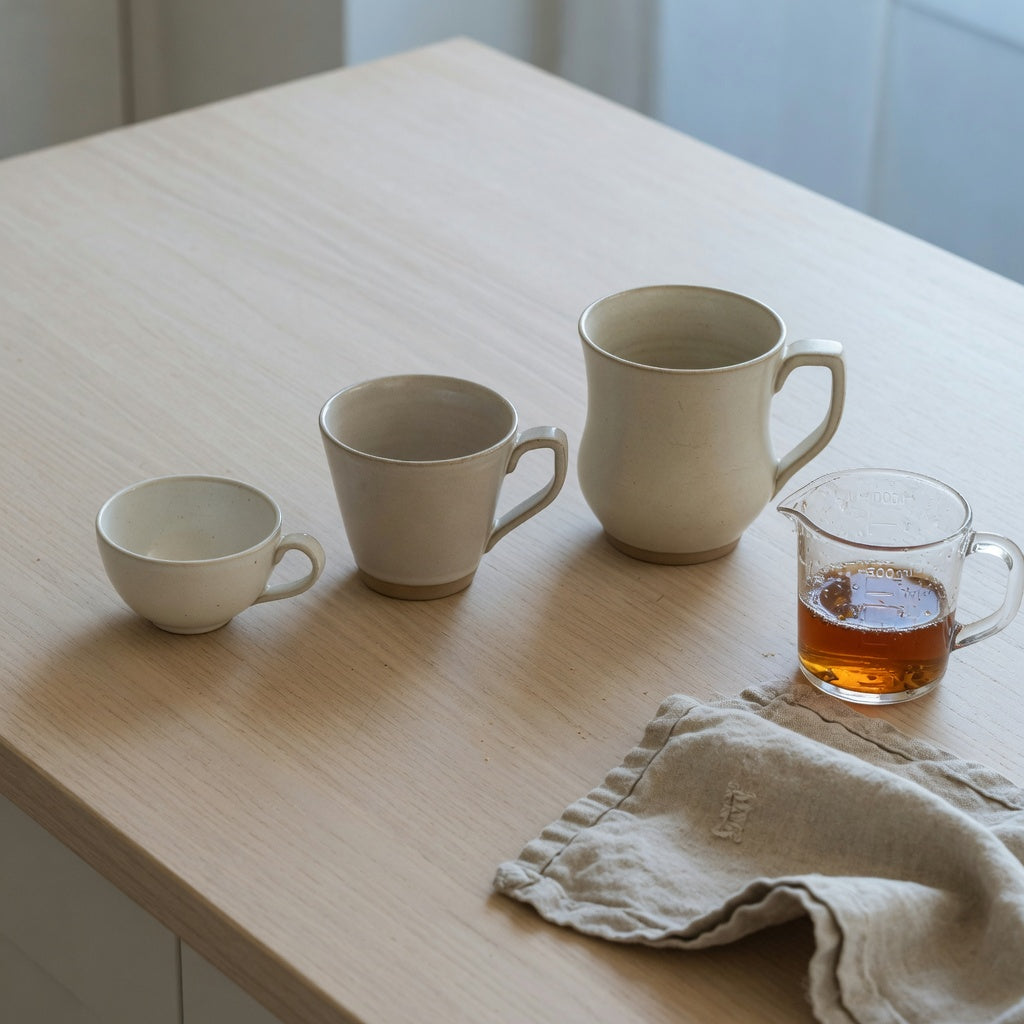
Pottery Tea Cups Shape and Handle Guide: 170, 200 or 250 ml
Reading time: about 12 minutes
A shopper orders the 250 ml mug, pours a usual tea, then sets it beside the 170 ml cup already on the shelf and finds the difference is roughly a third of a cup. Nothing was mislabelled. They simply never measured a pour against a listed capacity. That is why this pottery tea cups shape and handle guide is built around the three numbers and the visible forms in our own catalog — the 170 ml Retro, the 200 ml Pleated and the 250 ml Ball Handle — rather than around colour or styling language. In our store, the questions that arrive before checkout are about grip, volume and the glaze on the surface that touches tea and lips. Here is what the listings confirm, what depends on the exact piece, and what to check before you buy.
What does this pottery tea cups shape and handle guide compare on paper?
Three ceramic cups, listed at 170, 200 and 250 ml. Those are the hard numbers we can stand behind without pulling a fresh spec sheet for every variation, so treat the table as a first filter, not a finished decision.
| Option | Listed capacity | Visible form cue | Where it tends to fit | Honest trade-off |
|---|---|---|---|---|
| Retro Coffee Tea Cup | 170 ml | Name points to a retro-style body | Short, hot pours and frequent refills | Too little if you drink a long, slow cup |
| Pleated Coffee Tea Cup | 200 ml | Pleated or fluted body reads in the name | Middle ground; splitting a small pot two ways | Close enough to 170 ml that the gap may not matter to you |
| Ball Handled Coffee Tea Mug | 250 ml | Ball-form handle reads in the name | The biggest single pour in this group | Still smaller than the 350 ml mugs many people use for coffee |
All three are listed as ceramic, and that is as far as the shared material claim goes. Listed capacity does not tell you height, rim diameter, weight in the hand or handle opening. Those come from the individual product page or from an email to us.
Which listed capacity matches the tea you actually pour?
Do this before you compare anything visual. Fill the cup you reach for now with water, tip it into a measuring jug, and write the number down. Add the milk in the jug if you take it, because the finished drink is what has to fit.
- 170 ml — Retro. A small, hot, quick pour; the cup you empty while the second steep is still going. A poor fit if you like a long drink and resent getting up.
- 200 ml — Pleated. The middle stop, thirty millilitres above the Retro and fifty below the Ball Handle. If your measured pour landed near 200 ml, start here.
- 250 ml — Ball Handle. The largest here. If your pour measured above roughly 260 ml, none of these will take it comfortably in one go.
One adjustment matters more than the arithmetic: listed capacity is usually measured close to the rim, and nobody drinks from a cup filled to the rim. Leave headroom for a hot drink and your working volume drops below the listed figure — by how much depends on the cup's taper, which you can only judge from the spec sheet or in person.
If your number falls outside all three, step back and browse our unique coffee mugs collection, where the capacity range runs wider. Check each listing individually rather than assuming a bigger silhouette means a bigger pour. Small pottery tea cups for tasting flights sit below this group; large mug-style servings sit above it.
How do you judge a handle from listing photos before it arrives?
Two things get confused here: a handle's silhouette and a handle's function. A side view shows you the first. It rarely shows the gap between handle and wall, the thickness of the part your fingers wrap around, or how the cup balances when it is two-thirds full.
The Ball Handle mug's name tells you its handle reads as a ball form in the photos. For the Retro and Pleated cups, the names describe the body, not the handle — whether you are looking at a full loop, a small tab or no handle at all is a question the current images and spec sheet have to answer, not something we will assume for you.
- Opening size. Can you see daylight between handle and body? If the gap looks tight, ask for its height and width before buying, especially if you have large hands or wear rings.
- Wall offset. A handle set close to the body keeps the cup compact but puts your knuckles nearer the hot wall. A wider offset is more forgiving with a hot drink.
- Attach points. Where the handle meets the body is where shipping damage appears first. On arrival, run a thumbnail along both joins before the first wash.
- Overall width. Ask whether the listed width includes the handle. It decides whether the cup clears a narrow shelf gap or a cup holder.
- Balance. A handle set high can tip a full cup forward as you lift. You cannot test that from a photo, so keep the return window in mind.
If a particular grip matters — say you carry a cup with two fingers through the loop because the rest of your hand is holding a phone — match the measurements to a cup you already own rather than trusting a product name. Handle fit is the most common reason a pottery tea cup gets returned or relegated to the back of the cupboard.
Why do two cups with similar capacity take up different shelf space?
Capacity is volume. It is not footprint, and it is not height. A squat 250 ml cup can need more shelf depth than a tall 200 ml one, and a flared rim can sit noticeably wider than the base.
- Shelf gap. Measure floor to shelf underside. A cup you cannot slide out without tilting is a cup you stop using.
- Base diameter. Check the flat space on the desk, tray or bedside table where it will actually live.
- Rim diameter. Compare it with the cup you reach for now. Rim preference is personal.
- Width including the handle. This is the number that decides whether three cups fit on one shelf or two do.
Ask us whether any quoted figure is approximate. Hand-finished ceramics vary slightly piece to piece, so a rim that measures a millimetre or two off the listing is normal rather than a defect. That variation is also why a photo of one cup cannot promise the exact handle opening of the cup that ships to you.
What should you confirm about glaze and food contact before the first pour?
This is the part of the decision where appearance helps least. A glossy, even glaze tells you the piece was finished carefully. It does not tell you what is in the glaze or how the finished cup performs in a leach test.
The FDA's guidance on lead-glazed pottery is direct about the mechanism: lead can be present in glazes and decorations, and if the ware is not manufactured and fired properly it can leach into food and drink. Fired at the right temperature for the right time, essentially all of the lead is bound into the glaze. The FDA also flags higher-concern categories — antique, damaged or badly worn pieces, unidentifiable makers, and bright orange, red or yellow decoration.
Two official details are useful when you read a listing. Cups and mugs carry a lead guideline of 0.5 micrograms per millilitre of leaching solution across six tested units, with a parallel cadmium limit for small hollowware. The same guidance describes cups and mugs as small ceramic hollowware for hot drinks, normally around 240 ml and normally made with a handle — a reminder that a 170 ml cup and a 250 ml mug both sit inside that frame, while a very small handleless cup may not. Ware containing extractable lead should not be labelled 'lead free', and decorative-only pieces must be permanently marked as not for food use.
Here is where we stay honest. From our catalog we can confirm listed capacities and ceramic bodies. We cannot hand you a leach-test result for a specific cup in this article, and we will not imply one. If food-contact documentation matters — and for a cup you will use daily it reasonably might — ask us before ordering and we will tell you what is available for that exact item. Shoppers comparing food safe pottery tea cups online should treat 'food safe' as a question to verify, not a phrase that settles the decision. The same applies if you are weighing glazed pottery tea cups from a local potter: ask what fired the piece and which surfaces touch tea and lips.
When the cup arrives, inspect the surfaces that touch tea and lips: an even interior glaze, no bare clay on the drinking rim, no chips at the lip, no metallic decoration inside. Fine crackle lines are common in pottery and are not automatically a fault. A crazed glaze that you can feel with a fingernail, or crackle that appears after a wash cycle, is a different question — set the cup aside and ask before you keep drinking from it.
Which of the three fits your desk, bedside table, or a gift box?
Match the cup to the place it will live, not to the photo you like best.
- Office desk with a laptop beside it. A lower, wider profile takes knocks better than a tall narrow one, and volume per refill trip usually decides it — which points to the 250 ml Ball Handled mug. If you already know a 250 ml pour leaves you wanting a second cup before lunch, this is the one to beat.
- Bedside table or reading chair. Small pours, short reach. The 170 ml Retro cup keeps a short drink hot to the last sip, if a second trip to the kitchen does not bother you.
- Tea for two from one small pot. Two 200 ml Pleated cups split a modest pot evenly without anyone nursing an overflowing cup. The pleated body also gives fingers somewhere to sit if you hold the cup without the handle.
- A gift, chosen sight unseen. Capacity is the one thing you can promise; hand size and handle preference you cannot. A mid-size cup is the lower-risk pick, and knowing whether they drink tea or coffee narrows it further. If they take tea in small, repeated pours, the Retro is the more thoughtful choice; if they drink one large morning cup, the Ball Handle is closer.
If none of those scenarios fits, the wider range in the unique coffee mugs collection is the better place to look. If you specifically want a handleless pottery tea cup, do not assume one of these three is it — confirm the handle form on the current listing first. Espresso cups are a different comparison entirely, with a much smaller working volume.
How should you care for a pottery tea cup so it lasts?
Pottery tea cup care is product-specific, not category-wide. Ceramic is a material, not a care instruction. One maker's glaze may tolerate a dishwasher; another may not. We are not confirming appliance compatibility for these three in this article — check the care section on the exact listing or ask us.
- Follow the maker on dishwasher and microwave use. If the listing is silent, hand washing is the conservative choice.
- Avoid thermal shock. Do not pour boiling liquid into a cold cup or plunge a warm cup into cold water. Pre-warm with a little hot water first if you drink very hot tea.
- Keep metal decoration out of the microwave. Gold or metallic rims and overglaze decoration are common worry points; the safe rule is not to microwave them at all.
- Retire damaged pieces from drink duty. Chips at the lip, a crack you can feel, or a warning label that says not for food use are reasons to move a cup to display or storage.
None of that makes a cup indestructible. It simply keeps the surfaces that touch tea and lips in better condition for longer.
Frequently asked questions
Which cup in this pottery tea cups shape and handle guide holds the most?
The Ball Handle mug is listed at 250 ml, against 200 ml for the Pleated and 170 ml for the Retro. That is full listed capacity; your working pour will be lower once you leave headroom for a hot drink.
Is a 170 ml cup too small for everyday tea?
It depends on your measured pour, so measure before you decide. If you routinely drink 250 ml or more in one sitting, the Retro means a refill mid-cup — which some people prefer and others find irritating.
Will the handle fit my fingers?
Ask for the handle opening's height and width if they are not published, then compare them with a cup you already find comfortable. A photo and a name like 'ball handle' describe the look, not the clearance for your hand.
Are these cups dishwasher and microwave safe?
We are not confirming appliance compatibility for these three here — ceramic is a material category, not a care instruction. Check the care section on the exact listing or ask us, and keep any metallic decoration out of the microwave regardless.
Can I drink from a cup with visible crazed glaze lines?
Surface crackle is common in pottery and is sometimes intentional, but a line you can feel, a line near the rim, or crackle that appears after washing deserves a question to the seller before you keep using the cup for hot drinks.
Five checks to run before you add one to the cart
- Measured your usual pour in millilitres, milk included?
- Confirmed the handle opening and the overall width including the handle?
- Measured the shelf gap and the flat space where the cup will live?
- Asked about food-contact documentation if that matters to you?
- Read the care notes for the exact item rather than the category?
Five ticks and you are choosing between three known quantities instead of three photographs. Start with whatever sits closest to the number you wrote down — the 170 ml Retro, the 200 ml Pleated, or the 250 ml Ball Handled mug. If your pour falls outside all three, head to the collection page and compare the listed capacities there. We would rather you own one cup that gets used every morning than three that sit in the cupboard because the handle was never quite right.
Ready to pick your mug? Two ways to save on today's order:
Ordering 1–3 mugs? Get an extra 10% off your 1st order with code 10_OFF Apply 10% Off & Shop Wooden-Handle Mugs →
Gifting 4+ mugs? Buy 3, Get the 4th Free applies automatically at checkout (no code needed; offers do not stack) · Free standard shipping (Nov pre-Christmas delivery: 15–20 calendar days US) · Free replacement if chipped in transit.
Popular mug buying guides: Ceramic Tea Cups & Infuser Mugs · Ceramic Mugs with Lids Compared · Wooden-Handle Tea Infuser Mugs Compared · Christmas & Secret Santa Mugs 2026 · Espresso & Cortado Cups Guide · Cup & Saucer Gift Sets · All 25 Mugs Spec Table · Mug Size Guide · Shipping & Promo FAQ
FIRST ORDER 10% OFF (CODE: 10_OFF) · OR BUY 3, GET THE 4TH FREE


Read more
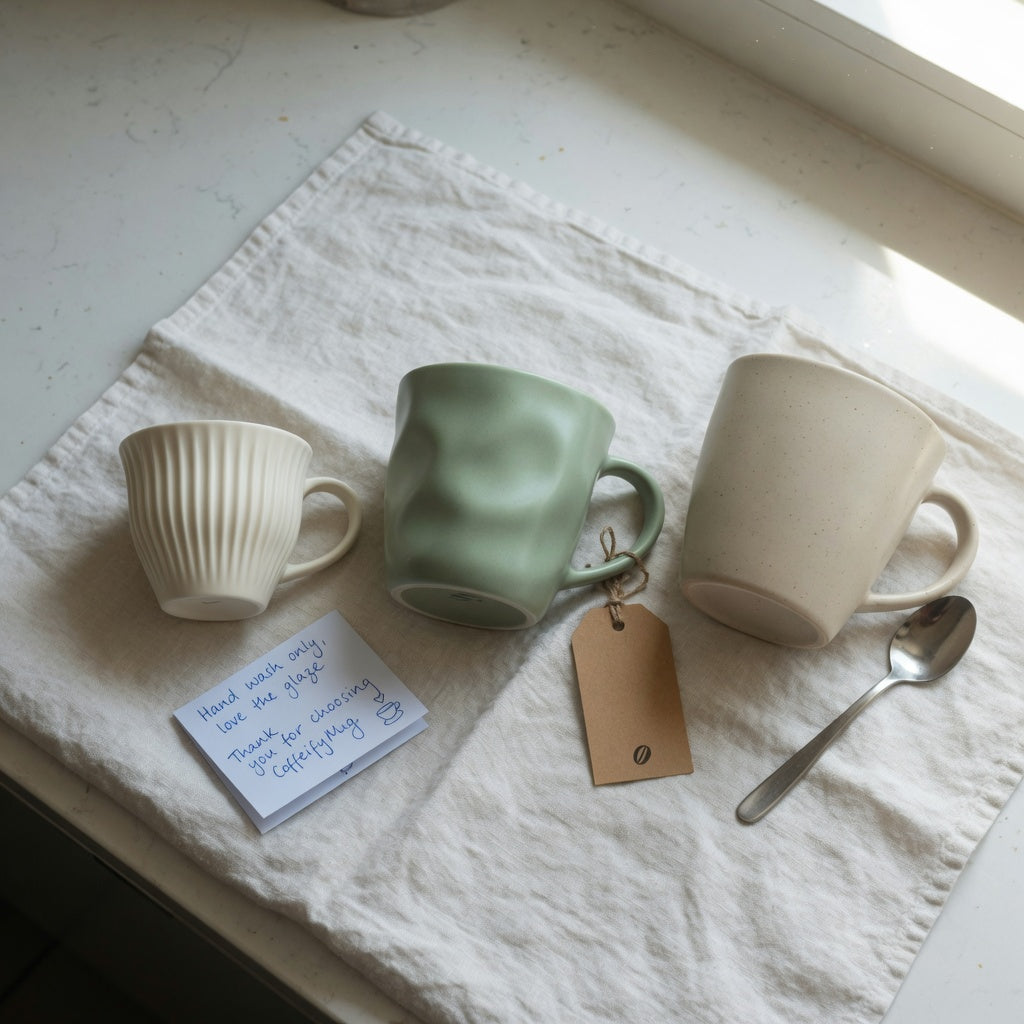
Coffee Mug Gifts Ideas Shape and Handle Guide: 200 vs 400 vs 440 ml
A practical comparison of the Pleated 200 ml, The Flow 400 ml, and Morning and Night 440 ml by listed capacity, visible ceramic finish, and handle form — plus the care and glaze questions to settle...
Read more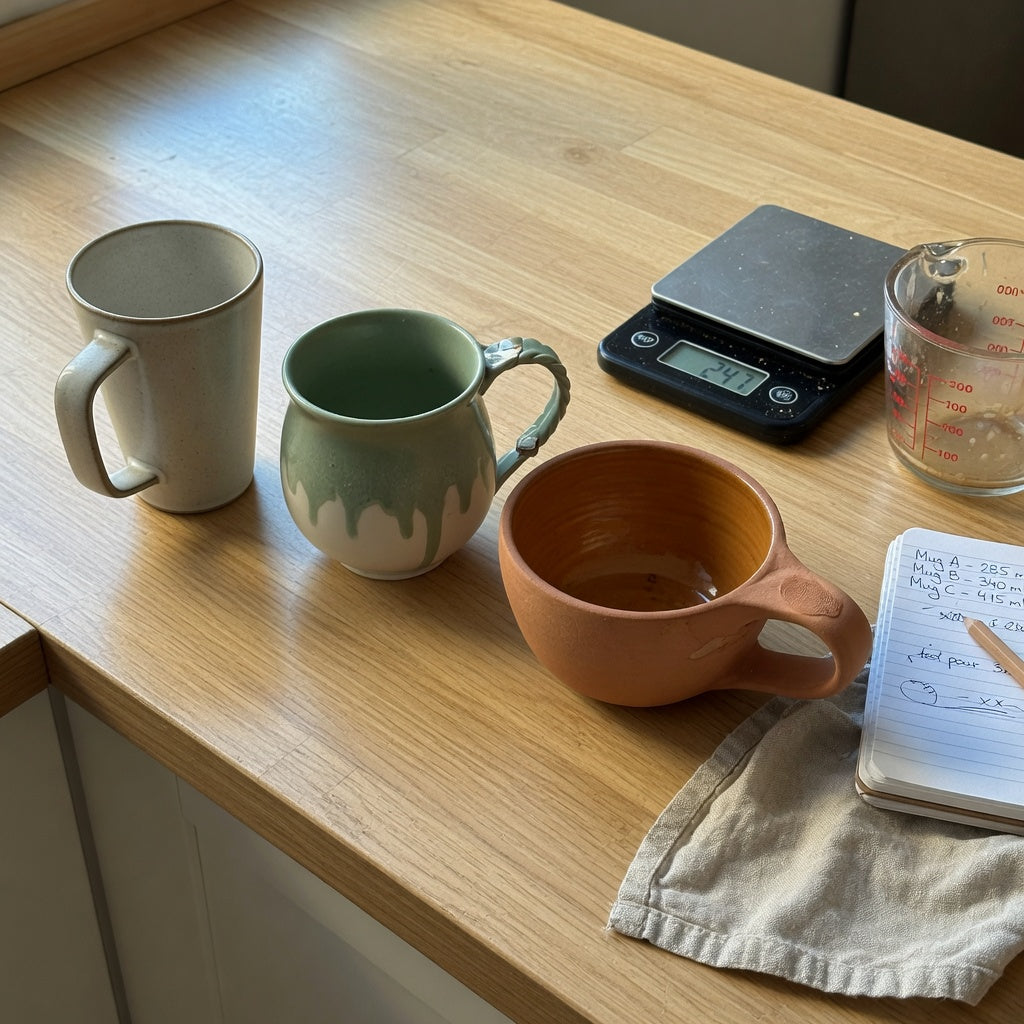
15 Oz Ceramic Coffee Mugs Shape and Handle Guide: 400, 440, 480 ml
A 15 oz label measures the brim, not the pour. We break down usable fill, handle clearance, and how our 400 ml, 440 ml, and 480 ml mugs split the range for real drinks.
Read more
Leave a comment
This site is protected by hCaptcha and the hCaptcha Privacy Policy and Terms of Service apply.