



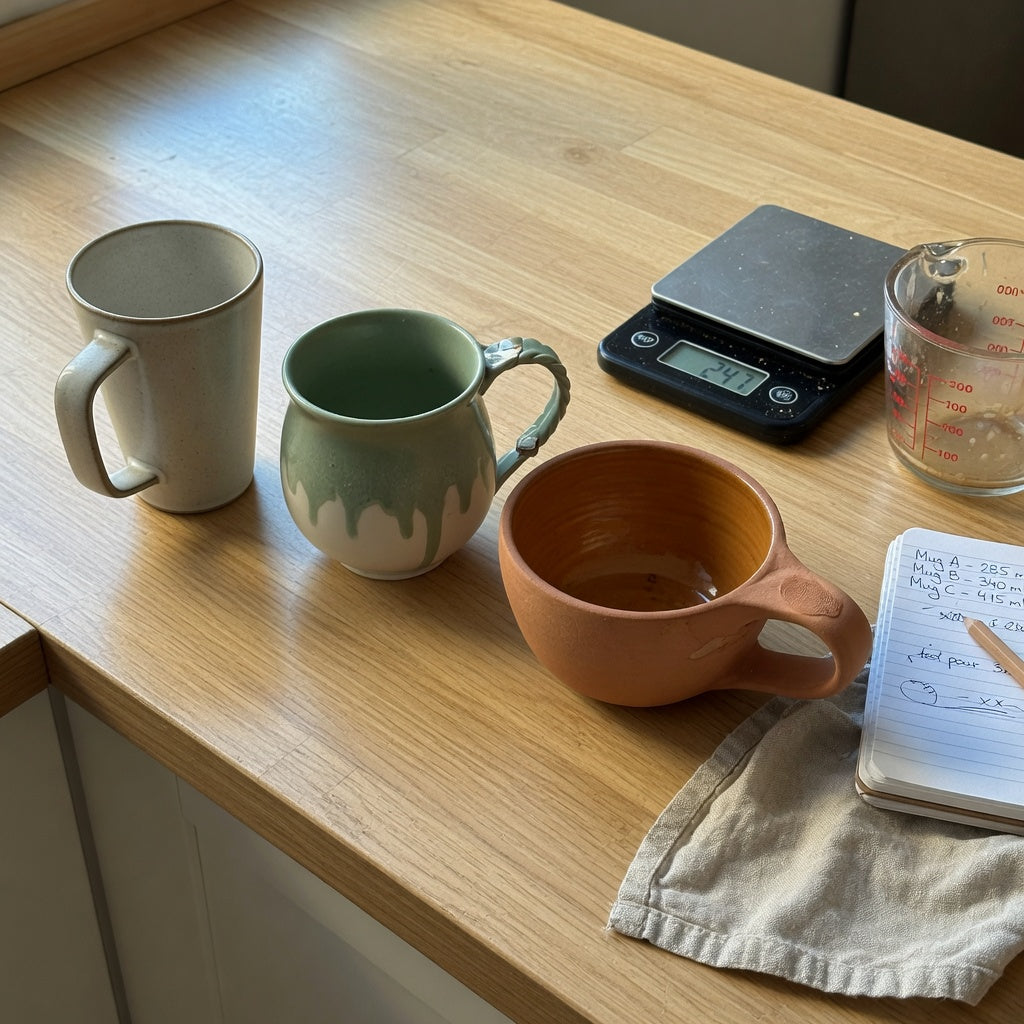
15 Oz Ceramic Coffee Mugs Shape and Handle Guide: 400, 440, 480 ml
Reading time: about 10 minutes
A mug labeled 15 oz arrives, you pour a 10 oz brew into it, add half-and-half, and the surface still sits an inch below the rim — yet by the second cup your wrist has opinions about the weight. Nothing on the listing was false. It measured the one thing that photographs well and skipped the three things your hand actually notices.
We sell ceramic mugs and we handle the returns that come from this exact mismatch, so this 15 oz ceramic coffee mugs shape and handle guide stays on numbers you can verify: the fluid-ounce conversion, brim capacity versus usable fill, handle opening size, empty weight, and finish-specific care. Then we show where our three current mugs sit against a 15 oz target.
Where the 15 ounces disappear before your first sip
Fifteen US fluid ounces is 443.6 ml. If a listing quietly used imperial ounces, 15 imperial fl oz is roughly 426 ml — a small difference, but the wrong direction if you were already worried about capacity. First check on any listing: which ounce.
Second check: brim or fill line. FDA's own description of a ceramic cup or mug uses about 240 ml (8 fl oz) as its reference beverage vessel, which tells you a 15 oz mug is close to double the reference size and firmly in the large-everyday category. It does not tell you how much you can pour.
Headroom is the missing number. Our working rule is 1 to 2 fl oz for black coffee or tea, and 2 to 3 fl oz for anything built with milk or foam. That puts a labeled 15 oz mug at roughly 12 to 13 oz of actual drink — enough for a large single-serve brew plus creamer, tight for a full latte.
Some listings publish a measured capacity; others publish only the number in the title. Where the two get conflated, "smaller than advertised" reviews follow, and they are usually accurate complaints about the listing rather than the mug.
Which 15 oz ceramic coffee mugs shape and handle guide spec matters most in the hand?
The handle, nearly every time. We watch customers pick a mug up, rotate it, and set it back down — that hesitation is finger clearance, not capacity. Four measurements decide it:
- Opening height. Two fingers through the hole is a pinch grip. Three is a normal adult hold. Four is what makes a heavy, full mug feel controlled instead of precarious.
- Opening width. On thick-walled stoneware the handle joint intrudes into the hole, so a handle that looks generous in a flat-lay photo can be snug in the hand.
- Thumb rest or flat top. This matters if you pinch the handle between thumb and forefinger rather than hooking it.
- Weight when full. 440 ml of coffee weighs roughly 440 g, close to a pound, before the mug itself is added. Empty weight is the figure most listings leave out.
Balance is the fifth, rarely published spec. A body that tapers toward the base shifts mass downward and reads as steadier on a desk. A straight cylinder keeps more clay and more liquid higher up. Two mugs with identical capacity can feel like different objects in use.
For arthritic hands or a weak grip, opening width and empty weight outrank extra capacity every time. A mug you have to set down between sips is a mug that stays in the cupboard.
Where our 400 ml, 440 ml, and 480 ml mugs land against a 15 oz target
None of our current mugs is labeled 15 oz. We publish millilitres because that is the figure we can state plainly, so here is the honest mapping against 443.6 ml.
| Mug | Stated capacity | Approx. fluid ounces | Who it suits |
|---|---|---|---|
| The Flow | 400 ml | ~13.5 fl oz | Black coffee or tea drinkers who want a large mug without a large lift |
| Morning and Night | 440 ml | ~14.9 fl oz | Closest to a true 15 oz mug, and the safest single-mug purchase when you do not know the recipient's habits |
| The Rock | 480 ml | ~16.2 fl oz | Milk drinks, foam, and anyone who finds 15 oz tight once the creamer goes in |
The 440 ml Morning and Night sits a few millilitres under the 443.6 ml mark — close enough that the gap will never show up in a pour. The 480 ml The Rock adds roughly 36 ml of headroom over a 15 oz mug, which is about the foam volume a cappuccino or flat white actually needs. The 400 ml The Flow gives up around 43 ml and, in exchange, a full pour weighs roughly 40 g less than a full 480 ml pour.
You can compare silhouettes side by side on the unique coffee mugs collection page before committing to a shape.
Matching shape and handle to the drink you make most mornings
- Two back-to-back drip refills at a desk. Go 400 ml. You are pouring twice anyway, and the lighter lift matters more than reservoir size.
- One large brew with creamer, no refill. 440 ml is the sweet spot — room for a 12 oz coffee plus two ounces of milk and still space to stir.
- Lattes, cappuccinos, matcha whisked with milk. 480 ml, because foam volume is not liquid volume and headroom disappears fast.
- A shared office kitchen. Larger mugs cut trips, but they also crowd shelves and dishwasher racks. Measure your cupboard's interior height before ordering a set.
- A gift for someone whose habits you do not know. 440 ml, the middle of the range and the least likely to be returned.
If the mug has to hold temperature through a commute or a two-hour meeting, stop here — that is insulated-tumbler work and ceramic will not do it. Buy ceramic for the lip, the weight, the look, and the way it survives a dishwasher.
Care follows the finish, not the word "ceramic"
Ceramic is a material family, not a care instruction. Three failures show up repeatedly in large mugs used daily:
- Crazing. A fine web of cracks in the glaze, typically from thermal shock — boiling liquid into a cold mug, or a hot mug under cold tap water.
- Staining. Coffee and tea pigment settles into crazed lines and matte or unglazed surfaces over months. Glossy white hides it longest; textured rims show it first.
- Rim and handle-joint chipping. A full 15 oz mug is heavier, so it meets the sink with more force. Thick rims chip less catastrophically than thin ones, but they also change how the mug feels against your lip.
Metallic trim, decals, and some printed finishes are hand-wash only. The care line on the individual product page governs; a general "dishwasher safe" note on a category page does not override it. Pre-warming a mug with hot tap water before pouring is the cheapest way to reduce thermal shock, and it is the habit we recommend to anyone buying a large mug for daily use.
What "lead free" and "microwave safe" each actually certify
These are separate claims resting on separate evidence. One does not imply the other.
Under FDA compliance guidance for ceramics, the lead guideline for cups and mugs is 0.5 micrograms per millilitre of leaching solution, judged on any one of six units using methods that include ASTM C738 and AOAC 973.32/973.82. FDA also states that ceramicware showing extractable lead in that test should not be labeled "Lead Free," and it has documented imported pottery carrying a Lead Free label that still leached. Cadmium guidance runs 0.5 micrograms per millilitre for small hollowware, defined as capacity under 1.1 litres — which covers every mug in this size class.
The California Department of Public Health adds context that matters for coffee specifically: lead cannot be seen in a glaze or paint, coffee and tea are acidic and leach lead from contaminated dishes faster than non-acidic drinks, microwaving speeds leaching, and repeated dishwashing can damage a glaze and make later leaching more likely. CDPH also notes that lead is rarely found in plain white dishes.
Practical reading: a "microwave safe" badge tells you about thermal behaviour, not about a leach test. If a specific product page does not state its position on testing, ask before you buy rather than inferring from either label. Decorative ceramicware not intended for food must carry a warning under 21 CFR 109.16 — if you see "Not for Food Use" on a base, believe it.
For how body material changes density, weight, and chip behaviour, our comparison of ceramic versus porcelain mugs goes deeper, and how many ounces a mug of coffee really holds covers the measurement side.
When a 15 oz ceramic mug is the wrong purchase
We would rather say this plainly than sell into a return:
- Long commutes or all-day desk sessions. Ceramic loses heat. An insulated tumbler holds it. Do not buy ceramic as a thermos.
- Small hands, arthritis, or a weak grip. A full large mug approaches 700 g once the liquid goes in. Step down to 400 ml or a smaller shape.
- Espresso and small teas. A 2 oz shot looks lost in a 15 oz mug and goes cold before you finish it.
- Bags, backpacks, car cup holders. Ceramic is breakable and does not seal.
- Anyone who mostly reheats coffee in the microwave. Reheating works against glaze longevity, and the mug's own care line has to allow it first.
The six-line check we run before recommending a mug
- Capacity in millilitres or fluid ounces, with the unit named. 443.6 ml is the true 15 fl oz mark.
- Brim capacity or usable fill — if unstated, assume brim and budget 2 oz of headroom.
- Handle opening height and width, compared against a mug you already own and like.
- Empty weight, plus a rough full weight once liquid is added.
- Finish and care: microwave, dishwasher, hand-wash-only decoration.
- Any published leach-testing or safety statement for that exact mug.
If four of those six are missing from a listing, the listing is the problem, not the mug.
Frequently asked questions
How much coffee actually fits in a 15 oz mug once I leave room for cream?
Expect 12 to 13 oz of drink. Fifteen US fluid ounces is 443.6 ml at the brim, and headroom for stirring and creamer eats 2 to 3 oz of that. If you routinely build milk drinks, step up to the 480 ml The Rock mug instead of pouring to the very edge.
Does this 15 oz ceramic coffee mugs shape and handle guide apply to porcelain and stoneware too?
The volume math and handle logic apply to any ceramic body, because 443.6 ml is 443.6 ml in porcelain or stoneware. What changes is care: glaze, wall thickness, and decoration determine dishwasher and microwave suitability, so read the care line on the specific mug rather than the category.
Is a 15 oz mug too heavy to hold comfortably?
The liquid alone is roughly 440 g, about a pound, before the empty mug is added. Whether that feels fine or tiring depends on the handle opening and the empty weight, both of which listings often omit. If you have a weak grip, compare a 400 ml mug before committing.
Do thick ceramic walls keep coffee hot longer than thin ones?
It sounds reasonable and it is repeated constantly in reviews, but we have not found a cited laboratory comparison for this size class, so we do not claim it. If heat retention matters for more than a few minutes, an insulated tumbler is the correct tool.
Which of your mugs is closest to a real 15 oz mug?
The 440 ml Morning and Night mug, at roughly 14.9 fl oz. It lands a few millilitres under the 443.6 ml mark, which is the safest pick when you are buying one mug without knowing the drinker's habits.
Start with the pour you make most mornings, not the number in the title. If that pour is a black coffee or a long tea, the 400 ml mug will feel right. If it is a large brew with creamer, take the 440 ml. If it is foam, take the 480 ml. Then check the handle opening, the empty weight, and the care line before checkout — and browse the full collection if you want to compare silhouettes in one place.
More from our blog
Ready to pick your mug? Two ways to save on today's order:
Ordering 1–3 mugs? Get an extra 10% off your 1st order with code 10_OFF Apply 10% Off & Shop Wooden-Handle Mugs →
Gifting 4+ mugs? Buy 3, Get the 4th Free applies automatically at checkout (no code needed; offers do not stack) · Free standard shipping (Nov pre-Christmas delivery: 15–20 calendar days US) · Free replacement if chipped in transit.
Popular mug buying guides: Ceramic Tea Cups & Infuser Mugs · Ceramic Mugs with Lids Compared · Wooden-Handle Tea Infuser Mugs Compared · Christmas & Secret Santa Mugs 2026 · Espresso & Cortado Cups Guide · Cup & Saucer Gift Sets · All 25 Mugs Spec Table · Mug Size Guide · Shipping & Promo FAQ
FIRST ORDER 10% OFF (CODE: 10_OFF) · OR BUY 3, GET THE 4TH FREE


Read more
Pottery Tea Cups Shape and Handle Guide: 170, 200 or 250 ml
Our pottery tea cups shape and handle guide compares three ceramic cups at 170, 200 and 250 ml by measured pour, visible handle form and shelf footprint — plus the glaze and food-contact checks we ...
Read more
Large Round Coffee Mugs Shape and Handle Guide: 400-480 ml
A short, wide mug changes how you measure, pour, and hold it. Compare the three rounded mugs we stock at 400, 440, and 480 ml, plus the handle, clearance, and fill-line checks worth doing before yo...
Read more
Leave a comment
This site is protected by hCaptcha and the hCaptcha Privacy Policy and Terms of Service apply.