
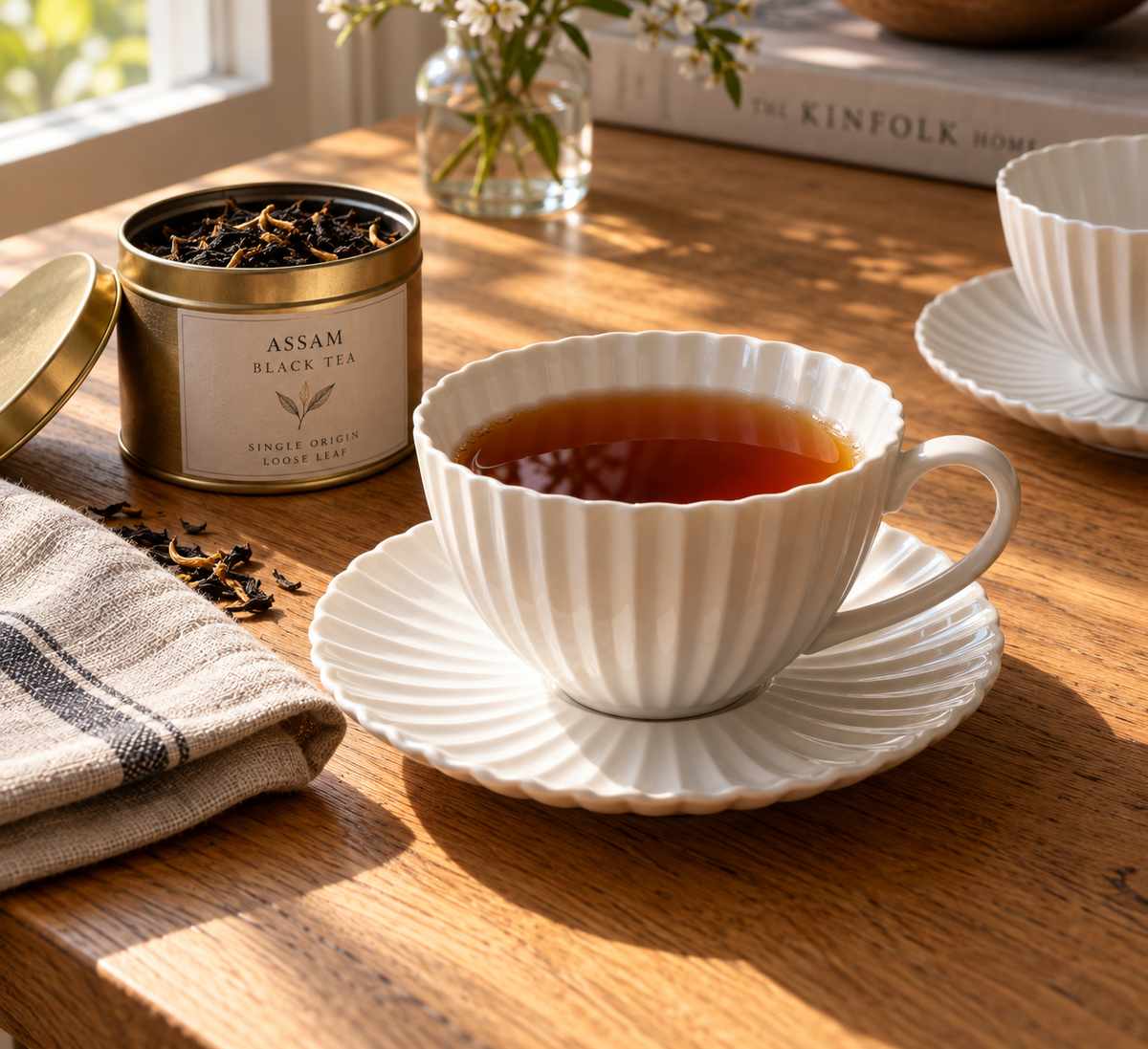
Pleated Ceramic Tea Cup 200 ml: What Buyers Should Compare
Reading time: about 9 minutes
Every week someone picks up a pleated cup from our shelf, runs a thumb down the folds, and asks the same two questions: does the texture feel odd on the lip, and is 200 ml a real serving of tea or a dollhouse prop? Both are the right questions. Photos flatten texture to almost nothing, and no photo shows true scale, so a pleated ceramic tea cup 200 ml bought on looks alone is the most common route to a surprise at the doorstep.
We pack and ship this style weekly, and nearly every pre-purchase question and after-purchase complaint traces back to five decisions: capacity, pleat geometry, body material and glaze, care routine, and saucer fit. This is the conversation we have at the counter, written down.
Pleated, fluted, ribbed or scalloped: which texture are you actually buying?
Sellers use these four words loosely and interchangeably, which makes side-by-side comparison genuinely confusing. Here is how we separate them in the store:
- Pleated — narrow, repeating folds running up the wall, like pressed fabric; edges usually soft.
- Fluted — deeper, more sculptural channels; the word borrows from columns and pastry.
- Ribbed — raised lines pronounced enough to catch a fingernail, common on stoneware.
- Scalloped — waviness shaped into the rim itself rather than the cup body.
The label matters less than the geometry. Our counter rule of thumb: folds shallower than roughly 2 mm read as decoration, while deeper channels give fingers real purchase. Two cups can both be sold as pleated and feel like different objects in hand. Study the side-profile photo rather than the top-down shot — depth is invisible from above.
Is a pleated ceramic tea cup 200 ml enough tea for one serving?
Yes, with context. 200 ml converts to about 6.8 US fluid ounces — classic teacup territory. That is roughly half of the 350–400 ml mugs many kitchens use daily, and two to three times the 60–120 ml cups used for gongfu-style brewing. One note from pouring hundreds of these: nobody fills to the brim. Leave a finger of headroom for milk, or just for carrying, and you are actually drinking around 160–170 ml — a proper serving, not a sip.
That capacity is why we stock the pleated ceramic cup listed at 200 ml even though our catalog titles it a coffee cup — at this volume it does classic teacup work, and most customers end up pouring both into it. If you want to weigh the shape against alternatives before committing, our unique coffee mugs collection lines up the silhouettes in one scroll.
| Style | Typical capacity | Best suited to | The trade-off |
|---|---|---|---|
| Gongfu tasting cup | 60–120 ml | Multiple short steeps of oolong or pu-erh | Constant refills for casual all-day drinking |
| Pleated cup at 200 ml | 200 ml / about 6.8 fl oz | One proper serving of black, green or herbal tea; serving guests | Feels small to big-mug drinkers |
| Everyday kitchen mug | 350–400 ml | Long mornings, latte-style drinks | Less refined at the table; wide bodies cool tea slowly |
By tea type: 200 ml is the traditional serving for a teabag or single-serve infuser of black tea with a splash of milk. It also suits green tea, because the smaller volume makes it harder to over-steep a full mug into bitterness. Where it falls short is iced tea and anything you want to nurse for an hour — the desk drinker who refills twice a day will be happier with a larger mug.
What pleats actually change: grip, heat and rim feel
Pleats are not purely decorative, and they are not magic either. Three real effects:
- Grip. Channels give fingertips purchase, which matters most on handleless cups where the whole hand cradles the body.
- Heat behaviour. Ridge tips shed heat slightly faster while glaze pooled in the grooves holds warmth. The net effect is texture in how the cup feels, not a performance feature.
- Rim feel. A pleated rim is textured where a smooth rim is glassy. Most drinkers adapt within a day; a few never enjoy it. If rim texture has ever made you return a cup, scrutinise this detail hardest.
Expect one visual quirk: on many glazes, pigment settles into the troughs, so the grooves read a shade deeper than the ridges. That is normal for textured glazing, not a defect — but it is fair to ask the seller whether the variation you see in photos is intentional.
Porcelain or stoneware? Glaze questions to settle before checkout
Most cups in this style and size are porcelain or stoneware, and the difference shows up in daily use more than on a spec sheet:
- Porcelain — fired hotter; lighter in hand, thinner walls, a whiter body that keeps glaze colours bright. The trade-off: thin edges chip more visibly, and the lighter mass holds a touch less heat.
- Stoneware — heavier, chunkier walls, better heat retention, more piece-to-piece variance. The trade-off: the weight, and a more casual presence on the table.
On glaze safety, skip the guesswork and read the listing. We advise customers to buy only where the seller states the glaze is intended for food contact; if a listing is silent, ask before ordering. The same discipline applies to metallic accents — gold and platinum rims are common on pleated designs, and they typically change both microwave and dishwasher guidance.
Our store rule: if the listing doesn't state it — glaze safety, microwave use, base diameter — treat it as a question to ask, not a detail to assume.
Set one more expectation before you buy: handmade and small-batch ceramics vary. Pleat depth, glaze pooling and a few millilitres of capacity tolerance are normal from piece to piece. If a listing shows several photos of the same cup with visibly different glaze depth, that is variance, not fraud. Decide now whether that reads as character or as a dealbreaker.
Dishwashers, microwaves and stained pleats: the honest care trade-off
The most common after-purchase surprise with textured cups is staining. Tannin from black tea settles into pleat grooves where a flat sponge cannot reach. None of it ruins the cup; it just needs a slightly different routine than a smooth mug:
- A soft bottle brush or a dedicated toothbrush reaches the grooves without scrubbing the glaze.
- A baking-soda paste left on the pleats for a few minutes lifts most tannin staining without abrasives.
- Avoid thermal shock as a rule — a cold cup plunged into boiling water is how ceramic cracks, pleated or not.
Whether a specific cup tolerates the dishwasher or microwave depends on its glaze and any metallic detailing, so confirm that wording on the listing rather than assuming. And be honest about your household: if everything goes in the dishwasher and nothing gets hand-washed, a textured cup will show its age faster than a smooth one. That is a legitimate reason to choose a simpler shape.
Saucer fit and gifting: the detail that decides whether the gift lands
A 200 ml pleated cup photographs beautifully and a set usually stays within a sensible gift budget — which is why it leaves our store wrapped more often than almost anything else on the shelf. What separates a great gift from an awkward one is fit. Pleated cups often have a narrower foot than a standard mug, so pairing one with a saucer or tray the recipient already owns is a gamble unless you know the base diameter.
Before buying for someone else, check whether the listing states a base diameter or includes a saucer; if it states neither, message the seller. Ask the same about gift packaging and single-versus-set options — some sellers list those answers and some do not, and guessing is how gifts arrive mismatched.
Who should skip a 200 ml pleated cup entirely
We would rather talk a customer out of a purchase than read a disappointed review. Pass on this style if:
- You drink from 350 ml-plus mugs. At 200 ml you will feel like you are pouring samples. A larger mug shape is the better match.
- Iced drinks are your default. Ice cubes clatter against pleats, and 200 ml of iced anything disappears in three sips.
- Textured rims bother you. If feel has ever been your reason for returning a cup, order a smooth-walled shape instead.
- Your kitchen runs on the microwave. Wait until the listing confirms the glaze and any metallic accents are microwave-safe.
Five checks to run on any 200 ml pleated cup listing
Run this list against any listing, ours included:
- Capacity wording. Is 200 ml measured to the brim or to a sensible fill? A few millimetres of fill line changes the serving.
- Material and glaze. Does the listing state porcelain or stoneware, and confirm a food-contact glaze?
- Care wording. Dishwasher? Microwave? Any metallic detail that changes the answer?
- Handle and accessories. Handled or handleless? Saucer included? Base diameter, if you are pairing it with a tray you own?
- Handmade variance. Do the photos show acceptable piece-to-piece variation, and does the seller say so plainly?
If those answers check out, the 200 ml pleated cup on our product page is the one we would hand a guest who wants classic teacup service with a little character — and the unique coffee mugs collection is where to weigh it against larger and smooth-walled shapes before you decide.
Frequently asked questions
Is a pleated ceramic tea cup 200 ml the same as a 7 oz cup?
Effectively, yes. 200 ml converts to about 6.8 US fluid ounces, so it sits just under 7 oz, and listings rounded to "7 oz" usually describe the same capacity. When you see both figures, compare dimensions, material and glaze instead — volume is not the difference.
Do pleated ceramic cups stain faster than smooth mugs?
They show staining sooner, because tea tannins settle into the grooves where a flat sponge cannot reach. A soft bottle brush after black tea sessions, plus an occasional baking-soda paste, keeps the pleats clean. Left alone, the valleys darken gradually — harmless, but visible.
Is 200 ml enough for black tea with milk?
For a traditional single serving, yes — one teabag brewed in 200 ml with a splash of milk is standard teacup territory. If your daily mug holds 300 ml or more, expect to refill often, and a larger mug style will fit the habit better.
Can pleated ceramic cups go in the dishwasher and microwave?
That depends on the glaze and any metallic detailing of the exact cup, so treat it as a listing question rather than a category rule. Metallic gold or platinum rims generally rule out microwave use, and textured glazes keep their looks longest with hand washing. Confirm the written care guidance before you order.
Why is your 200 ml pleated cup listed as a coffee cup?
Our catalog carries it as the Pleated Ceramic Coffee Cup at 200 ml, because the capacity serves tea and coffee equally well and our customers pour both. The name tells you the style and volume; the product page is where to confirm material, glaze and care specifics before buying.
More from our blog
Read more

Big Coffee Mug for Desk: Sizes, Stability, Heat and Care Compared
A desk mug lives beside your keyboard for hours, so capacity, base width and heat behavior matter more than looks. Compare 16–30 oz sizes, ceramic vs insulated walls, lids, caffeine math and care —...
Read more
Crane Ceramic Coffee Mug Gift: 6 Things to Compare Before You Buy
A crane ceramic coffee mug gift suits retirements, anniversaries, and bird lovers — if the design, capacity, and care match the person. Our team's checklist covers crane styles, glaze-safety labels...
Read more
Leave a comment
This site is protected by hCaptcha and the hCaptcha Privacy Policy and Terms of Service apply.