

Ceramic Cup Coffee Tray Guest Room: 7 Checks Before Buying
Reading time: about 10 minutes
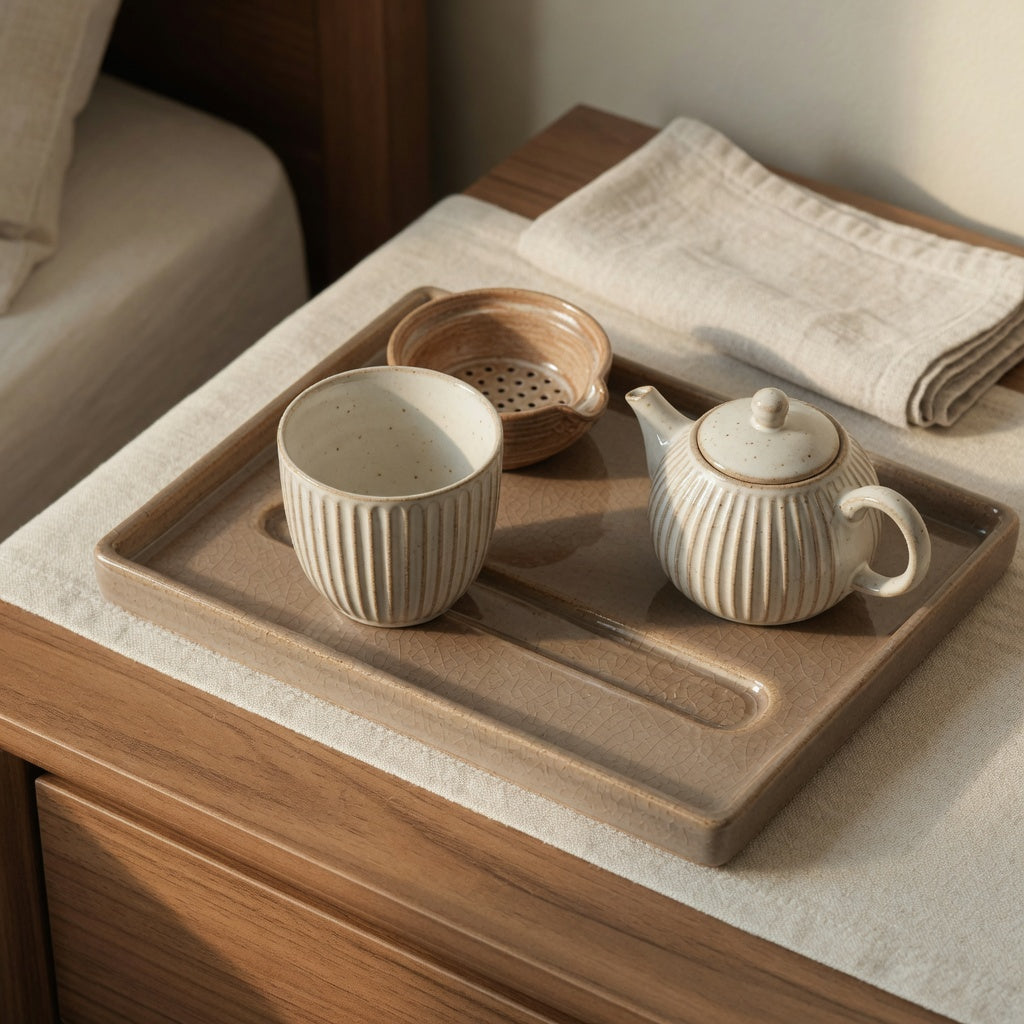
A ceramic cup coffee tray guest room setup can look balanced in a styled photo, then consume the only usable corner of a real nightstand. Add a lamp base, a charging phone, an optional saucer, a spoon, and drink sachets, and the welcome arrangement becomes something a guest must rearrange before bed.
In our store, we treat this as a small-space service setup rather than a mug-only purchase. The cup has to fit the tray, match the kettle or brewer serving size, suit the property's cleaning routine, and look properly reset for the next guest. These are the checks our team would make before buying for one home guest suite, an Airbnb, or several hotel rooms.
Will a ceramic cup coffee tray guest room setup fit the furniture?
Measure the room as it will actually be used. A nightstand may have a generous top in the listing photo, but its lamp, outlet location, clock, and charging cable can remove much of that space. The tray's outside dimensions also tell only part of the story because a raised rim reduces the usable interior.
- Measure the clear furniture surface. Leave the lamp, clock, and other permanent items in place.
- Measure inside the tray lip. This is the space available to the cup and supplies, not the tray's full outside width.
- Check the cup at its widest point. Include the handle, then measure any saucer or coaster separately.
- Make paper templates. Cut the cup footprint, optional saucer, and kettle base from paper, place them on the tray, and add the spoon and sachets.
The paper test catches a problem that dimensions alone miss: hand access. A cup can technically fit while its handle sits too close to the tray rim to grasp comfortably. If a needed product measurement is not shown on the current listing, do not estimate it from a lifestyle image.
The best ceramic cup coffee tray guest room layout leaves enough open surface for a guest to lift the cup without touching the lamp or pushing packets onto the floor. For double occupancy, test two complete setups. If they fit only by overlapping handles or crowding a hot appliance, move the station to a wider dresser or store the second cup nearby.
Cup capacity, handle clearance, and brewer output must agree
Capacity is useful only when paired with exterior dimensions and the drink-making method. A tall, narrow cup may save tray space but fail to fit beneath a brewer spout. A broad mug may accept the selected pour yet leave nowhere for a spoon. Match the stated cup capacity to the appliance's selected serving volume and allow headspace instead of planning to fill the cup to its rim.
| Buyer variable | Compare it with | Common failure |
|---|---|---|
| Maximum width, including handle | Tray interior and raised lip | The cup fits, but the handle cannot be grasped cleanly |
| Saucer or coaster diameter | Space needed for spoon and packets | Accessories end up on the furniture |
| Overall cup height | Brewer spout clearance | The cup cannot sit beneath the machine |
| Stated liquid capacity | Selected brew volume, with headspace | Overflow or an awkwardly underfilled cup |
A compact silhouette usually makes sense on a nightstand. A larger mug can work better on a dresser or counter where the guest has room to prepare the drink and set down a phone. There is no universal ideal size; the right choice depends on the combined cup, tray, appliance, and furniture footprint.
Pleated or round: which profile resets more easily?
Pleats can catch side light and give a quiet room visual detail without adding decorative objects to the tray. The trade-off is the extra surface that must be checked for dried splashes, dust, or residue. A smooth round exterior has fewer recesses to wipe, although it can look plain in a room that relies on the drinkware for character.
- Pleated profile: useful where the bedding and furniture are simple and the cup is meant to provide texture.
- Round profile: useful in a patterned room or a reset routine that favors straightforward surfaces.
- Large full-size mug: usually better at a counter coffee station than on a small bedside tray.
If a visually quiet room needs one designed element, compare our Pleated Coffee Tea Cup and check any listed measurements and care details against your paper template. If patterned bedding or wallpaper already supplies plenty of detail, compare the cleaner outline of our Round Coffee Tea Mug.
Shape alone does not establish capacity, durability, stackability, or care compatibility. Do not assume either option includes a saucer or can go in a dishwasher or microwave unless the current product listing states that information.
Glaze, rim, and foot-ring checks before guest use
Glaze quality affects more than appearance. Run a fingertip around the drinking rim and inspect the interior under side light. The small defect modes we watch for are pinholes, rough patches, fine craze lines, a hairline crack at the handle join, and a chip that exposes the ceramic body beneath the glaze.
The U.S. FDA's guidance on lead-glazed traditional pottery explains that action levels exist for extractable lead in ceramic foodware, including cups and mugs. Hot, acidic beverages such as coffee and tea can increase leaching from a problematic glaze. The FDA also notes that commercially manufactured ceramicware made for everyday use is much less likely to present lead-related problems than handmade, antique, damaged, or brightly decorated traditional pottery.
- Look for a continuous, glassy interior glaze without dry or gritty patches.
- Reject a cup with a chipped or sharp drinking rim.
- Examine fine crackle or crazing closely because it can make stains and wear harder to assess.
- Check the handle join for a visible line that changes when gentle pressure is applied.
- Inspect the unglazed foot ring and test whether it marks a wood or lacquered tray; a washable liner or coaster may be needed.
This is general category guidance, not a certification claim about any specific CoffeifyMug item or another seller's product. Decorative or vintage pottery may be appealing in a private display, but it is not our first choice for repeated guest service when its food-use status and care history are unknown.
Dishwasher cycles, chip control, and replacement planning
A reusable cup earns its place only if the reset routine is reliable. Guests cannot see the back-of-house process, so they judge what is in front of them: a dry interior, a clean rim, no lipstick or coffee film, and no chip where their mouth will touch.
- Follow the current product instructions and the property's cleaning procedure. Dishwasher and microwave suitability are separate checks.
- Avoid rim-to-rim impacts while loading, unloading, or storing cups.
- Clean the underside of the rim, the handle join, and any textured exterior rather than checking only the cup interior.
- Dry the cup completely before returning it to the tray.
- Inspect under good light and retire pieces with rim chips, spreading cracks, or damage that exposes the ceramic body.
Ceramic is not the best choice for every room. Consider another material if:
- The property cannot wash, dry, and inspect drinkware between guests.
- The tray sits on an outdoor balcony where tile, wind, and frequent moving raise the breakage risk.
- The room is designed for young children and unbreakable ware is a priority.
- The guest needs a sealed commuting cup; tray drinkware is not travel ware.
There is no honest universal replacement cycle for hospitality cups. Usage, handling, storage, and washing conditions vary too much. Replace by observed condition, and keep enough matching stock that a chipped cup can be removed immediately rather than returned to service.
Ceramic, paper, or unbreakable reusable ware?
Ceramic generally gives a guest-room station a more permanent, coordinated appearance. That presentation comes with washing, inspection, storage, and replacement work. Paper avoids washing and breakage, while unbreakable reusable ware can suit family or outdoor spaces.
| Option | Reset requirement | Main limitation | Best fit |
|---|---|---|---|
| Ceramic | Wash, dry, and inspect | Rim chips, cracks, and breakage | Managed indoor rooms with a reliable reset process |
| Paper | Replenish and dispose | More temporary presentation and recurring supply needs | Rooms without dependable drinkware washing |
| Unbreakable reusable ware | Wash and inspect for surface wear | May feel more functional than tableware | Family rooms, pool areas, and outdoor setups |
Do not treat ceramic as automatically more hygienic. Cleanliness depends on the handling process. Paper is not automatically less expensive either; labor, purchasing, waste handling, ceramic replacement, and storage all affect the operating decision.
What earns space on a one-cup or two-cup tray?
Every item should support making or drinking the beverage. Decorative filler often creates the crowding that buyers were trying to avoid with a smaller cup.
- One cup for each intended user, with the second stored nearby if the tray cannot hold both safely
- An optional saucer, coaster, or washable cup rest
- One teaspoon or stirrer per cup
- Sealed coffee and tea sachets rather than open canisters
- Sweeteners and creamer only when their labels permit the room-temperature storage conditions
- A clean folded napkin
- A kettle or brewer only where it can sit on a stable surface and meet its operating-clearance instructions
Point the cup handle toward the open side of the tray rather than toward the wall or lamp. Keep the spoon out from under the cup's foot ring, and place paper packets away from kettle steam. Leave off open sugar bowls, oversized snack plates, extra glasses, and objects that cannot be cleaned during the room reset.
Run this seven-check order test before adding rooms
- Record the usable furniture surface after permanent room items are in place.
- Measure the tray interior inside any raised edge.
- Compare the cup's external width, height, handle projection, and stated capacity.
- Add the separate footprint of any saucer, coaster, spoon, and packets.
- Inspect the glaze, rim, handle join, and foot ring.
- Verify current dishwasher, microwave, and other care instructions rather than assuming them.
- Plan storage and replacements, or choose paper or unbreakable ware if the reset process cannot support ceramic.
For a home guest suite or a host gift, appearance may carry more weight than standardized housekeeping storage. Browse our coffee mugs for gifts, then apply the same tray template and care checks to the recipient's actual setup. For multi-room inventory, test one complete station before committing to more pieces.
Frequently asked questions
How do I size a ceramic cup coffee tray guest room setup?
Measure the clear furniture surface and the tray interior, then make full-size paper templates using the cup's maximum width, including its handle. Add separate templates for the saucer, spoon, packets, and appliance base. The arrangement fits only if a guest can grasp the handle and use the supplies without moving the lamp or pushing items off the tray.
What size ceramic cup works best on a small guest coffee tray?
There is no single capacity that fits every tray. Compare exterior width and height with the available space, then match liquid capacity to the brewer's selected output or the intended kettle serving. A smaller profile usually suits a nightstand, while a larger mug is easier to accommodate on a dresser or counter station.
Should hotel or Airbnb guests wash a provided ceramic cup first?
The host or housekeeping team should present a properly cleaned, fully dry cup according to the property's procedure. If a guest sees film, moisture, lipstick, a rough rim, or a chip, the better response is to request a replacement rather than guess about its condition. Visible cleanliness and an undamaged surface build more confidence than a reassurance card.
Is a pleated ceramic cup harder to clean than a round mug?
Not automatically, but pleated surfaces create more recesses to inspect for dried splashes and dust. A round exterior is usually more straightforward to wipe. For either profile, the interior glaze, rim condition, handle join, and stated care instructions matter more than shape alone.
Can every ceramic guest-room cup go in a dishwasher or microwave?
No. Dishwasher and microwave compatibility should each be confirmed on the current product listing or care label. If that information is absent, do not assume compatibility, especially when choosing drinkware for repeated hospitality use.
Your next step: Photograph the empty surface, record the tray's inside dimensions and appliance pour setting, and make a full-size paper template for the cup and any saucer. Then compare the pleated and round options linked above and verify their current measurements and care details before adding more rooms or buying a gift set.
More from our blog
Read more
Pleated Ceramic Cup Tea Tray: Fit, Care and Material Checks
Compare a pleated cup by its widest footprint, foot-ring stability, rim comfort, stated capacity, and cleaning access—not just its base. We also weigh ceramic versus wood trays, food-use details, g...
Read more
Ceramic Coffee Mug for Small Kitchen: 7 Checks Before Buying
Small kitchens expose mug-fit problems that product photos hide. Compare shelf dimensions, practical capacity, handles, stackability, ceramic construction, safety labels, and chip-prone storage bef...
Read more
Leave a comment
This site is protected by hCaptcha and the hCaptcha Privacy Policy and Terms of Service apply.