
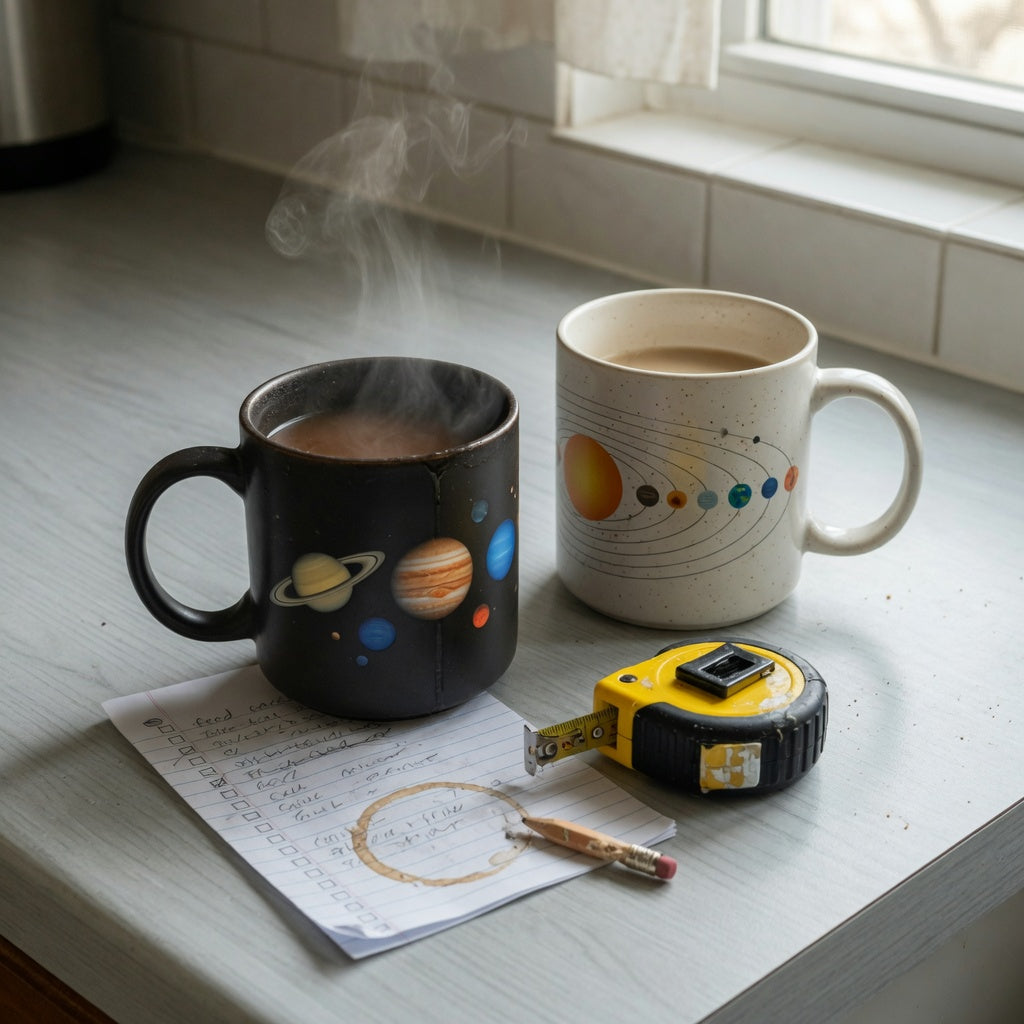
Planet coffee mug buying checklist: heat, print, and fit
Reading time: about 12 minutes
The first hot pour made the planets bloom. Three weeks in a shared office dishwasher left a cloudy ring and a chunk of Saturn gone. We see that arc often enough that a planet coffee mug buying checklist now starts with construction, not the listing photo. Heat-reveal coatings and permanently printed ceramic fail differently. Care labels, brewer clearance, and a real food-use statement decide which failure you are buying.
Daily coffee, a desk piece, or an astronomy gift?
Name the job before the artwork. In our store, the same planet scene gets requested three ways, and the checks change with the job.
- Everyday coffee or tea. Hot liquid, a sink, and usually a dishwasher. Handle comfort and a design that survives washing beat a one-time reveal.
- Desk display. The scene has to look finished when the mug is empty and cold. A coating that hides the planets until the cup is hot will sit blank beside a monitor.
- Astronomy gift. Unboxing and the first pour carry the moment. Packaging, an intact rim, and whether Pluto is a joke or a mistake matter more than years of daily abuse.
Open the Planet Ceramic Coffee Mug and read that page, not a screenshot from another shop. Capacity, care icons, and which planets are drawn live on the listing. They can change. A lookalike does not describe this cup.
If you want something unusual for the kitchen but you are not sure a heat trick is the right kind of unusual, browse our unique coffee mugs after you settle that split.
Where a planet coffee mug buying checklist splits on heat-reveal versus print
A heat-changing solar system mug uses a thermochromic coating. Cold, you may see a dark field or a faint outline. Hot liquid is supposed to bring the planets out. A permanently printed design shows the scene with cold water, iced coffee, or an empty cup on a shelf. Similar photos. Different products.
Heat-reveal is built for the fill. It is a weak choice for iced drinks, for a mug that sits out as decor, and for anyone who will not baby the exterior. A permanent print gives up the trick. In our experience, that is the style we would rather see in a dishwasher-heavy kitchen. Even then, the care line on the exact page beats any general rule. We are not stating which construction the Planet Ceramic Coffee Mug uses. Confirm it on the current listing before you match it to a job.
| What you are comparing | Heat-reveal coating | Permanent print |
|---|---|---|
| Empty or cold cup | Planets may stay hidden | Artwork stays visible |
| Iced coffee or tea | Poor fit if the scene needs heat | Design does not depend on temperature |
| Dishwasher and scouring | Common failure point; many listings say hand wash | Does not rely on a heat film; still verify the label |
| First gift impression | Strong, if the pour actually triggers the art | Strong on unboxing, no temperature trick |
Seller pages disagree on how hot a drink must be before the planets show. We do not treat any one activation temperature as standard. If the listing names a threshold, compare it with the coffee or tea you actually drink, not with boiling water poured for a video. Then look at where the scene sits. Planets hidden below a full cup are a bad surprise once the mug is in your hand.
Studio shots also run brighter than glazed ceramic under a kitchen light. Use close buyer photos if the page has them. Expect a gap between the render and the coated or fired surface.
Will ounce size clear the brewer, or is height the limit?
Shoppers compare 10, 11, 12, and 15 ounces as if those were one family of cups. They are not. A taller mug can still fail under a low cabinet or a pod machine with a short spout gap. A wide mug can feel clumsy in a smaller hand, and the drink can cool before you wanted a refill.
On the Planet Ceramic Coffee Mug page, read the stated capacity and any height or diameter. Do not borrow those numbers from another planet mug. Then measure the gap you actually have:
- From the drip tray or warming plate up to the brew head, with room so the rim clears the spout.
- From the counter to the shelf where mugs live, including a handle that sticks up.
- Across your usual grip, so fingers fit the opening without scraping knuckles on the cup wall.
An open planet mug is not a commute tumbler. If you need a sealed lid, decide that before the artwork wins. A planet-shaped set sold with a lid and spoon is a different product. Those parts need their own microwave and dishwasher notes. A ceramic body does not cover them. Our listing title does not mention a lid or a spoon, so do not assume either is included.
Dishwasher cycles, microwave labels, and film that peels
Heat-sensitive film fails in ways we can spot across a counter: lifted edges, ghosted planets, a cloudy patch where a scouring pad lived. Printed designs fail as a faded decal or a chipped glaze. The space theme does not choose the failure for you.
Read three lines on the listing you are about to buy. A missing line means unknown.
- Dishwasher. Hand wash only is common language on color-changing mugs. If you will not hand wash, pick another style instead of experimenting on the coating.
- Soaking and pads. Many heat-reveal sellers warn against long soaks and scouring pads. Treat that warning as the default until your page says otherwise. A soft sponge and a short wash match the care those sellers already print.
- Microwave. Claims conflict by brand. A blank is not a yes.
USDA guidance is direct: use only cookware made for the microwave, and glass or ceramic that is safe is usually labeled for it. Porcelain or china with metallic paint or trim is not safe. Gold or silver planet rings, a metallic logo, or a shiny handle accent are reasons to stop.
If the mug is not labeled microwave-safe, do not guess. Metallic trim is a stop sign, and a warm body after a one-minute water test means that piece is not safe in that oven.
USDA describes the check this way: one minute on high, with one cup of water beside the mug and not touching it. If the mug feels warm or hot afterward, it is not microwave-safe, because metal is in the material or the glaze. The test is about the ceramic body. It does not promise a color-changing layer will survive repeated microwaving. The body can stay cool while the coating dulls. When the listing is silent, we would rather you skip the microwave.
A fussy planet mug is a poor fit for a shared office kitchen where every cup hits the same dishwasher and the same microwave. Keep a plain daily mug in that room.
Eight planets, or a Pluto joke you mean to give?
NASA's count is eight planets: Mercury, Venus, Earth, Mars, Jupiter, Saturn, Uranus, and Neptune. The International Astronomical Union's 2006 definition reclassified Pluto as a dwarf planet. A mug can still show nine worlds. That is a design choice, not a tiny caption typo, and gift orders go wrong there.
- An eight-planet lineup, for someone who will notice an extra or missing world.
- A deliberate Pluto joke, including the back-in-my-day kind, for a friend who wants the argument.
- A loose galaxy illustration that is not pretending to be a diagram.
Open the listing photo at full size. Our product name does not say whether Pluto is on the cup. A nostalgia joke can feel like a correction for a student who just learned the lineup. For someone who still defends Pluto, the joke is the gift.
Is the inside for coffee, or only the outside art?
Outside art is not a food-safety claim. FDA guidance notes that some ceramic foodware can leach lead from food-contact surfaces, and that continued use of that lead can cause adverse health effects, including chronic lead poisoning. The cups-and-mugs guideline is 0.5 micrograms of lead per milliliter of leaching solution for any one of six units. That figure is a regulatory benchmark, not a lab result for any mug in our catalog. If the product page does not show a test number, we will not invent one.
Lead in a glaze is meant to fuse during a proper firing. If the firing was off, washing or boiling will not remove the lead. Take extra care with handmade, antique, or damaged ceramic, and with bright orange, red, or yellow decoration when the origin is unclear. Anything marked decorative, including a not-for-food-use line, stays off the table. Ornamental ceramic that looks drinkable is treated as foodware unless it carries the required not-for-food labeling and a permanent statement on the base, or it has a hole through the surface that would hold a drink.
Confirm the listing sells the cup for beverages, not as a display replica. Look at the lip and the interior, not only the planets. Retire a chipped rim, because damaged glaze is one of the cases those warnings treat carefully. The heat-sensitive film on the outside is a separate question from the glaze your coffee and your mouth touch. If you cannot find food-use wording, do not hand the mug to a child as an everyday cup, and do not read silence as lead-free or BPA-free.
This category is a poor nursery cup, a poor place for a space decal stuck on old pottery of unknown origin, and a poor choice if the piece is marked decorative only.
Handle opening, lip thickness, and a foot that rocks
Photos hide the second morning. When we handle mugs in this category, three details decide whether the cup stays in rotation.
- Handle opening. Two fingers or a full grip. Thick walls steal room inside the loop. Large hands hate a tight opening, and so does anyone grabbing the cup with a towel.
- Lip. A thick, blunt rim can dump coffee toward the chin. A very thin lip feels sharp and chips sooner when it meets the sink.
- Foot. An uneven base, or a rough unglazed ring, wobbles on a stone counter and scratches a wood desk. Use a bottom photo if the seller shows one.
Weight when full is the quiet fourth check. A heavy cup feels planted at the table and tiresome on a walk down the hall. Buy for a counter, not a car cup holder. We are not assigning a weight to the Planet Ceramic Coffee Mug. Use the figure if the listing prints one, and lift a similar cup at home if heavy mugs bother you.
Gift box, transit cracks, and the return window
Ceramic arrives cracked more often than gift buyers plan for, especially in a thin mailer with no inner box. Before a birthday date, check whether a gift box is actually included, how the piece is packed, and how long you have to report damage. A ribbon in the listing photo is not a ribbon in the parcel.
If the date is tight, ship to yourself first. Inspect the rim, the handle joints, and the foot, then rewrap. One extra day beats a cracked unboxing. Also match the care to the person. A heat-reveal mug for someone who puts every cup in the dishwasher is a short gift, no matter how good the planets looked in the photo.
Checks to finish on the live page
Run the planet coffee mug buying checklist on the current page, not from memory of a similar cup. A blank line means wait, or pick a mug that states the fact you need.
- Job: daily drink, cold desk display, or gift moment.
- Construction: heat-reveal coating or permanent print.
- Capacity, height, and diameter against the brewer gap and the cabinet.
- Handle opening, lip, and a flat foot you can see in the photos.
- Dishwasher, microwave, soak, and scouring rules printed, not guessed.
- No metallic trim if anyone might microwave it.
- Eight-planet diagram, or a Pluto joke you mean to give.
- Food-use wording on the page, and no decorative-only warning.
- Art that still shows above a full cup, in colors that look believable off a studio set.
- Packaging and a return window that covers the gift date.
The planet mug listing is the page we open first for this theme. It is not automatically right for a dishwasher-only kitchen, a microwave habit, an iced-coffee routine, or a child. Those limits are why the comparison exists.
Frequently asked questions
Is a heat-changing solar system mug dishwasher safe?
Sometimes the seller says yes, and often the seller says hand wash only. Coatings peel when people trust the wrong claim. Read the care line on the exact listing. If it is missing, assume the planets are at risk in a dishwasher and choose a permanently printed mug instead.
Can I microwave a color-changing planet mug?
Only if that mug is labeled microwave-safe and has no metallic paint or trim. USDA notes that ceramic safe for microwave use is usually labeled, and that china with metallic decoration is not. A one-minute test with a separate cup of water can show whether an unlabeled body heats up, but it will not guarantee the color-changing layer survives. When a listing does not say microwave-safe, do not assume it is.
How hot does coffee need to be before the planets appear?
There is no single temperature we can stand behind. Seller thresholds conflict, and many never compare their number with a normal mug of coffee or tea. Use the drink you actually make, and check that the scene appears above the liquid line. A reveal that only works with an extra-hot pour, or that hides under the fill line, will disappoint on a regular morning.
Should a planet mug include Pluto?
Only if you want it to. NASA's solar system count is eight planets, and Pluto has been classed as a dwarf planet since the 2006 definition. A nine-planet joke is a fine gift when the humor is the point. It is the wrong gift when the recipient wants an accurate diagram. Confirm the artwork instead of guessing from the product title.
What should a planet coffee mug buying checklist cover for an online order?
Cover the job the mug has to do, whether the art is heat-reveal or permanent, real capacity and height versus your brewer and shelf, dishwasher and microwave labels, Pluto versus eight planets, and a clear food-use statement. Then check packaging and the return window. Finish on the current Planet Ceramic Coffee Mug listing so you are judging this cup, not a lookalike from another shop.
If that listing answers the lines in a way that matches your kitchen, order from that page. If the care is vague and you need a daily driver, step back to other unusual mugs in the collection and pick a shape you can wash the way you already wash everything else.
More from our blog
Read more
Mountain Coffee Mug Gift Buying Checklist: What to Compare
A practical mountain coffee mug gift buying checklist that splits kitchen ceramic, enamel camp cups, and insulated travel mugs, then checks usable fill, artwork wear, metallic rims, and food-use la...
Read more
Gift Checklist Coffee Tea Mug Christmas: What to Compare
A store-side Christmas mug checklist: match the drinker, coffee or tea, desk or commute, care labels, and food-use marks before the print. We tell you what to verify on the listing and when to skip...
Read more
Leave a comment
This site is protected by hCaptcha and the hCaptcha Privacy Policy and Terms of Service apply.