
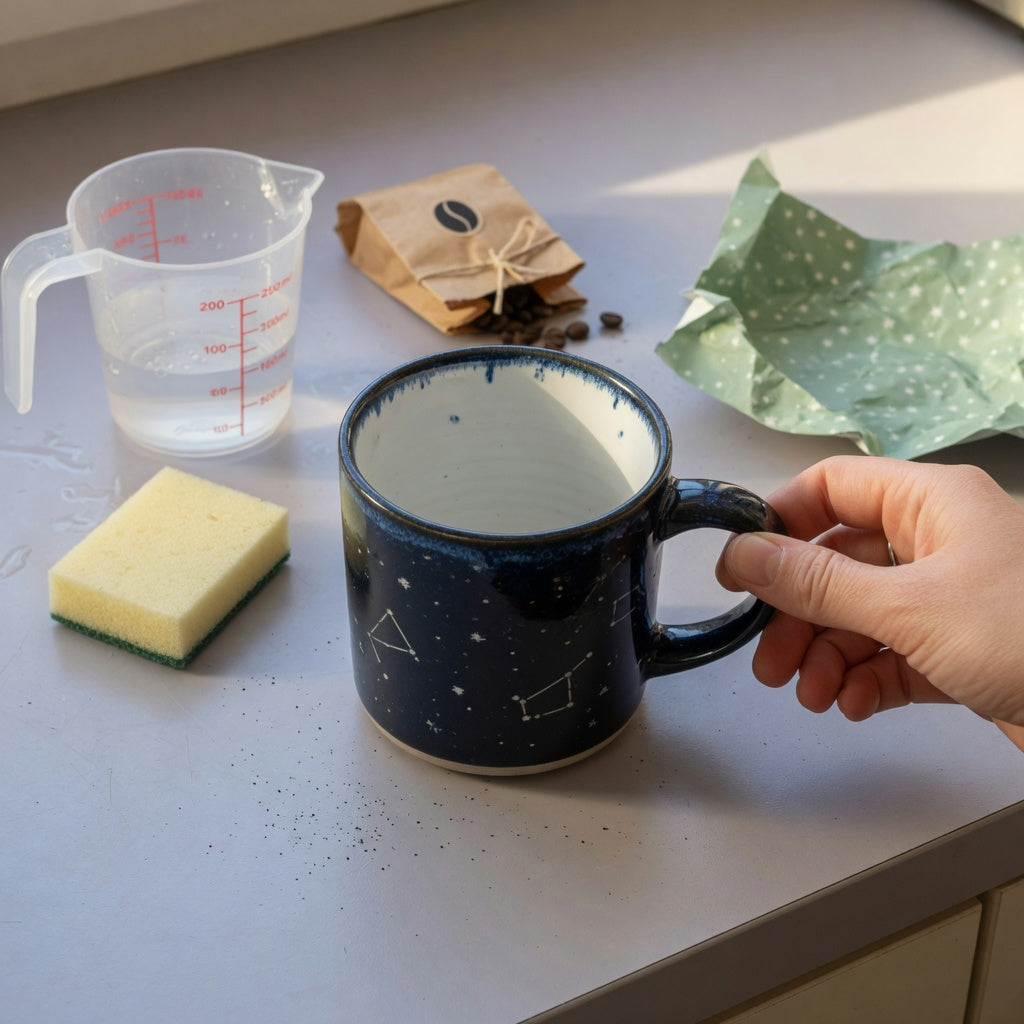
Planet Ceramic Coffee Mug Gift Checklist: 7 Checks Before You Buy
Reading time: about 10 minutes
A planet mug can look perfect in a gift photo and still fail at 7:15 the next morning: the handle pinches, the cup is smaller than the recipient's usual pour, or the care label rules out the microwave they use every day. Our planet ceramic coffee mug gift checklist starts with those routine details, because a design only becomes a good gift when it works beside the kettle, on an office desk, and through normal washing.
When our team assesses a mug gift, we picture three moments: the first full pour, the first trip to the sink, and the first attempt to find cupboard space. That quickly separates a useful present from another object the recipient has to store.
If a planet design is the point, open the live Planet Ceramic Coffee Mug listing while using this guide. Treat that page as the source of truth for capacity, care, packaging, accessories, food-contact statements, and every other exact specification. A similar marketplace mug cannot confirm facts about this product.
Daily drinkware or planet novelty: which job is the gift doing?
Planet mugs fall into several practical categories. Some are everyday ceramic drinkware with a fixed design. Others use a heat-changing surface for a reveal effect. There are also decorative pieces that resemble mugs but are intended primarily for display. Those products may share a theme, but they should not be evaluated by the same standards.
| Recipient routine | Likely product type | What must be verified |
|---|---|---|
| Morning coffee or tea at home | Everyday ceramic drinkware | Usable capacity, food-contact information, handle comfort, and care labels |
| Space fan who enjoys novelty reveals | Heat-changing planet mug | Surface-care instructions and microwave or dishwasher restrictions |
| Daily commute | Purpose-built travel vessel | Sealing lid, leak resistance, cup-holder fit, and carrying method |
| Shelf or desk collection | Decorative or novelty piece | Whether it is actually intended for beverages |
A standard ceramic mug is not a travel flask simply because it has a lid in a photograph. Likewise, a decorative piece should not hold coffee unless the seller identifies it as food-contact drinkware. If the recipient likes unusual designs but needs a different shape or routine fit, compare the current listings in our unique coffee mug collection rather than forcing the first planet design into the wrong job.
Capacity, handle clearance, and desk footprint: will the mug fit the routine?
Capacity labels are more useful when compared with a real drink. Someone who makes an 8-ounce milk drink has different needs from someone who pours 16 ounces of drip coffee and adds cream. Also check whether a listed capacity means filled to the brim or filled to a comfortable carrying level. Those are not always the same measurement.
Use the recipient's current favorite mug as a template:
- Fill it with water to the level they normally use, then pour that water into a measuring jug.
- Check how many fingers fit through the handle and whether the knuckles touch the mug wall.
- Measure the cupboard shelf or office storage space if the current mug is already a tight fit.
- Notice whether they hold the handle, cradle the body, or use both hands. That changes which shapes feel comfortable.
Handle stand-off, the distance between the mug body and the inside of the handle, matters with hot drinks. A tight loop can press the fingers against the heated wall. A larger loop offers clearance but can increase the mug's overall footprint. For a recipient with stiff fingers or limited grip strength, handle shape deserves more attention than the printed design.
At an office desk, look for a base that appears stable and a shape that will not crowd a keyboard. For a commuter, ceramic may be the wrong material and format unless the exact listing confirms a secure travel lid and leak resistance. For someone who mainly drinks large iced coffee through a straw, a conventional hot-drink mug may also go unused.
What should the listing say about ceramic, glaze, and food contact?
Ceramic is a broad label. Stoneware, porcelain, and earthenware can differ in wall thickness, porosity, weight, and firing method. Terms such as high-fired and vitrified describe how a ceramic body was matured, but they do not independently prove the safety of every glaze or decoration applied to it.
The U.S. Food and Drug Administration has established action levels for extractable lead in ceramic foodware. Its ceramic foodware guidance explains that ware exceeding those levels under prescribed testing may be considered adulterated. The FDA also states that lead and cadmium in ceramic glazes or decorations can migrate into food or drinks, with greater dissolution under hot and acidic conditions such as those associated with coffee and tea.
For a mug intended for regular drinking, look for a clear statement that it is made as food-contact drinkware. Review any food-safe, lead-free, or testing language exactly as written. Do not infer a certification from a smooth glaze, a country of origin, a handmade appearance, or a seller's use of words such as natural.
The linked product's catalog title establishes that it is presented as a planet ceramic coffee mug. It does not, by itself, establish the clay body, firing temperature, glaze chemistry, lead or cadmium testing, or certification. Verify those details on the current listing and contact the store if a safety point needed for your decision is not stated.
Microwave, dishwasher, and heat-changing finishes: what must be confirmed?
Microwave-safe and dishwasher-safe are separate claims. Neither is guaranteed by the word ceramic. Metallic-looking decoration is a reason to stop and read the instructions, while a heat-changing design may rely on a surface treatment with its own cleaning limits. Appearance cannot confirm compatibility.
Read the care section for exact language, then give the recipient care instructions that match it. A sensible routine for ceramic drinkware, subject to the maker's directions, includes:
- Rinse coffee or tea residue before it dries into a dark ring.
- Avoid moving the mug directly between extreme hot and cold conditions, which can place stress on ceramic and glaze.
- Use a soft sponge on printed or coated exteriors instead of abrasive pads.
- Use only cleaning methods permitted by the seller. If a mild baking-soda paste is not addressed, ask before applying it to a specialty finish.
- Keep the mug out of the microwave or dishwasher whenever the listing leaves that appliance compatibility unconfirmed.
Hand washing can be a reasonable choice for a decorated gift even if convenience matters less than preserving the exterior. For a busy office user, though, a hand-wash-only mug may be a poor fit. The recipient's actual washing habit should decide that trade-off.
Crazing, pinholes, chips, and wobble: inspect before wrapping
We check new ceramic pieces on a flat, well-lit counter before they become gifts. Handmade variation can include small differences in shape or glaze pattern, but functional defects require a closer look.
- Crazing: fine branching lines within the glaze. It can be intentional on some ceramics, but unexpected interior crazing should be raised with the seller before the mug is used.
- Pinholes: tiny pits in the glazed surface. Inspect the drinking rim and interior carefully, then ask whether any visible pits fall within the maker's acceptable finish.
- Chips or glaze flaking: sharp or loose material at the rim, handle joint, or base is not suitable for use.
- Body cracks: a crack through the ceramic is different from a line in the glaze. Do not fill or gift a cracked mug.
- Uneven foot: place the empty mug on a level counter and press lightly near the rim. A pronounced wobble is a problem near laptops and paperwork.
Also run a clean finger around the rim for rough spots and fill the mug with room-temperature water over a sink to check for leakage. Complete this inspection while the seller's return or replacement process is still available, and verify that policy on the live page rather than assuming one.
Planet ceramic coffee mug gift checklist by recipient and routine
Use this planet ceramic coffee mug gift checklist to match the person first and the design second.
- Home coffee or tea drinker who likes space themes: A planet ceramic mug may fit because it adds a personal design to an existing daily habit. Evaluate the Planet Ceramic Coffee Mug, then confirm its usable capacity, handle proportions, food-contact information, and care instructions on the current listing.
- Office drinker who leaves the mug at a desk: Prioritize a stable base, comfortable handle, and care method that works with the office kitchen. If a lid is needed for walks between rooms, verify that one is included rather than relying on a product image or another seller's version.
- Commuter carrying coffee in a bag or vehicle: A standard ceramic mug is not a good substitute for a tested travel vessel. Choose a product that explicitly states how the lid seals, whether it resists leaks, and how it fits a cup holder.
- Teacher, colleague, or gift-exchange recipient: Easy care and a familiar drink size usually matter more than an elaborate finish. Avoid unusual shapes that consume excessive shared-cupboard space.
- Collector who already has a favorite drinking mug: A novelty planet design can still work as a display piece. Be honest about that purpose and do not assume a decorative mug should hold beverages.
- Minimalist or anyone with a full cupboard: Skip another mug unless it clearly replaces something they use. Coffee beans, tea, or another consumable may be the better gift.
- Young child or someone who frequently drops drinkware: Breakable ceramic is generally a poor match. A more durable material is the practical choice.
What should you pair with a planet mug without adding clutter?
One useful consumable is enough. Choose coffee the recipient already drinks, a small package of tea, or a single-serve cocoa option that matches their habits. Avoid filling the mug with unrelated trinkets simply to make the package look larger.
Packaging is another listing detail to verify. Do not assume a gift box, spoon, lid, coaster, or infuser is included because a similar mug offers one. If presentation matters, confirm the contents first and plan simple external wrapping if the product arrives in standard protective packaging.
A short care card can add real value. Include only confirmed instructions, such as the stated dishwasher or microwave guidance. That is more useful than a decorative accessory the recipient has to store.
Five-minute checkout audit before you buy
- Confirm that the piece is sold for drinking, not only for decoration.
- Compare its stated capacity with the recipient's normal pour and ask whether the figure is brim-full or usable capacity if unclear.
- Study the handle opening, stand-off, rim, and base in the current product images.
- Read the exact food-contact, glaze, and safety statements without borrowing claims from another product.
- Find explicit microwave and dishwasher instructions.
- Verify every included item, including any lid, spoon, gift box, or other accessory.
- Review the return process before the mug is wrapped.
- Decide whether this gift will replace a daily mug, serve a new purpose, or add unwanted cupboard clutter.
If the planet theme and the recipient's routine line up, run those checks on the live product page. If size, care, or shape remains uncertain, compare other unique coffee mugs using the same standards.
Frequently asked questions
What belongs on a planet ceramic coffee mug gift checklist?
Check intended use, usable capacity, handle clearance, food-contact information, appliance care, included accessories, and the return process. Match those details to where the recipient drinks and washes the mug. The checklist should eliminate products that merely look right but do not fit the routine.
How do I know if a planet ceramic mug is microwave and dishwasher safe?
Look for explicit microwave-safe and dishwasher-safe wording on the exact product listing. Do not treat ceramic as automatic approval for either appliance, especially if the mug has a specialty coating or metallic-looking decoration. If the care guidance is absent, leave compatibility unconfirmed and ask the seller.
Are planet ceramic coffee mugs lead-free?
That cannot be determined from the theme, glaze color, product photo, or ceramic label. Review the exact maker or seller statement concerning food contact, lead, cadmium, and any testing offered. Do not transfer a lead-free claim from a similarly named product to the mug you are buying.
Why does a ceramic mug sometimes feel too hot to hold?
Heat can move through the mug wall and into a handle positioned close to the body. Thin walls, a narrow handle stand-off, and very hot coffee can make the grip uncomfortable. Buyers shopping for someone who prefers extra-hot drinks should give handle clearance and grip style more weight than novelty effects.
Should I buy the Planet Ceramic Coffee Mug or compare other designs?
Start with the Planet Ceramic Coffee Mug if the recipient specifically likes the planet theme and uses a stationary mug at home or work. Verify every required specification on that page before checkout. If the capacity, care, or format does not match, move to the unique coffee mug collection and compare alternatives against the same checklist.
More from our blog
Read more
The Flow Coffee Tea Mug Buying Checklist: 8 Checks Before You Buy
Compare The Flow mug's verified 400 ml capacity and glazed ceramic form against your real pour, grip, desk, cupboard, care needs, and gift recipient. This guide also flags which safety and applianc...
Read more
Mountain Sea Coffee Mug Wooden Handle: Buyer Checklist
Compare the details product photos often hide: body material, handle clearance and attachment, usable capacity, included pieces, and realistic wood care. This guide shows how to verify the current ...
Read more
Leave a comment
This site is protected by hCaptcha and the hCaptcha Privacy Policy and Terms of Service apply.