
Peppermint Tea Cup vs Mug: Capacity, Handle Fit, and Sipping Style
Reading time: about 8 minutes
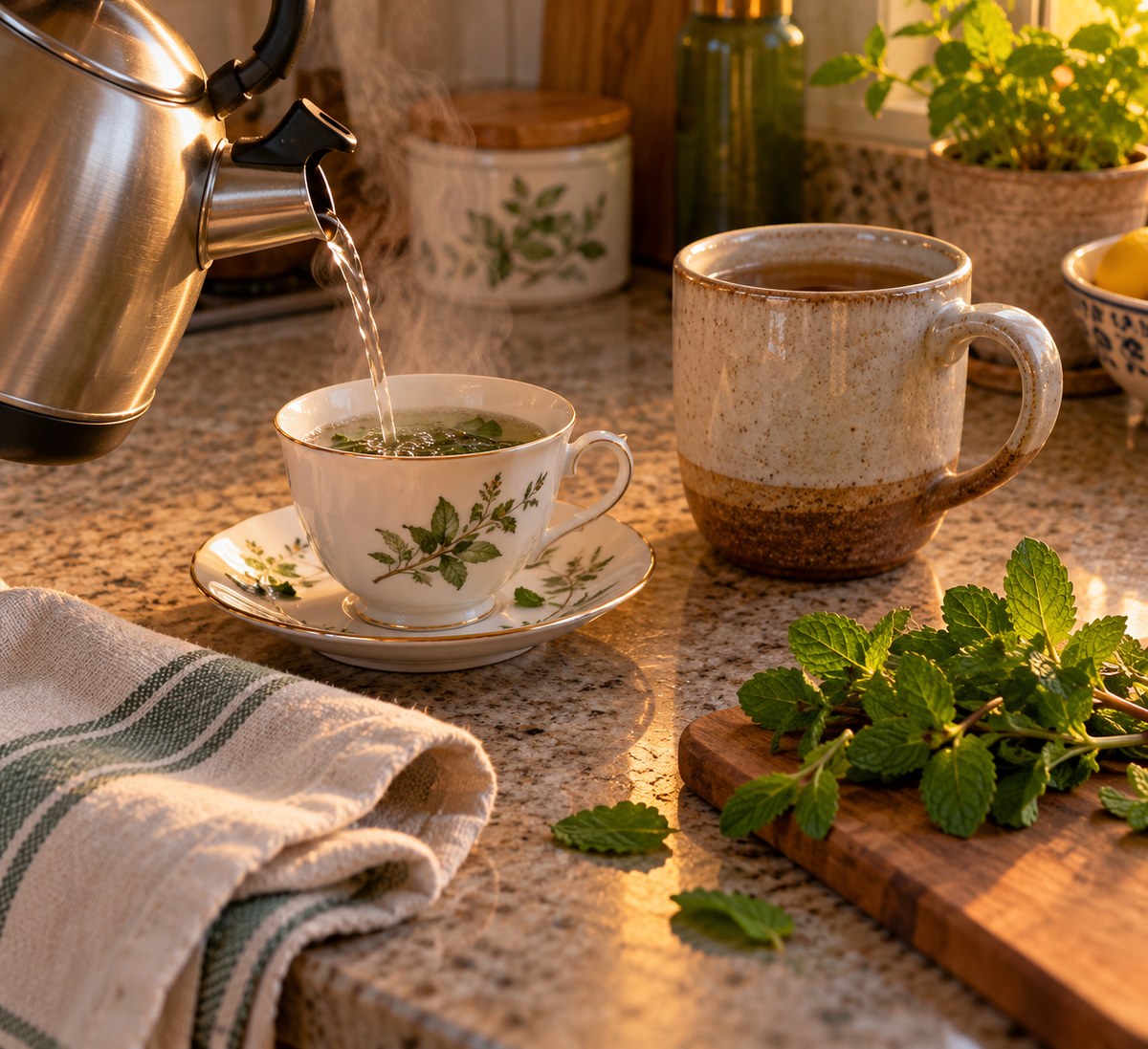
A customer emailed us last month about her nightly peppermint tea. She pours it into her grandmother's china teacup, which holds maybe four polite sips, and goes back to the kettle three or four times before bed. Her husband makes the same tea once, in a big mug, and carries it to the couch for a whole episode of whatever they're watching. Same kettle, same tea, same kitchen counter — and that one snapshot contains the entire peppermint tea cup vs mug decision, a question we hear a version of in our store nearly every week.
Neither vessel wins in the abstract. One matches a refill ritual; the other matches a single pour. What actually decides it is capacity, handle comfort, and how you finish a hot drink — so that's exactly how we'll walk you through it below, using the real numbers from our current listings.
What actually separates a tea cup from a mug?
Set the formality debate aside. The physical differences are straightforward, and they drive everything else:
| Feature | Tea cup | Mug |
|---|---|---|
| Typical capacity | Most hold well under 300 ml | Commonly 300–500 ml |
| Handle | Small loop, often paired with a saucer and a two-handed hold | Full-finger grip, one-handed carry |
| Rim and sip | Shaped for small, slow sips | Built for bigger drinks from a bigger volume |
| Session style | Multiple short refills | One pour, worked through over time |
One thing we'll say plainly: our mugs sit firmly on the mug side of that table. If the china-and-saucer ritual is what you're after, we're not the right shop for it — we'd rather tell you that up front than sell you the wrong shape.
Peppermint tea cup vs mug: does the tea itself change the answer?
It changes the math in one practical way. Most people drink peppermint tea straight — no milk, nothing stirred in later — so the whole drink arrives at once and the vessel sets your pace. A cup sends you back to the kettle every little while. A mug commits you to one long finish. The trade-off is real: by the time you reach the last third of a full mug, it has been sitting a while and won't be as warm as a fresh pour.
We won't pretend the vessel changes the tea itself — peppermint is peppermint, as far as we're concerned. What it changes is the rhythm of your evening. If slow refills are the point, the cup is genuinely pleasant. If you want the drink sorted in one pour so you can get back to your book or your desk, the mug wins, and it isn't close.
What capacity fits your pour: 400, 440, or 480 ml?
Capacity is the first spec we'd check with you, and it's the one place we can give exact figures from our current listings. Three mugs cover most of the peppermint tea drinkers we talk to:
- Light pourers — The Flow, 400 ml. If you fill a teacup twice and call it done, or your desk has no space to spare, The Flow coffee and tea mug gives you a proper drink at 400 ml without the footprint of an oversized mug. Smaller hands tend to get along with it better, too.
- The middle path — Morning and Night, 440 ml. The name fits how this drink actually gets used: one for the morning, one for later in the evening. The Morning and Night coffee and tea mug sits at 440 ml — enough for a full pour, not so much that the final stretch drags.
- One-pour drinkers — The Rock, 480 ml. Make it once, take it to the couch, done. The Rock coffee and tea mug is the largest of the three at 480 ml, which means fewer refills and fewer trips. If you carry a full pour across the room, look at the shape photos for how much headroom sits under the rim.
All three catalog descriptions support tea use, so nobody's forcing a coffee vessel into double duty. Two details we'd verify on each product page before ordering: the handle photos (does it fit your whole hand, or just a couple of fingers?) and the listed care instructions, which can vary from one product to the next. Confirm them on the current listing rather than assuming they match a mug you already own.
Which handle works for a full evening of one-handed sipping?
Handle comfort sounds like a footnote until you've carried a full 480 ml across a living room. Liquid is heavy, and a big pour in a handle built for two fingers turns the walk from kitchen to couch into a careful operation. In our experience, the buyers who sip over an hour care about the same three things:
- Finger clearance. A full-finger grip spreads the weight; a pinch grip fatigues fast. Photos and listed measurements on the product page will tell you more than any description we could write.
- One-handed everything. Desk workers open drawers, scroll, and type between sips. A mug you can lift and set down without a saucer keeps that workflow intact.
- A steady base. A wider footprint feels safer next to a keyboard. We keep a coaster under ours anyway — we've seen what a bumped mug does to a laptop.
If you'd rather compare shapes than take our word for any of this, the unique coffee mugs collection is the fastest way to see silhouettes side by side. And if the handle question is what's holding you up, we put round tea mugs head-to-head with coffee mugs in a separate practical breakdown.
When a mug is the wrong pick for peppermint tea
We like our mugs, but they're not universal, and pretending otherwise helps nobody:
- Formal tea service. A chunky 480 ml mug undercuts a proper hosting setup. If you serve guests from a teapot with saucers, the mug stays in the cupboard.
- Drinkers who hate lukewarm endings. A full mug takes longer to finish, and the final portion will have cooled more than a fresh pour would be. Small, repeated pours keep every sip closer to serving temperature.
- Very small hands or weaker grips. A full large mug is genuinely heavy. If that describes you or the person you're buying for, lean toward the 400 ml Flow and check the handle clearance on the listing first.
- Tight cabinets. The boring variable nobody mentions: big mugs eat storage. If your cupboard is already full, one well-chosen mug beats three.
If the small-cup side of this keeps pulling at you, we've also compared a pleated tea cup against a coffee mug purely on size — the fairest head-to-head between the two formats we've written.
Settling it in 60 seconds: your pre-order checklist
- Pour your usual amount of peppermint tea into a measuring jug once. That number — not the mug you already own — is your real capacity requirement.
- Decide the session style: repeated refills favor a cup; one long pour favors a mug.
- Within mugs, match the number: 400 ml for lighter pours, 440 ml for the middle ground, 480 ml for a full evening pour.
- Check the handle photos and finger clearance on the exact listing you're buying, not on a similar one.
- Confirm care instructions on that same current product page.
That's the whole peppermint tea cup vs mug decision in five lines — your jug measurement and your session style will settle it faster than any argument we could make. If you're still torn between formats, our guide to breakfast cup, coffee cup, and mug capacities sorts out the middle ground. Otherwise you already know your lane: the 400 ml Flow for lighter pours, the 440 ml Morning and Night for a bit of both, the 480 ml Rock for one-pour evenings — or browse the full unique coffee mugs collection and let the shapes decide.
Frequently asked questions
Peppermint tea cup vs mug: which one should I actually buy?
Buy for the session, not the tea. A cup suits slow evenings built around kettle refills; a mug suits one pour sipped over an hour. If making it once describes you, a 400–480 ml mug is the practical pick.
Can I serve peppermint tea in one of your coffee mugs?
Yes. The catalog descriptions for The Flow (400 ml), Morning and Night (440 ml), and The Rock (480 ml) all support tea use, so none of them are coffee-only. For washing and care specifics, check each product's current listing.
What size mug is best for peppermint tea?
Match capacity to your pour, which you can measure once with a jug. Full-mug drinkers get the biggest single pour with The Rock at 480 ml, lighter pourers get on well with The Flow at 400 ml, and Morning and Night at 440 ml covers both habits.
Is a 480 ml mug too big for herbal tea?
Only if you dislike finishing slowly. A full 480 ml pour takes a while to work through, and the last portion will have cooled more than a fresh pour would be. If that bothers you, choose the 400 ml Flow or keep refilling a smaller cup.
Cup or mug for peppermint tea at a desk?
A mug, for most desk drinkers. One pour means fewer trips to the kitchen, and a full-finger handle is easier to lift between typing and calls. Check the handle clearance on the listing, and keep the mug on a coaster, off the keyboard side of the desk.
Read more

Red Ceramic Coffee Mug for Gift: What Buyers Should Compare
A red ceramic coffee mug for gift buyers works when capacity, glaze, and food-safety language hold up in daily use. Compare 460 ml pour size, chip-prone edges, care claims, and shipping protection ...
Read more
Unique Pottery Mugs for Gifts: What to Compare Before Buying
We handle pottery mugs every day in our store, and this guide shares the comparisons that matter before you buy: clay weight, glaze texture, handle feel, care limits, and matching the piece to the ...
Read more
Leave a comment
This site is protected by hCaptcha and the hCaptcha Privacy Policy and Terms of Service apply.