
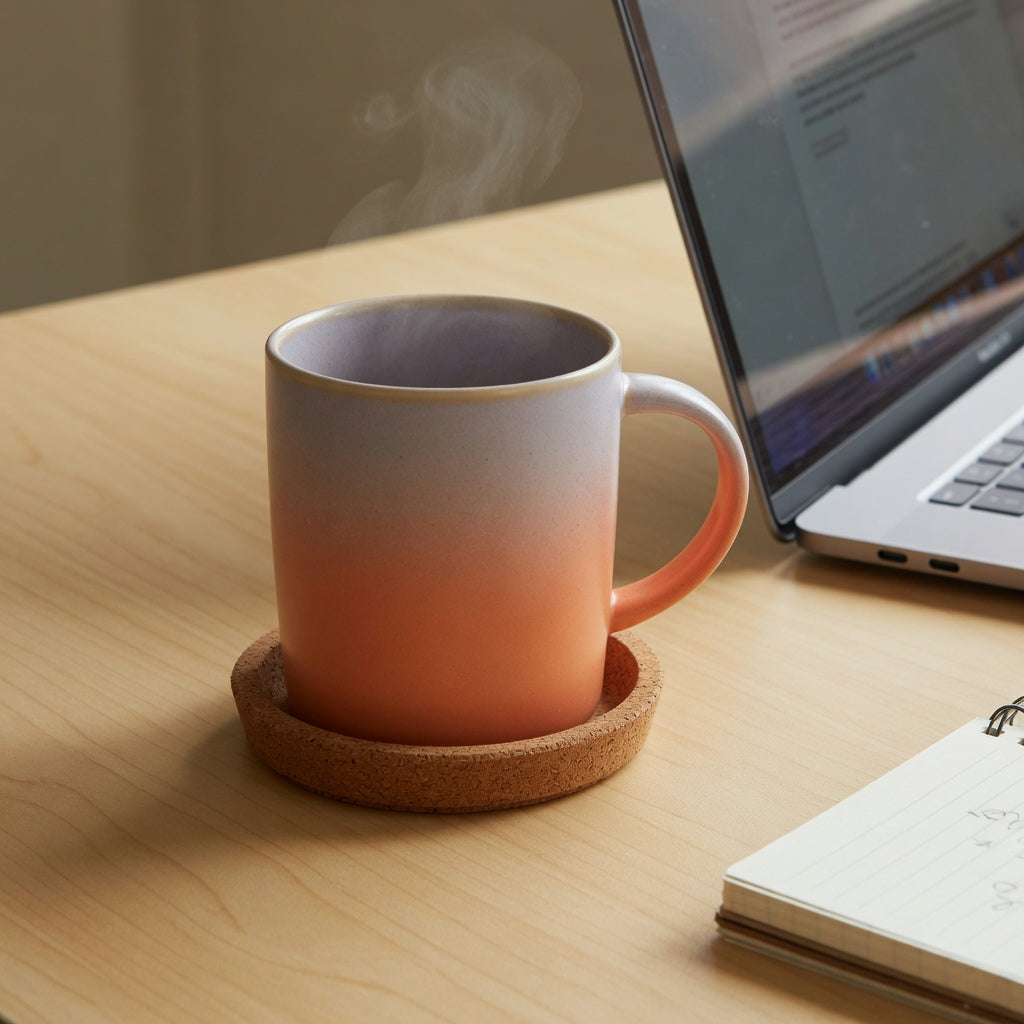
Office Desk Gradient Ceramic Mug: What Buyers Should Compare
Reading time: about 13 minutes
A fresh pour looks harmless until the foot sits on laminate and the handle clips a monitor arm. The product photo will not tell you whether that color shift is a fired glaze, a printed spray, or a tea mug whose wooden handle should never see a shared microwave. Shoppers ask us for an office desk gradient ceramic mug as if those were one object. They are not. In our store the pictures sit close together. The care lines often do not.
Three mugs hiding behind one gradient photo
We sort the request before we talk about shade. How the color was made decides washing, reheating, and whether two mugs can ever match on a conference table.
| What the listing usually is | Who it fits | The trap |
|---|---|---|
| Glossy two-tone or ombre promo mug, often a pale interior and a sprayed exterior fade | Matched coworker sets and a logo imprint | Hand-wash rules to protect gloss, carton minimums, and a mark that dulls if the care card is ignored |
| Coffee mug with the fade in the glaze: dipped, hand-sprayed, or reactive in the kiln | One desk cup with a shift a plain white mug will not have | Two pieces rarely match the photo or each other. Appliance safety is only what that maker marked |
| Gradient tea mug with an infuser, a lid, and sometimes a wooden handle | Loose leaf beside the keyboard | The basket cuts drinkable volume. Wood is a different care problem from ceramic |
The piece we list in this lane is the Gradient Ceramic Coffee Mug. The catalog name does not tell you capacity, whether a lid or infuser is included, what the handle is made of, or which appliances are allowed. Those lines live on the current listing, and that page is the only place to confirm them. If you are still choosing a shape, start in our unique coffee mugs and compare the written facts, not the color names.
A promo ombre mug is the wrong pick when you want kiln variation. A reactive glaze is the wrong pick when a client needs a dozen identical logo cups. A wood-handle infuser mug is the wrong pick when the whole vessel has to go into an office microwave. Open the gradient listing if you want one cup with a fade and you will read the care lines before the first wash. Leave it if you need a matched set.
What size office desk gradient ceramic mug fits under a brewer?
Regulators and shoppers are not using the same idea of a normal mug. FDA describes cups and mugs as small ceramic hollowware, commonly used for coffee or tea above room temperature. They normally, though not exclusively, hold about 8 fl oz (240 mL) and are usually made with a handle. That is a food-contact category. It is not advice to buy an 8 oz cup for a workday.
What we actually see people weigh, holding a listing up against a real desktop:
- About 10 to 12 oz. A short pour. Fine beside a tight keyboard or for a milky coffee. Annoying if you walk to the kitchen twice an hour.
- About 12 to 16 oz. Where most office ceramic settles. Enough for a real cup, still liftable with one hand when it is full.
- Roughly 17 oz and up. Fewer refills, more footprint, and a better chance a cable catches the handle. Bigger is a refill habit, not automatically a better desk mug.
Ounces on a product page are usually measured to the rim. You should not fill hot coffee to the lip, so the drink you carry is smaller than the headline. For an office desk gradient ceramic mug, height matters as much as volume. Measure the gap under a single-serve brewer or a hutch before you fall for a tall silhouette. A wide foot sits steadier next to a keyboard. A narrow foot looks neat in a photo and tips when you reach past it.
Handle clearance is the other quiet miss. A loop that barely takes three fingers forces you onto the hot wall once the mug is full. That is how a knuckle gets burned on the walk back from the kitchenette.
Heat and the desktop are separate from capacity. A hot single-wall ceramic base can leave a pale ring on some laminates and coated standing-desk tops. People notice it after the cup has sat through a meeting, not because a spec sheet warned them. If you do not already trust that surface with a hot kettle, use a coaster or a small trivet. If the listing never states height or foot width, do not guess from the crop of the photo. Compare another shape in our coffee mug collection that publishes those lines.
This style is not a commute bottle. It will not stay sealed in a bag, and a glazed foot needs a clear landing spot. If the desk is already a cable tray, buy less mug, not more color.
Microwave labels, metal trim, and a handle that comes out hot
USDA food-safety guidance says to microwave only cookware made for that job. Glass and ceramic that can take it are usually labeled. China with metallic paint or trim is listed as unsafe. If a piece has no label, the agency describes a one-minute high-power check beside a cup of water. A utensil that comes out warm or hot is not microwave safe, because metal is in the material or the glaze.
Treat that check as a warning, not as something to try with a full mug of yesterday's coffee. Read the piece first.
- A gold, silver, or other metallic lip is a no, even when the line is thin and sold as decoration.
- A wooden handle does not inherit a microwave claim from the ceramic body. Wood also does poorly in a dishwasher. If a listing includes wood, that part has its own rule. Do not assume the gradient mug has a wood handle, or that it does not, until the page says so.
- An unlabeled handmade cup is not safe just because it is ceramic. Some clay bodies and glazes absorb microwave energy. The wall or the handle comes out hot while the drink heats unevenly.
In our experience the awkward moment is a Monday morning. Someone heats a full mug, then cannot comfortably carry the handle back to the desk. If the current listing does not state microwave use, do not guess. Reheat in a vessel you already know is marked safe, then pour. A gradient color does not change that rule.
Hand wash or dishwasher: which fade survives
Listings that look alike do not share one care rule. Some ombre promo mugs are sold hand-wash only. Others, with a similar fade, are sold as dishwasher safe. Few pages say whether the color is a fired glaze, a reactive glaze, or a surface print. That missing sentence is the decision.
A glaze fired into the ceramic is part of the surface. A spray, decal, or printed fade sits on top, and daily detergent plus heat can dull it or lift the color where the shades meet. Reactive glazes can scuff or shift even when a dishwasher is allowed, because the color was never a flat printed coat. When a promo seller says hand wash, the usual reason is to protect gloss and a logo.
There is a safety version of the same habit. California public-health guidance says dishwashing ware that contains lead can damage the glaze and make later leaching more likely. You cannot see lead in a glaze. Without a leach test for that exact mug, wash it by hand with warm water and a soft sponge, skip abrasive pads across the color break, and dry the foot so it does not sit damp on a coaster all afternoon.
Follow the mark on the piece you bought. A blanket claim that ceramic is always dishwasher safe is how a finish fails across a month of shared-kitchen cycles. Repeated heat shocks are also how glaze crazes: fine lines that look like crackle and then stain with coffee. If our listing is silent, treat silence as hand wash until the page says otherwise.
Lead, cadmium, and the rim you actually drink from
Color is not evidence either way. Lead compounds such as lead oxide have historically been used in glaze formulas. If firing does not fully bind that lead into the glaze, it can move into food. Coffee and tea make this concrete when lead is present. California public-health guidance notes that those acidic drinks leach lead faster than non-acid drinks, and that heating or microwaving speeds leaching from dishes that contain lead or might contain it. Lead in a glaze or decoration cannot be seen.
For cups and mugs, FDA action guidance is 0.5 micrograms of lead per milliliter of leaching solution if any one of six tested units reaches that level. Ceramic that keeps releasing lead into food can contribute to chronic lead poisoning, which is why cups are a strict food-contact category. For small hollowware, defined as capacity under 1.1 liters, cadmium guidance is 0.5 micrograms of cadmium per milliliter in any one of six units. Acid foods can extract cadmium from ceramicware, and continued use of ware that releases it could contribute to chronic cadmium poisoning. A normal desk mug sits under that 1.1 liter line. These figures are regulatory benchmarks. They are not a test result we are assigning to any mug in our shop, including the gradient piece.
- Lead free is not a test result. FDA has said ceramicware that still shows extractable lead on the prescribed test should not wear that label. The agency has found imported pottery marked lead free that still released lead, in some cases above the action levels. The guidance covers all ceramicware, including pieces made without a lead glaze.
- Microwave-safe is not lead-free. One claim is about heating and metal. The other is about what leaves the surface into a drink.
- A cup that looks usable is foodware. Ornamental ceramic that appears suitable for food needs a permanent not-for-food-use statement, or a hole through the food-contact surface, if it is truly decoration only. A gradient mug on a desk is a drinking vessel unless the maker has clearly marked otherwise.
- The rim is not a side detail. A 2025 laboratory study of new and second-hand ceramic mugs found more cadmium and lead moving from exterior lip areas than from interior surfaces, especially where the rim was overglazed with decorative cadmium pigments. Interior concentrations over 24 hours in that study stayed comparatively low. Your mouth meets that band on every sip, so a bright overglaze at the lip deserves more questions than a plain interior photo.
We do not treat a slogan as a lab method. If a page says non-toxic or lead free and names no test, ask what the phrase is based on. Regulators point to ASTM C738 and AOAC methods 973.32 and 973.82, among FDA laboratory methods, for measuring leachable lead and cadmium from ceramicware. You do not need to run those tests at your desk. You do need to notice when a seller has offered none of them.
Handles, chips, and coffee that cools on a long call
Single-wall ceramic sheds heat. It is a cup, not a thermos, and a gradient does not change that. Listings almost never publish a measured hold time at a desk, so we do not quote one. A lid slows cooling more than a thicker-looking photo does. A lid also hides the fill level and can drip onto a notebook. An infuser helps loose leaf and takes away drinkable volume. If a basket is part of a set, compare the liquid you can actually drink, not only the outer ounce claim. Confirm on the listing whether any lid or infuser is included before you plan a tea routine around it.
Handles fail in ordinary office ways. They heat in the microwave when the clay or glaze absorbs energy. The rim chips when mugs are stacked in a kitchenette, knocked into a monitor base, or dropped into a metal sink. A thin lip looks refined and chips faster under daily handling than a heavier rim. When we box a mug for someone's desk, the rim and the handle junction are the spots we pad first, because those are the edges that meet a hard surface.
Some makers use a double wall so the outside stays cooler in the hand. That is a different build, with its own weight and footprint, and it is not what most single-wall gradient cups are. If a cooler grip and a longer warm cup are the real requirements, buy for that build. A fade will not deliver it.
Skip this style if you need a sealed commute cup, if the only washer available is a shared dishwasher and the listing says hand wash, or if you want metal trim and microwave reheats in the same piece.
Logo sets versus a gradient that will not match
Branded ombre mugs are a production product. Sellers of that style specify an imprint area, how many pieces ship in a carton, and often a hand-wash note so the gloss and the mark survive. A kiln gradient does the opposite job. Variation is the point. Ordering three reactive mugs because the hero photo looked like a set is how office gifts disappoint when the box opens.
For one person's desk, we look at whether a care line is actually stated and whether the interior reads as a straightforward food-contact surface even when the outside runs from light to dark. We cannot promise two gradient pieces will match. If the gift has to look identical on a row of desks, do not force this mug into that job.
Need twenty identical client cups? Buy the promo style and accept its wash rules. Our gradient listing is a poor substitute for a logo program.
Check the listing against the desk, then decide
Keep the product page open and run this list. It is the same pass we use when a customer is torn between a pretty fade and a mug they will use five days a week.
- Name the object: promo ombre, glazed gradient coffee mug, or infuser tea mug that might include wood.
- Read the stated capacity, then measure brewer clearance, handle swing, and where the foot will sit.
- Find the microwave and dishwasher lines. Silence is not a yes.
- Reject metallic trim if the mug itself will be reheated.
- Treat a lead-free slogan as unfinished until the listing shows a basis. Look at the rim, not only the inside photo.
- Plan a coaster for hot ceramic on laminate or a coated desktop.
- For a gift, decide whether you need matched color and a durable logo, or one piece that is allowed to vary.
If that pass still points at a gradient coffee or tea mug, read the live details on our gradient mug listing and confirm capacity, handle, and care there before you order. If you are comparing several looks, stay with the same collection and judge every listing the same way.
Frequently asked questions
Is an office desk gradient ceramic mug microwave safe?
Only if that exact mug is marked for microwave use. USDA says microwave-safe glass and ceramic are usually labeled, and china with metallic paint or trim is not. A wooden handle, a gold lip, or a handmade piece with no mark should not be assumed safe. If the listing is silent, reheat in a known-safe cup and pour.
Will the gradient fade or peel in a dishwasher?
It depends on whether the fade is a fired glaze, a reactive glaze, or a surface print. Similar-looking ombre mugs are sold both as hand-wash only and as dishwasher safe, often without saying which decoration method was used. Follow the care line on your mug. If there is no line, a soft hand wash is the safer bet for the color and for an untested glaze.
Does microwave-safe mean the colorful glaze is lead-free?
No. Those are separate questions. Microwave guidance is about heating and about metal in the body, glaze, or trim. Lead and cadmium are about what can leach into coffee or tea. A lead-free slogan is not a lab result. FDA has found some ware labeled that way which still showed extractable lead.
What mug size actually works on an office desk?
FDA's category description of a cup is about 8 fl oz, but the office mugs shoppers compare usually land around 12 to 16 oz for a normal pour. Larger mugs cut refill trips and take more space. Stated capacity is to the rim, which you should not fill with a hot drink. Measure height under your brewer and leave room for a coaster.
Will a hot ceramic mug mark my desk?
It can. A hot single-wall ceramic foot has left a ring on laminate and on some coated standing-desk surfaces when the cup is set down bare. Use a coaster or a small trivet unless you already know the top tolerates heat. The gradient color does not change that, and a pretty glaze is not a heat shield.
More from our blog
Read more

Office Desk Ceramic Mug Gift: Fit, Care, and Safety
An office desk ceramic mug gift has to earn a spot beside the keyboard, not just look good in a cart photo. Compare capacity, handle and base fit, print wear, packaging, and why a microwave-safe li...
Read more
Golden Waves Kio Coffee Tea Mug Buying Checklist
A gold wave on a mug is not a care label. This golden waves kio coffee tea mug buying checklist shows what to verify on our listing: material, metal versus printed gold, capacity, microwave and dis...
Read more
Leave a comment
This site is protected by hCaptcha and the hCaptcha Privacy Policy and Terms of Service apply.