
Ocean Coffee Mug Buying Priorities: Capacity, Shape, and Space
Reading time: about 10 minutes
A mug can look right on a product page and still become awkward by the first coffee break. The usual pour reaches too close to the rim, the handle bumps a laptop stand, or the mug barely clears the cabinet shelf. In our store, these routine mismatches are why our ocean coffee mug buying priorities start with capacity, shape, and available space rather than artwork alone.
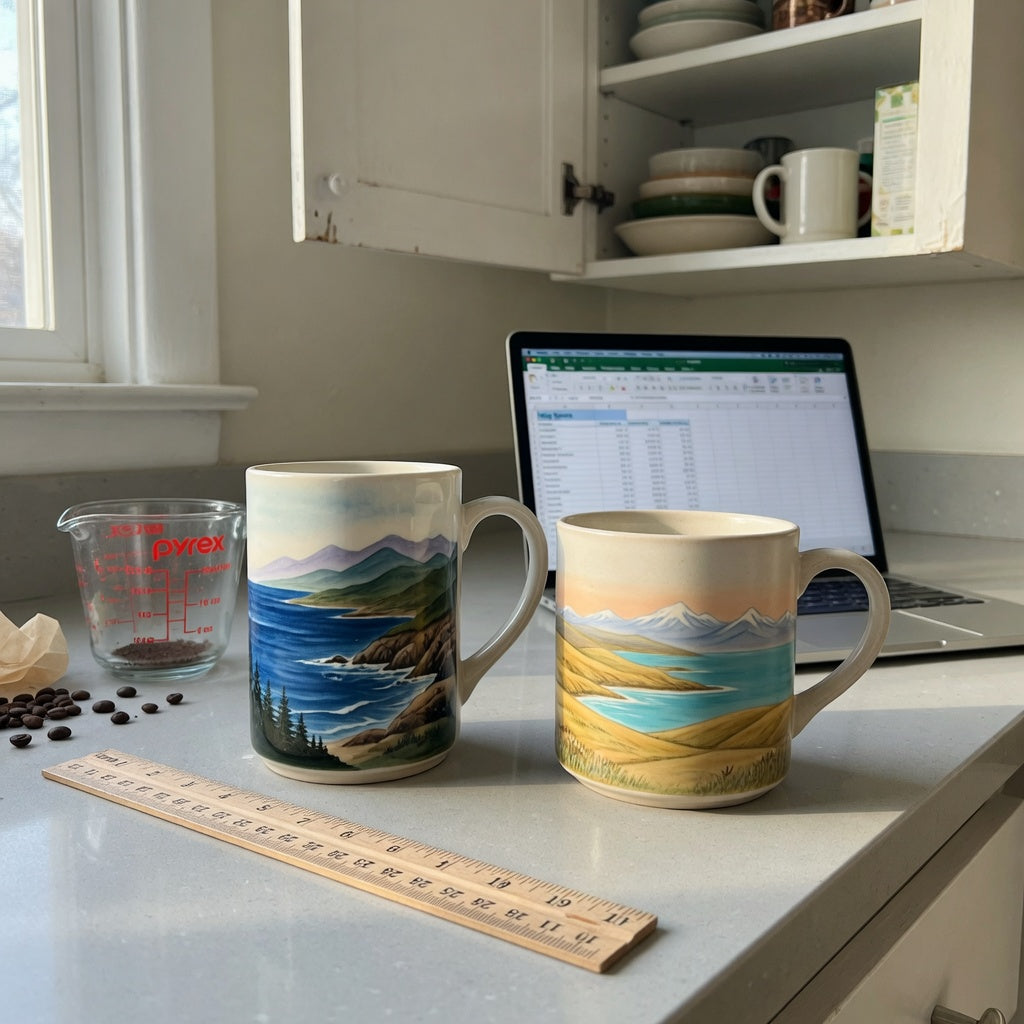
CoffeifyMug currently offers two relevant nature-inspired options: the Mountain Sea Coffee Tea Mug and the Landscape Coffee Tea Mug. Their product imagery shows ceramic material, handled mug forms, and visible outdoor scenes. We will stay within those observable details and the specifications listed on each current product page. Exact capacity, dimensions when provided, and care directions on the live listing should be your final reference before ordering.
Use these ocean coffee mug buying priorities in this order
Start with the variable that can make the mug unusable, then move toward personal style. For most shoppers, that produces this order:
- Normal pour volume: Compare the listed capacity with the amount you actually drink, leaving enough room to carry the mug without spilling.
- Total footprint: Account for the body and the handle, especially beside a keyboard, sink, or small coffee maker.
- Grip and visible shape: Check the handle opening, body profile, rim, and base shown in the product images.
- Material and care fit: Decide whether ceramic suits the surface, washing routine, and amount of handling the mug will receive.
- Nature scene: Choose between mountain-and-sea imagery and a broader landscape only after the functional checks pass.
A shopper choosing for a stable breakfast counter can give visual style more weight. Someone working at a crowded desk should put footprint first. A commuter who needs a sealed lid should stop before either decision and look for a product explicitly designed for travel.
What listed capacity matches your real coffee or tea pour?
Capacity becomes useful only when it is compared with your normal serving. Do not assume a listed capacity is the same as a comfortable fill line. A mug filled close to the rim may technically hold the drink but leave too little headroom for the walk from the kitchen to the desk.
- Fill your current mug to the level you normally use.
- Transfer that drink into a marked kitchen measuring cup and record the volume.
- Repeat the check with ice if iced coffee is part of your routine, since ice occupies space that would otherwise hold liquid.
- Compare the result with the capacity shown on the current product listing.
Coffee maker cup markings can also differ from the serving size you picture in your head, so measuring the finished pour is more reliable than counting brewer marks. Tea drinkers should include any space normally left for milk, lemon, or an infuser.
If your routine is one seated hot drink at a stable kitchen table and you prefer a horizon-led nature scene, review the current capacity and visible profile on the Mountain Sea Coffee Tea Mug product page. Its ceramic table-mug format suits that situation only if the listed volume matches your measured pour. It is not automatically the right choice for someone who wants one very large serving with no refill.
What does the visible shape tell you about grip and stability?
Product images show both current mugs with upright ceramic bodies, curved loop handles, and bases intended for flat surfaces. Those images help you judge the overall silhouette, but they cannot confirm exact weight, finger clearance, or base width unless measurements are also listed. We would not promise a two-finger, three-finger, or full-hand grip from a photograph alone.
A simple paper template gives you a better space check. Trace the base of a mug that already fits your routine, then mark how far its handle projects. Place that outline beside the keyboard, coffee maker, or drying rack. This catches a detail shoppers often miss: overall width includes the handle, not just the circular body.
- For a desk: Check the handle's path against the mouse, notebook, charging cables, and the hand you use most.
- For a kitchen counter: Leave room to lift the mug without striking a cabinet knob or appliance.
- For a shelf: Compare the full height and handle width with the shelf opening, not only the empty shelf depth.
- For a gift: Favor a conventional grip unless you know the recipient likes unusually narrow or sculpted handles.
After delivery, place the empty mug on a clean, dry, flat counter. If it rocks, wipe the foot ring and test it again. Persistent rocking, a chipped drinking rim, or a visible crack near a handle attachment point is a reason not to put any ceramic mug into service.
How much desk, counter, and cabinet space does the mug need?
A mug occupies more space during use than it does while sitting untouched. Your hand approaches from one side, the handle needs turning room, and a low cabinet can restrict the lifting angle. When dimensions are listed, compare four measurements with your available area:
- The body width at its widest visible point
- The total width from the body to the outer edge of the handle
- The mug height plus enough clearance to lift it comfortably
- The shelf or cabinet depth with the door fully closed
For a fixed office station where you prefer a general landscape scene, compare your measured desk zone with the Landscape mug's current details. Its visible upright, handled profile makes it straightforward to compare with a mug already on your desk. We do not label it smaller or more stable than the Mountain Sea option unless the current listed dimensions support that comparison.
Stacking also needs restraint. A cylindrical silhouette does not prove that mugs nest securely, and loop handles usually affect how closely several pieces can sit together. If dense vertical storage is essential, look for a listing that explicitly shows or describes stackability. These ocean-style mugs are a weaker fit for a shallow drawer or a shelf that only works when several mugs nest tightly.
Which visible ocean scene fits the way the mug will be used?
Once capacity and space work, the imagery can decide the purchase. The Mountain Sea option makes the mountain-and-water relationship the identifying visual feature. The Landscape option is the better starting point for a shopper who wants a more general scenic view rather than choosing solely for an ocean horizon.
Placement changes how much that difference matters. A mug left on an open kitchen shelf can be viewed from across the room, while an office mug is usually seen close up and from one repeated angle. Review all available product images to see which part of the scene faces outward in the position you expect to use it.
For gift unboxings, we suggest matching the scene to a known interest only after checking the recipient's routine. Someone who drinks from a travel tumbler during a commute may appreciate the artwork but rarely use an open ceramic mug. We describe these products through their visible nature imagery; that is not a claim about ocean provenance, artist identity, or an unlisted production method.
Where does ceramic work well, and where is another mug style better?
Ceramic is a practical match for coffee or tea served on a stable kitchen counter, dining table, tea tray, or fixed office desk. It provides a rigid, familiar drinking form and supports detailed visible imagery. The trade-off is that ceramic can chip or crack after a hard impact against a sink, tile floor, or another dish.
These handled, open mug forms are not the best choice for a backpack, a moving vehicle, or a workstation where spills could reach sensitive equipment. If you need a sealed lid, verified insulation, or a mug sized for a particular car cup holder, choose a listing that explicitly provides those features and dimensions. Do not infer them from a standard ceramic silhouette.
Care claims require the same discipline. Ceramic material alone does not establish dishwasher or microwave compatibility because the finish and decoration can affect the instructions. Our team checks the current product page before answering those questions, and shoppers should follow the care directions listed there rather than assuming every ceramic mug tolerates the same dishwasher cycle.
Iced coffee introduces a different trade-off. Ice reduces the usable liquid volume, and condensation may leave moisture on a desk in a humid room. A coaster can protect a surface, but it does not change the mug's capacity or add insulation.
What should you check at unboxing and before the first wash?
We use a short inspection routine for ceramic mugs because small issues matter most around the drinking edge and handle. These checks are useful for a personal order and especially helpful before wrapping a mug as a gift.
- Inspect the rim and interior under bright light for chips, sharp edges, or visible hairline cracks.
- Look at both handle attachment points and stop using the mug if a crack appears around either joint.
- Set the mug on a flat, dry surface to check that the base sits consistently after the foot ring is wiped clean.
- Compare the delivered shape and visible scene with the current listing before removing packaging needed for a return.
- Wash the mug according to the care instructions on its product page before the first drink.
This is not an assertion that either current mug has a defect. It is the same practical check we recommend for any rigid ceramic drinkware that has passed through packing and delivery.
Current product fit by routine, not by artwork alone
| Reader situation | Leading priority | Current product fit | Limitation to check |
|---|---|---|---|
| One regular hot drink at a stable breakfast table | Measured capacity and preferred horizon scene | Mountain Sea Coffee Tea Mug | Confirm the current listed capacity leaves carrying headroom |
| Fixed office desk with a known mug-sized space | Total footprint and scenic preference | Landscape Coffee Tea Mug if its imagery suits the user | Confirm handle projection and height from listed details when available |
| Iced coffee with a generous amount of ice | Usable volume after adding ice | Either mug only if the listed capacity supports the measured serving | Expect less room for liquid and possible exterior condensation |
| Gift for someone with a known home coffee routine | Capacity first, scene second | Choose the imagery that matches the recipient | Verify care and storage fit before wrapping |
| Commute, backpack, or moving workstation | Spill resistance and impact risk | A different mug style is likely a better fit | Look for an explicitly listed lid, insulation, and relevant dimensions |
Frequently asked questions
Which ocean coffee mug buying priorities matter most for a small office desk?
Start with the total footprint, including the handle, followed by the listed capacity. Measure the clear area beside your keyboard and check overhead clearance under any monitor shelf. Choose the ocean or landscape scene only after the mug fits that space without constant repositioning.
How do I compare listed mug capacity with my normal pour?
Transfer your usual finished drink into a marked measuring cup, then compare that amount with the capacity on the current product page. Leave practical headroom instead of planning to fill the mug to the rim. Measure iced and hot drinks separately because ice changes the usable liquid volume.
Are the Mountain Sea and Landscape mugs dishwasher and microwave safe?
Check the current care directions on each product listing before using either appliance. Ceramic material by itself does not confirm dishwasher or microwave compatibility, and we will not infer care claims from product photos. Follow the listing rather than a general rule for ceramic mugs.
Which ocean mug is the safer gift if I do not know the recipient's routine?
Neither is automatically safer because the recipient's pour size, storage space, and grip still matter. If you know they use standard ceramic mugs at home, choose between the Mountain Sea and Landscape imagery based on their visual preference. For someone who primarily commutes with drinks, a lidded travel style is likely to be more useful.
Make the decision with a five-point fit check
- Measure your normal hot or iced drink.
- Mark the available desk or counter footprint, including handle room.
- Check cabinet height and shelf depth.
- Confirm the current material, capacity, dimensions when listed, and care directions.
- Choose the visible ocean or landscape scene that fits the setting.
If both featured mugs miss one of those requirements, do not force the purchase for the artwork alone. Apply the same measurements while you compare other forms in our unique coffee mugs collection, then choose the option that fits your pour and your space before it reaches the cart.
More from our blog
Read more
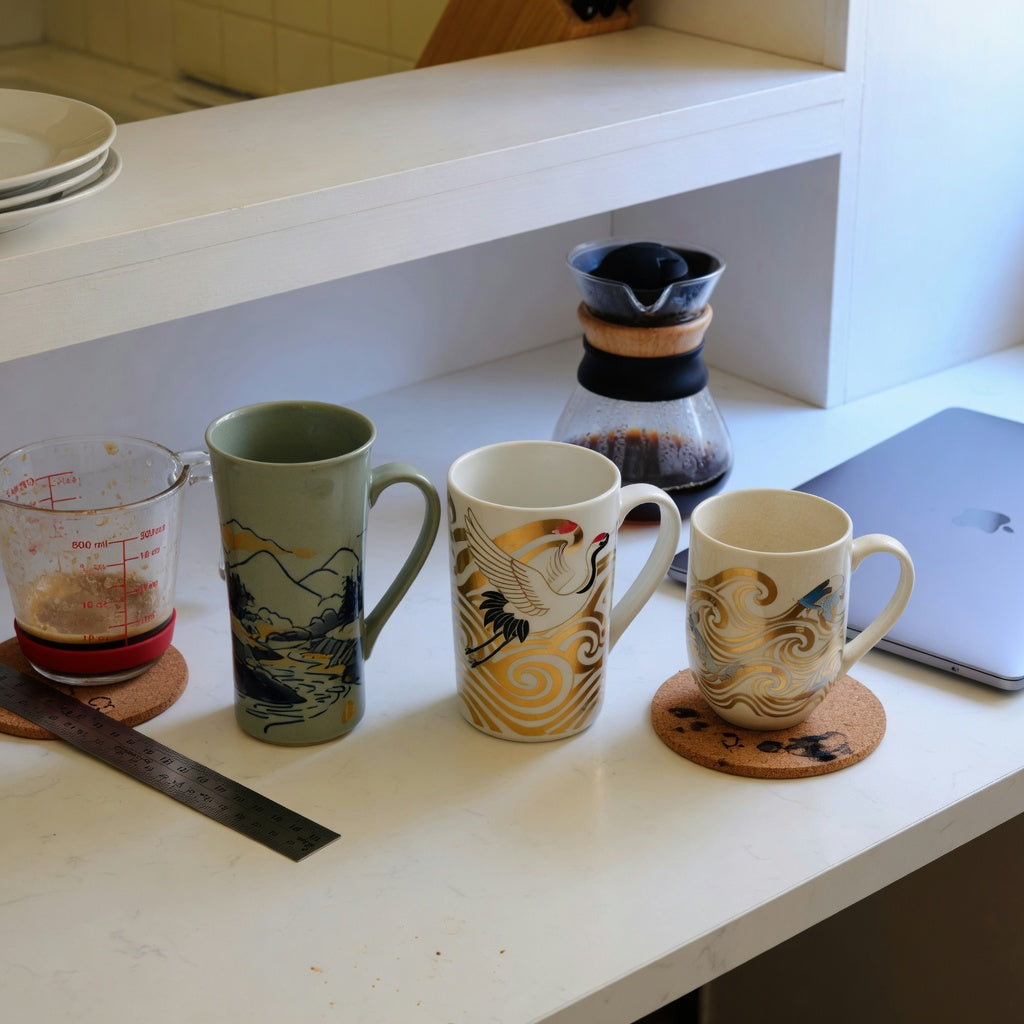
High Quality Ceramic Coffee Mugs Buying Priorities: Fit First
Use your actual pour, grip preference, brewer clearance, and storage space to compare ceramic mugs. See where Crane, Golden Waves Kio, and Landscape Tall fit, and where a different mug style would ...
Read more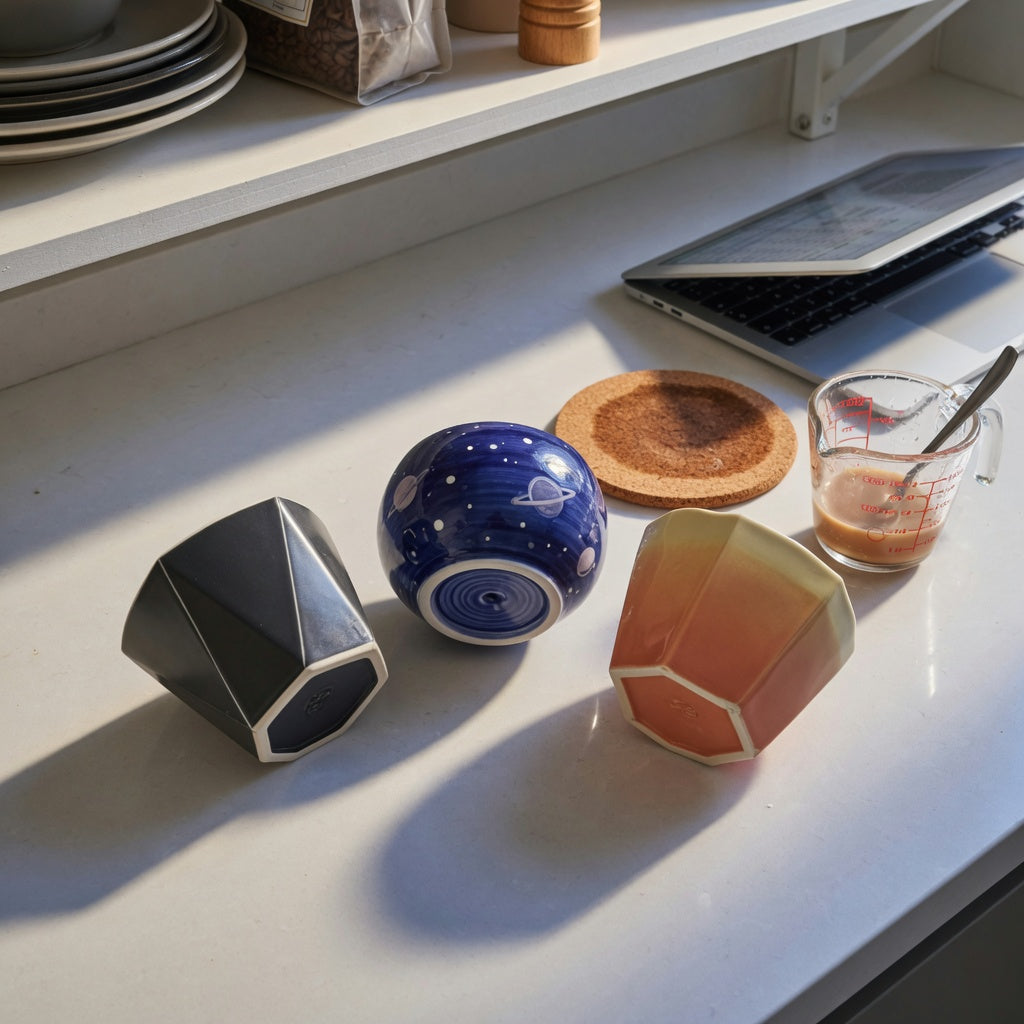
Geometric Coffee Mug Buying Priorities: Capacity, Shape, Space
Compare CoffeifyMug's 12 oz and 14 oz ceramic geometric mugs by real pour size, visible form, and the space available on your desk or shelf. This priority-led guide also covers care limits, gifting...
Read more
Leave a comment
This site is protected by hCaptcha and the hCaptcha Privacy Policy and Terms of Service apply.