
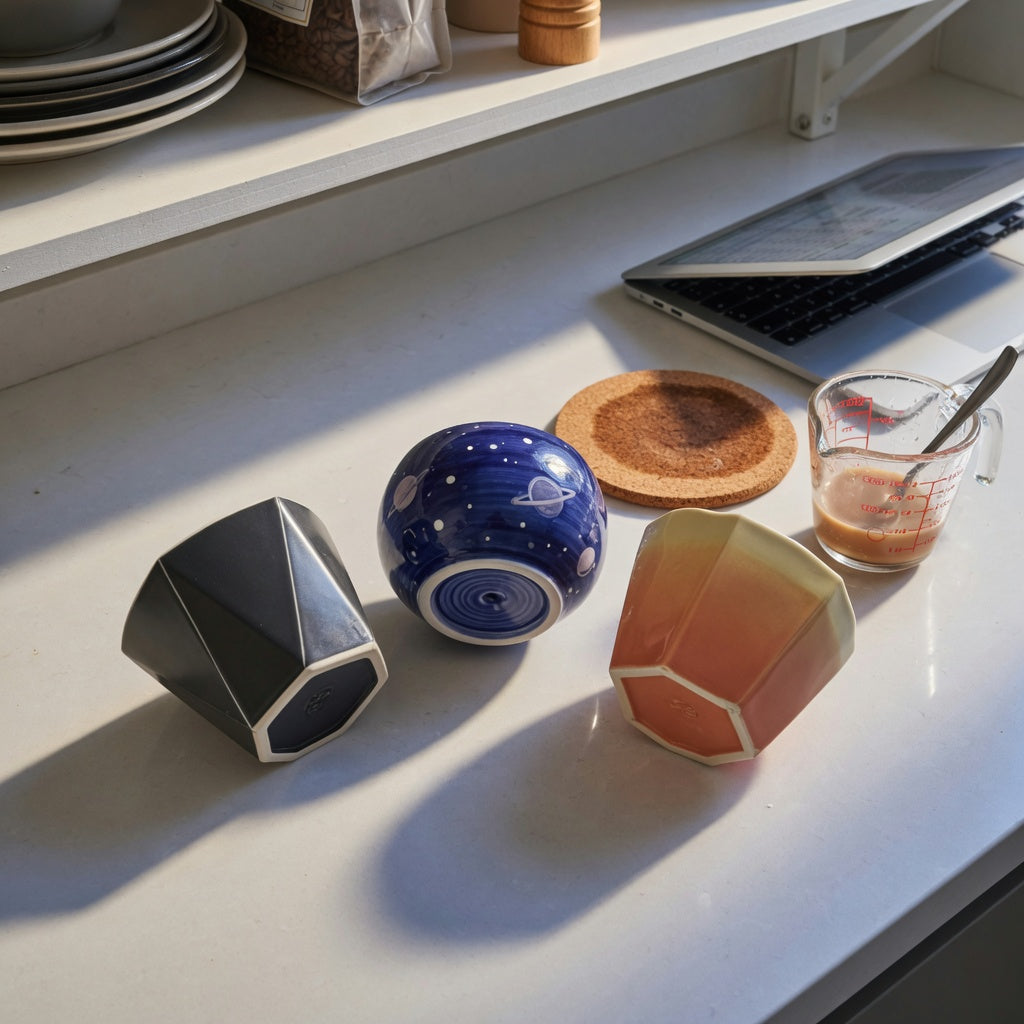
Geometric Coffee Mug Buying Priorities: Capacity, Shape, Space
Reading time: about 10 minutes
A mug can hold your usual coffee and still be wrong for the place where you drink it. On a crowded office desk, unplanned width can interfere with mouse movement; beneath a low kitchen shelf, height matters more than ounces. Those are the geometric coffee mug buying priorities we use at CoffeifyMug: match listed capacity to the finished drink, compare visible shape with your handling preference, and verify the mug against the space it must occupy.
We handle and pack ceramic mugs, so our team looks past the first product photo. We check the rim, confirm that the base sits level, pay attention to exposed shape transitions, and think about how much liquid a buyer actually pours. This comparison stays within the current listed facts: the Rhombus and Gradient options are listed at 12 oz, the Planet at 14 oz, and all three are ceramic. We do not infer dimensions, production methods, provenance, or durability claims from appearance alone.
Which geometric coffee mug buying priorities should come first?
The practical order is different from the order most people browse. Shape catches the eye first, but capacity and available space usually determine whether the mug works every day.
- Finished drink volume: Count the coffee or tea, milk, foam, sweetener, and ice you normally add. The brewed amount alone may understate the space you need.
- Desk and cabinet clearance: Compare maximum width and height, not only the base. Handles and projecting forms can be the limiting points.
- Grip and contact points: Decide whether you prefer smooth curves, distinct planes, or a visibly faceted surface.
- Ceramic care: Confirm the live listing's dishwasher and microwave instructions instead of assuming that every ceramic mug has the same care limits.
- Visual fit: Choose the form and finish after the routine checks pass, especially if the mug will sit on an open shelf or be given as a gift.
Using these geometric coffee mug buying priorities in this order prevents an attractive shape from hiding a poor capacity or storage match. A mug that fails the first two checks is unlikely to become more convenient after a week of use.
Does 12 oz or 14 oz match the drink you actually make?
Listed capacity is the cleanest first comparison, but it should not be treated as a target for filling a mug to the rim. Most people need headspace to carry the drink from the kitchen, add milk, or stir without spilling.
| Current option | Listed capacity | Material | Routine to compare |
|---|---|---|---|
| Rhombus Coffee Tea Mug | 12 oz | Ceramic | A standard-sized serving paired with an angular, rhombus-style visible form |
| Planet Coffee Tea Mug | 14 oz | Ceramic | A larger finished drink or extra room for additions, subject to your preferred headspace |
| The Gradient Coffee Tea Mug | 12 oz | Ceramic | A standard-sized serving with a more visibly faceted gradient appearance |
A two-ounce difference is about 59 mL. That is meaningful if milk or ice regularly pushes your drink beyond a 12 oz listing, but it is unnecessary space if you usually make a smaller serving. Capacity also does not reveal outer width, empty weight, or how the mug feels once full.
For a useful home test, make your usual drink in a marked measuring cup. Add milk or other ingredients before reading the total. For iced coffee, build the drink with your normal amount of ice because ice occupies part of the listed volume. Then leave the amount of headspace you normally need for carrying and stirring.
How should visible shape affect grip and placement?
Geometric describes the visible current form here. It does not establish a design movement, creator, production method, or performance advantage. Product images can help you compare where planes and curves appear, but they cannot prove comfort for your hand.
- Rhombus form: The angular profile suits shoppers who want distinct planes rather than a conventional cylinder. If you cradle the body of a mug for long periods, inspect the visible transitions closely because pronounced angles may feel less forgiving than a smooth curve.
- Planet form: The rounded visible profile is the better direction for someone who prefers continuous curves. It is not the strongest match for a buyer specifically seeking crisp, angular geometry.
- Gradient form: The faceted appearance puts more emphasis on changing planes and visual finish. That can work well on an open shelf or gift table, but a buyer who wants the simplest smooth-sided shape may prefer another style.
If reduced grip strength, hand sensitivity, or a very low loaded weight is your main concern, prioritize a clearly listed handle opening, dimensions, and weight. Those needs can make a classic smooth mug with an easy-to-grasp handle a better purchase than a form chosen mainly for geometry.
Will the mug fit your desk, cabinet, coaster, and brewer?
A 12 oz mug is not automatically narrower or shorter than a 14 oz mug. Wall shape, handle projection, and the relationship between the base and rim can produce very different footprints. This is why we do not assign compactness based on capacity or estimate measurements from photographs.
- For a desk: Measure the clear area beside the keyboard and include the path your hand takes to the mouse. Leave a buffer so the mug is not sitting against electronics.
- For a cabinet: Measure the actual shelf opening as well as the interior height. A mug can fit inside a cabinet but still catch on the frame while being lifted in.
- For a coaster: Compare the base contact area with the usable flat surface. The base should be fully supported rather than balanced across a raised edge.
- For a coffee maker: Check the distance from the drip tray to the spout. Capacity does not predict whether a mug clears the machine.
- For stacking: Do not assume geometric mugs nest. Only plan to stack them if the product description or images clearly support that use.
Use dimensions from the live product page whenever they are listed. If a strict shelf, brewer, or desk limit cannot be confirmed, browse the unique coffee mugs collection and compare listings before committing to a shape.
What does ceramic change about care and daily use?
All three current options in this comparison are listed as ceramic. Ceramic gives a solid everyday cup feel, but it is not drop-resistant and it can be damaged by abrupt temperature changes. Angles and raised transitions also deserve attention around tile counters and metal sinks because exposed points may receive the first impact.
- Inspect after unboxing: Check the rim, base, and visible high points under side light. Look for chips or hairline cracks before first use.
- Test the base: Place the empty mug on a flat counter and check for significant rocking.
- Avoid thermal shock: Do not move a chilled ceramic mug directly to very hot liquid or take a hot mug straight to a cold surface.
- Clean without abrasion: Use a non-scratching sponge. A soft brush can reach interior transitions that a broad sponge misses.
- Follow the listing: Dishwasher and microwave suitability must come from the current care instructions. Ceramic material alone does not guarantee either one.
These mugs are not substitutes for a sealed travel tumbler. If spill containment, cup-holder fit, or resistance to frequent drops is the main requirement, choose a product explicitly designed and listed for commuting rather than forcing a ceramic mug into that job.
Which current mug fits a 12 oz, 14 oz, desk, or gift routine?
We map product fit from the buyer's routine to the listed facts, then call out the limitation that still needs checking.
- You make a drink around the 12 oz range and want the angular form to be immediately visible: The 12 oz Rhombus ceramic mug is the direct match. It is not the best direction if you prefer a smooth cylindrical profile or cannot confirm the dimensions for a tight space.
- Your finished drink needs more room than a 12 oz listing provides: The 14 oz Planet ceramic mug offers two additional listed ounces and a rounded visible form. It may feel unnecessarily roomy if your normal serving is much smaller, and the larger capacity should not be mistaken for proof of a particular footprint.
- You want a 12 oz serving with a faceted, gradient-led appearance: The Gradient Coffee Tea Mug connects that visual priority with the same listed capacity as the Rhombus. A simpler smooth-sided mug may suit you better if fast wipe-downs and minimal visual detail matter more than display value.
- You have a strict shelf measurement or none of these forms matches your grip preference: Compare other shapes in our collection of unique coffee mugs. Start with listings that give you the capacity and dimensional information your space requires.
These recommendations are based on listed capacity, ceramic material, and visible current shape. They are not claims about origin, exclusivity, manufacturing technique, or long-term durability.
What should a gift buyer verify before checkout?
A gift recipient cannot explain a poor fit after the mug is already wrapped. We suggest checking four observable parts of their routine: the size of mug they already use, the height of their cabinet shelves, whether they rely on a dishwasher or microwave, and whether their current mugs are smooth, rounded, or angular.
During gift unboxing, inspect the rim, base, and most exposed points before wrapping. Describe the gift using facts you can support: ceramic material, listed capacity, and visible form. Do not attach an assumed creator story, production method, or limited-edition claim to a mug simply because its shape looks unusual.
Frequently asked questions
Which geometric coffee mug buying priorities matter most for a small desk?
Start with maximum width and the clear space beside your keyboard or mouse, then check the listed capacity against your normal drink. Shape comes next because visible angles or curves can affect placement and handling. Do not assume a 12 oz listing guarantees the smallest footprint.
Is a 14 oz geometric mug better than a 12 oz mug for iced coffee?
The 14 oz Planet listing provides two more ounces of capacity, which may help after ice and milk are added. The better size still depends on your finished drink and preferred headspace. Build your usual iced coffee in a measuring cup before choosing.
Are these geometric ceramic mugs dishwasher and microwave safe?
Check the current care instructions on the individual product page. Ceramic material by itself does not confirm dishwasher or microwave suitability, and finishes can have different care requirements. Follow the listing rather than a category-wide assumption.
Can geometric coffee mugs be stacked in a cabinet?
Some geometric forms do not nest securely because their walls, rims, or projecting shapes do not align. Only stack a mug if that use is clearly shown or stated. Otherwise, store it individually on a shelf or suitable mug stand.
Do angular ceramic mugs chip more easily than rounded mugs?
Exposed corners and high points can receive the first contact against a sink or tile counter, but shape alone does not establish overall durability. Ceramic of any shape can chip when struck or dropped. Inspect angular transitions during unboxing and handle them with the same care as other ceramic tableware.
A 60-second checkout comparison
- Measure the finished drink, including milk, foam, or ice.
- Choose between the 12 oz and 14 oz listings while preserving carrying headspace.
- Record the maximum width and height your desk, shelf, coaster, or brewer allows.
- Pick the visible form that matches your grip and display preference.
- Confirm dimensions and care instructions on the live listing before ordering.
If those checks point to an angular 12 oz mug, a rounded 14 oz mug, or a faceted 12 oz option, use the matching product page above. If one variable remains unresolved, return to the CoffeifyMug unique mug collection and compare that requirement first.
More from our blog
Read more
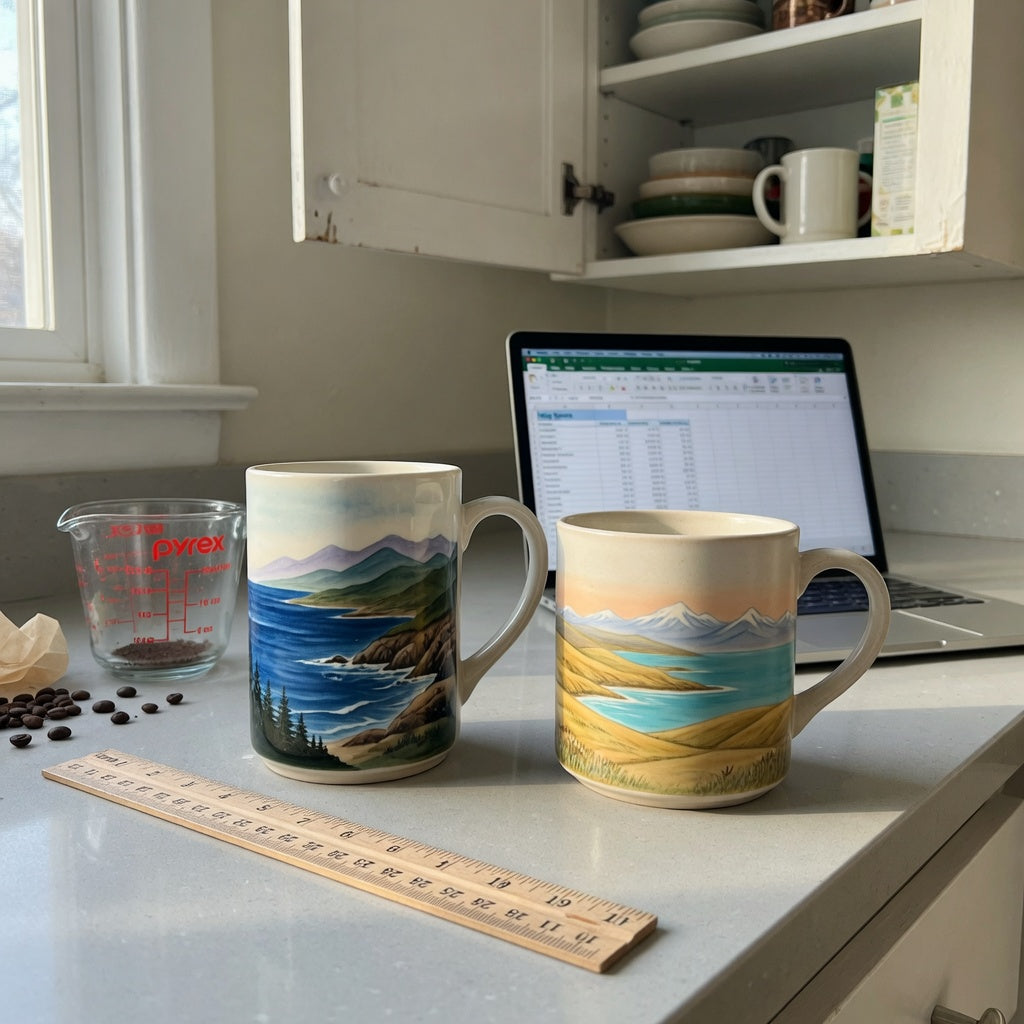
Ocean Coffee Mug Buying Priorities: Capacity, Shape, and Space
Match an ocean-themed ceramic mug to your real pour, hand clearance, desk footprint, and cabinet space. We compare the visible form and current listed details of the Mountain Sea and Landscape mugs...
Read more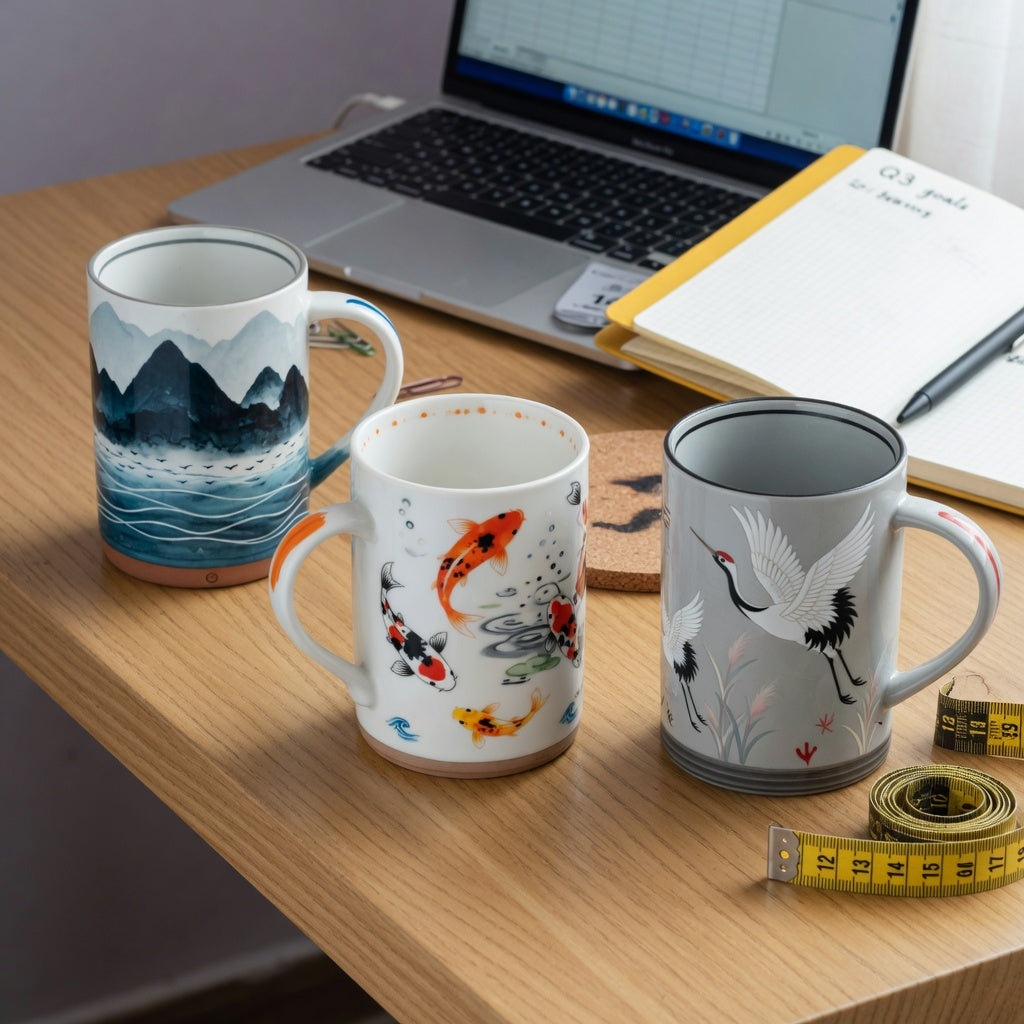
Art Coffee Mugs Buying Priorities: Capacity, Shape, Space
Match an art mug to the amount you pour, the clearance your hand needs, and the desk or cabinet space you actually have. We compare the visible mountain-sea, koi fish, and crane options without gue...
Read more
Leave a comment
This site is protected by hCaptcha and the hCaptcha Privacy Policy and Terms of Service apply.