



Mug Size for Green Tea: What Buyers Should Compare
Reading time: about 12 minutes
A return customer lined two mugs up on our counter and set a sencha tin between them. One was the small cup she uses for a single quiet steep. The other was the desk mug she actually finishes at work, closer to a 12 or 16 fl oz coffee pour than a teacup. The tin said one teaspoon per cup and stopped there. She asked which mug that word belonged to. That gap is what mug size for green tea comes down to. Printed capacity, leaf dose, and the water you pour are three measurements. Package copy often pretends they are one, and the liquor comes out thin or bitter.
A per cup line never names 6, 8, 12, or 16 fl oz
In our store that pause shows up with loose leaf and with bags. The direction says one teaspoon, or one bag, per cup. It almost never says whether the cup is 6 fl oz, 8 fl oz, or the 12 fl oz size that replaced smaller cups in a lot of kitchens once coffee mugs grew.
Those volumes are not close. About 6 fl oz is roughly 177 ml. About 8 fl oz is roughly 237 ml. A 12 fl oz pour is about 355 ml. A 16 fl oz pour is about 473 ml. Keep the leaf fixed and step from a small cup toward 16 fl oz, and the water has nearly tripled. The liquor tastes thin. Put a small-pot dose into that large mug and it tastes harsh. Capacity only helps after you name the way you brew.
Is mug size for green tea the brim stamp or the pour?
Printed capacity is usually filled to the brim, the line where the next tilt would spill. Few people drink from there. You leave room for an infuser, a spoon, or a wrist tilt beside a laptop. The water that should set the dose is the pour.
A hanging basket makes the gap wider. The water line you see is not all water. Metal and wet leaf occupy space inside the mug. A scale records the liquid you added. A brim stamp does not.
Check a mug you already reach for before you order another:
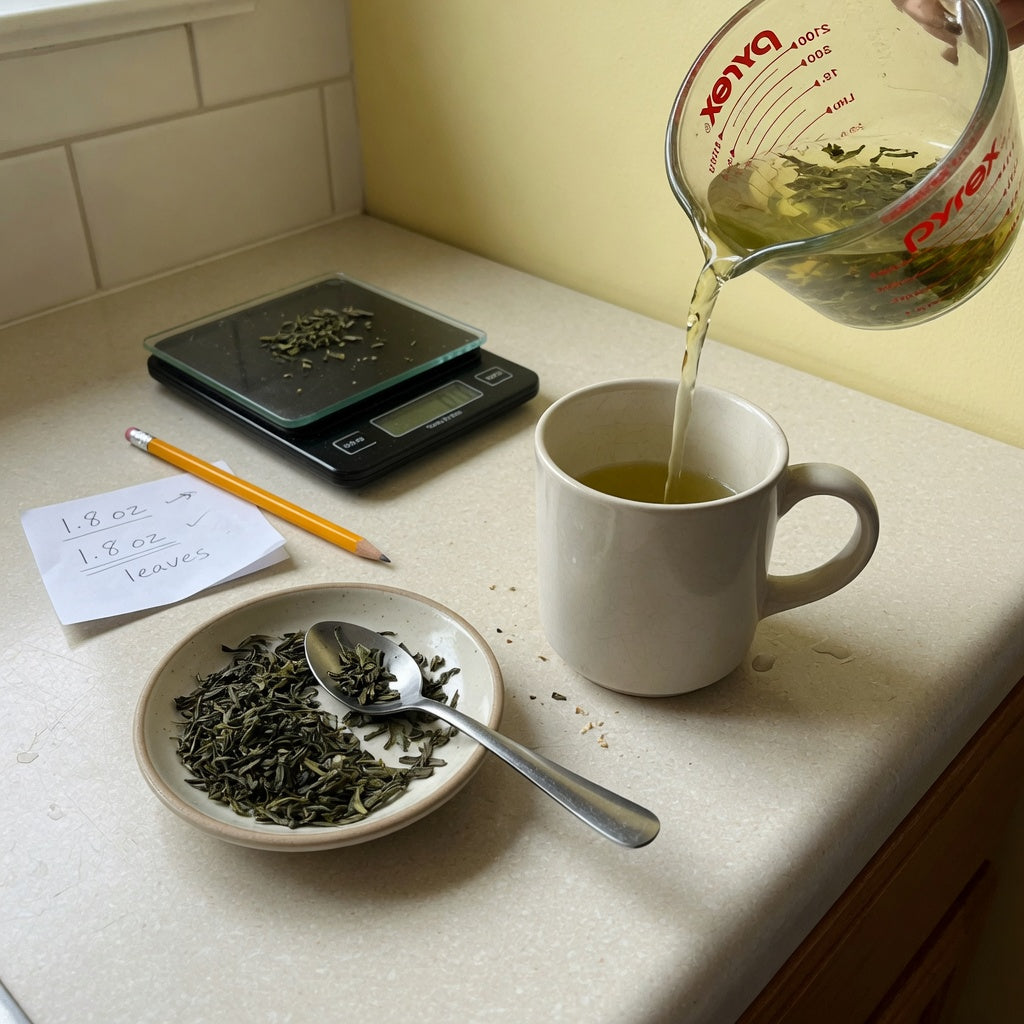
- Set the empty mug on a kitchen scale and tare it, or use a liquid measuring cup.
- Pour to your normal stop, often about a finger-width under the rim. If you use a basket, set the empty basket in first so you measure the space you really have.
- On a scale, read grams. For water, 1 gram is about 1 ml, so 300 g is about 300 ml, close to 10 fl oz.
- Tape that number under the base. Dose to it next time, including at the office if you can hit the same stop line.
The ounce figure on a product page lets you compare vessels. It is not your steep. Brim capacity and a comfortable pour can differ by a couple of ounces. On green tea, that is enough to skew the cup.
Short infusions, a Western steep, and matcha need different mugs
One mug will not cover every tea habit in a house. The dose changes with the job, and often the shape should too.
| Job | Water that counts | Vessel that fits | Poor match |
|---|---|---|---|
| Short repeated infusions | A small pour you empty each time | A cup you can drain, or a small pot | A 16 oz mug holding one huge leaf dose |
| One Western steep | The tin's cup, scaled to your pour | A mug with headspace above that pour | Filling an unknown brim at random |
| Matcha or tea with milk | Whisk room, then milk | A wider cup with spare height | A tall narrow coffee mug |
Some Japanese-style greens use a high leaf dose in a modest pour. You take the liquor off the leaves, then start another short infusion. A Western tin more often means one teaspoon in a cup it never defines. Do not copy the small-pot dose into a 12 or 16 fl oz mug. That is a reliable path to bitter green tea. If you want several fresh infusions, a large mug is a poor stand-in for a small kyusu. We would rather say that at the counter than ship a vessel you will fight.
Most desk mugs are bought for one Western steep: a measured dose, leaves out when the timer ends, and a free rim so you are not wearing the tea. Matcha is a separate job. You need a wider opening for the whisk and height left once milk goes in. Steeped-leaf directions do not apply, because you drink the powdered leaf instead of lifting it out.
ISO 3103 is a different job again. It is a sensory-test method so tasters can compare liquors prepared the same way. It is not a recipe for a mug of green tea you want to enjoy. When the producer prints grams, milliliters, and seconds, use those figures rather than a lab protocol that only looks more official.
Scale the tin's ratio onto an 8, 12, or 16 fl oz pour
No reference we trust assigns one leaf weight to every retail mug. We will not invent a grams-per-mug chart. Scale the ratio printed on your tea, and scale it only to the water you poured.
If the producer means 1 level teaspoon per 8 fl oz of water, about 237 ml, the arithmetic is:
- About 8 fl oz poured: 1 teaspoon
- About 12 fl oz poured, roughly 355 ml: 1.5 teaspoons
- About 16 fl oz poured, roughly 473 ml: 2 teaspoons
If their cup is 6 fl oz, those amounts are light and the big mug needs more leaf. If the label never defines the cup, start nearer the smaller dose, taste, and move one step.
A teaspoon lies when the leaf shape changes. Gunpowder is dense. A long, twisted green is airy, so the spoons are not equal weights. Use grams when the tin gives grams. When the cup tastes wrong, change one variable only: leaf amount, time, or temperature. Bitter usually means the water was too hot, the leaves stayed in too long, or the dose was high for that pour. Thin usually means too little leaf, a basket packed so tight the center stayed dry, or a later splash of water you forgot to count.
Why more ounces still need cooler water and a timer
A bigger pour does not brew itself. Leaf left in hot water keeps releasing flavor, then bitterness. Walk away from a 16 fl oz mug and you do not get the same tea in a larger serving. You get a longer steep.
Open, delicate leaf usually wants water well below a boil and a short contact. Tight rolled leaf often needs more time before the cup has body. Sencha and gunpowder should not share a clock just because both tins say green. The package for that tea is the authority. The mug is only the measuring cup.
Shape changes heat while you drink. A wide bowl loses warmth faster than a taller mug with a smaller open surface, because more liquor faces the room. In our experience both cool faster on a desk than a vacuum bottle does in a bag. That drop can rescue a pour that started too hot. It will not keep the last third as warm as the first. An open mug is also a weak commute cup. Unless the listing you are reading states a lid, do not assume one is in the box.
A larger mug is not a labeled caffeine serving
Some shoppers pick a size because they are managing caffeine, not flavor. The FDA cites 400 milligrams of caffeine a day for most adults as an amount not generally associated with negative effects. Its consumer table lists a typical caffeine amount for green tea of 37 milligrams and says the amount in specific products and container sizes can vary. On that same guidance, decaf coffee is given as an example at 2 to 15 milligrams in an 8 fl oz cup. The serving is part of the figure.
Do not multiply 37 milligrams because the mug feels large. That green-tea number is a typical amount. It is not labeled as an 8, 12, or 16 fl oz cup of your leaf. More leaf, a longer steep, and finishing the mug can raise what you take in. The same spoon stretched through too much water may not. If you are pregnant, trying to become pregnant, or breastfeeding, ask a health care provider about limiting caffeine. We sell drinkware. We do not give medical advice.
A desk steep, not a whisk and not six tiny pours
The fit we see most often is one measured green-tea steep at a desk, with coffee in the same mug later. That buyer does not need a matcha bowl, and does not need a cup small enough to empty in three sips. For that job we send people to the Green Waves coffee tea mug. Read the current listing for capacity, material, and care, and see whether an infuser, lid, or filter is actually included. A photograph is not a spec sheet. Another product with a similar name is not this page. If a line is missing, it is unanswered. We will not guess it for you.
When the stated size misses the pour you measured, compare handle, height, and the printed ounce or milliliter mark across our unique coffee mugs. Very large and lidless is a weak match for slow sipping, because the last third goes cold. A small cup is a weak match if you want one long pour and will not reheat water. A page with no volume cannot settle the dose. Choose a listing that prints a number, or ask before you order.
Pass on this style of mug when you need whisking room, when you want several small fresh infusions, or when you are carrying tea and the page never mentions a lid. Those are different tools. Forcing one piece to do all three is how people end up with harsh tea and a wet sleeve.
Leaf expansion, a heavy full mug, and ice that is not water
Capacity stamps skip the problems we notice after a mug has been used for a week.
- Leaf room. Rolled green tea swells as it wets. A basket sized for a flat bag can crush that leaf into a brick, dull in the center and harsh at the edge. If the listing does not include an infuser, or does not say how wide it is, use a strainer you already trust to give the leaf room.
- Weight. A ceramic mug plus 12 to 16 fl oz of water is a different object from the empty piece on a shelf. Handles in this category tend to crack at the join after a knock, a rough dishwasher cycle, or a drop on a hard floor. Lift a full mug over the counter before you park it beside a keyboard.
- Ice and milk. Ice steals volume. Dose for the water that touched the leaf, not the level after ice goes in. Milk needs headroom the brim rating never mentions.
- Heat shock. If the page does not say dishwasher-safe, wash by hand. Boiling water in a cold ceramic mug is a common crack. Warm the mug with hot tap water, empty it, then pour the brew.
Frequently asked questions
How many teaspoons of green tea go in a 12 oz mug?
Only after you know which cup the tin means. If it really means 1 level teaspoon per 8 fl oz of water, a 12 fl oz pour is about 1.5 teaspoons. If the tin's cup is 6 fl oz, you need more leaf than that. Weigh grams when the label gives grams, because gunpowder and long twisted leaf do not fill a spoon the same way. Lift the leaves out when the time ends so the large mug does not become an accidental long steep.
Is mug size for green tea the brim capacity or the water I pour?
Use the water you pour. Brim capacity is the spill line, and most people stop lower to leave room for a basket or a sip. Measure that pour once with a scale or a measuring cup and dose to it. The printed ounce size is only a starting comparison between mugs.
If I refill a 16 oz mug with the same green-tea leaves, am I oversteeping?
Fresh water on used leaves is a new infusion, and later pours run thinner. Leaving those leaves in hot water between refills keeps extracting, which often turns green tea bitter. A 16 oz mug also makes it easy to drink a large amount without noticing the total. For several fresh infusions, smaller pours you empty are easier to control, and a large mug is a poor fit for that style.
Does a bigger mug contain the FDA figure of 37 mg of caffeine from green tea?
No. The FDA consumer table lists 37 milligrams as a typical caffeine amount for green tea and says the amount in a specific product and container size can vary. It is not a promise about your mug. For most adults, 400 milligrams a day is the amount the FDA cites as not generally associated with negative effects. A larger mug is not a simple multiple of 37 milligrams.
Measure the pour before you add a mug to the cart
Write four facts from your own kitchen before anything goes in the cart:
- The pour you actually drink, in fl oz or ml, not the brim.
- The leaf dose your producer states, and the cup size they mean if they state one.
- The temperature and steep time for this green tea, not for black tea and not for a tasting-lab method.
- Whether the listing states capacity, material, care, and any infuser. A missing line stays unanswered.
Open the Green Waves listing if a single measured steep at a desk is the job, or compare stated sizes in the unique coffee mug collection and keep pieces that can hold that pour with headspace. If you drink in short repeated infusions, choose a smaller vessel on purpose. The useful mug size for green tea is the one that matches the water on your scale.
More from our blog
Shop Popular In-Stock Mugs — Extra 10% Off 1st Order (10_OFF) + Free Shipping
 Pleated Ceramic Coffee Cup, Crumpled Paper Cup Style, 200 ml
Default color: Green
 Christmas Tree Coffee Mug with Lid and Spoon, 460 ml
Default color: Red
 Handbag Shaped Coffee Mug with Saucer and Spoon, 310 ml
Default color: Pink
 Elk & Moon Deer Coffee Mug with Tea Infuser & Lid, 420 ml
Default color: Dark Blue
Browse by budget & style: Cute & Gift Cups (10% Off Applied) · Wooden-Handle Bestsellers · Large 14–15.5 oz Mugs · Holiday Gift Mugs · 8–9 oz & Espresso Cups
Popular mug buying guides: 2026 Mug Gift Ideas · 4-Piece Mug & Espresso Cup Sets · 8 oz & 9 oz Mugs · Cute & Aesthetic Mugs · Ceramic Tea Cups & Infuser Mugs · Ceramic Mugs with Lids Compared · Wooden-Handle Tea Infuser Mugs Compared · Christmas & Secret Santa Mugs 2026 · Espresso & Cortado Cups Guide · Cup & Saucer Gift Sets · All 25 Mugs Spec Table · Mug Size Guide · Shipping & Promo FAQ
1ST ORDER: EXTRA 10% OFF (CODE: 10_OFF) · OR BUY 3, GET 1 FREE


Read more

Tall White Ceramic Coffee Tea Mug: What Buyers Should Compare
Shoppers comparing a tall white ceramic coffee tea mug need height, rim, base, and usable fill together, not ounces alone. We cover brewer clearance, full weight, single-wall heat, white-glaze stai...
Read more
Mountain Sea II Coffee Tea Mug: What to Compare First
The listing calls this a 450 ml ceramic mug with a wooden handle for coffee, tea, a desk or kitchen, and gifting. Compare pour size, hand-wash reality, full-mug grip, and whether a lid or infuser i...
Read more
Leave a comment
This site is protected by hCaptcha and the hCaptcha Privacy Policy and Terms of Service apply.