
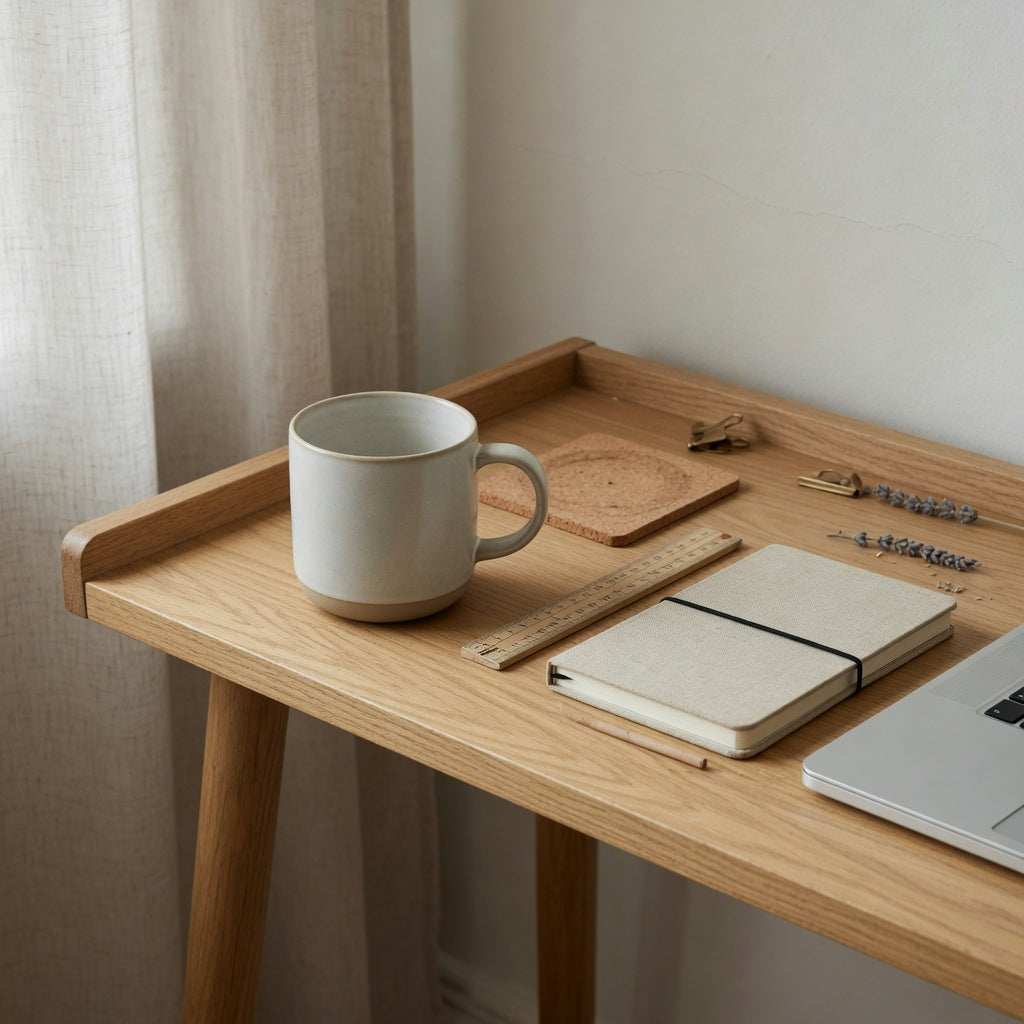
Mug Shelf Desk Ceramic: Compare Fit, Stability, and Care
Reading time: about 10 minutes
A mug can look compact in a product photo and still crowd a keyboard as soon as it lands beside a monitor. The real mug shelf desk ceramic problem is not style alone: the handle sweeps into a charger, the foot sits too close to the edge, or the cup cannot be lifted past the shelf above it.
At CoffeifyMug, we assess a desk mug as both drinkware and workspace equipment. It has to fit the available surface, feel secure during a normal reach, and stay presentable after repeated coffee refills. This guide separates general ceramic behavior from product facts such as material, dimensions, capacity, and care, which should always be confirmed on the current listing.
Mug shelf desk ceramic fit: depth, handle sweep, and lift room
Measure the usable space rather than the full shelf board. A monitor stand, raised edge, cable channel, or wall trim can reduce the area where a mug can safely sit.
- Usable shelf depth. Measure the shortest front-to-back point. Plan for the entire base to be supported and keep the mug body away from an edge where a sleeve or cable could catch it.
- Vertical lift path. Record the space from the shelf to the object above it. The mug must move upward before it moves toward you, with room for your fingers and any lid you intend to use.
- Total width. Maximum body width and total width including the handle are different measurements. Also consider handle orientation: a handle that points into a monitor stand may fit on paper but fail in daily use.
- Base contact area. A mug can have a broad body and a much narrower foot ring. Compare the base diameter separately because height or capacity alone does not establish stability.
- Reach path. Rehearse the movement with your laptop open and your chair in its normal position. Watch for your elbow, headphone cable, mouse, and charging lead.
Once you have listing dimensions, make a quick paper footprint and stand a piece of card upright to represent the height. This simple mock-up catches crowding that a product photo cannot. If a required dimension is absent from the listing, ask for it rather than estimating from the image.
Tall profile or round body: which geometry suits the workstation?
A tall mug is not automatically slim, and a round mug is not automatically more stable. Maximum body width, base diameter, handle projection, wall mass, and filled weight all affect how the mug behaves.
| Reader situation | Useful design direction | Why it may fit | Relevant next step |
|---|---|---|---|
| Narrow strip beside a monitor or laptop | Tall-profile direction | It may use available vertical room, but only the measured maximum width proves that it saves shelf space. | Open the Landscape Tall Coffee Tea Mug as a comparison starting point, then verify material, height, body width, base size, handle clearance, capacity, and care on the live page. |
| Deeper shelf with more lateral clearance | Round-profile direction | A deeper area can accommodate a broader visual shape, but the shape name alone does not prove stability or warmer compatibility. | Review the Round Coffee Tea Mug and check the same live-listing details before deciding. |
| Visible shelf, gift setup, or style-first purchase | Compare several silhouettes | Finish and proportion matter when the mug stays on display, yet product photos do not establish real scale. | Browse our unique coffee mugs and compare each candidate against your written measurements. |
| Desk mug warmer already in use | Either shape | The base contact patch and appliance guidance matter more than a tall or round label. | Verify the mug instructions, warmer plate size, and foot-ring contact before pairing them. |
The linked product names are browsing cues, not substitutes for specifications. We do not infer exact material, dimensions, capacity, food-contact status, appliance compatibility, or care from a title or photograph. The current product page should answer those questions; if it does not, contact our store before ordering.
Will ceramic keep coffee warm through a work block?
An open ceramic mug offers a different experience from a sealed, vacuum-insulated travel vessel. Research available for this guide does not include a controlled, side-by-side desk test of the linked products, so we will not claim that a tall or round option stays warmer.
General guidance on mug heat retention indicates that thicker ceramic can retain heat better because of its greater mass, while a narrower opening can reduce evaporative cooling. Those principles are useful, but they do not establish the performance of a specific catalog item without its measurements and testing.
- Prewarm carefully. If the mug's care guidance permits it, warm the vessel with hot water before pouring the drink. This reduces the initial heat transferred into room-temperature ceramic.
- Use smaller, fresher pours. Refilling more often usually suits a seated work session better than leaving one large open drink beside a keyboard for hours.
- Add only a confirmed lid. A lid can reduce heat and steam loss, but rim diameter and profile determine fit. Do not assume a generic silicone lid will seal an unmeasured rim.
- Check warmer contact. A recessed foot ring or small base may leave little surface touching a warmer plate. Follow both manufacturers' instructions and never assume that ceramic alone makes a mug suitable for direct heat.
- Move away from airflow. A mug beside an air-conditioning vent, fan, or open window will cool faster than one in still air.
If you need a drink to remain hot through long meetings or repeated trips away from the desk, a sealed insulated vessel is the more practical choice. A ceramic-lined insulated mug may suit someone who wants a ceramic contact surface with better heat and spill control.
Glaze, rim, handle joins, and foot: what should daily users inspect?
Desk mugs stay visible and often sit closer to electronics than kitchen mugs do. When our team handles a mug, we check the same four areas a buyer should inspect after unboxing and after any hard knock: the rim, the interior, the handle joins, and the foot.
- Rim and interior. Look for chips, sharp spots, or a crack that crosses the drinking surface. Fine glaze lines are commonly called crazing; if new lines appear during use or begin collecting discoloration, stop using the mug and ask the seller or maker for guidance.
- Handle joins. Inspect both points where the handle meets the body. A hairline crack after a sink or shelf impact is more significant than a harmless color variation in the glaze.
- Foot and base. Dry the foot before returning the mug to a wood shelf. Residual rinse water creates rings, while trapped grit can scratch a finished surface.
- Finish texture. A smooth glazed interior is generally quicker to rinse than raised or heavily textured details. Matte and textured exteriors may also require a more deliberate wipe around fingerprints and dried drips.
- Declared care method. Use a non-scratch sponge unless the listing directs otherwise. If dishwasher use is explicitly allowed, position the mug so its handle cannot strike adjacent dishes during the cycle; do not infer dishwasher or microwave compatibility from the material name.
Food-contact safety is separate from appearance. For ceramic cups and mugs, FDA ceramicware guidance sets an action level of no more than 0.5 micrograms per milliliter of extractable lead in any one of six units tested. That is a regulatory action level, not a marketing badge, and it does not prove anything about a linked product without exact product evidence. Check the live listing for intended beverage use, glaze or food-contact information, and care guidance; ask if those details are missing.
Warmer, coaster, lid, or clamp: which accessory changes the fit?
Accessories change the mug's effective footprint. A cup that fits a bare shelf can become crowded after adding a coaster, warming plate, lid, or clamp-style holder.
- Mug warmer: Compare the warmer plate with the mug's actual base contact area, not its maximum body width. Check for rocking, a raised foot ring, and any restrictions in both sets of instructions.
- Coaster: Measure the coaster as part of the setup. It should support the base without forcing the mug closer to the shelf edge, and its surface should remain easy to wipe after drips.
- Lid: Verify rim diameter, rim shape, added height, and any drinking or steam opening. A loose universal lid may reduce splashes without providing a reliable seal.
- Clamp holder: Compare the holder's inner opening with the mug body diameter below the handle. Also check body taper, handle clearance, the holder's filled-weight limit, and whether the mug can lift straight up without hitting a shelf.
We cannot confirm that either linked product fits a third-party warmer, lid, or desk clamp unless that exact compatibility appears on its current listing. Treat a clamp holder as a space-management accessory, not proof that an open ceramic mug is spill-proof.
Who should skip an open ceramic mug on a desk shelf?
Open ceramic works best for someone who stays seated, refills periodically, and values the feel of drinking from an open rim. It is not the strongest match for every workday.
- If you carry the drink between rooms, choose a sealed travel vessel.
- If pets, children, or coworkers regularly pass the desk, prioritize a secure lid and spill resistance.
- If you need heat for several hours without a cord, choose an insulated design.
- If the only available surface is a shallow or vibrating ledge, place the mug on the main desktop or use a safer drink station away from electronics.
- If the mug must travel in a backpack, open ceramic is the wrong tool even if it looks tidy on a shelf.
Choosing a different style is not a compromise if it solves the actual risk. Shelf display, commuting, long-term heat, and spill control are separate jobs.
Before checkout: turn the live listing into a desk-fit checklist
Keep your shelf measurements open beside the product page. For a reliable mug shelf desk ceramic setup, work through these checks in order:
- Confirm the stated material, selected variant, and intended use on the exact listing.
- Record height, maximum body width, base diameter, and total width including the handle.
- Compare those numbers with shelf depth, overhead lift room, and your normal hand path.
- Verify capacity rather than assuming a taller or rounder mug holds more.
- Find explicit care, dishwasher, microwave, and food-contact guidance where those details matter to you.
- Confirm lid, warmer, or clamp compatibility only when the exact pairing is stated or the necessary measurements are available.
- After delivery, inspect the rim, handle joins, interior, and base before the first drink. Photograph any transit damage before using the mug.
For a narrow visual slot, return to the Landscape Tall listing and verify every required detail. If you prefer a round-profile direction and have more lateral room, compare the current Round Coffee Tea Mug page. If neither starting point matches the measurements, continue through the collection instead of forcing a mug into the wrong workspace.
Frequently asked questions
What measurements matter most for a ceramic mug on a desk shelf?
Measure usable shelf depth, overhead lift clearance, maximum mug width, total width with the handle, and base diameter. Also test the path your hand takes past the keyboard, monitor, and cables. Capacity alone does not tell you whether the mug will fit.
Do regular ceramic mugs work with desk mug warmers?
Some pairings can work, but base contact and manufacturer guidance determine suitability. A small or recessed foot may touch only part of the warming plate, and ceramic material alone does not confirm warmer compatibility. Check the instructions for both items before use.
Is a tall ceramic mug less stable than a round mug?
Height by itself does not settle the question. Base diameter, body taper, weight distribution, shelf depth, and the filled mug's position all affect stability. Compare actual measurements rather than relying on tall or round labels.
How do I keep an open-shelf ceramic mug looking clean?
Rinse it soon after use, wipe the exterior, and dry the foot before returning it to the shelf. Use a coaster on wood and avoid leaving coffee, tea, or milk residue overnight. Follow the listing's cleaning instructions and inspect the rim and handle joins after a knock.
How do I compare a mug shelf desk ceramic option before buying?
Measure the shelf first, then check the live listing for material, dimensions, capacity, care, and any accessory compatibility you need. Do not fill missing specifications from a photograph or a similarly named product. Compare your notes against our unique coffee mugs collection, and ask us for any missing detail before ordering.
More from our blog
Read more
Find the best round ceramic mug for coffee breakfast: 7 checks
A breakfast mug must sit steadily beside a plate, feel comfortable at the rim and handle, and keep coffee pleasant through a slow meal. Use these seven checks to compare heat retention, glaze safet...
Read more
Best Flow Coffee Mug for Home Decor: 7 Buyer Checks
A decorative Flow-style mug has two jobs: work comfortably at breakfast and look intentional on an open shelf. Compare handle clearance, capacity, shelf fit, care, gifting, and exact listing facts ...
Read more
Leave a comment
This site is protected by hCaptcha and the hCaptcha Privacy Policy and Terms of Service apply.