
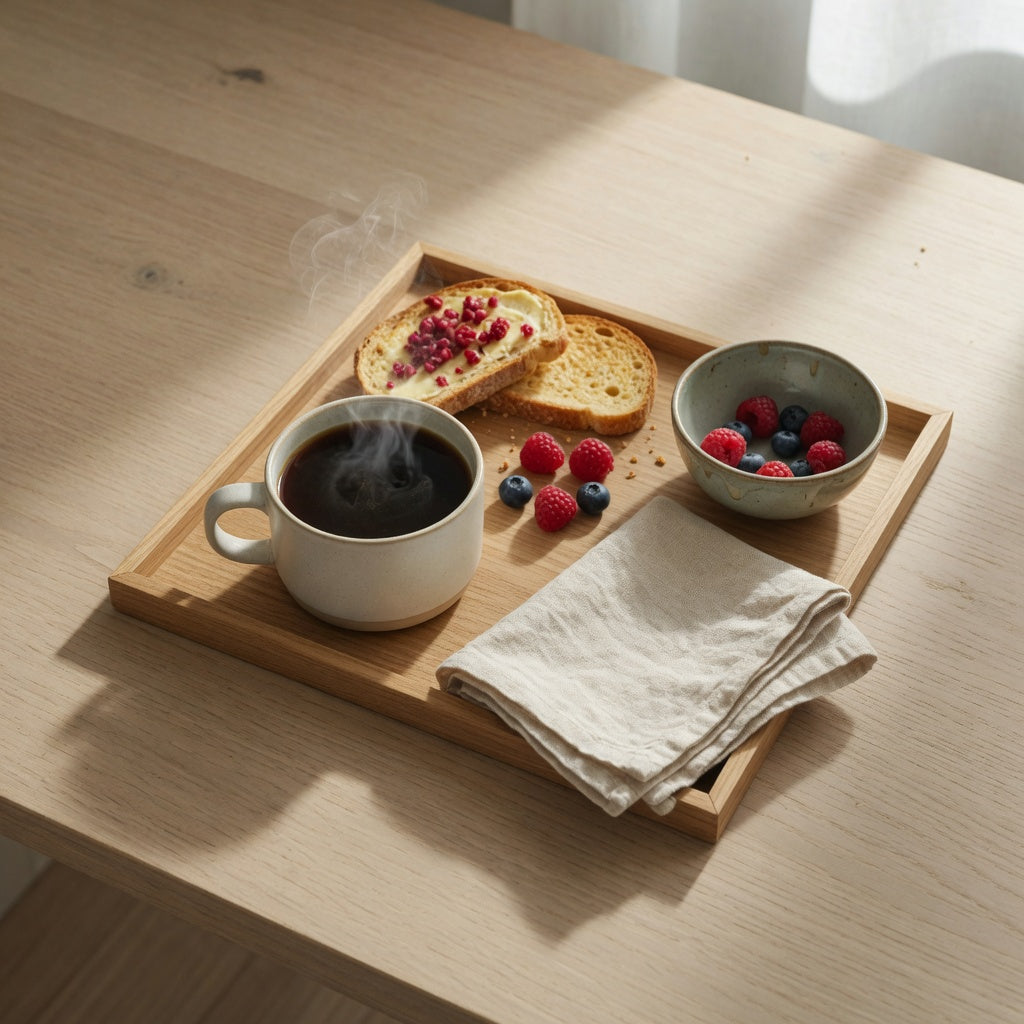
Find the best round ceramic mug for coffee breakfast: 7 checks
Reading time: about 10 minutes
A mug can look perfectly balanced in a product photo and still expose its flaws on the first trip from the kitchen counter to the breakfast table: the foot clicks against the tray, the handle crowds the plate, or the coffee turns lukewarm before the toast is gone. For shoppers searching for the best round ceramic mug for coffee breakfast, those ordinary moments are the useful test.
We sell and handle mugs with weekday use in mind. Our team checks how a cup sits on a level surface, where the thumb lands, how close the knuckles come to the hot wall, and what the live listing actually says about capacity and care. A rounded body is a style cue, not proof of a flat base, substantial walls, food-contact suitability, or appliance compatibility.
Why do the foot and handle matter more than the round outline?
The outside curve gets attention, but the foot determines how the mug meets a tray or countertop. Stability depends on the flatness and contact area of that foot, the fill level, and the mug's center of gravity. A visually round body can still sit on a narrow or uneven base.
After unboxing, place the empty mug on a clean, level counter. Press gently at four points around the rim. Clicking or rocking can indicate uneven contact or a bit of packing debris under the foot. If the foot ring is unglazed, run a fingertip around it to check for sharp grit before setting it on a wooden table.
Test the handle with cool water before using hot coffee. Use your normal grip and check knuckle clearance, thumb placement, and balance as you lift. Inspect both handle joins for hairline gaps. A large loop can feel comfortable but consume tray and dishwasher space; a compact loop saves room but may feel cramped with larger hands.
Which seven checks help find the best round ceramic mug for coffee breakfast?
- Base and overall dimensions. Look for base diameter, mouth diameter, height, and total width including the handle on the current listing. A lifestyle photo cannot reliably show how much room the mug will take beside a plate.
- Usable capacity. Confirm the stated unit and whether the measurement represents a brim-full volume or a normal serving level. Leave room for milk, foam, or careful carrying if those are part of your routine.
- Wall mass and empty weight. Thicker, heavier ceramic generally stores more thermal energy, but it also feels heavier one-handed and occupies more space in a dishwasher rack.
- Mouth and rim geometry. A wider mouth releases aroma and accommodates a spoon or biscuit more easily. It also exposes more coffee to the air. Check that the drinking rim looks even and smooth rather than choosing solely by glaze color.
- Handle clearance. Compare the space inside the loop, the distance from the handle to the hot wall, and the position of the handle relative to the mug's center. A decorative handle is not always a comfortable one.
- Glaze and intended use. Verify that the exact item is presented as drinkware intended for food contact. Do not transfer safety language from a similar design, another color, or an unrelated marketplace listing.
- Exact care instructions. Microwave and dishwasher compatibility must appear on the product page for the item being purchased. If the page is silent, treat the answer as unknown rather than assuming all ceramic behaves alike.
These checks are a more dependable route to the best round ceramic mug for coffee breakfast than selecting by finish alone. They also make returns less likely because you are comparing the details that affect an ordinary Tuesday morning.
Does a round shape hold heat, or do wall mass and mouth width matter more?
A ceramic mug is not a vacuum flask. Its walls absorb heat from the coffee and then release that energy over time. Thicker walls and greater ceramic mass can keep a drink warmer longer than thin glass or uninsulated metal of a similar size, a trade-off also reflected in independent guidance on coffee mug materials.
That mass has an early cost: a cold mug takes heat from the first pour as it warms. For a slow breakfast, our practical routine is simple:
- Fill the mug with hot water while the coffee brews.
- Empty the preheating water immediately before pouring the coffee.
- Keep the filled mug away from a direct draft and off a very cold stone surface when practical.
A wide-mouth ceramic breakfast mug gives you more aroma and easier access for stirring, but the larger exposed surface can speed cooling. A substantial wall helps with heat storage but makes the mug heavier. Roundness alone does not settle the question, so we would not promise that a round mug will outperform a tall one without controlled testing of the two specific pieces.
Which glaze and food-contact details deserve a closer look?
Ceramic describes the body material, not the safety of every glaze or decoration applied to it. A published review of U.S. FDA ceramic-ware limits reports an action level of 0.5 μg/mL for extractable lead from small hollowware such as cups and mugs in an acidic test solution. That is a laboratory threshold; shoppers cannot confirm it by studying a product photo.
The FDA guidance on lead-glazed traditional pottery calls for particular caution with antique, damaged, unlabeled, or unreliable pottery, including some handmade pieces and bright red, orange, or yellow decorations. This does not mean every handmade or colorful mug is unsafe. It means the maker, intended use, and supporting product information matter.
- Confirm that the exact piece is sold for drinking, not only as decorative ware.
- Look for an identifiable seller or manufacturer who can answer food-contact questions.
- Make sure safety and care statements apply to the selected item and variant.
- Do not keep using a mug with a deep rim chip, cracked handle, or newly damaged glaze while waiting for it to fail completely.
A lead-free badge or short marketplace description is not the same as test documentation. If daily hot coffee is the use case and the seller cannot explain the mug's intended use, choosing a better-documented piece is the more sensible move.
Can the mug handle microwave reheating and dishwasher cycles?
Ceramic alone does not guarantee microwave or dishwasher compatibility. Glaze composition, decoration, construction, and manufacturing all matter. In our store, we do not copy an appliance claim from one mug to another merely because the silhouettes look similar.
- Microwave use: Confirm permission on the exact listing. Do not microwave metallic bands, luster decoration, or other metal-containing finishes unless the manufacturer specifically permits it.
- Dishwasher use: Confirm the care statement first. Position the mug so its handle cannot knock against a plate and its rim is not supporting a heavy bowl during the cycle.
- Thermal shock: Avoid moving a refrigerator-cold mug directly to boiling liquid or rinsing a very hot mug under cold water. Abrupt temperature changes can crack ceramic.
- Ongoing inspection: Watch for a chipped drinking lip, a hairline crack at either handle join, unexpected fine lines in the glaze, or interior staining that no longer cleans normally.
Fine networks of glaze lines are often called crazing. Some finishes are intentionally crackled, so appearance alone does not diagnose a defect. If new lines appear during use or the mug begins staining, stop using it and ask the seller or manufacturer for guidance. Hand washing takes more time but gives you better control around decorative finishes; dishwasher convenience only counts when the current page supports it.
Round, tall, glass, or insulated: which format suits breakfast?
| Format | Situation to consider | Details to verify | Main trade-off |
|---|---|---|---|
| Round ceramic mug | Open table sipping and a rounded visual profile | Foot flatness, base diameter, mouth width, wall mass, and care | Can occupy more tray area; breakable; a wide opening may cool faster |
| Tall ceramic mug | Comparing a more vertical silhouette for a crowded place setting | Actual base width, total width with handle, height, and capacity | The word tall does not guarantee a small footprint; a narrow base may feel easier to tip |
| Thin glass mug | Seeing the coffee color and prioritizing a visually light cup | Heat-safe use, wall thickness, handle temperature, and care | Thin glass generally stores less heat than a heavier ceramic mug of similar size |
| Vacuum-insulated vessel | Long gaps between sips, transport, or spill control | Lid seal, cleaning access, and material care | Less open aroma and a different drinking feel at the breakfast table |
A round ceramic breakfast mug is not the right tool for a leak-resistant commute, all-day temperature control, or unbreakable outdoor use. A vacuum-insulated or nonbreakable vessel suits those jobs better. Round ceramic makes more sense for open sipping at a table, provided the exact mug passes the stability, comfort, and care checks.
Which CoffeifyMug page matches your shopping situation?
Product names are useful wayfinding, but they are not evidence of dimensions, materials, capacity, or care. Use each page as a comparison target and read its current details before ordering.
- Round-first breakfast setup. If a round option is non-negotiable, start with the Round Coffee Tea Mug listing. This page fits the comparison stage because it is the catalog target for that shape; confirm its current material, dimensions, capacity, variants, food-contact wording, and care instructions.
- Space-first place setting. If you want to compare a more vertical option against the round candidate, open the Landscape Tall Coffee Tea Mug page. Do not assume the name proves a narrower base or larger capacity. Compare the live measurements.
- Gift buyer or style-undecided shopper. Browse our unique coffee mugs collection, shortlist by silhouette, and then apply the same seven checks to each exact listing. This keeps visual preference from overruling practical fit.
For gift unboxing, keep the protective packaging until you have inspected the foot, rim, interior glaze, and handle joins. If the mug rocks, arrives chipped, or shows a crack, use the seller's return process instead of dismissing the problem as normal character.
Frequently asked questions
How do I choose the best round ceramic mug for coffee breakfast?
Compare the live base and overall width dimensions, usable capacity, wall mass, mouth, rim, handle clearance, intended food use, and exact care instructions. For breakfast specifically, check whether the mug can share your tray or place setting without crowding the plate. Do not infer missing measurements or appliance claims from photos.
Does a round ceramic mug keep coffee hotter than a tall mug?
Not automatically. Wall mass, ceramic thickness, mouth width, starting temperature, and preheating can matter more than the outside outline. We would not promise that round beats tall without a controlled test of the two exact mugs.
How can I verify that a ceramic mug is suitable for hot coffee?
Check that the exact item is identified as food-contact drinkware and that the seller or manufacturer is traceable. Look for safety and care statements that apply to the selected variant rather than a similar listing. Avoid using antique, damaged, or unlabeled pottery of uncertain origin for daily coffee.
Can I put a ceramic breakfast mug in the microwave and dishwasher?
Only if the current product page says the exact mug is compatible with those appliances. Keep metallic decoration out of the microwave unless the maker explicitly permits it, and avoid abrupt hot-to-cold temperature changes. If the listing does not answer the question, treat compatibility as unknown.
Is a wide-mouth round mug better for a breakfast tray?
A wide mouth suits shoppers who value aroma, easy stirring, and open sipping alongside food. The trade-off is more exposed coffee surface, potentially faster cooling, and a larger footprint if the body is also broad. Base dimensions and flatness still matter more for tray stability than roundness alone.
Your next step: Write down your usual pour, available tray width, normal handle grip, and whether microwave or dishwasher use is non-negotiable. Open the round mug listing with that note beside you; if a required fact is missing, treat it as unknown and compare another option in the unique coffee mugs collection rather than guessing.
More from our blog
Read more
Emerald Mug Gift Ideas: Compare Size, Material, Care, and Fit
Compare emerald mug gift ideas by material, usable size, handle comfort, care, and occasion. See what to verify before choosing a mug for a birthday, anniversary, desk, or kitchen.
Read more
Mug Shelf Desk Ceramic: Compare Fit, Stability, and Care
A desk-shelf mug must fit the shelf, the hand path, and the way you actually work. Compare footprint, handle clearance, stability, heat management, glaze care, and accessory fit before ordering.
Read more
Leave a comment
This site is protected by hCaptcha and the hCaptcha Privacy Policy and Terms of Service apply.