
Mug Cozy Size Guide: What to Measure and Compare Before You Buy
Reading time: about 9 minutes
The question that lands in our inbox most weeks is some version of this: “I ordered a cozy labeled standard, stretched it over my 16 oz diner mug, and it slides off every time I lift the cup.” The cozy is rarely defective. The mug is simply bigger around than the seller guessed. There is no industry-wide sizing standard for mug cozies, so every maker works differently — some size by capacity, some by tape-measured dimensions, some by eye. This mug cozy size guide covers what to compare before you order, so fit gets decided by a tape measure instead of luck.
Which mug measurements actually decide cozy fit?
Four numbers, in this order:
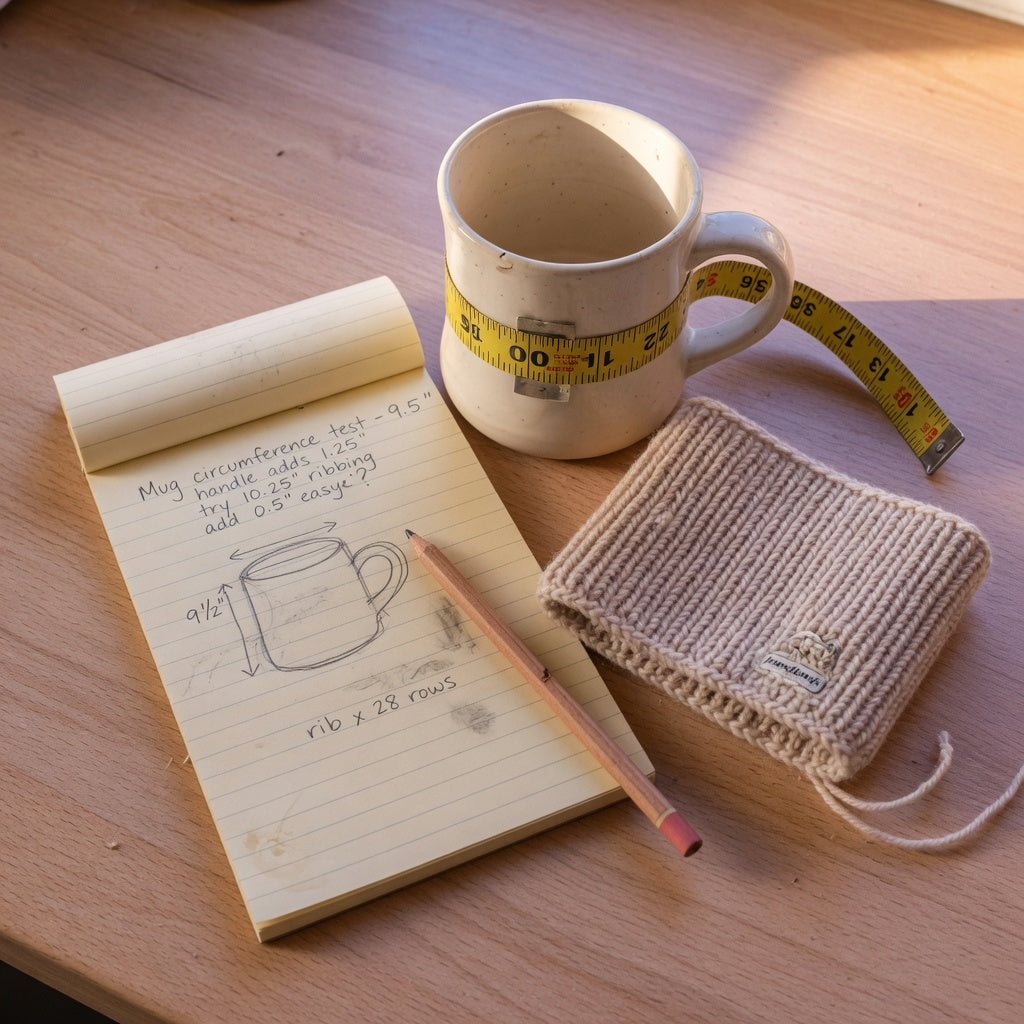
- Body circumference. Wrap a flexible tape around the widest part of the mug wall — usually mid-body or just under a flared rim. No sewing tape? String works: wrap, mark the overlap, lay it flat against a ruler.
- Coverage height. Measure from the base up to where you want the top edge. Most buyers stop about an inch below the rim, which keeps the lip-contact area bare and the yarn out of every sip.
- Handle gap. Only relevant for cutout styles: measure the space between the handle and the mug wall at its narrowest point. Wrap bands skip this entirely.
- Rim flare. If the mug widens toward the top and the band will sit high, measure the rim separately — a band sized to the body will bind at a flared lip.
Keep those numbers handy while you shop, because listings publish cozy dimensions in different formats: relaxed width, stretched width, “fits mugs up to X inches.” Your tape is the only common language between them. And if the mug itself is still an open decision, its listed dimensions are your baseline — on a tall silhouette like our Landscape Tall Coffee Tea Mug, pull the height and diameter from the current listing before ordering a band cut for a squat 12 oz, because a tall wall changes both numbers at once.
What should a mug cozy size guide chart include?
Ounces alone won't get you there. A useful chart maps capacity to the dimensions a cozy actually grips — diameter, circumference, finished width, height. The ranges below are typical for standard ceramic shapes in our experience; individual designs vary, so treat them as starting points rather than promises. We publish capacity and approximate dimensions for every shape in our unique coffee mugs collection for exactly this reason: shape, not just ounces, decides fit.
| Mug capacity | Typical body diameter | Typical circumference | Relaxed cozy width | Cozy height |
|---|---|---|---|---|
| 8 oz | 3–3.25 in | 9.5–10.5 in | 8–9.5 in | 2.5–3 in |
| 10–12 oz | 3.25–3.5 in | 10–11 in | 8.5–9.5 in | 2.5–3.25 in |
| 14–16 oz | 3.5–3.75 in | 11–12.5 in | 9.5–11 in | 3–3.5 in |
| 18–20 oz | 4–4.25 in | 12.5–14 in | 10.5–12.5 in | 3.5–4 in |
Two things stand out. First, the relaxed widths run roughly 10–15% under the mug circumference — that gap is deliberate, and the next section explains it. Second, identical capacities can want different proportions: a squat round 12 oz takes a wide, short band, while a tall 12 oz takes a narrower, taller one. We put those two silhouettes head to head in our tall-versus-round 12 oz ceramic mug comparison.
How much smaller should a knit or crochet cozy be?
Yarn stretches, so a well-sized band is made noticeably smaller around than the mug — typically 10–20% under the circumference in our experience. A band measuring about 9 inches flat will hug a 10.5-inch mug snugly without straining the stitches. Too little margin and the cozy slides; too much and it binds or distorts.
Mug circumference ÷ the maker's stitches per inch = stitches to cast on. That single line of arithmetic is the whole sizing system behind knit and crochet cozies.
If your yarn's gauge doesn't match a pattern's stated gauge, recompute the stitch count from your actual gauge instead of trusting the pattern numbers — a half-stitch-per-inch difference adds up to a full inch around a 12 oz mug.
Wool, cotton, or acrylic? Fiber changes both fit and care
The stretch allowance only works if the fiber keeps the properties you sized for:
- Wool stretches easily and is the most forgiving on fit — but hot water and agitation felt it. The fibers lock up, the band stiffens, and the stretch is gone for good. Hand wash cold.
- Cotton gives moderate stretch and shrinks in a hot dryer. Cold wash, reshape while damp, air dry. Because of that shrink potential, cotton bands benefit from a slightly generous starting width.
- Acrylic holds its dimensions wash after wash, but it grips less and buffers heat less than wool. Fine for a decorative band on a mug you sip slowly; a weak choice for a boiling-hot fill.
- Felted wool barely stretches at all. Size it nearly to the exact circumference or it will never go on.
- Fabric with an elastic edge hugs through the elastic, so the relaxed size can sit well under the mug measurement without slipping.
There's an honest trade-off here: the fiber that fits most forgivingly (wool) demands the most careful washing, and the lowest-maintenance fiber (acrylic) is the weakest against heat. For fabric behavior and wash routines in more depth, see our ceramic mug cozy fabric and care guide.
Do cutout wraps, straight bands, and full sleeves size the same?
No — style changes how exact your measurements need to be:
- Handle cutout wraps are the least forgiving. They need accurate circumference and an accurate handle gap, or the cutout lands over the wrong spot.
- Straight wrap bands are the most forgiving. They slide over the base and let stretch do the fitting — the first style we suggest when a mug can't be measured.
- Full sleeves need accurate height plus rim circumference on flared walls, and the extra bulk matters if the mug shares a dishwasher basket or gets stacked.
- Buttoned wraps adjust by a stitch or two, but an undersized one gapes at the button, and the button is the first failure point under load.
Weigh the grip trade-off honestly: a cutout keeps the handle bare and cool, while a wrap band covers the handle roots — snug, but you're holding yarn where your fingers meet the ceramic. Neither is wrong; they feel different in the hand.
Hard-to-fit mugs: pleated tea cups, tall profiles, camp mugs, tumblers
Some shapes fight every chart:
- Tapered tea cups and demitasse — cone walls let a straight band ride upward. Shaped or elasticized designs hold better.
- Oversized camp mugs (20 oz and up) — they need the widest bands; a cozy sized for a 12 oz mug looks like a bracelet on one.
- Insulated travel tumblers — straighter, wider walls and often a tapered base for cup holders. Mug sizing doesn't transfer; measure the tumbler itself.
- Ridged or pleated walls — run the tape across the outside of the ridges, not between them. Texture adds real circumference.
- Double-walled glass — heat at the palm isn't the issue, grip is, so a slim band is usually enough.
Two shapes from our own shelf explain why this list exists. Our Pleated Coffee Tea Cup is the ridged-wall case: measure across the outside of the pleats, and remember that a pleated wall already gives fingers some purchase — there, a cozy is as much about palm warmth and looks as traction. Confirm the cup's capacity and dimensions on its current listing before sizing anything to it. A tall profile like the Landscape mug makes the opposite mistake easy: a standard 3-inch band reads underscaled against the height, so size the band's height up to the listing's measurements. Silhouette, not capacity, is the first filter we teach.
How do you size a cozy for a gift mug you've never seen?
Blind gifting is where most fit mistakes happen, so stack the odds in your favor:
- Default to a straight wrap band sized for a 12 oz mug — it covers the most common mug in the most kitchens, and stretch absorbs the rest.
- Ask for one photo of the recipient's everyday mug next to a soda can for scale.
- Skip handle cutouts and full sleeves as surprise gifts; they're the least forgiving of a wrong guess.
- Tuck a cheap flexible tape measure into the box with a note — it turns every future cozy into an easy reorder.
- If they drink at a desk all day, our desk-mug size comparison will help you guess whether their daily driver is a 12, 16, or 20 oz.
Frequently asked questions
What size mug cozy fits a 12 oz mug?
Most 12 oz ceramic mugs run roughly 10–11 inches around at the body. Per the mug cozy size guide chart above, match that to a cozy with a relaxed width of about 8.5–9.5 inches and a height near 3 inches. Measure if you can — a tall 12 oz and a round 12 oz are not the same knit.
How do I measure my mug for a cozy?
Wrap a flexible tape or string around the widest point of the body for circumference, measure from base to about an inch below the rim for height, and add the handle-gap measurement only if you're buying a cutout style. Those two or three numbers cover nearly every listing.
Should a mug cozy fit tight or loose?
Snug, never straining. Stretchy yarn cozies should sit 10–20% smaller around than the mug so they grip without sliding; barely-stretchy felted wool should match the circumference almost exactly. If the cozy spins or slips when you lift the mug, it's a size too big.
Will a cotton mug cozy shrink after washing?
It can, especially in a hot dryer. Wash cold, reshape it while damp, and let it air dry. That shrink potential is exactly why cotton bands benefit from a slightly generous starting width.
Do mug cozies fit travel tumblers like a Yeti?
Not reliably. Tumblers have wider, straighter walls than coffee mugs and often taper at the base, so mug-based sizing doesn't transfer. Measure the tumbler's circumference directly and buy from a listing that states tumbler dimensions.
The 30-second fit check before you order
- Measure the mug's circumference at its widest point — string and a ruler work fine.
- Set coverage height about an inch below the rim.
- Choose a straight wrap band if the mug is unmeasured; reserve cutouts for mugs you've taped.
- Confirm the cozy's relaxed width sits 10–20% under your circumference — near-exact for felted wool.
- Match the care instructions to how you actually run your sink, not how you wish you did.
Run those five checks and any cozy listing becomes easy to judge — no “standard size” guesswork required. And if the measuring reveals that the mug is the real problem, start from shapes you can measure once and fit for good in our unique coffee mugs collection.
Read more

Round Ceramic Coffee Mug for Daily Routine: What Buyers Should Compare
A store-side breakdown of what separates a round ceramic coffee mug that survives daily use from one that ends up on a shelf: the 6 oz cup versus listed capacity, microwave and glaze safety, handle...
Read more
The Rock Mug 480 Ml: Capacity, Care, and Fit Compared
A 480 ml rating usually means filled to the brim — so what do you actually get? Our team compares usable capacity, glaze care, weight, and kitchen fit for The Rock mug before you order.
Read more
Leave a comment
This site is protected by hCaptcha and the hCaptcha Privacy Policy and Terms of Service apply.