
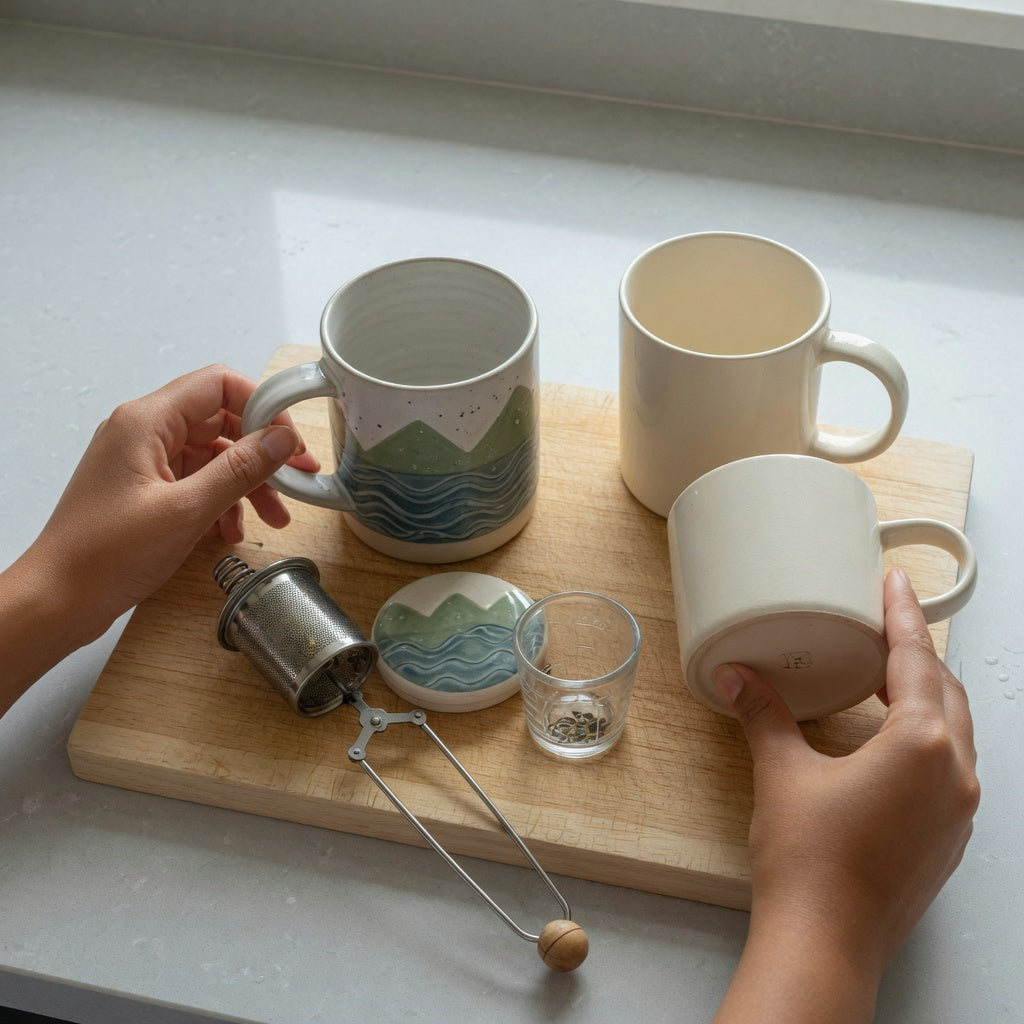
Mountain Sea Coffee Tea Mug Buying Checklist: 10 Checks
Reading time: about 10 minutes
A landscape mug can look perfectly balanced in a product photo and feel wrong the first time it is full beside a keyboard. We see shoppers focus on the mountain-and-sea design, then discover that handle clearance, rim comfort, cleaning, or an unsuitable infuser matters more in daily use. Our mountain sea coffee tea mug buying checklist starts with those contact points because they decide whether a mug stays in regular rotation or moves to the display shelf.
Keep the current Mountain & Sea Ceramic Coffee Mug page open as you work through the checks. The catalog title establishes the product category, but the supplied research does not confirm its capacity, handle material, included accessories, care instructions, food-contact claims, or appliance compatibility. Treat every one of those details as unconfirmed unless the live listing states it for this exact product.
Who will use this mug daily, and who should choose a simpler cup?
Mountain-and-sea mugs are commonly sold as decorative hot-drink vessels. Some versions in the wider category add wooden handles, lids, or removable infusers, but those features are not universal. The practical question is not whether the design looks good. It is whether the construction matches the place where the mug will be used.
- Personal desk or reading chair: This style can make sense for a shopper who drinks in one place and is willing to handle the mug carefully. The product page above is a relevant starting point because it matches the mountain-and-sea style; confirm its current construction and care details before ordering.
- Loose-leaf tea routine: Look for a listing that explicitly confirms an included infuser, shows its openings clearly, and explains whether it is removable. A product name or similar marketplace photo is not enough.
- Gift purchase: Check the rim, handle area, base, and any separate pieces during unboxing. A decorative mug is a better gift when the recipient's washing habits match its care requirements.
- Shared office kitchen: If everything goes through a dishwasher, scan our unique coffee mugs collection for a current listing that explicitly confirms the construction and cleaning method you need.
- Commuting or car use: Skip this category unless the exact listing confirms a leak-resistant travel design. A decorative lid should be treated as a steeping cover, not a travel seal, unless the seller states otherwise.
Handle material and balance: what changes once the mug is full?
An empty mug hides two problems: torque and finger clearance. A side-mounted handle carries the weight away from the mug's center, so a large serving can make a narrow or shallow grip tiring. Check whether the listing shows enough room for your usual grip. If only two fingers appear to fit, expect more of a pinch grip when the mug is full.
If wood appears in the construction, inspect how it meets the ceramic. A wood-to-ceramic assembly may use adhesive, hardware, or a combination, and you cannot identify the method reliably from another seller's version. Look for clear close-ups of the mounting point and ask the seller if the attachment method is not described.
Potential defect modes worth checking at delivery include rotational play, a visible gap at the handle seat, cracked glaze near the mounting area, and lifting or roughness in a wood finish. We do not advise twisting a new handle to test it. Hold the mug over a counter, apply normal lifting pressure, and stop using it if the joint shifts.
Infuser openings and lid fit: will they match your drink?
The words tea infuser do not tell you how well a basket will handle your tea. Whole leaves are relatively forgiving. Broken-leaf tea, rooibos, herbal dust, and fine coffee particles need smaller openings if you want less sediment in the final sip. Basket depth also matters because tightly packed leaves have less room to expand.
Fine stainless-steel mesh and perforated ceramic baskets behave differently. Mesh can retain smaller particles but needs prompt cleaning because tea residue and coffee oils lodge between the wires. Larger ceramic holes are easier to inspect and may suit intact leaves, but they can pass smaller fragments. There is no standardized, product-specific mesh performance test available for every mountain-and-sea mug, so close-up photos and an exact material description are more useful than a general infuser label.
A lid can cover the drink during steeping, but do not assume it seals. Confirm whether the listing calls it a cover, a lid, or a leak-resistant closure. Also verify whether the infuser and lid are included with the exact product rather than pictured only as styling props.
Capacity, rim, and base: will the mug work at your desk?
The largest listed capacity is not automatically the most practical. Compare the stated volume with your normal pour. If you usually make 8 to 10 ounces, a much larger mug adds vessel weight and takes more cupboard space without improving the drink. If you regularly pour 14 to 16 ounces, check whether the handle still looks comfortable at that load.
Rim shape becomes noticeable after repeated use. Look for a smooth drinking edge, an even glaze transition, and no obvious drips or rough patches where your lip will rest. At the base, a broad contact area is useful on a desk crowded with a laptop, phone, and notebook. A narrow foot or tall silhouette needs more open space around it.
Our practical arrival test is simple: place the empty mug on a flat kitchen counter and check for rocking, inspect the rim under direct light, then fill it first to halfway and later to your normal serving level. That sequence reveals balance and grip without asking the handle to carry a maximum load immediately.
Mountain Sea Coffee Tea Mug Buying Checklist: 10 Listing Checks
Run this mountain sea coffee tea mug buying checklist against the live page, line by line. Mark missing details as unknown. Do not borrow specifications from a similar product name, marketplace result, different color, or previous batch.
- Confirm the exact item and variant. Make sure every photo, option, and description refers to the version in your cart.
- Find the stated capacity. Compare it with your normal serving rather than choosing the largest number.
- Identify every material. Verify the body, handle, infuser, lid, decorative finish, and any connecting hardware.
- Inspect the handle attachment. Look for a clear mounting photo or written construction detail. Ask if the method is hidden.
- Judge grip and balance. Check finger clearance and picture the mug carrying your usual volume, not sitting empty.
- Inspect the rim and base. Look for an even drinking edge, stable footprint, and intact glaze at high-contact points.
- Match the infuser to your drink. Compare mesh or perforation size with whole leaves, broken leaves, herbal particles, or coarse coffee grounds.
- Define the lid's job. Confirm whether it is for steeping, heat coverage, storage, or travel. Do not assume leak resistance.
- Read the care and appliance guidance. Dishwasher and microwave compatibility must be stated for the complete mixed-material item, not inferred from the ceramic body.
- Check food-contact and support details. Review the exact claims made for the glaze, ask what supports them if needed, and confirm the process for reporting damage or a loose joint.
Wooden-handle or all-ceramic: which fits your routine?
The handle material often matters more than the landscape motif. Wood may feel cooler and visually warmer, but it introduces another finish and attachment point to maintain. All-ceramic construction removes that mixed-material joint, although it can still chip and must still have explicit appliance guidance.
| Buyer variable | Wood-involved design | All-ceramic design |
|---|---|---|
| Grip | May feel cooler; comfort depends on shape and clearance | Can warm with the body; one-piece loops may feel more rigid |
| Cleaning | Usually calls for a conservative hand-washing routine unless stated otherwise | Potentially simpler, but machine washing still requires listing confirmation |
| Main inspection point | Wood finish and the wood-to-ceramic attachment | Cracks or chips around the handle and rim |
| Best setting | Personal desk, careful home use, or gifting | Heavier rotation when the listing confirms suitable care |
| Poor match | Long soaking or an automatic dishwasher without approval | Anyone expecting an unbreakable travel mug |
If hand-washing one personal mug is realistic for you, a mixed-material design may be worth considering. If your mug will sit in a full sink or enter a shared dishwasher, use the collection link to compare current listings for a simpler construction with clearly stated care instructions.
Care and food-contact claims: what must the listing confirm?
For any mug that the current listing confirms has a wooden component, use a conservative routine unless the manufacturer provides different instructions. Let very hot ceramic cool before washing, remove any detachable infuser, clean the ceramic with a soft sponge, wipe wood instead of submerging it, and air-dry the pieces separately. Do not place the item in a dishwasher or microwave solely because the main body is ceramic.
- Rinse a used infuser promptly so small particles do not dry inside the openings.
- Use a soft brush on mesh instead of bending or twisting the basket.
- Avoid prolonged soaking around mixed-material joints.
- Keep abrasive pads away from glossy or decorative glaze.
- Inspect the handle seat, rim, and interior after cleaning for movement, chips, or new cracks.
Food-contact language deserves the same product-specific discipline. The FDA action level for extractable lead in ceramic cups and mugs is 0.5 micrograms per milliliter of leaching solution, based on any one of six tested units. That is a regulatory benchmark, not evidence that a particular mug or batch has undergone testing.
The FDA's guidance on lead-glazed pottery explains that proper firing binds essentially all lead into the glaze, leaving insignificant migration into food. A seller's lead-free statement should still apply to the exact product being sold. If documentation matters to your purchase, ask what testing or supplier evidence supports the current listing rather than accepting a claim attached to a similar-looking mug.
Frequently asked questions
What should a mountain sea coffee tea mug buying checklist include?
Check the exact materials, listed capacity, handle clearance, attachment method, full-mug balance, rim, base, infuser openings, lid purpose, care instructions, and food-contact claims. Verify each point on the current listing. Leave any missing specification marked as unknown instead of filling it in from another seller's product.
Is the Mountain & Sea Ceramic Coffee Mug dishwasher or microwave safe?
The supplied product evidence does not confirm dishwasher or microwave compatibility for the exact linked item. Check the live page or ask CoffeifyMug before using either appliance. Do not infer compatibility from the ceramic product title because handles, finishes, adhesives, or decorative details may change the care requirements.
Does this mountain sea mug include a wooden handle, lid, or infuser?
Those accessories and construction details are not confirmed by the evidence supplied for the exact product URL. Review the current listing and selected variant to see what is included. Photos or descriptions from similarly named mugs cannot establish what ships with this item.
How fine should a mug infuser be for tea or coffee?
Choose openings based on the smallest particles you brew. Whole-leaf tea can work with larger perforations, while rooibos, broken leaves, herbal dust, and coffee grounds usually require finer mesh to reduce sediment. For coffee, a coarse grind is more suitable for a basic strainer than espresso-fine grounds.
What mug capacity is best for a desk?
Match the listed capacity to your normal serving and available desk space. A mug that is comfortable with 8 to 10 ounces may become awkward if you fill a larger stated capacity to the rim. Check handle clearance, base width, and full weight together rather than judging capacity alone.
Start by opening the Mountain & Sea Ceramic Coffee Mug listing and writing down only the details it currently confirms. It is the relevant next step for a personal desk, careful home routine, or mountain-and-sea gift once its construction matches your needs. If you need simpler care or a different grip, compare the current unique coffee mugs and choose the listing that answers the most practical questions before you order.
More from our blog
Read more
Spittoon Coffee Tea Mug Buying Checklist: 9 Buyer Checks
A practical checklist for comparing spittoon-shaped drinking mugs by intended use, capacity, rim and handle comfort, food-contact claims, stability, cleaning needs, and gift suitability.
Read more
Pleated Coffee Tea Cup Buying Checklist: 10 Checks
Measure your normal pour, inspect the pleats, verify care claims, and separate reusable ceramic cups from disposable paper versions. This checklist explains what a 200 ml listing can and cannot tel...
Read more
Leave a comment
This site is protected by hCaptcha and the hCaptcha Privacy Policy and Terms of Service apply.