



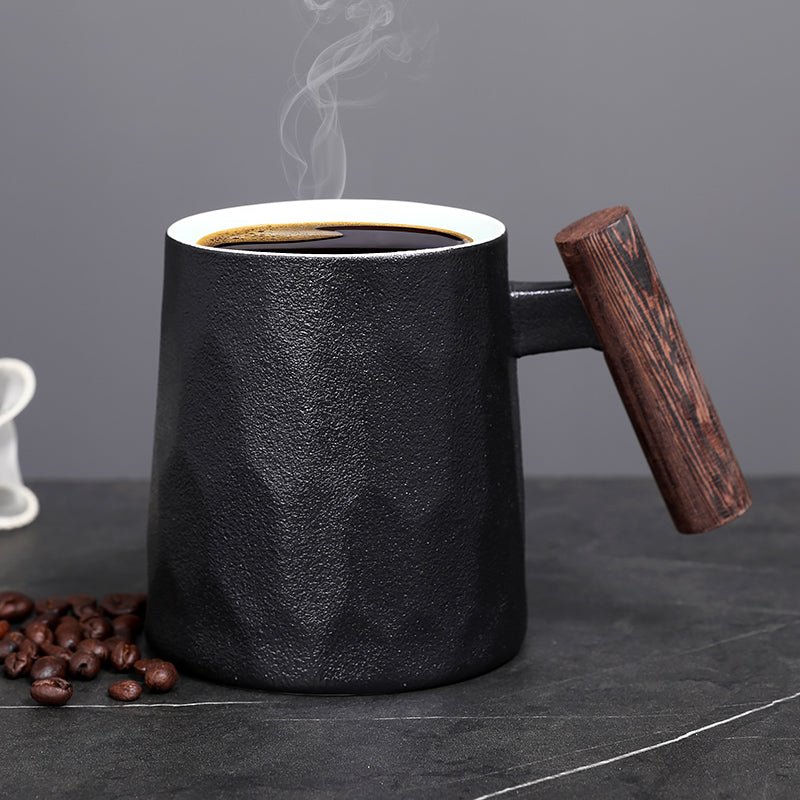
Mocha Mug vs Coffee Mug: Capacity, Shape, and Daily Fit
Reading time: about 9 minutes
A customer sends us a photo of a mug filled to the lip, cream sliding down the side, and asks why the mocha mug vs coffee mug decision feels harder than it should. The labels overlap. The jobs do not.
Search the phrase in any store and you will get a handled mug, a tall clear glass, and sometimes a brown-and-cream banded pottery mug from an antiques dealer. All three get called a mocha mug. Only one has anything to do with the chocolate-and-espresso drink most shoppers are trying to make at home.
In our store, the confusion shows up in customer messages almost weekly. Here is the split:
- The drink mug. A larger-than-average handled cup people buy for a mocha: espresso, chocolate, milk, often something piled on top. This is what most shoppers mean.
- Mocha ware. Historic banded pottery that collectors and decorators call mocha mugs. Nothing to do with the drink, and care instructions vary by piece.
- The moka pot mix-up. A moka pot is a stovetop brewer. Its cups are small espresso-sized measures, not 8 oz mugs, so owners searching for a mocha mug are often really hunting for a cup that does not leave their pot looking half empty.
We found no government or standards-body definition that separates a mocha mug from a coffee mug by capacity, diameter, or height. The closest thing to an official description is the FDA compliance guidance for cups and mugs: small ceramic hollowware with a handle, normally holding about 240 mL (8 fl oz). Note the word normally. It is a description, not a rulebook. That is why any mocha mug vs coffee mug comparison has to be settled by what you pour and how you drink it, not by the label on the box.
Mocha mug vs coffee mug: how much usable capacity do you actually get?
Bigger helps. Mandatory, no.
The number that matters is not the printed capacity. It is the usable capacity left after you account for foam, toppings, and the gap you need to carry the mug across a room without sloshing. A mug printed 400 ml rarely takes 400 ml of drink comfortably.
Unit confusion makes this worse. One U.S. fluid ounce is 29.573 mL under NIST Handbook 44, so a 12 oz mug is roughly 355 ml and a 16 oz mug is roughly 473 ml. When a listing says 400 ml and a buyer expects about 13 oz, both are correct. They are speaking different units. Convert before you reject a mug that was actually the size you wanted.
| Mug | Stated capacity | Approx. U.S. fl oz | Where it tends to fit |
|---|---|---|---|
| The Flow | 400 ml | about 13.5 | A standard coffee, or a chocolate drink with no topping cap |
| Morning and Night | 440 ml | about 14.9 | The middle ground: coffee on one side of the day, cocoa on the other |
| The Rock | 480 ml | about 16.2 | Generous servings and drinks built with something on top |
Those capacities come from our current listings. What each one is like to drink from, including rim thickness, handle feel, and how it stacks in a cupboard, is worth reading on the product page itself. Those details decide whether you reach for a mug daily or forget it in a month.
Where does headroom change which of our mugs fits?
Picture the last badly served mocha you had: filled to the lip, cream sliding over the side, one hand cupped underneath on the walk back to your desk. Headroom is the fix. A couple of centimetres of clearance beats a mug filled to its absolute limit every time.
Translated to our three mugs:
- You drink 8 to 10 oz and rarely add anything on top. The Flow coffee and tea mug at 400 ml is the closest fit: a real serving rather than a mug you have to half-fill.
- You switch between coffee in the morning and cocoa at night. The Morning and Night coffee and tea mug at 440 ml covers both without turning into a two-handed mug. Our catalogue lists these mugs for coffee and cocoa, which is exactly the split being described.
- You want a generous pour, or you build the drink with a topping. The Rock coffee and tea mug at 480 ml gives you the most room of the three, a bit over 16 fl oz, so a full serving plus cream still leaves a margin.
If none of those line up with your routine, do not force a size. Browse the unique coffee mugs collection and compare capacities side by side instead of guessing from photos.
Wide mouth or narrow rim: what does each shape cost you?
Two mugs can hold identical volume and behave nothing alike. Shape is where the day-to-day difference lives, and it is the part most comparison posts skip.
- Wide mouth. Easy to spoon cream, marshmallows, or a dusting of cocoa. Aroma reaches you faster. The cost: more liquid surface exposed to open air, and a full wide mug is heavier to hold one-handed.
- Narrower mouth. Easier to drink from while walking. The cost: toppings are awkward, and a chunky rim can hide the foam you wanted to see in the first place.
- Thick vs thin rim. A thick rim feels sturdy and buffers your lip; a thin rim puts more of the drink on your tongue at once. Slow cocoa drinkers tend to forgive thick. Fast coffee drinkers usually prefer thin.
We do not publish minute-based heat claims for our mugs. Shape and material set expectations; they do not come with a guarantee. If keeping a drink hot for a specific length of time is your main requirement, an insulated travel mug is a better tool than any open handled mug.
Clear glass or opaque ceramic for a layered drink?
A glass mug makes the layers visible. That is the entire reason cafe mochas so often arrive in one, and if the look is part of what you are paying for, glass earns its place honestly.
But glass brings costs nobody mentions on a product photo. It often shows every smear and water spot, and it is less forgiving when it slips off a draining board. Opaque mugs hide the mess and feel warmer in the hand. For a drink you make at 7 a.m. and sip at a desk for twenty minutes, that usually matters more than the visual.
If you want to see the layers, buy glass on purpose. If you want a mug that hides the evidence of a rushed morning, an opaque mug is the practical pick. Do not pay for see-through unless the look is actually the point.
Glaze, lead, and the care symbols most shoppers scroll past
This is the part of the comparison that affects your health and your dishwashing routine, and it is the part product photos never show.
- Lead. The FDA action level for leachable lead in cups and mugs is 0.5 micrograms per millilitre of leaching solution, measured across six units. The agency also notes that ceramicware labelled Lead Free may be considered misbranded if it still releases extractable lead under its test method. In plain terms: lead free is a claim, not a certificate.
- Metallic and heavily decorated glazes. These are the ones to check before microwaving. Whether a specific mug is microwave safe depends on its glaze and body, not its colour, so read the label on the exact mug in your basket.
- Dishwasher. Repeated cycles wear rims and can dull a reactive glaze. If a mug is hand-wash only, the listing should say so. If you cannot find the care line, ask before you buy rather than after.
We keep microwave and dishwasher claims tied to the exact product listing rather than a comparison article like this, because the honest answer depends on the piece. Check the care section on the product page before the first wash.
Which mug matches your actual drinking routine?
Forget the category name for a minute and answer four questions:
- How much do you actually drink? Measure your usual pour once with a jug. Guesses tend to run large.
- Do you add anything on top? If yes, allow headroom. Go up a size rather than filling to the rim.
- Does it need to be see-through? Only if the layered look is the point of the drink for you.
- Where does it live? Cupboard height, desk space, and cup-holder diameter rule out more mugs than buyers expect.
Then map your answers:
- Coffee only, standard serving, nothing on top: 400 ml is plenty. Start with The Flow.
- Coffee some days, cocoa others: 440 ml splits the difference. Morning and Night.
- Big servings or a topping most times: 480 ml. The Rock.
- Still deciding: scan the unique coffee mugs collection and read the capacity line on each listing.
What a large mocha-style mug is not good for: anyone who drinks a single small pour and hates a half-empty cup. A big mug makes a small drink look wrong and leaves more surface area to deal with, and no glaze fixes that. Buy the size you will actually fill. That is the one piece of advice we give more than any other.
If you want the next step, open the collection and compare the capacities against your usual pour. That is a five-minute exercise that beats guessing from a photo.
Frequently asked questions
Is a mocha mug just a coffee mug with a different name?
Mostly, yes. No regulated standard separates them by size or shape. Retailers use mocha mug loosely to signal a larger or wider cup, while coffee mug covers everyday handled cups. Judge the mug by its capacity and rim, not its name.
In a mocha mug vs coffee mug size comparison, which is usually bigger?
Usually the mocha mug, but not by rule. A basic coffee mug is often around the FDA description of 240 ml, while the mugs we list for coffee and cocoa run 400 to 480 ml. That is a size range, not a category law, so check the stated capacity on the listing.
Do I need a clear glass mug to serve a mocha?
No. Glass shows the layers, which is why cafes use it, but an opaque mug hides smudges and is easier to live with. Choose glass only if the visual is part of the drink for you.
Can I put a lead free ceramic mug in the dishwasher and microwave?
Those are two separate questions, and the label should answer both. Lead free refers to leachable lead under FDA test methods, not to heat or detergent resistance. Check the care line on the exact product page before the first wash.
Why does my moka pot only half fill a standard mug?
Because a moka pot's cups are small espresso-sized measures, not 8 oz mugs. A three-cup pot makes a modest amount of concentrated coffee. If that is your routine, a 300 to 400 ml mug will look partly empty by design. Size down rather than up.
Ready to pick your mug? Two ways to save on today's order:
Ordering 1–3 mugs? Get an extra 10% off your 1st order with code 10_OFF Apply 10% Off & Shop Wooden-Handle Mugs →
Gifting 4+ mugs? Buy 3, Get the 4th Free applies automatically at checkout (no code needed; offers do not stack) · Free standard shipping (Nov pre-Christmas delivery: 15–20 calendar days US) · Free replacement if chipped in transit.
Popular mug buying guides: Ceramic Tea Cups & Infuser Mugs · Ceramic Mugs with Lids Compared · Wooden-Handle Tea Infuser Mugs Compared · Christmas & Secret Santa Mugs 2026 · Espresso & Cortado Cups Guide · Cup & Saucer Gift Sets · All 25 Mugs Spec Table · Mug Size Guide · Shipping & Promo FAQ
FIRST ORDER 10% OFF (CODE: 10_OFF) · OR BUY 3, GET THE 4TH FREE


Read more
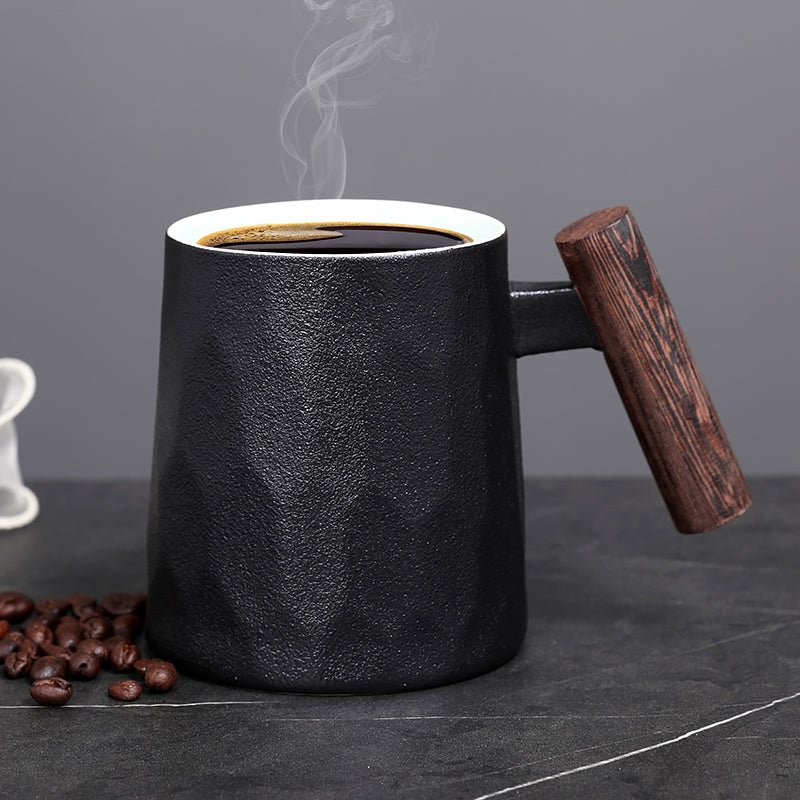
15 oz Ceramic Coffee Mugs Current Product Facts: Sizes Compared
The verifiable facts behind a 15 oz label, plus exact milliliter capacities for The Flow, Morning and Night, and The Rock and where each lands against that mark. We also flag the usable-pour, weigh...
Read more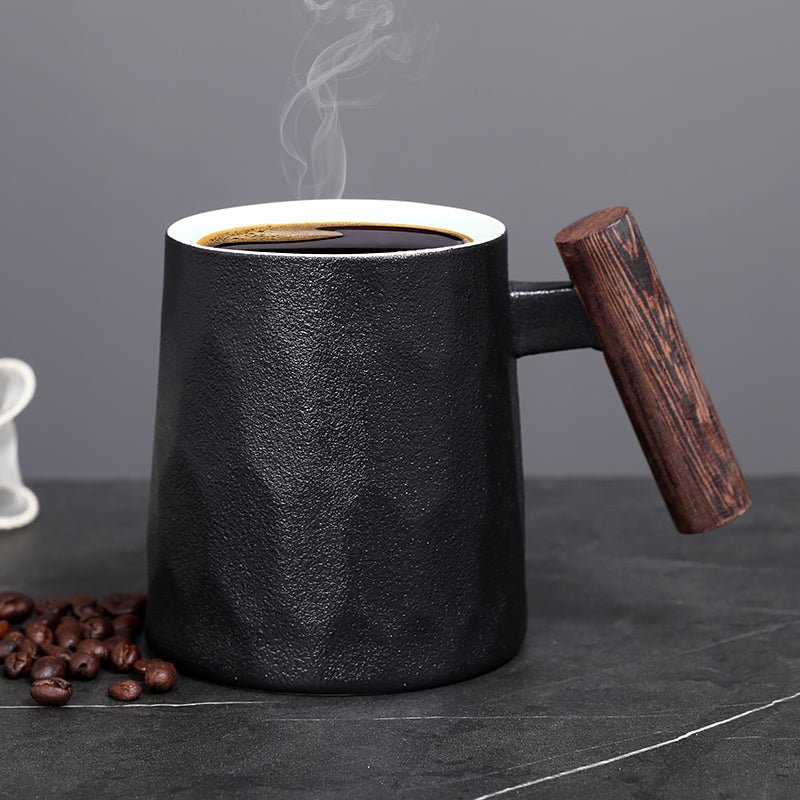
Coffee Mugs With Big Handles Buying Priorities: Fit, Weight, Space
Compare 250 ml, 400 ml and 480 ml handled mugs by the three things that actually decide the purchase: how much you pour, how much hand room the loop gives, and what fits under your brewer.
Read more
Leave a comment
This site is protected by hCaptcha and the hCaptcha Privacy Policy and Terms of Service apply.