
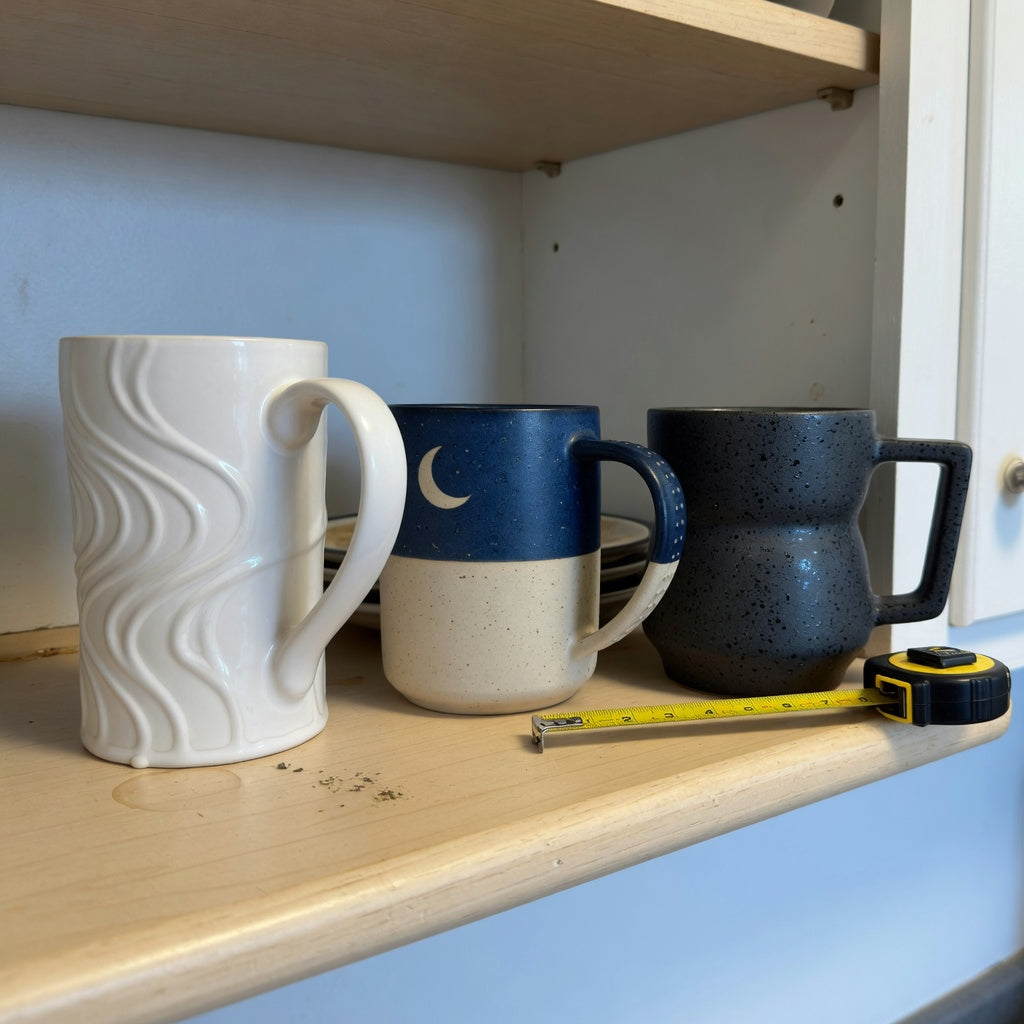
Mocha Mug Storage Fit Guide: 400-480 ml Shapes and Shelf Fit
Reading time: about 9 minutes
A mug can sit neatly on a shelf and still stop the cabinet door from closing because the handle reaches farther forward than the body. This mocha mug storage fit guide compares CoffeifyMug's current 400-480 ml options using the facts we can support: listed capacity, visible form, and the storage measurements shoppers should verify before ordering.
In our store, we treat serving capacity and exterior fit as separate questions. A packing box and a kitchen cabinet face the same basic issue: the rim, base, and outer edge of the handle create an irregular footprint. The largest capacity does not automatically have the greatest height, and the lowest capacity is not guaranteed to have the narrowest handle.
Mocha mug storage fit guide: which measurements decide cabinet fit?
The three verified capacities are useful, but milliliters describe internal volume rather than the space a mug occupies. If exact exterior dimensions are available on a current product page, compare them with the usable space in your cabinet. If a dimension is not listed, do not estimate it from capacity or convert a product photo into an invented measurement.
These are the fit points our team uses when discussing mug storage:
- Overall height: measure from the resting surface to the highest point of the rim, then compare it with the clear shelf opening rather than the distance between shelf boards.
- Maximum body diameter: find the widest part of the bowl or body. This may be different from the base diameter.
- Base or foot diameter: this determines how much stable shelf surface the mug needs, but it does not describe the full footprint.
- Overall width including the handle: measure from the body edge opposite the handle to the handle's outermost point.
- Handle projection: this is the distance the handle extends beyond the body. It affects side-by-side spacing and whether the mug can rotate inside a cabinet.
- Usable shelf depth: measure from the back panel to the inside face of the closed door, accounting for shelf lips, hinges, and door-mounted hardware.
Handle opening and handle projection are also different measurements. The opening affects grip room; projection affects storage. A generous opening can be comfortable to hold but require more lateral clearance, which is a poor trade-off in a tightly packed cupboard.
What do the 400 ml, 440 ml, and 480 ml capacities tell you?
Capacity establishes how much drink space you are choosing. It does not establish exterior dimensions because body profile, wall construction, rim flare, foot geometry, and handle shape can distribute that volume differently. The catalog descriptions for all three options support coffee and cocoa use.
| Current mug | Verified capacity | Who should start here | Storage fact to confirm |
|---|---|---|---|
| The Flow | 400 ml | A shopper satisfied with the lowest capacity in this comparison and trying to limit unnecessary volume | Confirm overall width, height, and handle projection; 400 ml alone does not guarantee the smallest exterior |
| Morning and Night | 440 ml | A shopper who wants a capacity midpoint for everyday coffee or cocoa | Check the visible body profile and the handle's outer edge against the intended shelf |
| The Rock | 480 ml | A shopper prioritizing the most drink room among these three | Verify the complete footprint before assigning it to a closed cabinet or crowded desk |
Morning and Night holds 40 ml more than The Flow and 40 ml less than The Rock. The Rock holds 80 ml more than The Flow. Those are valid capacity comparisons, but none proves how many mugs will fit across a shelf.
How should you read body shape and handle projection in product photos?
Product images are useful for comparing visible form, particularly when each mug is viewed from a similar angle. They are not a scale drawing. Camera distance, lens perspective, and image cropping can make one handle appear closer to the body than it is.
- Trace the silhouette: look for the widest point at the rim, shoulder, main body, and base.
- Follow the handle arc: note both its outer edge and where its upper and lower attachments meet the body.
- Check for taper: a tapered body can have a small base while still requiring more room at the rim.
- Inspect surface details: any raised or projecting feature visible on the current product should be included in the maximum width, not ignored as decoration.
Compare the current product images with a mug you already own, then use listed measurements where available. Our unique coffee mugs collection is the practical next page when visible shape matters as much as capacity, because you can compare the silhouettes before opening individual listings.
Which mug suits a closed cabinet, open shelf, or office desk?
The right recommendation begins with the mug's permanent home. Match your situation to a capacity, then confirm the exterior fit rather than treating the recommendation as a dimensional guarantee.
- Tight closed cabinet: start by evaluating The Flow 400 ml if that serving capacity is enough. It avoids buying more volume than you need, but its height and handle still need to be checked against the door plane.
- Everyday kitchen shelf with moderate serving needs: consider Morning and Night 440 ml. Its midpoint capacity is useful when 400 ml feels limiting but storage still matters; verify its current listed dimensions before ordering.
- Open shelf or dedicated drink station: evaluate The Rock 480 ml when maximum capacity among these choices is the priority. Open placement removes the cabinet-door constraint, although the base and handle still need stable surface clearance.
- Gift with unknown cabinet dimensions: compare the collection and favor a capacity the recipient already uses. A distinctive large-capacity mug can make a thoughtful gift, but it becomes less useful if it cannot live near the recipient's other drinkware.
These larger-capacity mugs are not the safest assumption for a narrow cubby, a tightly packed office drawer, or a vehicle cup holder. A smaller cup, a purpose-made stackable shape, or a lidded travel mug would suit those situations better. We also would not promise that any of these mugs nest securely unless the current listing explicitly identifies a stackable design.
How do cabinet doors, shelf lips, and dishwasher racks change the answer?
Cabinet measurements often fail because shoppers record the shelf board but miss the obstruction in front of it. A face frame reduces the opening. A raised shelf lip reduces lift-out room. A hinge can occupy the exact corner where a handle needs to rotate.
- Remove the mug currently occupying the intended spot and close the cabinet door.
- Measure usable depth to the inside face of that closed door, not to the cabinet's exterior front.
- Measure the narrowest opening height, including a face frame or shelf above.
- Use an existing mug as a benchmark. Record its overall height, maximum body diameter, and complete width including its handle.
- Test whether that mug can be lifted and rotated without striking a hinge, shelf lip, plate, or neighboring handle.
A dishwasher creates a separate fit question. If dishwasher use matters, first follow the care instructions on the current product listing; do not assume every mug is dishwasher- or microwave-safe. Then check rack-tine spacing, clearance below the upper rack or spray component, and whether the handle catches adjacent pieces. Cabinet fit does not prove dishwasher fit.
Close packing also increases contact points. A base resting on another mug's rim can create an unstable stack, while one handle knocking a neighboring body can cause surface marking or edge damage depending on the material and finish. Leaving enough room to lift each mug without scraping the next one is more useful than forcing one extra piece into the row.
What storage trade-offs should gift buyers and mug collectors expect?
Capacity is easy to discuss during gift shopping; shelf geometry is personal. For a gift, ask how much usable height and depth the recipient has or choose from a form similar to a mug they already store comfortably. The unboxing may last a few minutes, but the mug needs a workable home afterward.
Open shelves make unusual silhouettes easier to see and remove door clearance from the calculation. They also leave drinkware more exposed to dust and accidental contact. Closed cabinets protect the mug from everyday counter activity but demand stricter control of depth, handle direction, and lift-out space.
Collectors should plan around the widest individual piece rather than the average mug. Alternating handle direction can improve spacing in some layouts, but only if each mug can be removed independently. If you need a dense, uniform stack, a product explicitly designed and documented for stacking is a better choice than these capacity-led options.
A two-minute fit check before ordering
- Choose whether 400 ml, 440 ml, or 480 ml matches your usual coffee or cocoa serving.
- Record usable shelf depth and the narrowest clear opening height.
- Measure a mug that already fits, including the handle's outermost edge.
- Check current product photos for rim flare, taper, base stance, and handle attachment points.
- Use listed exterior dimensions if available; treat any unlisted measurement as unconfirmed.
- Confirm current care instructions if dishwasher or microwave use affects where the mug will live.
- Leave enough clearance to lift the mug without contacting a door, hinge, or neighboring piece.
Use this mocha mug storage fit guide with your own measurements beside you. Capacity narrows the shortlist; verified exterior dimensions and visible form decide whether a mug will work in the space you actually have.
Frequently asked questions
Does this mocha mug storage fit guide include exact product dimensions?
No. The verified facts available for this comparison are The Flow at 400 ml, Morning and Night at 440 ml, and The Rock at 480 ml. We do not invent exterior measurements; use dimensions shown on the current product listing when available and compare them with your usable shelf space.
Is The Flow 400 ml guaranteed to use less shelf space than The Rock 480 ml?
No. The Flow has 80 ml less stated capacity, but internal volume does not prove exterior height, body diameter, or handle projection. The Flow is a sensible first option to evaluate when 400 ml is enough, but you still need to confirm fit.
What is the most important mug measurement for a closed cabinet?
Usable depth and complete width including the handle usually expose problems that body diameter misses. Also measure the narrowest opening height and the distance to the inside face of the closed door, since a mug can rest on the shelf yet block closure.
Can The Flow, Morning and Night, or The Rock be stacked?
Do not assume stackability unless the current product information explicitly supports it. Secure stacking requires the base to sit stably within the mug below while the handles and rims remain clear. A single row is the more cautious storage plan when that geometry is unverified.
Which capacity is best for coffee and cocoa?
All three catalog descriptions support coffee and cocoa use. Choose The Flow for 400 ml, Morning and Night for 440 ml, or The Rock for 480 ml based on the serving room you want, then let cabinet and handle measurements settle the final choice.
Measure one mug that already fits, select the closest useful capacity, and compare that benchmark with the current product page. For more forms beyond these three, continue through the CoffeifyMug unique coffee mugs collection.
More from our blog
Read more
Hot Toddy Mug Size Decision Guide: 400 ml or 480 ml?
Compare CoffeifyMug's current 400 ml and 480 ml ceramic options using your actual pour, preferred headspace, handle grip, storage space, and filled-mug comfort. This guide explains where The Gradie...
Read more
Ceramic vs Porcelain Coffee Mugs Current Product Facts: Sizes & Shapes
Compare what the current Round, Pleated, and Landscape listings establish, plus the material, capacity, dimension, and care details that still require confirmation. Includes practical next steps fo...
Read more
Leave a comment
This site is protected by hCaptcha and the hCaptcha Privacy Policy and Terms of Service apply.