
Minimalist Ceramic Mug Capacity Guide: 300, 350 or 400 ml?
Reading time: about 11 minutes
A 300 ml cup and a 400 ml cup can look close in a product grid. The difference becomes obvious after the pour: milk reaches the rim, an infuser takes up more room than expected, or a desk drink runs out before the meeting does. Our minimalist ceramic mug capacity guide compares the three current CoffeifyMug options by listed volume, ceramic material, visible shape, and handle form so you can choose around the drink you actually make.
In our store, we handle these cups side by side and find that capacity questions become clearer once a shopper describes the routine: one longer desk coffee, two shorter tea pours, milk added after brewing, or a compact serving beside breakfast. We use minimalist as a shopper-facing description of the clean visible forms. It is not a formal design classification, material grade, or claim about durability, heat retention, or care compatibility.
Minimalist ceramic mug capacity guide: what changes from 300 to 400 ml?
The current range covers three listed capacities. The 300 ml and 400 ml cups are separated by 100 ml, while the 350 ml option sits 50 ml from either end. Those differences sound modest until you account for milk, an infuser, ice, or the space you prefer to leave below the rim.
- 300 ml: Start here if your finished drink is clearly below 300 ml and you are comfortable returning for another pour.
- 350 ml: Consider the middle capacity if 300 ml regularly feels short but your drink does not need the full 400 ml.
- 400 ml: Choose the largest current option if your measured serving is above 350 ml or reducing refill trips matters most.
- More than 400 ml: All three will require a smaller serving or a refill. A larger mug or lidded drink vessel will suit that routine better.
Here is the comparison we use when helping shoppers narrow the current styles:
| Current style | Listed capacity | Visible body shape | Handle form | Best starting situation | Main limitation |
|---|---|---|---|---|---|
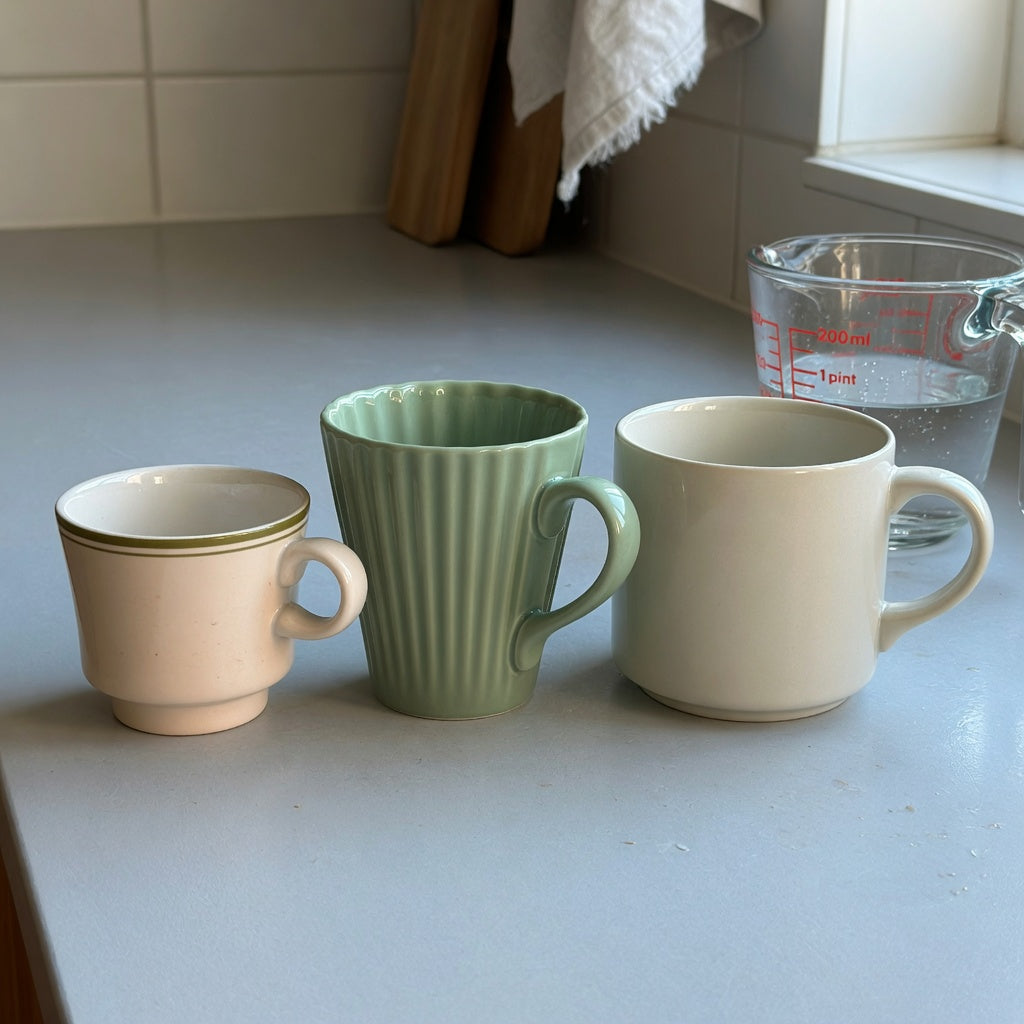
| Round Coffee Tea Mug | 400 ml | Smooth cylindrical body with a gentle lower curve | Standard open-loop handle | One larger coffee or tea serving | Carries up to 100 ml more liquid than the 300 ml cup and may be more volume than short-drink users need |
| Pleated Coffee Tea Cup | 350 ml | Vertical pleats across the body | Contoured loop handle | Medium servings and mixed coffee or tea routines | Only 50 ml separates it from either alternative, so accurate pour measurement matters |
| Retro Coffee Tea Cup | 300 ml | Slightly flared retro silhouette | Compact ear-style handle | Short servings and planned refills | Milk, an infuser, or ice can use the available room quickly |
A listed capacity is a comparison point, not a promise that a rim-level fill will be comfortable to carry. If your finished drink measures exactly 350 ml and you prefer visible space below the rim, do not assume that the 350 ml cup will provide that buffer. The 400 ml option is the more practical starting point in that situation.
Is 400 ml the best fit for a one-pour office routine?
The 400 ml Round Coffee Tea Mug is the closest fit in this group for someone who makes one substantial drink, carries it to a desk, and wants to delay the next kitchen trip. It also makes sense if your measured black coffee is already above 350 ml before adding milk.
Its smooth cylindrical body, gentle lower curve, and standard open-loop handle distinguish it from the textured and flared alternatives. We treat those as visible form details, not guarantees about balance or universal hand comfort. If finger clearance is a deciding factor, inspect the current product images and any listed measurements rather than assuming that an open-loop handle fits every hand the same way.
The trade-off is straightforward: at its listed capacity, the round mug can hold 100 ml more liquid than the retro cup. That extra beverage adds weight during lifting even though this comparison does not state the empty weight of any mug. The round option is not the best match for deliberately short servings, drinks above 400 ml, commuting, or any routine that requires a sealed lid.
Does the 350 ml pleated cup suit mixed coffee and tea days?
The 350 ml Pleated Coffee Tea Cup is the middle choice for shoppers whose routine changes between coffee and tea. It can be a sensible fit when the finished drink measures comfortably under 350 ml, but 300 ml has proved restrictive after adding milk or leaving room below the rim.
The visible vertical pleats introduce texture without changing the listed ceramic material. The contoured loop also gives the cup a different profile from the standard open loop on the round mug. We do not describe the pleats as slip-resistant because visible texture alone does not establish grip performance, especially with wet hands.
This is also the capacity gift buyers often consider when they know the recipient drinks coffee or tea but do not know the exact serving size. Its position in the middle reduces the difference from either end of the range, but that does not make it a universal gift choice. A person who fills a 400 ml vessel every morning may find it short, while someone who prefers small tea servings may see the extra volume as unnecessary.
When is the 300 ml retro cup the smarter refill choice?
The 300 ml Retro Coffee Tea Cup fits a routine built around shorter servings and intentional refills. It is the most direct match for a drinker whose complete coffee or tea serving measures well below 300 ml and who does not need extra room for a large amount of milk, ice, or a bulky infuser.
Its slightly flared silhouette and compact ear-style handle create a visibly different profile from the round and pleated options. Compact-looking does not automatically mean that it will occupy the least cabinet space or provide a particular amount of finger clearance. Capacity is an internal volume measurement, not an external dimension, so check current product details if shelf fit or handle access is critical.
The limitation is the refill pattern. The retro cup lists 100 ml less capacity than the round mug. It is not a strong match for long meetings, large milk drinks, or shoppers who already know that a 300 ml serving ends too soon. If your usual finished pour reaches 300 ml before leaving carrying room, move up rather than trying to make the smaller style work.
How do round, pleated, and retro forms change the choice?
Capacity should lead the decision, but shape and handle style help separate mugs with similar volume. When we compare the three on our store side by side, these are the visible distinctions worth checking:
- Round at 400 ml: A smooth cylindrical form with a gentle lower curve and a standard open-loop handle. It has the largest listed volume and the quietest surface treatment of the three.
- Pleated at 350 ml: Vertical pleats and a contoured loop handle. It sits in the middle for capacity and has the most visible body texture.
- Retro at 300 ml: A slightly flared body with a compact ear-style handle. It has the smallest listed volume and the most compact-looking handle form.
Product photography can make a textured cup look larger or make a smooth cup look more compact than it is. Use the milliliter listing for serving capacity, then use the images for style comparison. Neither the shape name nor the handle description supplies exact height, width, base diameter, or finger clearance.
The unique coffee mugs collection is useful for viewing these current forms in the same shopping context. If accessibility, grip, or cabinet clearance is your main concern, visual comparison alone may not be enough; rely on documented dimensions or contact our store for current product-specific information.
How should milk, tea infusers, and ice affect your capacity?
The most reliable measurement is the finished drink, not the first ingredient. A coffee dose or tea brew may begin small and still require a larger cup after everything else is added.
- Coffee with milk: Measure the coffee and milk together. If the completed drink is close to a mug's listed capacity, move to the next size so you are not depending on a rim-level fill.
- Tea with an infuser: Account for the space occupied by the infuser and leave enough room to insert and remove it without pushing liquid toward the rim. The required room depends on your own infuser, which is not included in this comparison.
- Iced coffee: Ice occupies part of the internal volume. A liquid serving that already measures 300 ml will require more than a 300 ml vessel after ice is added.
- Desk refills: Compare how much you drink during one work block. The 400 ml round reduces the capacity gap, while the 300 ml retro suits someone who prefers a planned return to the kitchen.
All three styles in this guide are open ceramic drinkware rather than lidded travel vessels. A large iced drink, a commute, or frequent walking between rooms calls for a different product type. The 400 ml mug is the largest option here, but larger does not turn it into a sealed or insulated cup.
What should you verify about ceramic care and cabinet fit?
All three products are listed as ceramic, but material alone does not establish microwave, dishwasher, freezer, oven, or thermal-shock suitability. This capacity comparison does not add care claims that are not part of the stated product facts. Review the current product page and any instructions supplied with the mug before choosing a cleaning or heating method.
We also recommend a basic inspection at unboxing, especially for a gift that will not be used immediately. Check the rim for chips, look across the glazed surface for transit damage, and inspect the points where the handle joins the body. These checks do not imply that a particular defect is expected; they are sensible steps for any shipped ceramic item.
For cabinet planning, do not convert milliliters into assumed exterior dimensions. Measure the available shelf height and depth, including the space a handle can project into. The 300 ml cup has a smaller listed internal volume than the 400 ml mug, but capacity by itself does not prove an exact difference in outer footprint.
Use this six-step check before choosing a current mug
The practical value of this minimalist ceramic mug capacity guide is the ability to eliminate a poor fit before ordering. We use the same sequence when a shopper asks us to compare the three styles:
- Prepare your normal drink exactly as you serve it, including milk, water, or other additions.
- Pour it into a measuring jug and record the finished volume in milliliters.
- Decide how much visible room you prefer below the rim instead of treating listed capacity as a target fill line.
- Choose your refill pattern: shorter and more frequent, balanced, or one larger serving.
- Compare the round, pleated, and retro shapes, then inspect the handle style that best matches your visual and handling preferences.
- Verify current dimensions, care directions, and included items on the relevant product page before placing the order.
If your serving is clearly below 300 ml, begin with the retro cup. If it falls between the smaller and larger routines, review the pleated 350 ml cup. If it exceeds 350 ml or you want the largest current buffer, open the round 400 ml mug. A finished drink over 400 ml means this three-product range is not the right capacity match.
Frequently asked questions
What does this minimalist ceramic mug capacity guide recommend for a 350 ml drink?
If the finished drink measures exactly 350 ml, the 400 ml round mug is the more practical starting point because a listed 350 ml capacity should not be assumed to include extra carrying room. The 350 ml pleated cup is better considered when your actual serving sits comfortably below that figure.
Which current minimalist ceramic mug has the largest listed capacity?
The Round Coffee Tea Mug has the largest listed capacity at 400 ml. It is followed by the Pleated Coffee Tea Cup at 350 ml and the Retro Coffee Tea Cup at 300 ml.
Is the 300 ml retro cup large enough for tea?
It can fit a shorter tea serving if the finished liquid volume remains below the listed capacity. Measure after accounting for any infuser and the space you leave below the rim. Drinkers who regularly prepare more than 300 ml should choose one of the larger options.
Can I use these ceramic mugs for iced coffee?
You can compare them by capacity, but ice occupies internal volume and the largest listed option is 400 ml. They are open ceramic cups, not sealed travel vessels. A large iced drink or a drink carried during a commute needs a different format.
Can I assume the mugs are dishwasher or microwave safe?
No. A ceramic material listing alone does not confirm dishwasher or microwave compatibility. Check the current product page and the care instructions supplied with the specific mug before cleaning or heating it.
Measure one finished drink, write down the milliliters, and decide how often you are willing to refill. Then open the matching 300 ml, 350 ml, or 400 ml product page, or compare the three visible forms together in CoffeifyMug's current unique coffee mugs collection.
More from our blog
Read more
Geometric Coffee Mug for Small Coffee Setup: Fit and Capacity
Compare the space a mug actually occupies, not just its base. This guide covers listed capacity, ceramic care, brewer clearance, and which Rhombus, Planet, or Gradient form best matches a compact c...
Read more
The emerald green coffee mug shape and handle guide: 12 vs. 14 oz
Compare CoffeifyMug's 12 oz upright and 14 oz rounded emerald green ceramic mugs by listed height, visible handle profile, placement, and real buying trade-offs. It also flags the measurements and ...
Read more
Leave a comment
This site is protected by hCaptcha and the hCaptcha Privacy Policy and Terms of Service apply.