
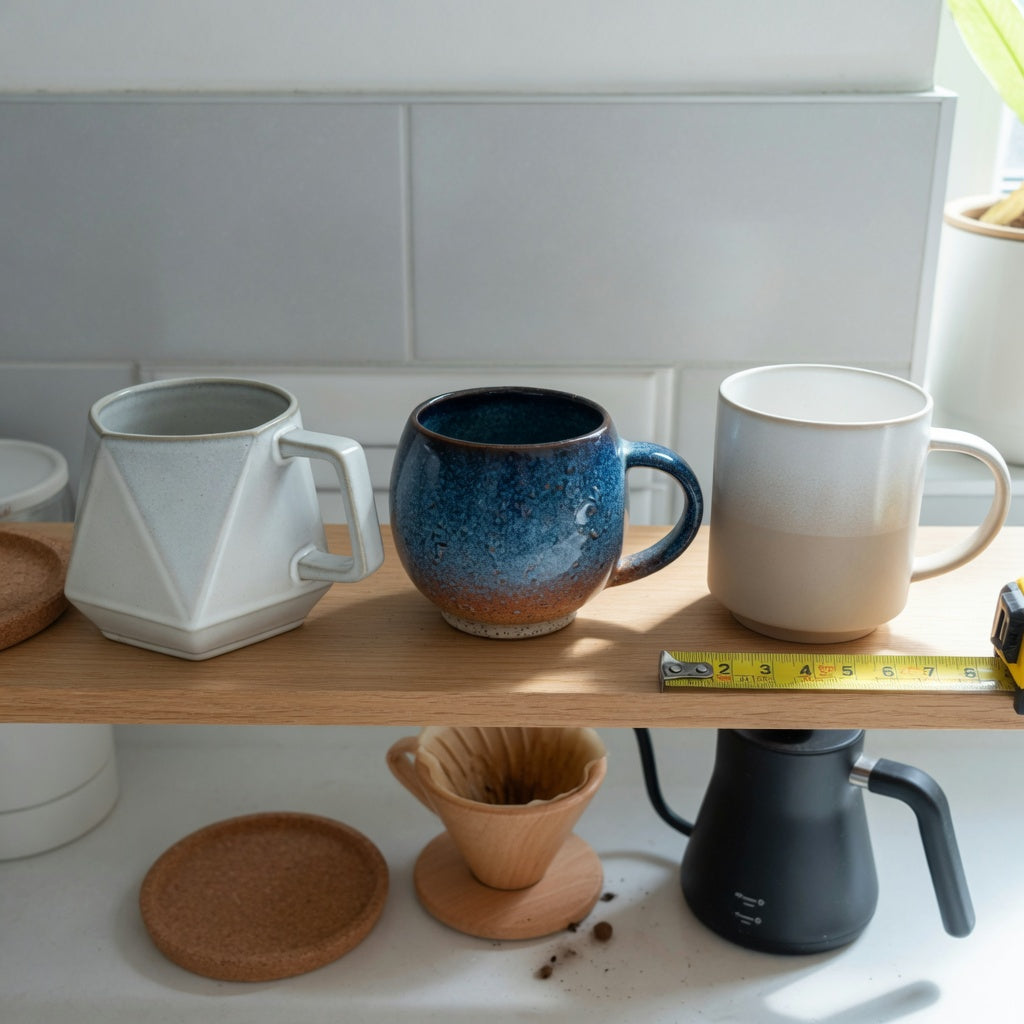
Geometric Coffee Mug for Small Coffee Setup: Fit and Capacity
Reading time: about 9 minutes
A mug can sit on a narrow shelf and still fail a compact coffee station because its handle hits the grinder, its rim blocks a cabinet door, or its height will not clear the brewer. We see this mismatch when shoppers judge a form from a front-facing product photo. For shoppers choosing a geometric coffee mug for small coffee setup, the useful question is how much working room the full mug requires during brewing, drinking, washing, and storage.
In our store, we compare four things before recommending a mug for limited space: the visible outer form, the material stated on the current listing, listed capacity, and the occupied envelope created by the rim, body, and handle. The trade-offs matter. An angular base may look compact while an upper facet claims extra shelf width, and a modest capacity may save room but force an unwanted second pour.
Geometric coffee mug for small coffee setup: which measurements decide fit?
The base tells you where a mug touches the counter. It does not tell you how much space the mug occupies. For that, measure the widest body or rim and the full handle projection. A narrow foot will not help if an upper plane presses against the kettle or the handle extends into the space needed to operate your grinder.
- Clear shelf depth: Measure from the front edge or cabinet lip to the backsplash or rear wall. Account for any door rail that reduces the usable opening.
- Maximum body width: Use the widest facet or rim, not only the base. This is the dimension that determines whether two mugs can sit beside each other.
- Handle reach: Measure from the opposite edge of the mug to the outermost handle point. Leave enough room to fit your fingers without moving the next item.
- Overall height: Check cabinet shelves, the space beneath wall cabinets, and the clearance under an espresso machine or pour-over stand.
- Working accessories: Include the coaster, drip tray, spoon rest, or scale that stays under or beside the mug during use.
We recommend marking the available rectangle on the counter with removable tape, then placing your current mug inside it and completing your normal brewing routine. A buffer of about 1/2 inch is more practical than an exact fit near a wall or cabinet door. If a dimension you need is not shown on a product page, do not estimate it by scaling the photo. Ask our team before ordering.
Capacity or compactness: which compromise will you notice daily?
External size and drink volume do not always move together. Wall profile, interior taper, and rim shape can give two mugs with similar outside dimensions different listed capacities. The listed figure is useful for comparison, but it may not equal the amount you pour while leaving spill-free headroom.
- Fill your current mug to the level you normally drink from, then transfer the liquid to a marked measuring cup.
- Reserve extra room if you add steamed milk, foam, cream, or loose tea that needs an infuser.
- For iced coffee, add your usual amount of ice before measuring. Ice displaces liquid and can make a compact mug feel smaller than its listing suggests.
A lower capacity can be a sensible choice for short coffee drinks or tea at a desk. It is less suitable for a long filter brew, a generous latte, or iced coffee with plenty of cubes. Buying too small creates extra refills and washing. Buying the largest option can add height or rim width that the station cannot support. Match the listing to the drink you make most often, not the occasional maximum serving.
Rhombus, Planet, or Gradient: which form fits your routine?
The current choices below are ceramic mug listings, so the primary comparison is not ceramic versus metal or glass. It is visible shape, listed capacity, and the care guidance shown on each live product page. We do not rank one as the smallest without matching its current dimensions to the shopper's measured space.
| Current option | Visible form | Reader situation | Check before buying |
|---|---|---|---|
|
Rhombus Coffee Tea Mug Listed material: Ceramic |
Pronounced rhombus-led facets and a clearly angular exterior. | A shopper wants the mug to be the focal object on an open shelf or a one-mug coffee station. | Compare the widest facet, handle reach, overall height, and listed capacity with your available rectangle. |
|
Planet Coffee Tea Mug Listed material: Ceramic |
A rounder, segmented geometric form with softer visual transitions. | A shared kitchen or office desk needs visible character without the strongest sharp-angle appearance. | Check rim width, full handle projection, listed capacity, and the current care instructions. |
|
The Gradient Coffee Tea Mug Listed material: Ceramic |
A cleaner contour with a gradient finish and subtler plane changes. | Color transition is as important as shape, and the shopper prefers a less overtly angular silhouette. | Confirm the live dimensions, capacity, finish care, and compatibility with your usual washing routine. |
These are appearance-to-routine matches, not proof that one mug occupies fewer square inches than another. On a very small counter, live dimensions should decide the purchase. The word geometric describes the visible form; it does not guarantee a narrow footprint, greater stability, or stackability.
If you are still deciding how angular the mug should be, scan the broader unique coffee mugs collection. Comparing the three featured shapes with simpler silhouettes makes it easier to see how much geometry your shelf and daily routine can support.
How do ceramic facets change washing, storage, and unboxing?
Ceramic keeps a rigid, defined form, but it can chip or crack after impact. On a faceted mug, a corner, rim section, or handle attachment point may be the first area to contact another dish. Those are the same areas our team checks while handling pieces in our store.
- Check the base first: Set the empty mug on a dry, flat counter and rotate it. If it rocks, inspect the foot for packing material, residue, or visible damage.
- Inspect impact points: Use side light to examine the rim and exposed facets. Look closely at both handle joins for a hairline crack before the first use.
- Follow the live care instructions: Ceramic material alone does not prove that a particular finish is dishwasher-safe or microwave-safe.
- Prevent dish contact: If dishwasher use is permitted, position the mug so its handle and facets cannot knock against plates or other mugs during the cycle.
- Use a soft washing surface: A non-abrasive sponge is a better choice than a metal scouring pad for preserving a finished ceramic surface.
- Avoid abrupt temperature changes: Let a very hot ceramic mug cool before rinsing it with cold water to reduce thermal stress.
Do not assume a geometric mug will nest securely. Unless the listing explicitly demonstrates stacking, plan to give it an individual shelf position. A shelf riser is safer and more accessible than balancing one irregular form on another in a tight cabinet.
Will the mug work with your brewer, coaster, and desk?
Small-space fit includes the full coffee workflow. A mug that fits an empty shelf but cannot sit beneath the brewer, support the dripper, or leave room for your hand is not a useful compact choice.
- Pour-over setup: Verify that the dripper sits securely on the mug's rim. The lower geometric form cannot compensate for an incompatible rim diameter.
- Espresso machine: Measure vertical clearance with the drip tray and any scale left in place. Do not use the machine's empty cavity measurement.
- Office desk: Include the coaster and handle sweep in the footprint. Check that lifting the mug will not catch a charging cable or push into the keyboard.
- Open shelf: Measure the actual shelf opening, including brackets and front rails. A tall mug can fit the shelf depth yet remain awkward to remove.
- Gift purchase: Consider how the recipient stores mugs. A distinctive unboxing moment does not offset a shape that cannot join an already stacked cabinet set.
The Rhombus form suits a buyer prioritizing visible angles, Planet offers a softer geometric appearance, and The Gradient shifts more attention toward contour and finish. That selection logic addresses style. Your measurements still determine practical fit.
Who is better served by a simpler mug?
A geometric ceramic mug is not the right tool for every compact setup. A rounder or more conventional form is likely to work better if any of these needs are non-negotiable:
- You drink large iced beverages or want an entire long brew in one serving.
- You must stack several mugs securely in one narrow cabinet.
- The mug will be handled roughly in a communal sink or frequently used by young children.
- You need a sealed lid, cup-holder compatibility, or drop resistance for travel.
- Your routine requires dishwasher or microwave use, but the individual product listing does not confirm that care option.
In those cases, use the unique mug selection to compare less angular profiles. Choosing a simpler shape is a practical decision when volume, stacking, or rough daily handling matters more than a faceted exterior.
Use this five-point check before checkout
Keep the decision tied to your actual counter and drink rather than the proportions shown in a styled product image.
- Measure the maximum width, depth, and height available at the mug's storage and brewing positions.
- Measure your usual drink volume, including space for milk, foam, an infuser, or ice.
- Compare the live listing's material, capacity, dimensions, and care instructions.
- Choose Rhombus for stronger angles, Planet for softer geometry, or Gradient for a cleaner contour and color-led finish.
- Reject any option if an essential dimension or care requirement remains unconfirmed.
The right geometric coffee mug for small coffee setup is not necessarily the one that looks smallest. It is the one whose complete footprint, usable capacity, ceramic care needs, and visible form all fit the same routine.
Frequently asked questions
Is a geometric coffee mug for small coffee setup always smaller than a round mug?
No. A geometric mug may have a narrow base but a wide rim, projecting facet, or long handle. Compare its maximum occupied width, total depth, and height with a round mug rather than relying on the shape name.
Which CoffeifyMug option has the strongest angular appearance?
The Rhombus Coffee Tea Mug is the clearest starting point for a shopper who wants pronounced angular planes. Planet has a softer segmented form, while The Gradient uses a cleaner contour and subtler plane changes. Check each page's current dimensions and capacity before treating any visual difference as a space advantage.
Can I put a geometric ceramic mug in the dishwasher or microwave?
Only follow those care methods if the individual product page confirms them. Ceramic material by itself does not establish that every finish or mug construction is suitable for a dishwasher or microwave. If dishwasher use is allowed, keep the mug separated from dishes that could strike its rim, handle, or facets.
What mug capacity works best on a small coffee station?
The useful capacity is the amount you drink most days, with enough headroom for carrying and any milk, foam, tea infuser, or ice. Measure your normal serving in a marked cup, then compare it with the capacity stated on the live listing. A smaller mug saves little if it creates repeated refills.
Do geometric coffee mugs stack safely?
Do not assume they do. Facets, tapered walls, and handle positions can prevent secure nesting even when two mugs have similar dimensions. Unless stacking is explicitly shown or stated, plan for single-layer storage or use a shelf riser.
Next step: Write down your available width, depth, height, and normal drink volume. Then compare those four numbers against the Rhombus, Planet, and Gradient product pages, or review them together in the CoffeifyMug unique coffee mugs collection.
More from our blog
Read more
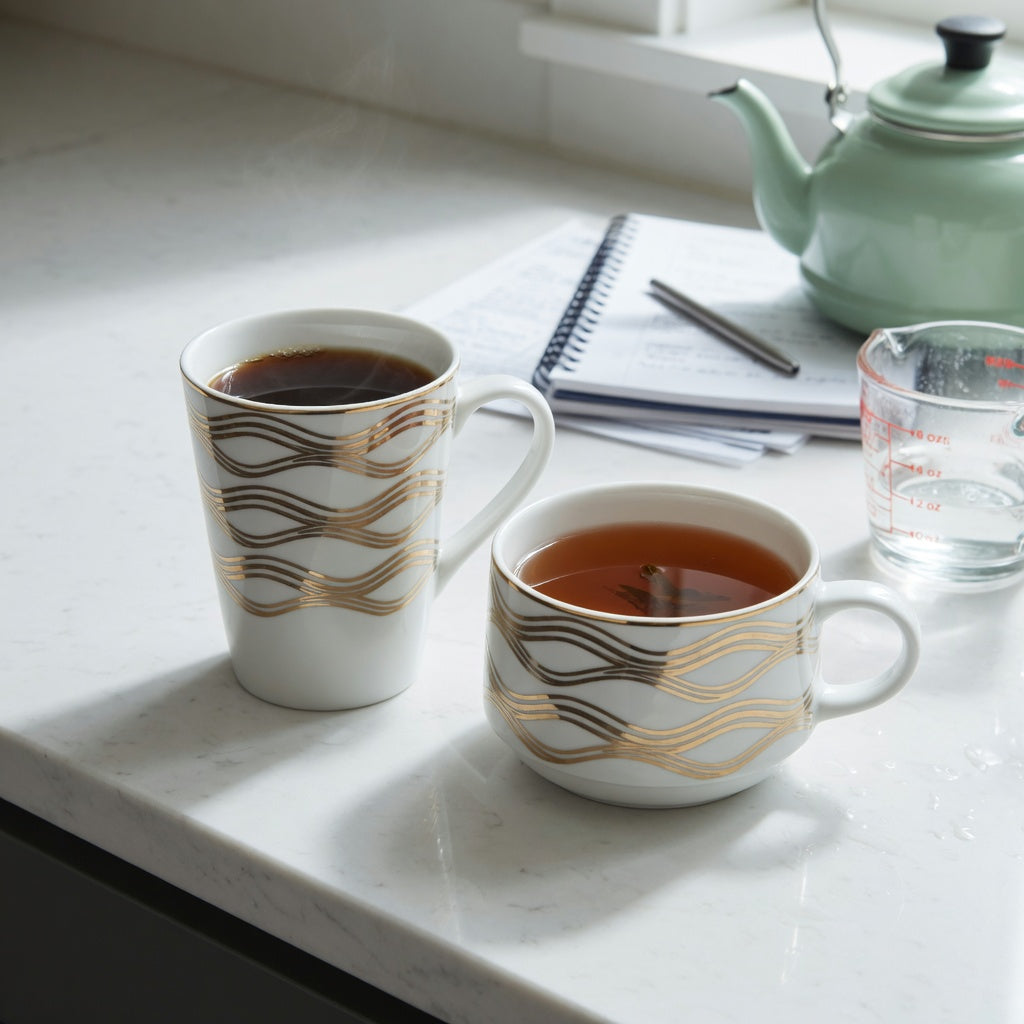
White and Gold Coffee Mug Capacity Guide: 400 ml vs 480 ml
Use this white and gold coffee mug capacity guide to compare the listed 400 ml Kio and 480 ml Tall mugs, then match each visible form to coffee, tea, iced drinks, desk space, and refill habits.
Read more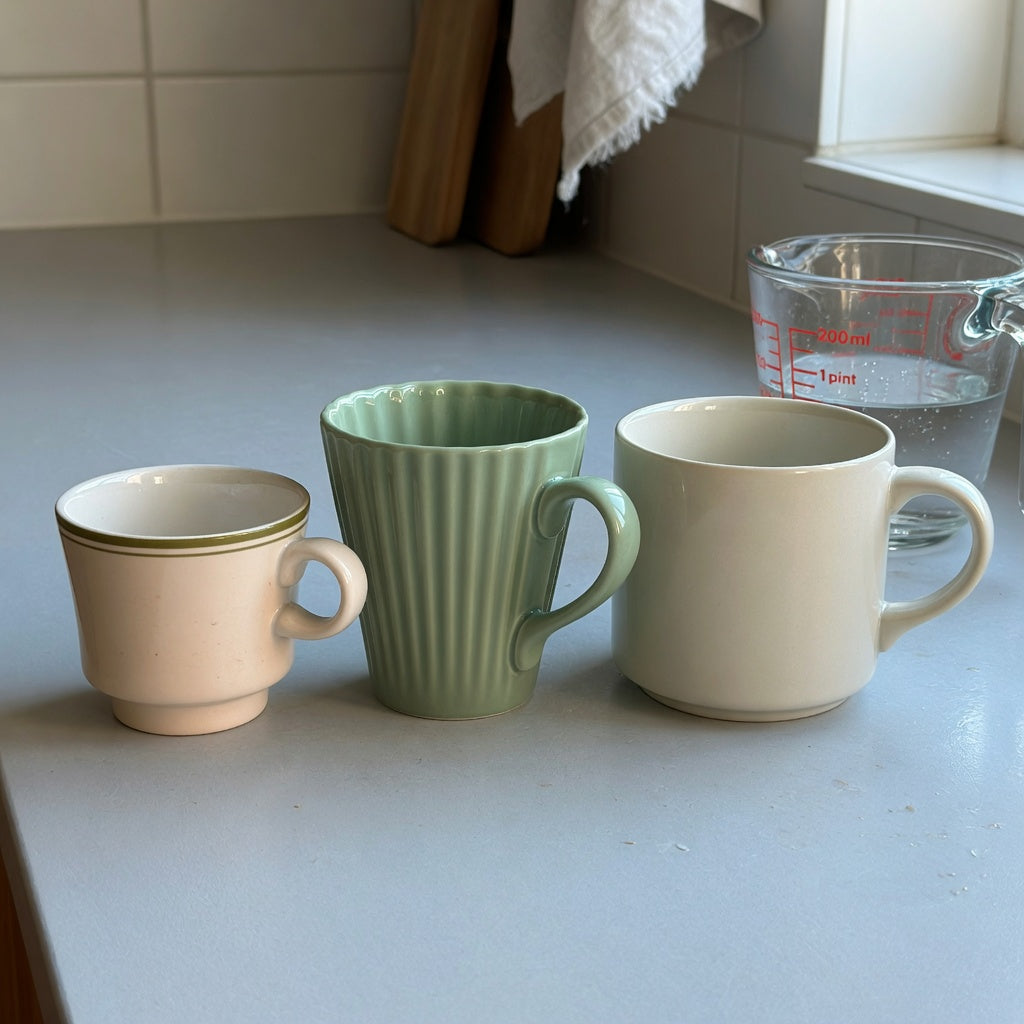
Minimalist Ceramic Mug Capacity Guide: 300, 350 or 400 ml?
Compare CoffeifyMug's current 300 ml, 350 ml, and 400 ml ceramic options by serving size, refill pattern, visible shape, and handle style. Use the routine-based checklist to narrow the round, pleat...
Read more
Leave a comment
This site is protected by hCaptcha and the hCaptcha Privacy Policy and Terms of Service apply.