
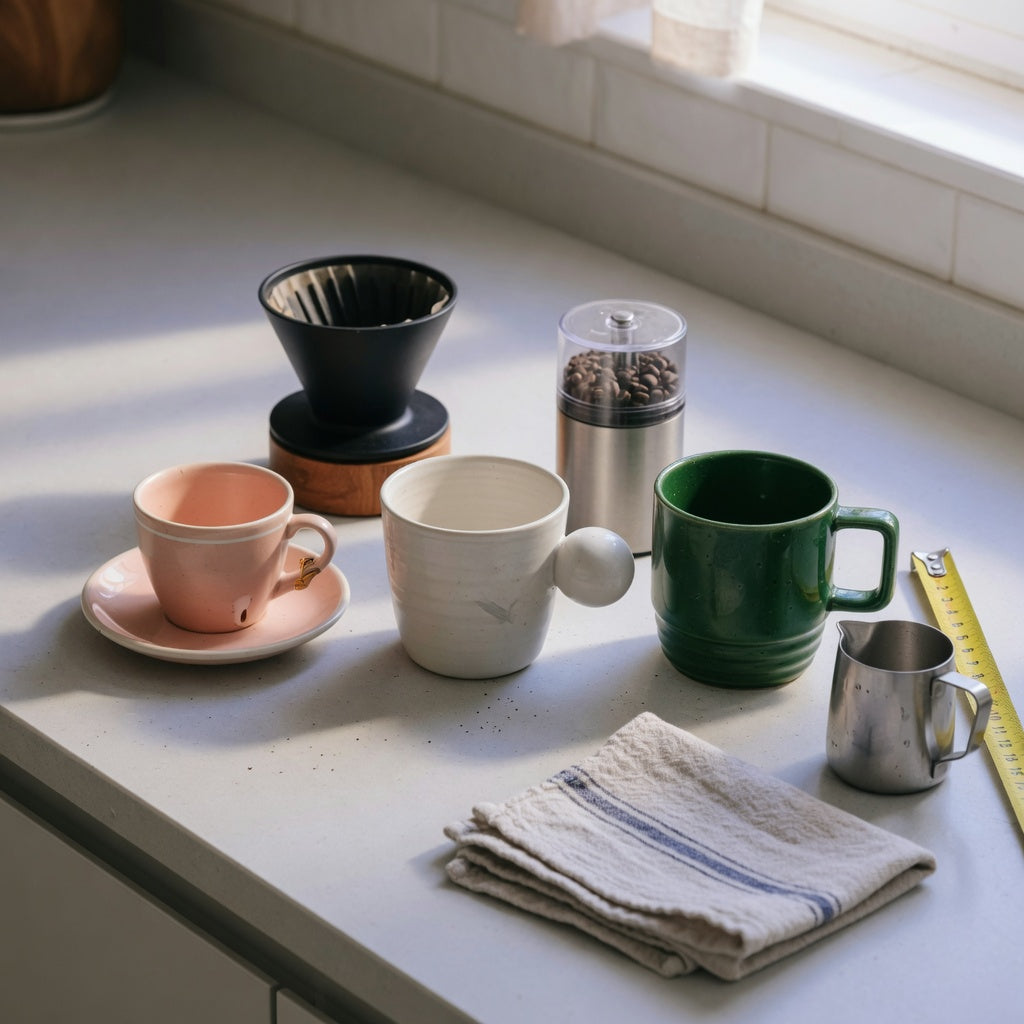
Piccolo Cup Home Coffee Station Product Shortlist Guide: 3 Sizes
Reading time: about 10 minutes
On a crowded kitchen counter, the cup is often the first item pushed behind the grinder or returned to a cupboard. A short coffee may need little liquid volume, but its vessel still has to clear the brewer, sit steadily while you pour, and leave room on the drying rack. Our piccolo cup home coffee station product shortlist guide starts with that daily sequence, not with a cafe label.
In our store, we handle compact drinkware during product checks, picking, and packing, and the same buyer questions recur: Is 170 ml enough? Will 270 ml feel unnecessarily roomy? Can one cup cover both short coffee and tea? The verified options here are the Retro at 170 ml, Ball Handle at 250 ml, and Emerald at 270 ml. We are not presenting any of them as a certified piccolo cup, prescribing a milk-to-coffee ratio, or claiming barista testing or cafe provenance. Capacity is the firm comparison point; it does not establish material, external dimensions, wall thickness, thermal performance, or appliance compatibility.
What should a piccolo cup home coffee station product shortlist guide rule out first?
Start by eliminating cups that conflict with your routine. Color and styling matter, but they should come after these three practical filters:
- Your usual pour: Make the drink you prepare most often and note how much headroom remains in your current cup. If the measured pour is close to 170 ml, a 170 ml vessel is unlikely to leave comfortable carrying room.
- Your station envelope: Check vertical clearance beneath the brewer, the available counter area, and the widest space a handle can occupy. Milliliter capacity cannot tell you any of these dimensions.
- Your cleanup path: Follow the cup from the counter to the sink, drying rack, and shelf. A cup that fits beneath a brewer can still be awkward if its handle catches the rack or its height conflicts with a shelf.
Shortlist rule: listed capacity helps compare drink volume. It does not prove physical footprint, material, care requirements, or suitability for a particular machine or recipe.
170 ml, 250 ml, or 270 ml: where does the extra room matter?
The difference between the smallest and largest option is 100 ml. That is enough to change how flexible the cup feels, but the 20 ml gap between the Ball Handle and Emerald is much less significant. Use the figures to match your drink pattern rather than assuming bigger is automatically safer.
| Option | Reader situation | Why it fits | Reason to skip it |
|---|---|---|---|
| Retro 170 ml | You repeat one genuinely short hot drink and rarely use the same cup for tea. | It has the smallest verified capacity, sitting 80 ml below the Ball Handle and 100 ml below the Emerald. | Your usual pour approaches 170 ml, you add milk freely, or ice is part of the drink. |
| Ball Handle 250 ml | You want one cup for short coffee, a slightly longer pour, and occasional tea. | It adds 80 ml over the Retro while remaining only 20 ml below the Emerald. | You prefer a conventional handle shape, already know 170 ml is enough, or need more room for ice. |
| Emerald 270 ml | Two people share the station, or one person alternates between short coffee and modest tea servings. | It is the roomiest option by verified capacity, with 100 ml more than the Retro. | Your drink stays very small, you dislike visible empty space, or you need a genuinely large morning mug. |
Treat each capacity as a comparison figure, not a recommended fill line. A practical pour normally needs some headroom to reduce sloshing, and the required amount depends on how you prepare and carry the drink. We do not attach a fixed coffee or milk ratio to any of these cups.
Retro 170 ml: is your routine genuinely short?
At a one-person station where the same short hot coffee is made each morning, the Retro 170 ml coffee and tea cup is the clearest starting point. Choose it if you have measured your normal pour, it leaves usable headroom below 170 ml, and you do not need the cup to double as a tea mug. You are buying a focused capacity rather than spare room for occasional drinks.
Skip the Retro if you tend to add milk by eye, carry the drink between rooms, or want ice. It is also a poor match for long breakfast drinks. The Retro is the smallest option by stated capacity, but that does not guarantee the smallest external footprint; check current product dimensions or ask our store before relying on it for tight machine clearance.
Ball Handle 250 ml: do you need one cup for coffee and tea?
The Ball Handled Coffee Tea Mug at 250 ml suits a station where one cup needs to cover more than one routine. Its extra 80 ml over the Retro provides more tolerance for a slightly longer pour, added milk, or occasional tea without moving all the way to the largest option in this comparison.
The handle deserves as much attention as the capacity. A ball-style handle creates a different contact point from a familiar loop handle, so inspect the product images and consider how you naturally lift a hot drink. Skip this option if you strongly prefer putting several fingers through a conventional loop, if 170 ml already covers your routine, or if the Emerald design suits your storage and grip better. With only 20 ml separating the Ball Handle and Emerald, handle comfort can reasonably decide between them.
Emerald 270 ml: does the roomiest option prevent a second purchase?
The Emerald Coffee Tea Mug at 270 ml makes the most sense on a shared station or in a kitchen where one vessel must handle a short coffee one day and a modest tea the next. It provides 100 ml more capacity than the Retro, giving you more room to adjust a hot drink without immediately reaching for another mug.
Do not overstate the difference between 270 ml and 250 ml. That 20 ml gap is modest, so outer dimensions, grip, appearance, and shelf fit should carry more weight than capacity alone. Skip the Emerald if your measured drink remains far below 170 ml and you prefer a deliberately small-cup presentation. It is also not the answer for large iced coffee; ice can consume limited capacity quickly.
Will the cup fit beneath your brewer and on the drying rack?
No cup in this shortlist should be treated as compatible with an appliance without measurement. Capacity and machine clearance are separate facts. Use this sequence at the actual station:
- Measure from the drip tray or work surface to the lowest fixed point above the cup path, with the machine in its normal configuration.
- Measure the height, base diameter, and widest point including the handle of a cup that already fits. Compare those figures with current product information where available.
- If you use a pour-over dripper that rests on the cup, check the dripper maker's vessel requirements and the cup rim dimensions. Do not infer support from capacity.
- Place your current cup in the drying rack and cupboard, then note where its rim or handle nearly touches another item. Those contact points often reveal the real storage limit.
A low-capacity cup can still have a broad body or prominent handle. If a listing does not provide the measurement needed for your setup, ask before ordering instead of treating the milliliter figure as a substitute.
Which material and care details need confirmation before first use?
The verified comparison data supplied for this shortlist confirms capacity, not material or dishwasher and microwave status. We will not turn a product's appearance into an unsupported material or care claim. Check the live product page and the instructions supplied with the item, because material can affect weight, heat feel, thermal-shock guidance, and cleaning requirements.
The practical inspection sequence we use for handled drinkware is straightforward:
- Hold the rim under strong side light and check for a chip, rough lip-contact area, or fine line that was hard to see in the box.
- Set the dry cup on a flat counter and confirm that the base rests steadily rather than rocking.
- Inspect the handle attachment area for hairline damage, especially after shipping or gift unboxing.
- Wash before first use according to the supplied care instructions. After a milk-based drink, rinse before residue dries and begin with a soft, non-abrasive sponge.
- Use a dishwasher or microwave only if the current product guidance permits it. If dishwasher use is approved, position the cup so its rim and handle cannot knock against heavy cookware during the cycle.
Rim chips, base wobble, and handle-joint damage are common drinkware inspection points, not defects we are attributing to these three products. Reporting any issue before use also makes it easier for our team to assess what happened.
Which option fits a solo station, shared kitchen, or gift?
- Solo station with one repeatable short drink: Start with the Retro 170 ml, provided your measured pour leaves headroom and its listed outer dimensions fit the station.
- One-cup setup for coffee and occasional tea: Put the Ball Handle 250 ml first if its grip style suits you. It offers substantially more capacity than the Retro without a meaningful volume gap from the Emerald.
- Shared station with different hot-drink habits: Keep the Emerald 270 ml on the list. Its extra room is useful when two people do not pour exactly the same amount.
- Gift for someone whose routine is unclear: The Ball Handle is the middle capacity, but grip and care preferences may matter more than volume. Review the recipient's usual mug shape before choosing.
- Large iced coffee or long breakfast drink: Skip all three rather than forcing a compact cup into the wrong job. Browse our unique coffee mugs collection and verify the capacity and dimensions of a larger option.
A five-minute station check before checkout
- Make your usual drink and measure the liquid once, if you have a marked jug or scale-based method you already trust.
- Note how much carrying headroom you prefer instead of planning to fill a cup to its rim.
- Measure the current cup's height, base, and widest point including its handle.
- Choose the capacity that passes those checks, then write down one clear reason you would skip it.
- Open the relevant product page and confirm the latest material, dimensions, and care wording before ordering.
Frequently asked questions
What should a piccolo cup home coffee station product shortlist guide compare?
It should compare verified capacity, your measured drink volume, outer fit, handle preference, storage, and care requirements. It should also give a clear reason to skip each option. Capacity must be kept separate from physical dimensions, appliance compatibility, and any claimed coffee recipe.
Is 170 ml enough for a piccolo-style coffee at home?
It can be enough if your usual drink is genuinely short and leaves comfortable headroom below 170 ml. There is no fixed milk-to-coffee ratio used in this shortlist, so measure the drink you actually prepare. Choose a larger option if your normal pour would sit close to the rim.
How different are the 250 ml and 270 ml options?
The verified difference is 20 ml, which is modest compared with the 80 ml gap between the Retro and Ball Handle. For most shoppers comparing the 250 ml and 270 ml options, handle feel, outer dimensions, storage fit, and design should decide the result. Neither should be assumed suitable for large iced drinks.
Are the Retro, Ball Handle, and Emerald certified piccolo cups?
No certification or cafe-standard claim is being made here. We shortlisted them as compact coffee and tea options with verified capacities of 170 ml, 250 ml, and 270 ml. Their usefulness depends on your home drink routine rather than a fixed piccolo definition.
Can I put these cups in a dishwasher or microwave?
Confirm the current care statement on the relevant product page and the instructions supplied with the cup. This article does not claim dishwasher or microwave suitability for any of the three options. If the guidance is unclear, contact our store before using either appliance; hand washing is the conservative interim choice.
Take your current cup to the station now, measure its outer dimensions, and make your usual drink once. Select the Retro, Ball Handle, or Emerald only if both the volume and physical setup pass that check. If none does, return to the unique coffee mugs collection and compare a different capacity or silhouette instead of compromising your daily routine.
More from our blog
Read more
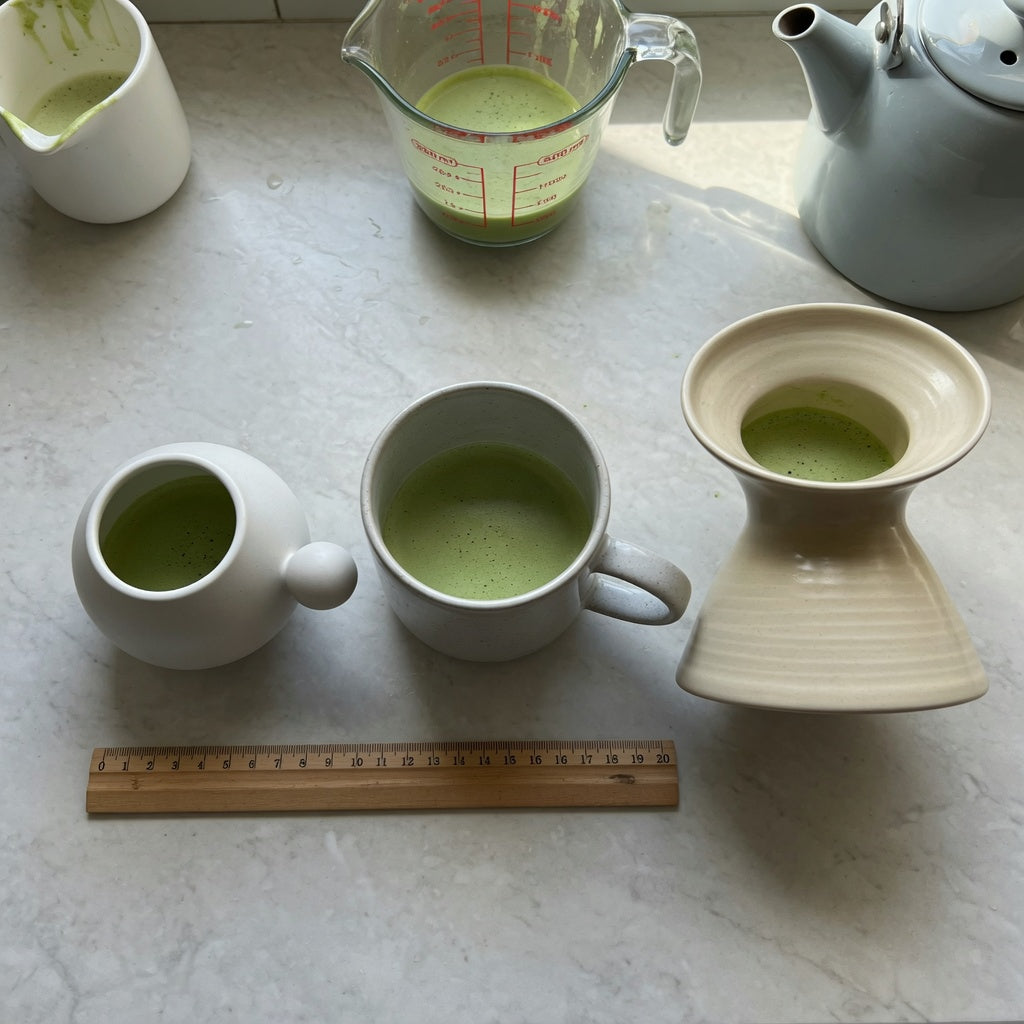
Matcha Latte Mug Home Coffee Station Practical Purchase Checklist
Compare three CoffeifyMug options using published 250 ml, 390 ml, and 400 ml capacities, the Ball Handle mug's listed 11.2 cm diameter, visible opening shapes, and a practical process for verifying...
Read more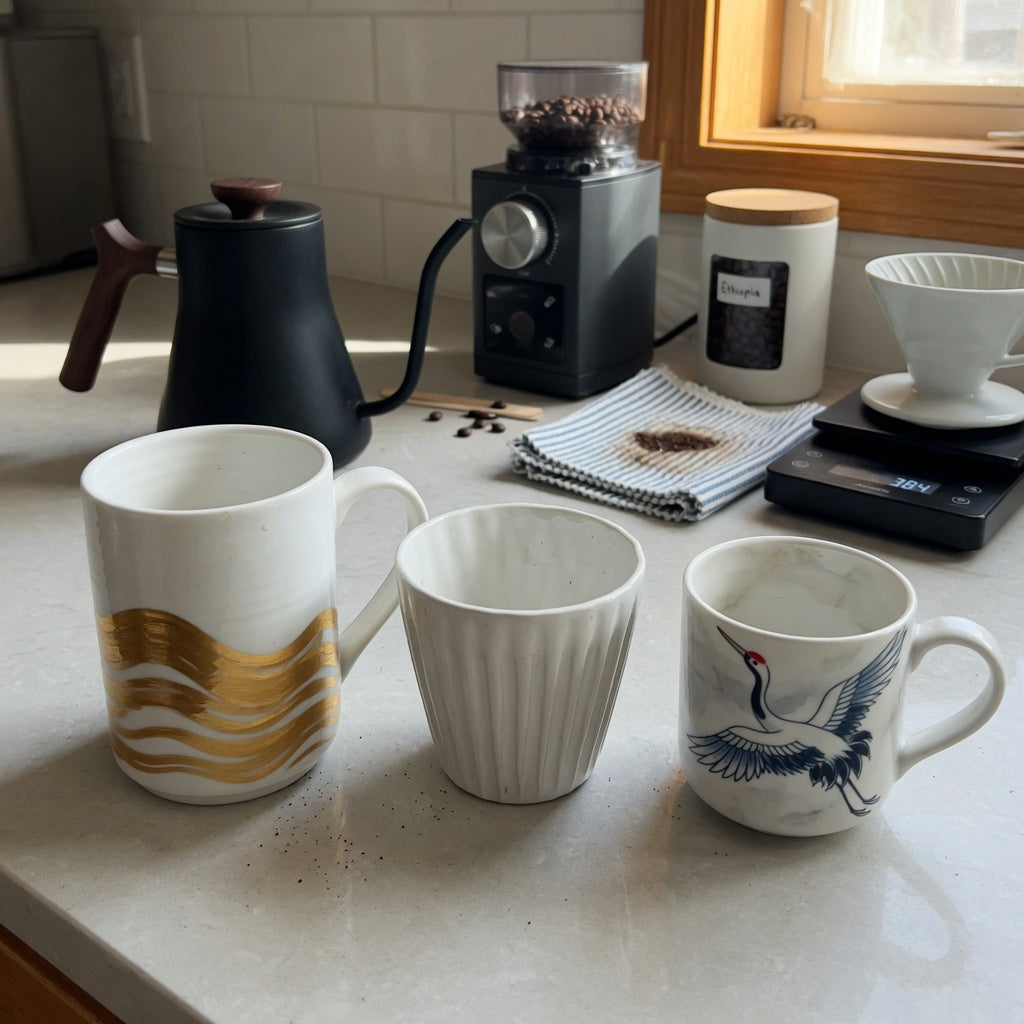
White Pottery Coffee Mugs Home Coffee Station Product Shortlist Guide
Compare three white pottery mugs by counter clearance, exterior texture, visual impact, cleanup habits, and gifting fit. Each option includes a clear reason to choose it, a reason to skip it, and t...
Read more
Leave a comment
This site is protected by hCaptcha and the hCaptcha Privacy Policy and Terms of Service apply.