
Macchiato Cup Storage Fit Guide: Shapes and Shelf Space
Reading time: about 9 minutes
A cabinet can have plenty of empty air and still be a poor fit for a small cup. The rim clears the shelf above, but the handle meets the door or catches the mug beside it. This macchiato cup storage fit guide separates listed drink capacity from external storage fit, two details that shoppers often assume are interchangeable.
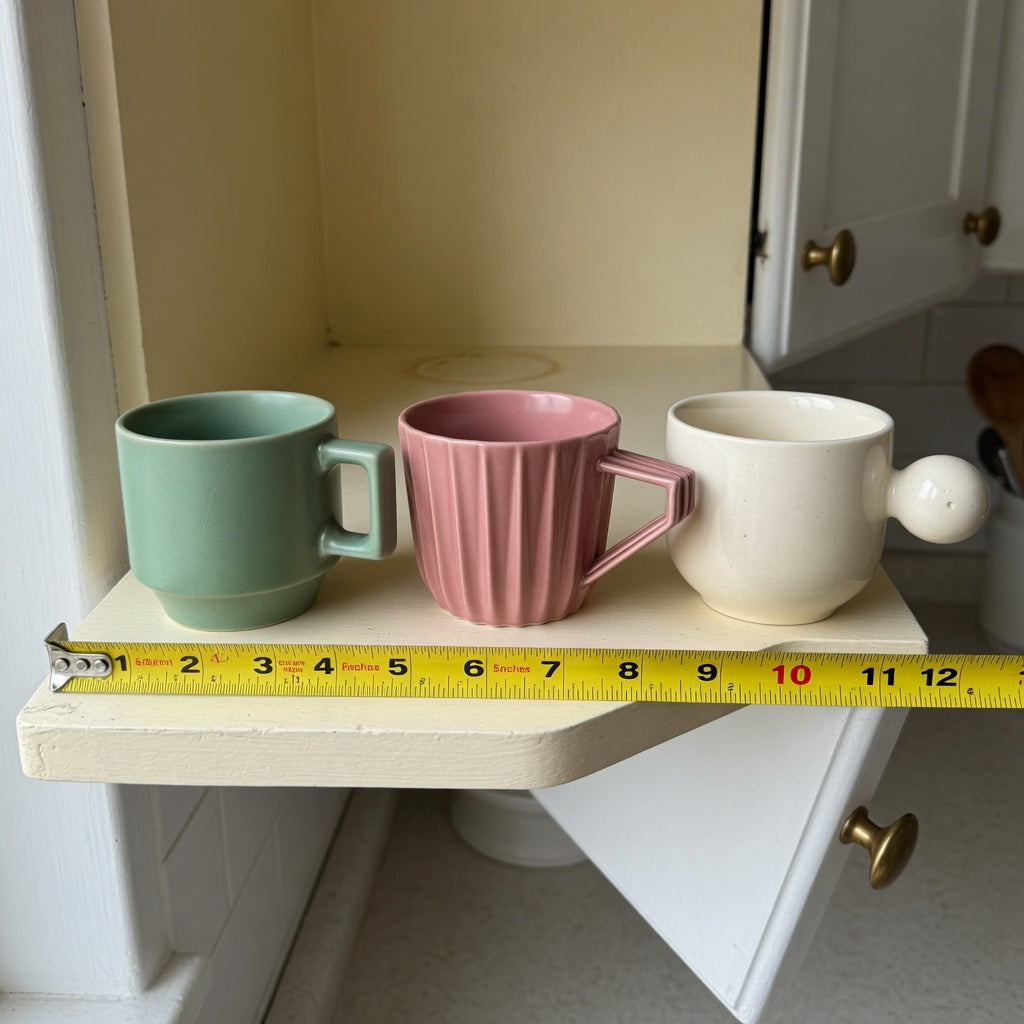
In our store, we handle these compact ceramic forms while checking orders, packing cups, and arranging product displays. The same practical questions keep coming up: How much headroom is available? How far does the handle occupy side space? Can the cup be lifted out without knocking its neighbor? The current comparison covers the Retro at 170 ml, the Pleated at 200 ml, and the Ball Handle at 250 ml. We do not have verified external measurements in the supplied catalog facts, so we will not turn capacity into guessed height or width.
What does this macchiato cup storage fit guide compare?
The guide compares listed capacity, visible body form, handle profile, and the part of your shelf that each feature makes important. Capacity tells you how much the cup is listed to hold. It does not prove the cup's overall height, base diameter, or total width with the handle included.
Macchiato recipes and cafe serving conventions vary, so the 170 ml to 250 ml range should be treated as product capacity rather than a universal drink standard. Your preferred espresso, milk, and foam proportions still determine which volume is useful.
| Current cup | Listed capacity | Visible form | First storage check |
|---|---|---|---|
| Retro coffee tea cup | 170 ml | Retro-style body with a loop handle | Overall height and total width including the handle |
| Pleated coffee tea cup | 200 ml | Pleated exterior | Side spacing between the textured body and neighboring ceramics |
| Ball Handle coffee tea mug | 250 ml | Prominent ball-shaped handle | Side clearance, door clearance, and the path used to lift it out |
No row in this comparison promises an exact fit. A 170 ml cup is not automatically shorter or narrower than every 200 ml cup. Treat the capacity as a drink-volume comparison and use listed external dimensions, when available, for cabinet planning.
Which current cup shape fits your storage situation?
Retro 170 ml for a modest serving and crowded cabinet
If your cupboard is already busy and your preferred drink is small, the Retro 170 ml cup is the first form we would investigate. It has the lowest listed capacity of the three and a conventional visible handle shape, so there is less visual complexity to account for than with the ball grip. That is a sensible starting point, not a measured guarantee of the smallest footprint.
The trade-off is drink room. It is not the best match for a long milk drink, a large office coffee, or an ice-heavy recipe. Buyers who prefer generous foam clearance should also remember that a listed capacity is not necessarily the amount they will want to carry comfortably without filling near the rim.
Pleated 200 ml for middle capacity and an open display row
The Pleated 200 ml cup sits between the other two in listed volume. Its pleated exterior is the defining visual detail, making it a logical option for an open shelf where the body texture remains visible instead of disappearing in a tightly packed cupboard.
For storage, leave enough separation that the raised exterior does not repeatedly knock or rub against another ceramic piece. We do not treat the pleats as proof of added grip, stability, or stackability because those claims are not established by the visible form alone. It is not the cup to buy on the assumption that several pieces will nest securely.
Ball Handle 250 ml for a roomier shelf and larger drink
The Ball Handle 250 ml mug has the largest listed capacity in this group. It suits a shopper who wants more drink room and has a dedicated shelf position where the rounded handle can remain visible and unobstructed. The distinctive grip can also make the piece feel more considered as a gift, provided the recipient has somewhere practical to keep it.
The handle is also its clearest limitation. Its prominent form makes lateral clearance the first measurement to verify. This cup is not the default choice for edge-to-edge cabinet storage, narrow upright dividers, or two-deep rows where a rear cup must pass the handles in front.
How does handle projection change cabinet and shelf fit?
Shoppers often measure the cup body and forget that the handle controls the usable footprint. We assess the whole side profile, including the empty space needed for fingers during retrieval. A cup that technically enters a shelf but must be tilted around another handle is unlikely to feel convenient in daily use.
- Closed cabinet doors: Measure from the back wall to the inside face of the closed door. Hinges, inner rails, and door panels can reduce usable depth.
- Side-by-side rows: Include the full handle in the width envelope. Body diameter alone does not tell you how many cups fit across the shelf.
- Two-deep storage: Check whether the rear cup can pass the front handles without contact. The Ball Handle form deserves particular attention here.
- Open shelves: Keep the full cup base supported. A handle hanging beyond the shelf edge does not compensate for insufficient body depth.
- Shared office cupboards: Leave retrieval room because coworkers may not return every cup at the same angle.
The ball-shaped grip is the most obvious handle-clearance variable among these three visible forms. We cannot responsibly assign a projection in millimeters without a listed measurement, so verify total width rather than relying on the product's 250 ml capacity.
How do you measure shelf fit without guessing cup dimensions?
A tape measure and a few cabinet notes are more useful than estimating from a product photo. Use this process before ordering:
- Check the product listing for overall height, body diameter, base width, and total width including the handle. Record only measurements that are actually supplied.
- Measure usable shelf height from the shelf surface to the lowest obstruction above it. A front rail or shelf lip can reduce the apparent opening.
- Measure usable depth from the back wall to the inside face of the closed door, not merely to the front edge of the shelf board.
- Measure uninterrupted side-to-side space. Dividers, bowls, and neighboring mug handles all reduce the width that is genuinely available.
- If external product measurements are listed, mark that footprint on paper and place it on the shelf. This makes door and neighbor conflicts easier to see.
- Test the removal path with a cup you already own. Add enough room for your fingers and for lifting the cup without scraping the shelf above.
Our practical rule: Do not use milliliters as a substitute for an external size chart. If a necessary dimension is not listed, ask our team before treating a tight cabinet fit as confirmed.
What storage habits reduce chips and handle stress?
Ceramic storage problems commonly begin at exposed contact points: rims tap together, handles become trapped under another cup, or a damp foot ring is put straight into an enclosed cabinet. These risks are easy to reduce.
- Let the interior, base, and foot ring dry fully after hand washing. If the product listing permits dishwasher use, check for trapped water after the cycle before shelving the cup.
- Do not assume a cup is stackable. Store it side by side unless the product information specifically supports stacking.
- Avoid resting one cup's rim on another cup's handle. That creates concentrated ceramic-to-ceramic contact at two vulnerable areas.
- Leave a small retrieval gap instead of wedging pleated or glazed bodies tightly together.
- After a hard knock, inspect the rim and the handle-to-body junction for chips or cracks before using the cup again.
Material alone does not establish dishwasher or microwave compatibility. Follow the care guidance on the relevant product listing rather than applying one rule to every ceramic cup.
Which cup works for kitchens, offices, gifts, and iced drinks?
- Crowded kitchen cabinet: Start with the Retro 170 ml because it pairs the smallest listed capacity with a familiar loop-handle form. Confirm external measurements before relying on that capacity to predict fit.
- Open kitchen shelf: Consider the Pleated 200 ml if you want the exterior texture to remain visible and have room to keep neighboring ceramics from touching.
- Dedicated shelf or gift: Consider the Ball Handle 250 ml when the larger listed capacity and distinctive grip matter more than dense storage.
- Shared office cupboard: Favor a form that can be removed without precise handle orientation. Reserve a dedicated position if choosing the Ball Handle design.
- Ice-heavy coffee or a long milk drink: These compact capacities may feel restrictive once ice, milk, and carrying room are considered. A larger style from our unique coffee mugs collection may suit that use better.
This is also worth considering before gifting. A visually distinctive cup can make a strong unboxing impression, but the recipient still has to store it. The best gift shape is one that suits both the drink they make and the shelf they actually use.
Frequently asked questions
What should I measure before buying a macchiato cup?
A macchiato cup storage fit guide should compare usable shelf height, depth to the closed cabinet door, and total side-to-side width including the handle. Also check the path needed to lift the cup out without striking the shelf above or neighboring pieces.
Is the Retro 170 ml cup definitely the smallest on the shelf?
No. It has the smallest listed capacity in this three-product comparison, but capacity does not establish external height, body diameter, or handle projection. Use listed product dimensions when available before treating it as the smallest physical option.
Will the Ball Handle 250 ml mug fit a standard upper cabinet?
There is no single standard cabinet interior, and the supplied product facts do not provide a verified handle-projection measurement. Its prominent ball grip makes total width and door clearance the priority checks, especially in a full or shallow cabinet.
Can the Retro, Pleated, and Ball Handle cups be stacked?
Do not assume that any of these forms are designed for stacking. The safer storage plan is side-by-side placement unless the relevant product listing specifically confirms stackability.
Which macchiato cup is best for iced coffee?
The Ball Handle has the largest listed capacity at 250 ml, but all three remain compact compared with vessels intended for ice-heavy drinks. If ice takes up much of your usual cup, a larger mug or tumbler style will probably be more practical.
Before ordering, use this final check: confirm your preferred drink volume, record usable cabinet height and depth, measure the full side space available for the handle, and verify care or stacking guidance on the product page. If any external dimension is missing and your shelf tolerance is tight, contact our team with the product name and your cabinet measurements before checkout.
More from our blog
Read more
Ceramic vs Porcelain Coffee Mugs Buying Priorities: Fit First
Use your usual pour, mug footprint, handle clearance, and storage limits to compare ceramic and porcelain. We connect those priorities to current CoffeifyMug styles without pretending one material ...
Read more
Ceramic Coffee Mugs With Large Handles Current Product Facts: 3 Styles
Compare the listed handle materials and silhouettes of the Ball-Handled, Mountain Sea II, and The Flow mugs. We separate confirmed page details from capacity, dimension, and care points that should...
Read more
Leave a comment
This site is protected by hCaptcha and the hCaptcha Privacy Policy and Terms of Service apply.